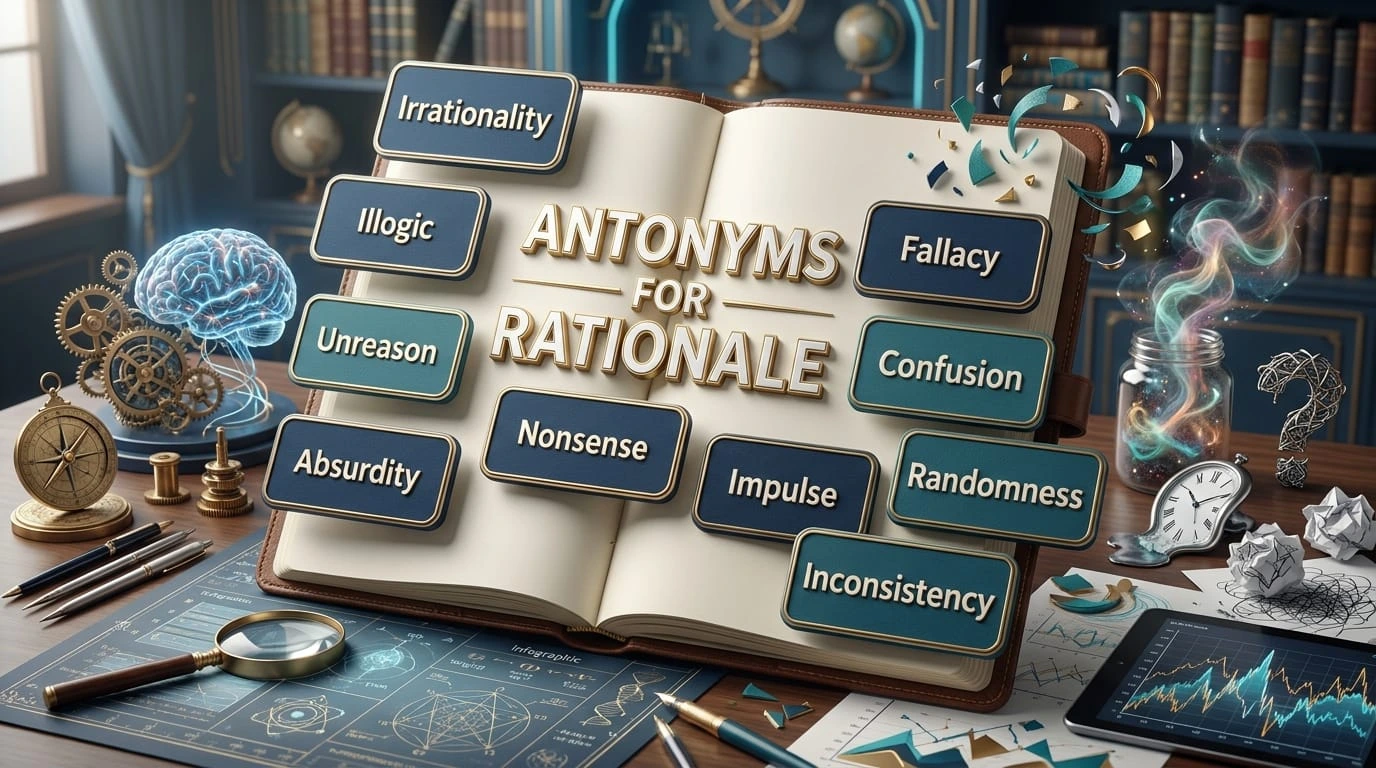
Rationale: reasoning, logic, justification, reasoning-based thinking, sound judgment , its opposites include irrationality, illogic, unreasonableness, groundlessness, and absurdity.
What is the opposite of rationale?
The strongest contextual antonyms for rationale include irrationality, illogic, unreasonableness, groundlessness, absurdity, incoherence, and lack of justification. While rationale refers to the reasoning or justification behind something, these opposites describe decisions, ideas, or arguments that lack sound reasoning or a valid basis.
Quick Answer:
Rationale means the reasoning or justification that explains why something was done or believed. Its opposite is usually a lack of reasoning or justification. Depending on context, words such as irrationality, illogic, unreasonableness, groundlessness, absurdity, and incoherence can express contrasting ideas.
Rationale vs. Its Opposites
| Word | Meaning | Example |
| Rationale | Reasoning or justification behind something | The report explained the rationale behind the decision. |
| Irrationality | Lack of logical reasoning | His irrationality made the decision difficult to understand. |
| Illogic | Lack of logical connection or reasoning | The argument was rejected because of its illogic. |
| Unreasonableness | Lack of sound judgment or reason | The unreasonableness of the demand surprised everyone. |
| Groundlessness | Lack of a valid basis or evidence | The claim was dismissed as groundless. |
Rationale: Simple Definition
Definition: The reasoning or justification behind a decision, action, belief, or argument.
Main opposite: Irrationality a lack of logical or reasonable thinking.
25 Antonyms for Rationale
Here are useful opposites of rationale, arranged according to how naturally they contrast with the idea of reasoning and justification.
1. Irrationality
A lack of logical or reasonable thought.
Example:
The irrationality of the decision was obvious to the entire team.
2. Illogic
A failure to follow logical reasoning.
Example:
The professor pointed out the illogic in the student’s argument.
3. Unreasonableness
A lack of good judgment or sensible reasoning.
Example:
The manager questioned the unreasonableness of the proposed policy.
4. Unreason
A state of thinking without logic or sound judgment.
Example:
The debate quickly descended into unreason.
5. Groundlessness
The quality of having no valid basis, evidence, or justification.
Example:
The accusation was rejected because of its groundlessness.
6. Unjustification
A lack of adequate reason or justification.
Example:
The unnecessity and unjustification of the action were criticized.
7. Absurdity
The quality of being unreasonable, illogical, or ridiculous.
Example:
The absurdity of the proposal became clear during the meeting.
8. Incoherence
A lack of logical connection or consistency.
Example:
The incoherence of his explanation made the argument difficult to follow.
9. Meaninglessness
A lack of meaningful purpose, reason, or significance.
Example:
The meaninglessness of the exercise frustrated the students.
10. Inconsistency
A lack of agreement, logic, or consistency between ideas or actions.
Example:
There was an obvious inconsistency between the explanation and the evidence.
11. Randomness
The absence of a deliberate or logical basis.
Example:
The randomness of the selection process raised concerns.
12. Thoughtlessness
A lack of careful consideration before acting.
Example:
His thoughtlessness caused unnecessary problems.
13. Impulsiveness
Acting suddenly without sufficient thought or reasoning.
Example:
Her impulsiveness led her to make a decision she later regretted.
14. Carelessness
A lack of proper attention or consideration.
Example:
The error resulted from carelessness rather than a deliberate choice.
15. Negligence
Failure to give something the proper care, attention, or consideration it requires.
Example:
The investigation revealed negligence in the decision-making process.
16. Inattention
A failure to pay sufficient attention.
Example:
The mistake was caused by inattention to important details.
17. Confusion
A lack of clear understanding or organized thought.
Example:
The explanation created more confusion than clarity.
18. Disorder
A lack of organization or logical arrangement.
Example:
The disorder in the argument made its main point difficult to identify.
19. Disorganization
A lack of systematic arrangement or structure.
Example:
The disorganization of the report weakened its argument.
20. Contradiction
A situation in which statements or ideas conflict with one another.
Example:
The contradiction between his claims weakened his position.
21. Fallacy
A mistaken or misleading line of reasoning.
Example:
The conclusion was based on a logical fallacy.
22. Error
A mistake in reasoning, judgment, or understanding.
Example:
The conclusion resulted from an error in reasoning.
23. Misjudgment
An incorrect decision caused by poor judgment.
Example:
The failed strategy was ultimately a serious misjudgment.
24. Baselessness
The condition of having no sound foundation or justification.
Example:
The baselessness of the accusation was eventually exposed.
25. Lack of justification
The absence of a valid reason supporting an action, claim, or decision.
Example:
The committee found a lack of justification for the additional expense.
Context Matters: Not Every Opposite Means Exactly the Same Thing
The word rationale is closely connected to reasoning and justification, so its opposite can change slightly depending on what you are describing.
When rationale means “reasoning”
The strongest contrasts are:
- Irrationality
- Illogic
- Unreason
- Absurdity
- Fallacy
- Incoherence
Example:
The rationale behind the decision was carefully explained.
Possible contrast:
The decision appeared to be based on irrationality rather than careful reasoning.
When rationale means “justification”
Better contextual opposites include:
- Groundlessness
- Baselessness
- Unjustification
- Lack of justification
Example:
The manager provided a rationale for changing the policy.
Contrast:
The manager offered no justification for changing the policy.
When rationale means “sound basis for a decision”
Useful contrasts include:
- Impulsiveness
- Thoughtlessness
- Misjudgment
- Randomness
- Carelessness
Example:
The decision was supported by a clear rationale.
Contrast:
The decision appeared impulsive and poorly considered.
Rationale vs. Irrationality
Rationale and irrationality represent one of the clearest conceptual contrasts.
| Rationale | Irrationality |
| Reasoned thinking | Unreasonable thinking |
| Logical basis | Lack of logical basis |
| Justification | Lack of justification |
| Deliberate reasoning | Poor or absent reasoning |
| Sound explanation | Illogical explanation |
Example:
Rationale: The company explained its rationale for increasing prices.
Irrationality: The sudden decision appeared to result from irrationality rather than careful analysis.
Rationale vs. Illogic
Illogic is particularly useful when you are discussing an argument, explanation, or line of reasoning.
- Rationale = logical reasoning supporting something
- Illogic = reasoning that does not follow logically
Example:
The researcher clearly presented the rationale for the conclusion.
The reviewer identified several examples of illogic in the opposing argument.
Rationale vs. Groundlessness
These words contrast most strongly when evidence or justification is involved.
- Rationale suggests a valid reason or basis.
- Groundlessness suggests that there is no adequate basis.
Example:
The policy had a clear rationale.
The criticism was dismissed as groundless.
Example Sentences Using Antonyms of Rationale
- The decision was criticized for its irrationality.
- The argument contained obvious illogic.
- His demand was considered unreasonable.
- The accusation was completely groundless.
- The proposal revealed serious inconsistency.
- The conclusion was based on a fallacy.
- Her impulsiveness led to a poor decision.
- The report’s incoherence made it difficult to understand.
- The claim had no factual basis and was therefore baseless.
- The mistake resulted from carelessness.
- His thoughtlessness caused unnecessary confusion.
- The decision appeared to be a serious misjudgment.
Grammar & Word Class
Rationale is a noun.
Its most useful contextual opposites are also generally nouns:
- rationale → irrationality
- rationale → illogic
- rationale → unreasonableness
- rationale → groundlessness
- rationale → absurdity
- rationale → incoherence
- rationale → impulsiveness
- rationale → misjudgment
However, some related opposites are adjectives rather than nouns:
- rational → irrational
- logical → illogical
- reasonable → unreasonable
- justified → unjustified
- grounded → groundless
This distinction matters because rationale itself is a noun, while rational is an adjective.
Common Mistakes
❌ Mistake: Treating “irrationality” as the only antonym
Although irrationality is a strong conceptual opposite, it does not fit every context.
✅ Better approach:
Choose the opposite according to the intended meaning:
- reasoning → irrationality / illogic
- justification → groundlessness / lack of justification
- decision-making → impulsiveness / misjudgment
- argument → fallacy / incoherence
❌ Incorrect:
The rationale of his argument was irrationality.
✅ Better:
The argument showed clear signs of irrationality.
Or:
The argument lacked a logical rationale.
Expert Tip
Rationale is not simply the opposite of “irrational.” Remember that rationale is a noun meaning a reason or justification, while rational is an adjective meaning logical or reasonable. Therefore, choose an antonym based on whether you are discussing a reason, justification, argument, or decision.
Short Questions & Answers
What is the strongest antonym of rationale?
Irrationality is one of the strongest conceptual opposites of rationale, especially when rationale refers to logical reasoning.
Is “illogic” an antonym of rationale?
Yes, illogic can function as a contextual opposite when rationale refers to logical reasoning or a coherent argument.
What Is the Synonym and Antonym for Rationale?
Synonyms for rationale include reason, justification, logic, reasoning, basis, explanation, grounds, and argument. Antonyms for rationale depend on context and may include irrationality, illogic, unreasonableness, groundlessness, absurdity, and lack of justification.
What is the opposite of rationale in terms of justification?
Groundlessness, baselessness, unjustification, or lack of justification can express the opposite when rationale means a valid reason or basis.
Is “randomness” a direct antonym of rationale?
Not exactly. Randomness is a contextual opposite when something happens without a deliberate or logical basis, but it is not a universal direct antonym of rationale.
What is the difference between rationale and reasoning?
Rationale is the specific reasoning or justification behind something, while reasoning is the process of thinking logically and reaching a conclusion.
Key Takeaway
The best opposite of rationale depends on context. Irrationality and illogic work well when the focus is on reasoning, while groundlessness, baselessness, and lack of justification are better when the focus is on evidence or justification. For decisions, impulsiveness and misjudgment can provide useful contextual contrasts.
Antonyms for Federalism: 20 Opposite Concepts Explained

I’m Moazama Akbar, an English language researcher and content writer with a passion for helping people build stronger vocabulary and language skills. I create clear, well-researched guides on antonyms, opposite words, and word meanings, designed to make English learning simple, practical, and enjoyable for students, writers, and learners everywhere.