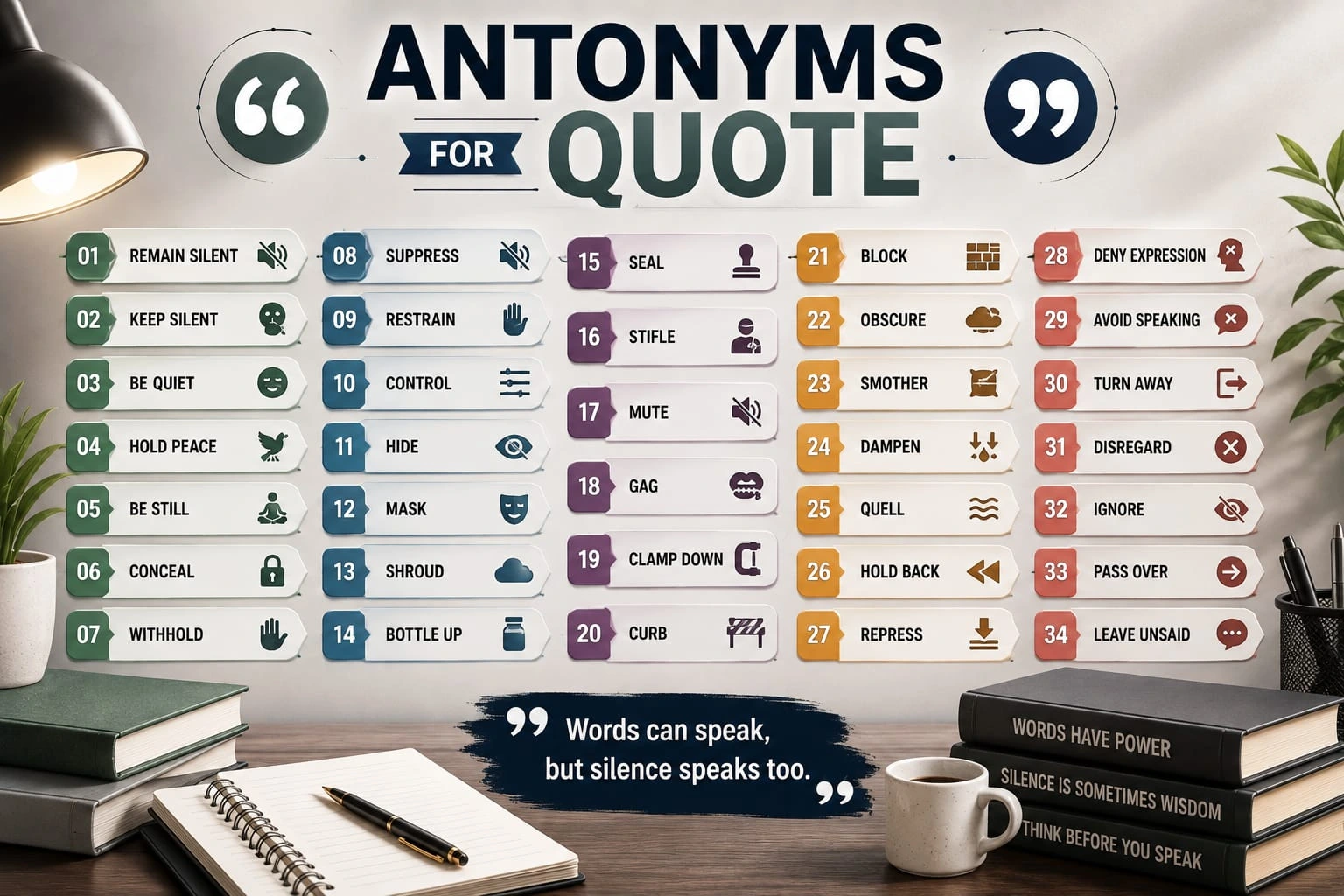
There is no single direct antonym for quote. When quote means repeating someone’s exact words, paraphrase is the closest contextual opposite because it expresses the same idea in your own words.
Quick Answer
The closest contextual opposite of quote is paraphrase. To quote means to repeat someone’s exact words, while to paraphrase means to express the same idea using different words. Summarize, rephrase, interpret, and describe can also contrast with quote in specific situations.
Quick Comparison Table
| Word | Meaning | Example |
| Quote | Repeat someone’s exact words | She quoted the author. |
| Paraphrase | Express the same idea in your own words | She paraphrased the author’s point. |
| Summarize | Give the main points briefly | He summarized the article. |
| Rephrase | Say something in different words | Please rephrase your answer. |
| Interpret | Explain the meaning of something | She interpreted the speaker’s message. |
One-Line Definition
Quote: To repeat someone’s exact words, usually with attribution.
Closest contextual opposite: Paraphrase — to express someone’s meaning in your own words.
Learning Outcomes
After reading this guide, you will know:
- Why quote has no single universal antonym
- Why paraphrase is its closest contextual contrast
- How quote, paraphrase, summarize, and rephrase differ
- How to use these words correctly in sentences
Core Antonyms of Quote
Because quote has more than one meaning, its opposites depend on how the word is being used.
1. Paraphrase
Meaning: To express the meaning of someone’s words using your own words instead of repeating them exactly.
Example:
The student paraphrased the writer’s argument instead of quoting it.
Best context: Academic writing, essays, explanations, and reports.
2. Rephrase
Meaning: To say or write something again using different words.
Example:
Can you rephrase the statement in simpler English?
Best context: Everyday speech, writing, and communication.
3. Summarize
Meaning: To give only the main points of something in a shorter form.
Example:
The researcher summarized the speaker’s main argument.
Best context: Articles, reports, books, lectures, and academic writing.
4. Interpret
Meaning: To explain the meaning or significance of someone’s words.
Example:
The journalist interpreted the politician’s comments differently.
Best context: Analysis, criticism, journalism, and academic discussion.
5. Describe
Meaning: To explain what someone said or what something is like without necessarily repeating the original words.
Example:
She described the author’s argument in her own words.
Best context: General writing and explanations.
6. Explain
Meaning: To make an idea or statement clear by giving more information.
Example:
The teacher explained the author’s main point.
Best context: Education, conversation, and instructional writing.
7. State
Meaning: To express an idea or fact directly.
Example:
The report stated the main findings without quoting the researcher.
Best context: Formal and professional writing.
8. Report
Meaning: To tell someone information about what another person said or did.
Example:
The newspaper reported what the minister had said.
Best context: Journalism and formal communication.
9. Relay
Meaning: To pass information from one person to another.
Example:
She relayed the manager’s message to the team.
Best context: Workplace and everyday communication.
10. Convey
Meaning: To communicate an idea, feeling, or message.
Example:
The writer conveyed the speaker’s idea without using a direct quote.
Best context: Formal writing and communication.
11. Express
Meaning: To communicate a thought, feeling, or idea.
Example:
He expressed the author’s main idea in simple language.
Best context: General and academic writing.
12. Restate
Meaning: To say something again, usually in a different or clearer way.
Example:
The teacher restated the student’s answer for clarity.
Best context: Education and formal communication.
13. Reword
Meaning: To change the wording of something while keeping its general meaning.
Example:
Please reword this sentence before submitting your essay.
Best context: Writing and editing.
14. Condense
Meaning: To make information shorter while keeping the important parts.
Example:
The editor condensed the long statement into two sentences.
Best context: Editing, reports, and academic writing.
15. Elaborate
Meaning: To give more details about an idea instead of simply repeating someone’s exact words.
Example:
The speaker elaborated on the point during the interview.
Best context: Presentations, interviews, and formal discussion.
16. Analyze
Meaning: To examine information carefully and explain its meaning.
Example:
The students analyzed the author’s statement instead of quoting it.
Best context: Academic writing and critical thinking.
17. Discuss
Meaning: To talk or write about a subject by considering its ideas or details.
Example:
The essay discusses the author’s argument without relying on long quotations.
Best context: Essays, reports, and academic discussion.
18. Interpretive Statement
Meaning: A statement that explains what someone’s words mean rather than repeating those words.
Example:
The article included an interpretive statement about the speaker’s comments.
Best context: Analysis and critical writing.
19. Indirect Statement
Meaning: A statement that reports someone’s meaning without giving their exact words.
Example:
The journalist used an indirect statement rather than a direct quotation.
Best context: Journalism and formal writing.
20. Original Expression
Meaning: Your own wording used to communicate an idea rather than someone else’s exact words.
Example:
The student presented the idea through an original expression.
Best context: Writing and explanation.
Contextual Antonyms of Quote
When “quote” means “repeat someone’s exact words”
The strongest contextual contrasts are:
- Paraphrase
- Rephrase
- Reword
- Summarize
- Restate
Here, the key difference is simple: quoting preserves the original wording, while paraphrasing or rewording changes the wording.
When “quote” means “give a price”
The meaning changes completely.
For example:
The builder quoted $2,000 for the repair.
In this sense, quote means to give a specific price or estimate. There is no clear direct antonym. Words such as withdraw, decline, or withhold may create a contextual contrast, but they are not true antonyms of quote.
Quote vs. Paraphrase
Quote and paraphrase are often confused in academic writing.
A quote uses the speaker’s or writer’s original words.
The author wrote, “Reading changes how we see the world.”
A paraphrase keeps the idea but changes the wording.
The author suggests that reading can change our view of the world.
So, if the exact wording matters, use a quote. If you want to explain the same idea in your own words, paraphrase it.
Quote vs. Summarize
These words are also different.
- Quote: Uses the exact original words.
- Paraphrase: Uses different words but keeps the original idea.
- Summarize: Gives only the main point in a shorter form.
For example, a long speech can be summarized in one sentence, paraphrased in a few sentences, or quoted word for word.
Grammar & Word Class
Quote can function as both a noun and a verb.
Quote as a noun
A quote is a group of words taken from what someone else has said or written.
The essay contains a famous quote from the novel.
Quote as a verb
To quote means to repeat someone’s exact words.
The student quoted the researcher in her essay.
The closest contextual opposites, such as paraphrase, summarize, rephrase, and interpret, are mainly verbs.
Word Formation
The word quote comes from a root related to the idea of marking or citing a passage.
Common forms include:
- quote: noun / verb
- quoted: past tense / past participle
- quoting: present participle / gerund
- quotation; noun
- quotable: adjective
- quotation marks: noun phrase
There is no simple negative prefix that creates a direct antonym of quote.
Common Mistakes
Mistake 1: Treating paraphrase as an exact opposite
Paraphrase is the closest contextual contrast, but it is not a perfect dictionary antonym.
❌ Paraphrase is the exact antonym of quote in every situation.
✅ Paraphrase is the closest contextual opposite when quote means repeating exact words.
Mistake 2: Confusing paraphrasing with summarizing
A paraphrase usually preserves the main meaning and level of detail, while a summary reduces information to its main points.
Mistake 3: Changing only one or two words
Replacing a few words in a quotation does not automatically make it a proper paraphrase. A good paraphrase should express the idea naturally in your own wording.
Mistake 4: Assuming “unquote” is an antonym
Unquote is not the opposite of quote. It is used to signal the end of quoted material, especially in speech.
Expert Tip
When you need the closest opposite of quote, ask yourself: “Am I repeating the exact words or explaining the same idea in my own words?” Exact words = quote. Your own wording = paraphrase.
Grammar Relay / Usage Insight
In academic writing, quote, paraphrase, and summarize serve different purposes. A quotation preserves the original language, a paraphrase changes the wording while retaining the idea, and a summary gives a shorter version of the main information.
Choosing the correct term makes your writing more precise.
Mini Quiz
Choose the best word.
1. The student used the author’s exact words.
A. Paraphrased
B. Quoted
C. Summarized
Answer: B. Quoted
2. The writer explained the author’s idea in her own words.
A. Quoted
B. Paraphrased
C. Copied
Answer: B. Paraphrased
3. The reporter gave only the main points of the speech.
A. Summarized
B. Quoted
C. Repeated
Answer: A. Summarized
Short Questions and Answers
What is the opposite of quote?
There is no single direct antonym. Paraphrase is the closest contextual opposite when quote means repeating someone’s exact words.
Is paraphrase the antonym of quote?
Not in every context. It is a contextual opposite because paraphrasing expresses an idea in different words rather than using the exact original wording.
What is the difference between quote and paraphrase?
A quote uses the original words, while a paraphrase communicates the same idea using your own words.
Is summarize an antonym of quote?
Summarize can contrast with quote, but it is not a direct antonym. A summary gives only the main points, while a quote preserves the original wording.
Can “rephrase” replace “quote”?
Not always. Rephrase means to express something in different words, while quote means to reproduce the original wording.
What is the opposite of quote in academic writing?
In academic writing, paraphrase is usually the closest contextual contrast when you want to communicate a source’s idea without using its exact words.
Key Takeaways
- Quote means to repeat someone’s exact words.
- Paraphrase is the closest contextual opposite.
- Rephrase and reword focus on changing the wording.
- Summarize reduces information to its main points.
- Interpret explains meaning rather than reproducing exact words.
- Quote has different meanings, so its contextual opposite can change.
- Not every related contrast is a true dictionary antonym.
Conclusion
There is no single perfect antonym for quote, and that is important to understand. When quote means repeating someone’s exact words, paraphrase is the closest contextual opposite because it communicates the same idea in your own words. Rephrase, reword, summarize, interpret, and restate can also provide useful contrasts, but each has a slightly different meaning. If quote means giving a price, the antonym relationship becomes different because the word is being used in another sense. For English learners, the key lesson is to focus on context rather than memorizing one supposed opposite. Knowing the difference between quoting, paraphrasing, and summarizing is especially useful in academic, professional, and everyday writing. Choose the word that accurately describes what you are doing, and your writing will become clearer and more precise.
Antonyms for Blunt: 22 Opposite Words to Know

I’m Noreen Akbar, an English language researcher and content writer with a passion for words,their meanings, origins, and the subtle differences between them. I specialize in antonyms and vocabulary, creating clear, easy-to-follow guides that help readers expand their word power, sharpen their understanding of language, and express themselves with greater clarity and confidence.