What Is the Opposite of Always?
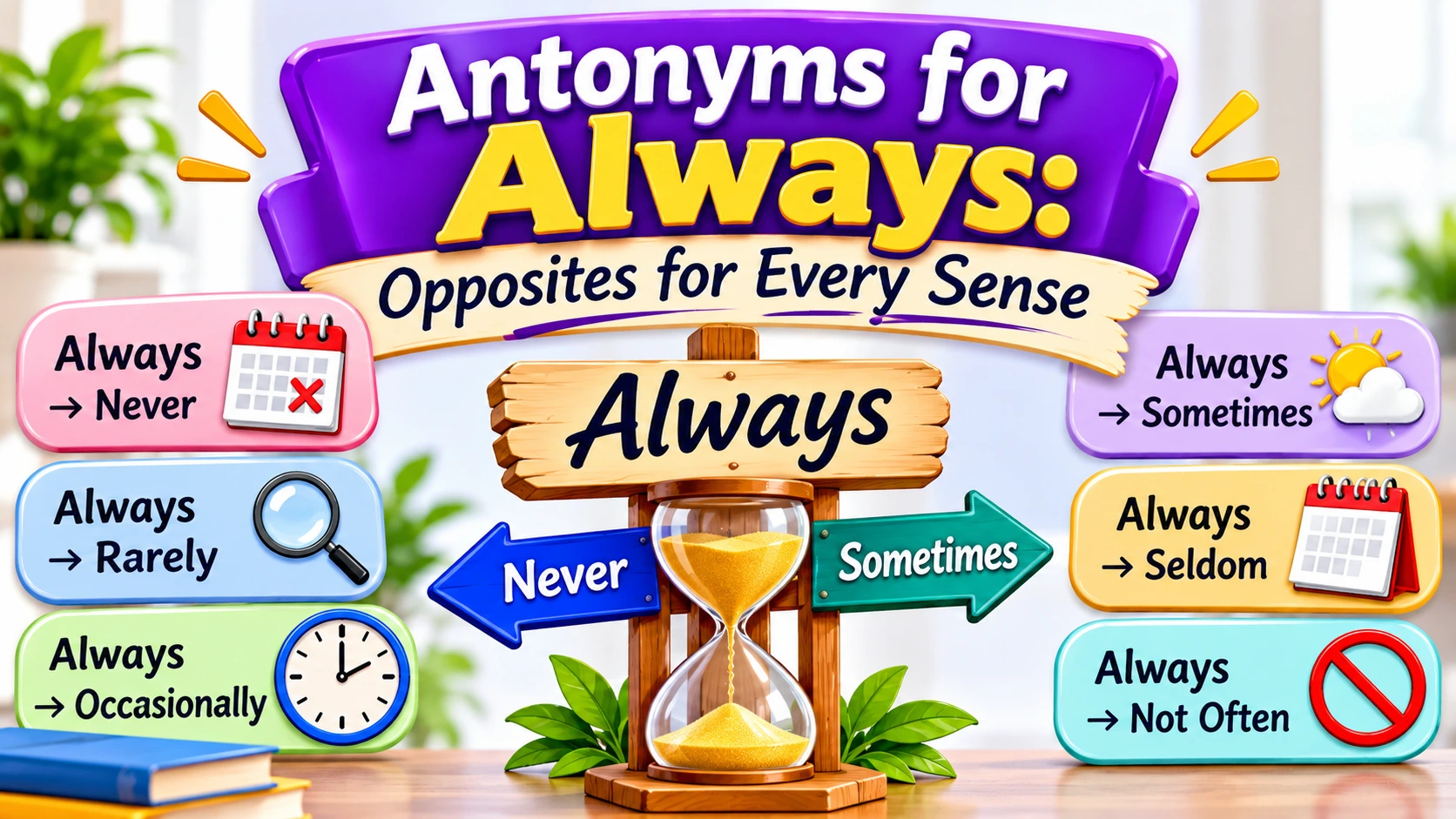
What is the opposite of always? The strongest opposite is never: always means at all times or on every occasion, while never means at no time or on no occasion. For softer contrasts, sometimes, occasionally, and rarely also work, depending on how often something happens.
Answer in Brief
The most common antonym of always is never. But always has more than one sense, so it has more than one opposite. When always means “on every occasion”, the opposites run from never (zero times) through rarely and sometimes (a few times). When always means “forever”, the opposite is temporarily or for a time. And in logic, the true opposite of “always” is often not always, not never a distinction that matters in careful writing.
Quick Word Comparison
| Word | Meaning | Example |
|---|---|---|
| Always | At all times; on every occasion | She always arrives on time. |
| Never | At no time; on no occasion | She never arrives late. |
| Sometimes | On some occasions, but not all | We sometimes walk to work. |
| Rarely | On very few occasions | It rarely snows in this city. |
| Temporarily | For a limited time only | He is temporarily in charge. |
Simple Definition
Always: At all times, on every occasion, or forever.
Main antonym: Never at no time, or on no occasion.
For the full dictionary entry, see always on Merriam-Webster.
Key Learning Points
After reading this guide, you will know:
- The main antonym of always
- Softer opposites like sometimes, rarely, and occasionally
- How the opposite changes with the meaning of always
- Why “not always” is often more accurate than “never”
Common Opposites of Always
Never
at no time, on no occasion. This is the direct, strongest opposite. “She never eats meat.”
Sometimes
on some occasions, but not every time. This is the most useful softer opposite. “We sometimes walk to work instead of driving.”
Occasionally
now and then, at irregular intervals. Slightly more formal than sometimes. “He occasionally visits his parents on Sundays.”
Rarely
on very few occasions. This sits close to never but leaves room for exceptions. “It rarely snows in this part of the country.”
Seldom
not often. A little formal, common in writing. “She seldom complains, even when things go wrong.”
Hardly ever
almost never. A natural spoken phrase for very low frequency. “We hardly ever watch television these days.”
Intermittently
starting and stopping, with gaps in between. This describes a pattern, not just a low count. “It rained intermittently all afternoon.”
Sporadically
irregularly, scattered across time. Similar to intermittently but with more randomness. “Team meetings happen sporadically, with no fixed schedule.”
Not always
the logical opposite. This says something is not true every time, without claiming it never happens. “Teachers are not always right.”
Different Meanings, Different Opposites
Always wears several meanings, and each one takes a different opposite.
If always means “on every occasion”, use never for zero times, rarely or seldom for very few times, and sometimes or occasionally for a few times. “He always comes home on Saturdays” becomes “He never comes home on Saturdays” or “He sometimes comes home on Saturdays”.
If always means “forever”, use temporarily, briefly, or for a time. “I will always love you” contrasts with “I will love you for a time”, not with a frequency word.
If always means “in every case”, use not necessarily or in some cases. “Hard work always pays off” softens to “Hard work does not always pay off” a claim most readers find more honest.
One sense has no real opposite: always in the “at any rate” sense, as in “You can always try again”, means “whatever happens”. That use does not take an antonym, and forcing one only confuses the sentence.
Understanding Each Antonym
Never is absolute: it allows no exceptions, which makes it powerful but risky. Sometimes is the safest soft opposite because it claims only that an event happens at least once. Rarely and seldom sit near never on the frequency scale but stay honest about rare exceptions. Intermittently and sporadically describe patterns over time rather than simple counts: rain can fall intermittently all day, while meetings happen sporadically across a year. Not always is the thinker’s opposite: it corrects an absolute claim without making an absolute claim of its own.
Examples in Context
- In conversation: “Do you always take this road?” “No, only sometimes — when the main road is closed.”
- At school: “She never forgets her homework, unlike her brother, who forgets it occasionally.”
- At work: “Our manager is rarely late, but he hardly ever misses a meeting entirely.”
- In writing: “The old machine worked intermittently, stopping and starting all morning.”
- In everyday life: “We eat out sporadically, maybe once every few months.”
- In an argument: “You say I always ignore you, but that is not fair — I am not always free to reply at once.”
Grammar and Word Forms
Always is an adverb. Its useful antonyms are adverbs or adverb phrases too: never, sometimes, rarely, seldom, occasionally, and phrases like once in a while, now and then, and from time to time. Because the word class matches, you can usually swap one for another without rebuilding the sentence. “She always calls” becomes “She never calls” or “She sometimes calls” with no other change needed.
The Prefix Pattern
English does not build the opposite of always with a prefix like un- or dis-. Instead, the opposite word carries its own built-in negation. Never comes from Old English “ne” (not) plus “ever”: it literally means “not ever”. Always itself comes from Old English “ealne weg”, meaning “all the way”. So the pair is not formed by adding a prefix to always; it is formed by two old words that grew up as natural opposites.
Nearby Words to Know
Forever means for all time without end, while always usually means on every occasion within some period. “She always arrives on time” is about repeated occasions; “I will love you forever” is about endless time. Ever appears in questions and negatives (“Have you ever been here?”), and constantly means without pause, which is close to always but stresses continuity rather than repetition.
Common Errors to Avoid
- ❌ Incorrect: “I never always agree with you.” ✅ Correct: “I do not always agree with you.” Two absolute words collide; not always fixes it.
- ❌ Incorrect: “He never helps, except last week when he did.” ✅ Correct: “He rarely helps.” If it happened once, never is false.
- ❌ Incorrect: “You always ignore me!” (said after one missed message) ✅ Correct: “You sometimes take a while to reply.” Absolute language in complaints usually overstates the case.
- ❌ Incorrect: “The shop is always closed on Sundays, except this Sunday.” ✅ Correct: “The shop is usually closed on Sundays.” An exception breaks always, so a softer word fits.
A Useful Language Tip
In arguments and essays, “not always” is usually the smartest opposite of always. It disagrees with an absolute claim without making an absolute claim of its own. “Money does not always bring happiness” is stronger and harder to attack than “Money never brings happiness”, because one exception defeats never but not not always.
Test Your Knowledge
- Choose the correct antonym: “He ___ arrives late; in ten years it has happened once.” A. always B. rarely C. sometimes — Answer: B. rarely, because one occasion in ten years is very low frequency, not zero and not occasional.
- Fill in the blank: “We eat out only ___ — maybe twice a year.” — Answer: occasionally (or sporadically), both fitting a low, irregular frequency.
- True or false: “‘Not always’ and ‘never’ mean the same thing.” — False. Not always means something is untrue at least once; never means it is untrue every time.
Frequently Asked Questions
What is the opposite of always?
The most direct opposite of always is never. Always means at all times or on every occasion, while never means at no time or on no occasion.
What is a stronger opposite of always?
Never is the strongest opposite, because it allows no exceptions. Sometimes and occasionally are softer opposites, since they allow the action to happen at least once.
Can never always replace always?
No. Never only works when the action truly happens zero times. If something happens rarely, sometimes or rarely is accurate, while never would be wrong.
What is the difference between always and forever?
Always usually means on every occasion or at all times within a period, while forever means for all time without end. You can say ‘she always arrives on time’ but ‘I will love you forever’ for endless time.
Is sometimes an antonym of always?
Yes, in the sense of frequency. If always means every time, sometimes means only on some occasions, so it is a genuine, if softer, opposite.
Key Takeaways
The strongest opposite of always is never, but the most honest opposite is often not always. Frequency opposites like sometimes, rarely, and occasionally cover the middle ground, while temporarily answers the “forever” sense. Match the opposite to the meaning, and avoid absolute words unless you truly mean zero exceptions.
Antonyms for Diary: What Is the Opposite?

I’m Daniel Carter, a language enthusiast and content writer focused on the fascinating world of antonyms and vocabulary. I break down word meanings and opposites into simple, practical guides helping readers build a richer vocabulary, understand language more deeply, and speak or write with greater confidence.