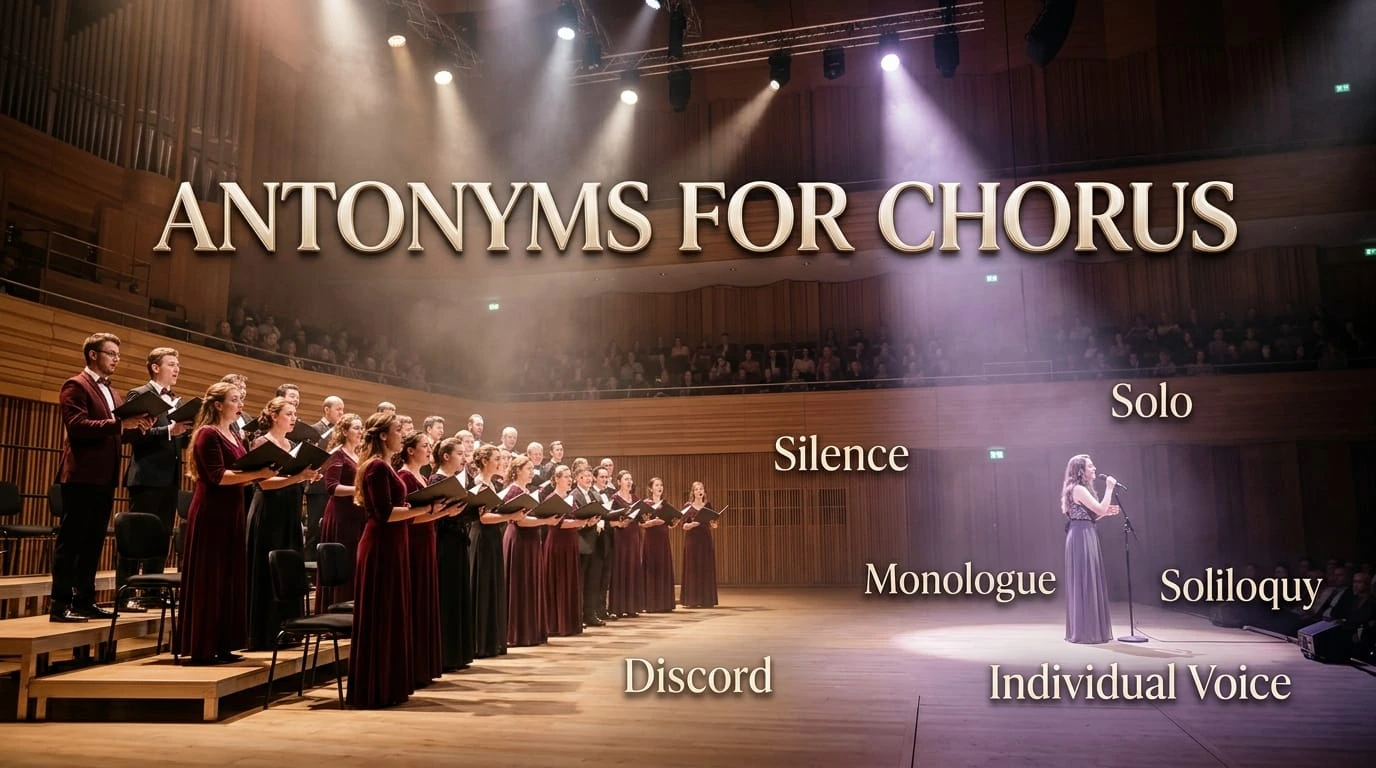
The most direct antonym of chorus is solo when chorus means a group of people singing together. Other contextual opposites include individual voice, monologue, and dissent depending on whether chorus refers to group singing, a repeated response, or a shared opinion.
What Is the Opposite of Chorus?
The best opposite of chorus is solo. A chorus involves several singers performing together, while a solo features one singer performing alone. In other contexts, individual voice or dissent may express the opposite idea. Verse is a contrasting song section, but it is not a strict antonym.
Chorus and Its Opposite: A Quick Comparison
| Word | Meaning | Example |
|---|---|---|
| Chorus | A group singing together | The choir performed a beautiful chorus. |
| Solo | A performance by one person | She sang a solo at the concert. |
| Group response | Several people responding together | The audience gave a group response. |
| Individual voice | One person’s separate opinion or expression | Each individual voice was heard. |
Meaning in Brief
Chorus is a noun that refers to a group of singers performing together, a repeated section of a song, or a group of people expressing the same opinion or response.
Main antonym: Solo a performance or activity carried out by one person rather than a group.
Common Opposites of Chorus
The right antonym depends on how the word chorus is used. Here are the most useful contextual opposites.
1. Solo
Meaning: A musical performance by one singer or musician rather than a group.
Example: The singer performed a solo after the choir finished its chorus.
Solo is the clearest opposite when chorus refers to group singing.
2. Individual Voice
Meaning: A separate person’s expression, opinion, or contribution.
Example: The discussion allowed every individual voice to be heard.
This phrase contrasts with a chorus when many people express one shared response.
3. Monologue
Meaning: A long speech delivered by one person, often without interruption.
Example: The actor delivered a dramatic monologue on stage.
A monologue can contrast with a chorus of voices in a theatrical performance.
4. Soliloquy
Meaning: A speech in which a character speaks their thoughts aloud, usually while alone on stage.
Example: The play opened with a powerful soliloquy.
It is a contextual opposite when chorus refers to a group speaking or performing together.
5. Dissent
Meaning: Disagreement with an opinion or decision held by a group.
Example: One member expressed dissent while the rest supported the proposal.
Dissent contrasts with a chorus of agreement or shared opinion.
6. Disagreement
Meaning: A lack of agreement between people.
Example: Disagreement replaced the chorus of approval during the meeting.
This is useful when chorus describes people expressing the same view.
7. Solitude
Meaning: The state of being alone, away from other people.
Example: She enjoyed the solitude of the quiet countryside.
Solitude contrasts with the collective nature of a chorus, although it is not a direct antonym.
8. Silence
Meaning: The absence of sound or speech.
Example: A sudden silence followed the audience’s loud chorus of cheers.
This works as a contextual opposite when chorus refers to a loud group response.
9. Unison’s Opposite: Discord
Meaning: A lack of harmony between sounds, voices, or opinions.
Example: The singers’ voices created discord instead of harmony.
Discord contrasts with the harmony often associated with a musical chorus.
10. Solitary Performance
Meaning: A performance carried out by one person without a group.
Example: The musician chose a solitary performance instead of joining the chorus.
This phrase clearly expresses the opposite arrangement of group participation.
Choosing the Right Antonym for Chorus
Not every opposite works in every sentence. Use the context to choose the most accurate word.
When Chorus Means a Group of Singers
Use:
- Solo: One singer performing alone.
- Solitary performance: A performance by one person.
- Individual voice: One separate voice rather than a group.
When Chorus Means a Shared Opinion or Response
Use:
- Dissent: An expression of disagreement.
- Disagreement: A difference of opinion.
- Individual voice: A separate personal viewpoint.
When Chorus Means a Group Sound
Use:
- Silence: No sound or speech.
- Discord: A lack of harmony.
- Solitude: Being alone rather than participating in a group.
How These Opposites Differ
Some words above are direct contextual opposites, while others describe contrasting situations.
- Solo vs. chorus: A solo features one performer; a chorus features a group.
- Dissent vs. chorus of agreement: Dissent expresses disagreement rather than shared approval.
- Silence vs. chorus: Silence means no sound, while a chorus involves multiple voices.
- Discord vs. chorus: Discord describes a lack of harmony, whereas a musical chorus often aims for harmonious singing.
- Monologue vs. chorus: A monologue is delivered by one speaker, while a chorus involves multiple voices.
Chorus and Its Antonyms in Sentences
Compare these examples to understand how the words work naturally.
1. Chorus: The students sang the chorus together.
Solo: One student performed a solo at the school event.
2. Chorus: A chorus of approval followed the announcement.
Dissent: One person expressed dissent during the discussion.
3. Chorus: The actors spoke together as a chorus.
Monologue: The main character delivered a monologue.
4. Chorus: The hall filled with a chorus of cheers.
Silence: The room fell into silence after the announcement.
5. Chorus: The choir sang in harmony.
Discord: The instruments produced discord during the rehearsal.
Grammar and Word Class
Chorus is primarily a noun. Its contextual opposites are also mostly nouns or noun phrases.
| Word | Part of Speech |
|---|---|
| Chorus | Noun |
| Solo | Noun or adjective |
| Monologue | Noun |
| Soliloquy | Noun |
| Dissent | Noun or verb |
| Disagreement | Noun |
| Silence | Noun or verb |
| Discord | Noun |
| Solitude | Noun |
Usage tip: When comparing chorus and solo, keep the musical context clear. For example, say “The choir sang a chorus, and the lead singer performed a solo.”
Common Questions About Chorus and Its Antonyms
What is the strongest antonym of chorus?
Solo is the strongest antonym when chorus means a group of singers performing together.
Is solo the opposite of chorus?
Yes. In music, a solo is performed by one person, while a chorus involves a group of singers.
Is verse the antonym of chorus?
No. A verse and a chorus are different sections of a song. They contrast in structure and function, but they are not true opposites.
What is the opposite of a chorus of agreement?
Dissent or disagreement expresses the opposite idea because both refer to a lack of shared agreement.
What is the opposite of a chorus of voices?
An individual voice, a solo, or silence may work, depending on whether you mean one speaker or the absence of sound.
Bottom Line
The best antonym for chorus is solo when discussing music and group singing. For shared opinions, use dissent or disagreement. For group sounds, silence and discord can provide useful contrasts. Always choose the opposite that matches the intended meaning.
Antonyms for Rhythm: Is Silence the Opposite of Rhythm?

I’m Moazama Akbar, an English language researcher and content writer with a passion for helping people build stronger vocabulary and language skills. I create clear, well-researched guides on antonyms, opposite words, and word meanings, designed to make English learning simple, practical, and enjoyable for students, writers, and learners everywhere.