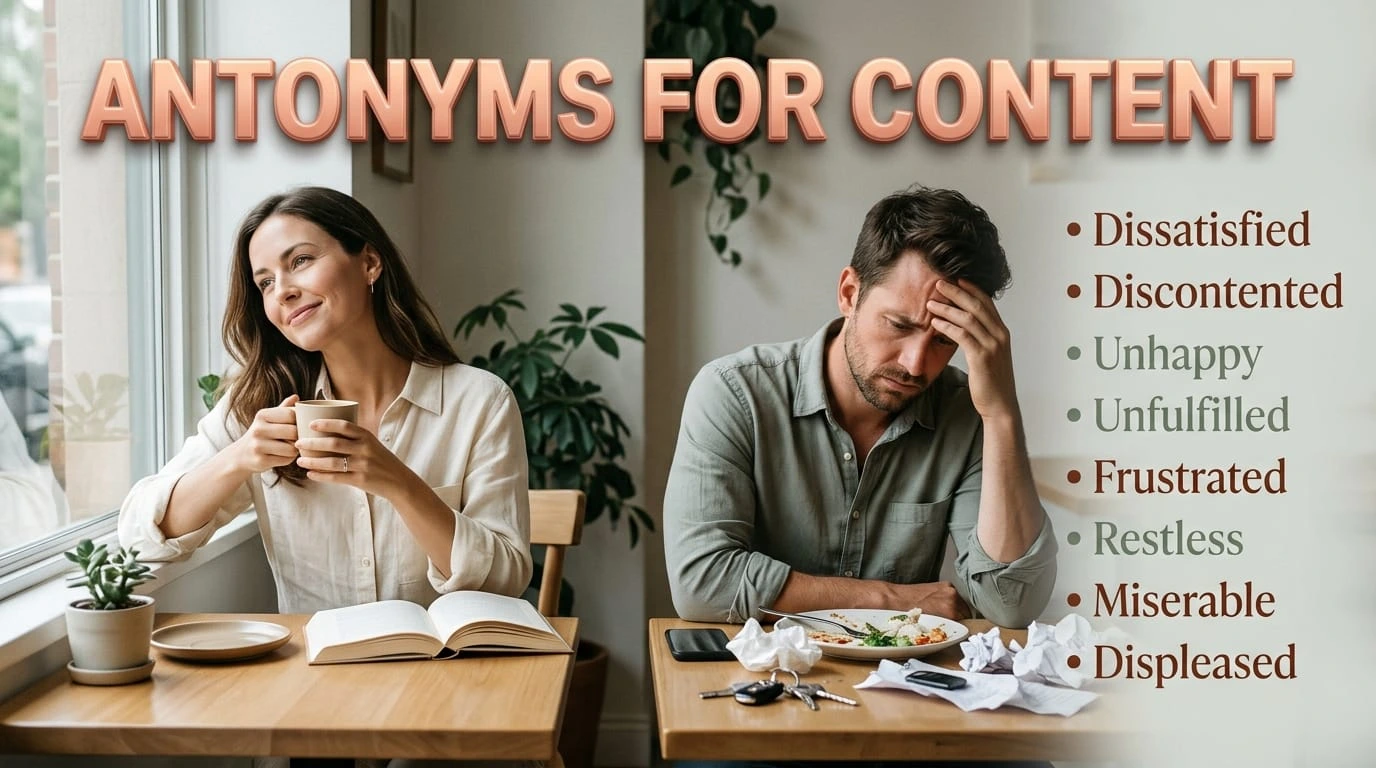
The most common antonym of content is dissatisfied when content means happy or satisfied with a situation. Other useful opposites include unhappy, discontented, displeased, and frustrated.
The Short Answer
The best antonym for content is dissatisfied.
However, the correct opposite depends on how you use the word:
- Content (happy or satisfied): dissatisfied, unhappy, discontented, displeased.
- Content (information or material): lack, absence, emptiness, or a blank space, depending on the sentence.
Content vs. Its Opposite
| Word | Meaning | Example |
|---|---|---|
| Content | Happy and satisfied | She felt content with her life. |
| Dissatisfied | Not happy or satisfied | She was dissatisfied with her life. |
| Discontented | Unhappy because something is missing or unsatisfactory | The workers were discontented with their pay. |
| Unhappy | Feeling sad or displeased | He was unhappy with the decision. |
Meaning in Brief
Content (adjective): Feeling happy, peaceful, or satisfied with what you have.
Content (noun): The information, ideas, or material contained in something, such as a book, website, or document.
Main antonym: Dissatisfied not feeling happy or pleased with a situation.
Common Opposites of Content
The following words are useful opposites when content describes a person’s feelings or state of satisfaction.
1. Dissatisfied
Meaning: Not pleased or happy with something because it does not meet your expectations.
Example: Customers were dissatisfied with the quality of the service.
Usage: This is one of the clearest and most direct antonyms of content when discussing satisfaction.
2. Discontented
Meaning: Unhappy or dissatisfied with a situation, condition, or experience.
Example: The employees became discontented with their working conditions.
Usage: Often suggests ongoing dissatisfaction rather than a brief feeling of disappointment.
3. Unhappy
Meaning: Feeling sad, displeased, or not satisfied.
Example: She was unhappy with the final results.
Usage: A common, everyday opposite. It can describe general sadness as well as dissatisfaction.
4. Displeased
Meaning: Annoyed or unhappy about something.
Example: The manager was displeased with the team’s performance.
Usage: Often expresses a reaction to a particular action, decision, or result.
5. Disgruntled
Meaning: Annoyed or dissatisfied, especially because of unfair treatment or an unpleasant situation.
Example: Several disgruntled customers complained about the delayed orders.
Usage: Stronger than dissatisfied and often suggests frustration or resentment.
6. Frustrated
Meaning: Upset or annoyed because something is not happening as expected.
Example: He felt frustrated with the slow progress of the project.
Usage: A useful contextual opposite when dissatisfaction comes from difficulty, delay, or failure.
7. Miserable
Meaning: Extremely unhappy or uncomfortable.
Example: She felt miserable in her new job.
Usage: Much stronger than unhappy. It describes serious emotional discomfort, not simply a lack of satisfaction.
8. Restless
Meaning: Unable to relax or feel comfortable, often because you want something to change.
Example: He felt restless with his routine and wanted a new challenge.
Usage: A contextual opposite when content suggests peaceful satisfaction or a settled state of mind.
9. Disappointed
Meaning: Sad or unhappy because something did not happen as expected.
Example: The students were disappointed with their exam results.
Usage: Best when the lack of satisfaction comes from unmet expectations.
10. Unsatisfied
Meaning: Not having received or achieved what is needed or wanted.
Example: The customer remained unsatisfied with the explanation.
Usage: Similar to dissatisfied, but it can also suggest that a need, requirement, or desire has not been fulfilled.
11. Unfulfilled
Meaning: Not satisfied because an important need, desire, or goal has not been achieved.
Example: She felt unfulfilled in her current position.
Usage: Particularly useful when discussing personal goals, ambitions, and emotional needs.
12. Discontent
Meaning: A feeling of dissatisfaction or unhappiness.
Example: There was growing discontent among the residents.
Usage: This is a noun, not an adjective. Use discontented when describing a person.
Antonyms by Context: Which Opposite Fits?
The word content has more than one meaning. Therefore, its antonyms change according to the context.
When Content Means Happy or Satisfied
Use these opposites:
- Dissatisfied: Not pleased with a situation.
- Discontented: Unhappy with existing conditions.
- Unhappy: Not feeling happy or pleased.
- Displeased: Annoyed about something.
- Disgruntled: Irritated because of dissatisfaction.
- Unfulfilled: Not satisfied because an important desire remains unmet.
Example:
- Content: She is content with her current lifestyle.
- Dissatisfied: She is dissatisfied with her current lifestyle.
When Content Means Information or Material
In this meaning, content refers to what is included in a book, article, website, video, or other material. It does not have one universal antonym.
Depending on the sentence, useful contrasts include:
- Absence: Something is not present.
- Lack: Not having enough of something.
- Emptiness: The state of containing nothing.
- Omission: Something that has been left out.
- Blankness: A state in which no writing or information appears.
Examples:
- The website contains useful content.
- The website has a lack of useful content.
- The document was completely blank.
These are contextual opposites, not direct antonyms in every use of the noun content.
How These Antonyms Differ
Some opposites of content are similar, but they do not express exactly the same feeling.
| Antonym | Main Difference | Best Context |
|---|---|---|
| Dissatisfied | Not pleased with something | General satisfaction |
| Discontented | Ongoing unhappiness with conditions | Living or working situations |
| Unhappy | General lack of happiness | Everyday emotions |
| Displeased | Annoyed about a particular thing | Decisions or behaviour |
| Disgruntled | Strong irritation and dissatisfaction | Complaints or unfair treatment |
| Frustrated | Upset because of difficulty or delay | Problems and obstacles |
| Unfulfilled | Important needs or goals remain unmet | Personal ambitions |
Examples in Context
Here are more natural sentences showing how to use content and its opposites.
- Content: The children were content with their simple picnic.
- Dissatisfied: The client was dissatisfied with the final design.
- Discontented: The workers felt discontented after the salary cuts.
- Unhappy: My brother was unhappy with his test results.
- Displeased: The teacher was displeased with the students’ behaviour.
- Disgruntled: A disgruntled passenger complained about the cancelled flight.
- Frustrated: I became frustrated when the computer stopped working.
- Miserable: He felt miserable after losing his job.
- Restless: She grew restless after spending months in the same routine.
- Disappointed: We were disappointed when the event was cancelled.
- Unfulfilled: He felt unfulfilled despite his professional success.
- Absence: The absence of useful content made the page difficult to understand.
Grammar and Word Forms
The word content has different grammatical roles, so it is important to identify its meaning before choosing an antonym.
| Word | Part of Speech | Example |
|---|---|---|
| Content | Adjective | She feels content. |
| Content | Noun | The content of the article is useful. |
| Content | Verb | He contented himself with a simple meal. |
| Dissatisfied | Adjective | They were dissatisfied with the service. |
| Discontented | Adjective | The discontented employees requested changes. |
| Discontent | Noun | Public discontent continued to grow. |
Important: The noun content (information or material) and the adjective content (satisfied) are pronounced differently:
- Content (satisfied): /kənˈtent/
- Content (information): /ˈkɒn.tent/ in British English; /ˈkɑːn.tent/ in American English.
Common Errors to Avoid
1. Confusing Dissatisfied and Discontented
Both words express a lack of satisfaction, but discontented often suggests a deeper or more lasting feeling.
- Dissatisfied: The customer was dissatisfied with the meal.
- Discontented: The residents were discontented with the poor living conditions.
2. Using Discontent as an Adjective
Discontent is generally a noun, while discontented is the adjective.
- Incorrect: The employees were discontent with their salaries.
- Correct: The employees were discontented with their salaries.
- Also correct: The employees felt discontent about their salaries.
3. Treating Every Meaning of Content the Same Way
The opposite of content meaning satisfied is not necessarily the opposite of content meaning information.
- Correct: She was dissatisfied with the service.
- Correct: The website lacked useful content.
Choose an opposite based on the meaning you want to express.
Teacher’s Tip
When describing a person’s feelings, dissatisfied is usually the safest general opposite of content. Use discontented for deeper dissatisfaction and disgruntled when someone is particularly annoyed or resentful.
Frequently Asked Questions
What is the best antonym for content?
Dissatisfied is the best general antonym when content means happy or satisfied. It describes someone who is not pleased with a situation or experience.
Is discontented an antonym of content?
Yes. Discontented is an antonym of content when the word describes a person’s feelings. It means unhappy or dissatisfied with existing circumstances.
What is the difference between dissatisfied and unhappy?
Dissatisfied usually means that something does not meet your expectations. Unhappy is broader and can describe sadness, disappointment, or a general lack of happiness.
What is the opposite of content in writing?
When content means information or material in writing, there is no single direct antonym. Depending on the sentence, words such as absence, lack, omission, and blankness can express the opposite idea.
Is discontent a noun or an adjective?
Discontent is generally used as a noun meaning dissatisfaction or unhappiness. Discontented is the adjective used to describe someone who feels dissatisfied.
What to Remember
The most useful antonym of content is dissatisfied, especially when describing a person’s feelings. Other choices include unhappy, discontented, displeased, and frustrated. When content refers to information or material, use a contextual contrast such as lack, absence, or omission instead.
Antonyms for Unscrupulous: Scrupulous, Honest and Principled

I’m Moazama Akbar, an English language researcher and content writer with a passion for helping people build stronger vocabulary and language skills. I create clear, well-researched guides on antonyms, opposite words, and word meanings, designed to make English learning simple, practical, and enjoyable for students, writers, and learners everywhere.