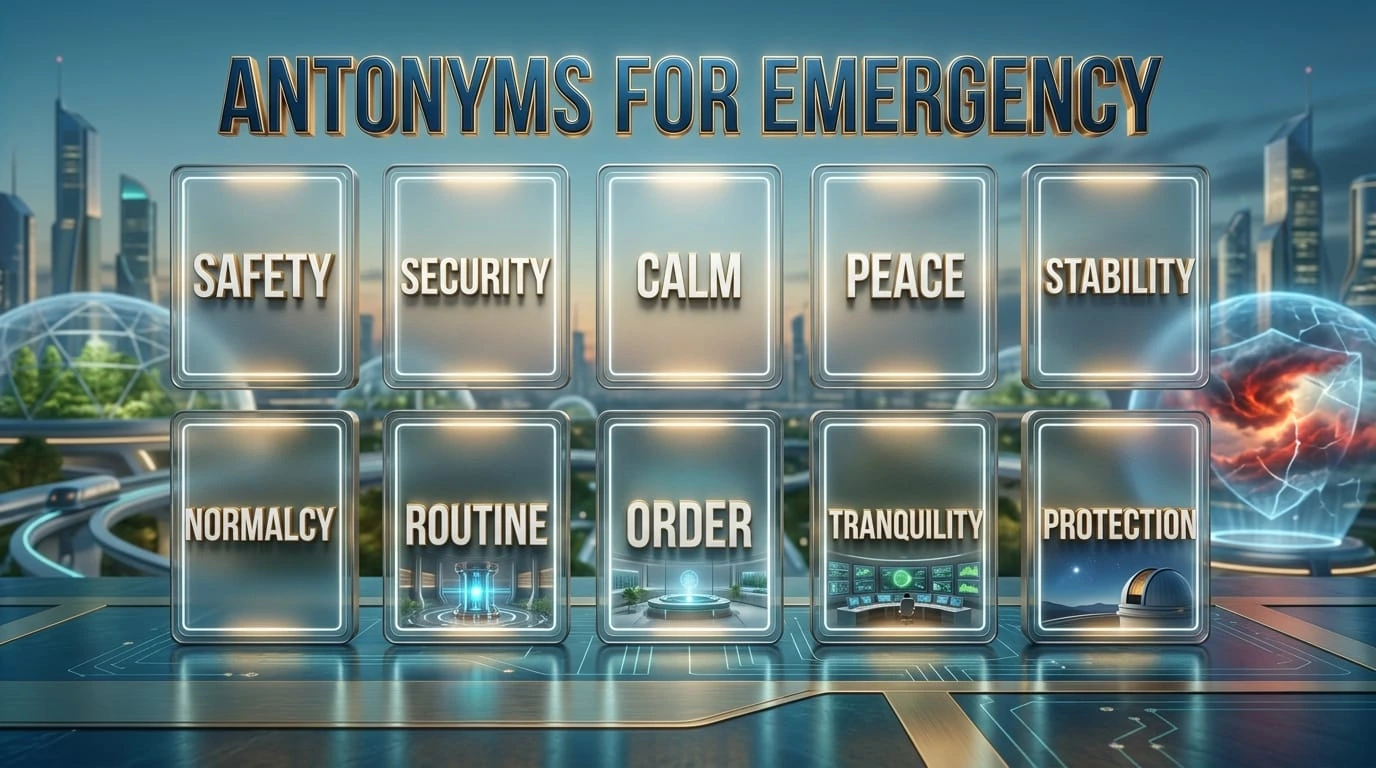
Common antonyms for emergency include normalcy, routine, safety, security, stability, calmness, peace, and regularity.
When a hospital receives an emergency patient, staff immediately switch from their normal routine to urgent action. But when there is no immediate danger or need for urgent intervention, the situation returns to normalcy, safety, and routine. That contrast helps explain why emergency has several contextual opposites rather than one perfect antonym.
Quick Answer
The most natural antonym for emergency is normalcy or normal situation. An emergency is an unexpected and urgent situation requiring immediate attention, while normalcy describes a situation in which things are proceeding normally.
Depending on the context, useful opposites include routine, safety, security, stability, calmness, peace, regularity, and nonemergency.
Emergency vs. Its Main Opposites
| Word | Meaning | Example |
| Emergency | A serious situation requiring immediate action | The hospital declared an emergency. |
| Normalcy | A normal state without unusual problems | The city slowly returned to normalcy. |
| Routine | A regular and predictable situation or activity | The inspection was a routine procedure. |
| Safety | Freedom from danger or harm | Everyone was moved to safety. |
| Stability | A steady condition without sudden disruption | Economic stability reduced uncertainty. |
One-Line Definition
Emergency: An unexpected and serious situation that requires immediate action or attention.
Main antonym Normalcy: A normal state in which there is no unusual crisis or disruption.
20 Antonyms for Emergency
Here are useful opposites of emergency, ranging from direct contextual opposites to words that contrast with particular aspects of an emergency.
1. Normalcy
Meaning: The state of being normal, especially after an unusual or difficult event.
Example: The community gradually returned to normalcy after the storm.
Best context: Situations involving a return to ordinary conditions.
2. Routine
Meaning: A regular situation or activity that does not require urgent action.
Example: The nurse was completing a routine health check.
Best context: Medical, workplace, administrative, and everyday situations.
3. Safety
Meaning: A condition in which people are protected from danger or harm.
Example: The firefighters worked quickly to ensure everyone’s safety.
Best context: When emergency emphasizes danger or risk.
4. Security
Meaning: Protection from danger, threat, or harm.
Example: The building remained under security throughout the event.
Best context: Physical, personal, financial, and organizational contexts.
5. Stability
Meaning: A steady condition without sudden or serious disruption.
Example: The company has achieved financial stability.
Best context: Economic, political, social, and organizational situations.
6. Calmness
Meaning: A peaceful state without panic, excitement, or disturbance.
Example: Her calmness helped everyone respond effectively.
Best context: Emotional or situational contrast.
7. Peace
Meaning: A state without conflict, violence, or serious disturbance.
Example: The region enjoyed several months of peace.
Best context: Conflict, violence, disasters, and social situations.
8. Regularity
Meaning: The quality of occurring in a normal or predictable way.
Example: The train service resumed its regularity after the disruption.
Best context: Schedules, processes, and recurring activities.
9. Normality
Meaning: The condition of being usual, ordinary, or expected.
Example: Life gradually returned to normality.
Best context: Everyday and formal writing.
10. Nonemergency
Meaning: A situation that does not require immediate emergency treatment or intervention.
Example: Nonemergency cases are handled separately from critical patients.
Best context: Healthcare, public services, and official communication.
11. Stability
Meaning: A state of being steady and unlikely to change suddenly.
Example: Political stability encouraged long-term investment.
Best context: When an emergency represents disruption or uncertainty.
Note: Stability is repeated conceptually in many contexts but is one of the strongest contextual opposites of emergency when the focus is disruption.
12. Continuity
Meaning: The state of continuing without interruption.
Example: The company maintained continuity of service during the transition.
Best context: Business, education, services, and operations.
13. Security
Meaning: Freedom from significant threat or danger.
Example: The passengers were assured of their security.
Best context: Situations where emergency refers to danger or threat.
Security is especially useful when the contrasting idea is protection rather than urgency.
14. Order
Meaning: A condition in which things are organized and controlled.
Example: The police restored order after the disturbance.
Best context: Public situations, organizations, and social conditions.
15. Tranquility
Meaning: A peaceful and undisturbed state.
Example: The village is known for its tranquility.
Best context: Descriptive, literary, and formal writing.
16. Predictability
Meaning: The quality of being expected or foreseeable.
Example: The predictable schedule made planning easier.
Best context: When contrasting an emergency’s unexpected nature.
17. Preparedness
Meaning: The state of being ready for possible problems or events.
Example: Good preparedness can reduce the impact of disasters.
Best context: Disaster planning and risk management.
Important: Preparedness is not a direct antonym of emergency. It is a contextual contrast because preparedness represents readiness before or during a potential crisis.
18. Prevention
Meaning: Action taken to stop something harmful from happening.
Example: Prevention is often more effective than responding to a crisis.
Best context: Healthcare, safety, disaster management, and risk reduction.
Important: Like preparedness, prevention is a contextual contrast rather than a strict dictionary antonym.
19. Normal Operation
Meaning: The usual way in which a system or organization functions.
Example: The airport has returned to normal operation.
Best context: Businesses, transportation, technology, and public services.
20. Ordinary Situation
Meaning: A normal situation without unusual urgency or danger.
Example: What initially looked serious turned out to be an ordinary situation.
Best context: Everyday explanations and learner-friendly writing.
Context Matters: Why Emergency Has Several Opposites
Emergency is a noun describing an urgent or dangerous situation. Its opposite changes depending on which part of the meaning you want to contrast.
When emergency means an urgent situation
Use:
- routine
- normalcy
- normality
- nonemergency
- ordinary situation
- normal operation
Example:
The doctor treated the emergency immediately.
→ The doctor later returned to routine appointments.
When emergency emphasizes danger
Use:
- safety
- security
- protection
- stability
Example:
The emergency put residents at risk.
→ The evacuation brought them to safety.
When emergency emphasizes disturbance or disruption
Use:
- calmness
- peace
- tranquility
- order
- continuity
- stability
Example:
The emergency disrupted normal services.
→ Services eventually returned to normal operation.
When emergency emphasizes unpredictability
Use:
- predictability
- regularity
- routine
- normality
Example:
The unexpected emergency interrupted the schedule.
→ The predictable routine resumed afterward.
Antonym Meaning and Usage
Not every word in the list can replace emergency directly.
Normalcy, normality, and routine are among the closest opposites when the intended meaning is an unusual situation versus an ordinary one.
Safety and security work better when the focus is danger.
Peace, calmness, and tranquility emphasize the absence of disturbance.
Stability contrasts with the disruption or uncertainty that an emergency can create.
Words such as preparedness and prevention should be treated as contextual contrasts, not strict antonyms. Preparedness is the state of being ready for an emergency, while prevention aims to stop a harmful event before it occurs.
Example Sentences
Here are natural examples showing how these opposites work:
- The hospital returned to normal operation after the emergency.
- The situation was serious at first but soon returned to normalcy.
- The appointment was a routine medical checkup.
- The passengers were moved to a place of safety.
- Strong cybersecurity measures improved the company’s security.
- The country needs economic stability to encourage investment.
- Her calmness reassured the frightened children.
- The community hoped for lasting peace.
- The village is famous for its tranquility.
- The police restored order after the disturbance.
- The airline resumed normal operation after the delay.
- Good preparedness can help organizations handle emergencies effectively.
- Fire prevention measures can reduce the likelihood of an emergency.
- The school returned to its regularity after the unexpected closure.
- The new system provides greater predictability for users.
Grammar and Word Class
Emergency is primarily a countable noun.
- an emergency
- the emergency
- several emergencies
Examples:
Call the emergency services if necessary.
The hospital treated several emergencies overnight.
Most common antonyms are nouns or noun phrases:
- emergency → normalcy
- emergency → normality
- emergency → routine
- emergency → safety
- emergency → security
- emergency → stability
- emergency → peace
- emergency → calmness
Some contextual opposites are also nouns:
- continuity
- prevention
- preparedness
- predictability
- regularity
Common Mistakes
Mistake 1: Assuming “safe” is always the direct antonym
Emergency is a noun, while safe is an adjective.
❌ Emergency → safe
✅ Emergency → safety / normalcy / normal situation
The grammatical form matters.
Mistake 2: Treating “preparedness” as a strict antonym
Preparedness does not mean the opposite of an emergency. It means being ready to deal with one.
Good preparedness helps hospitals respond to emergencies.
Mistake 3: Using “peace” in every context
Peace is appropriate when an emergency involves conflict, violence, or serious disturbance. It may sound unnatural when talking about a routine medical appointment.
Mistake 4: Confusing “normality” and “normalcy”
Both refer to a normal state. Normality is widely used in British English, while normalcy is particularly common in American English, although both words occur across varieties of English.
Expert Tip
Think about what makes the situation an emergency before choosing its opposite. If the key idea is urgency, use routine or normalcy; if it is danger, use safety or security; if it is disruption, use stability, order, or continuity.
Mini Practice
Choose the best contextual opposite:
1. The city finally returned to ______ after the crisis.
A. emergency
B. normalcy
C. danger
Answer: B. normalcy — Normalcy means a return to normal conditions.
2. The hospital classified the patient’s case as a ______ appointment.
A. routine
B. emergency
C. crisis
Answer: A. routine — A routine appointment does not normally require immediate emergency treatment.
3. Fire prevention improves public ______.
A. emergency
B. safety
C. urgency
Answer: B. safety Safety refers to protection from danger.
Short Questions & Answers
What is the most common antonym of emergency?
The most useful general antonyms are normalcy, normality, and routine. The best choice depends on the sentence. Normalcy describes a normal state, while routine describes a regular situation or activity.
What is the opposite of an emergency situation?
A normal situation, routine situation, or nonemergency situation can contrast with an emergency situation. Normalcy is also useful when describing a return to ordinary conditions.
Is safety an antonym of emergency?
Safety is a contextual antonym, not a perfect direct antonym. It works when emergency refers to danger or risk. For example, an emergency may put people in danger, while evacuation can bring them to safety.
Is routine the opposite of emergency?
Routine is one of the closest contextual opposites when emergency means an urgent situation requiring immediate attention. A routine task or appointment normally follows an expected process without exceptional urgency.
What is the opposite of emergency in a hospital?
In a medical context, routine, nonemergency, and normal care can contrast with emergency care. The appropriate term depends on whether you are describing the patient’s condition, the type of treatment, or the urgency of care.
Key Takeaways
The best general opposites of emergency are normalcy, normality, and routine. However, the ideal antonym depends on the meaning being contrasted.
- Routine → opposite of urgency
- Normalcy/normality → opposite of an unusual or disrupted condition
- Safety/security → opposite of danger
- Peace/calmness/tranquility → opposite of disturbance
- Stability/continuity/order → opposite of disruption
- Preparedness/prevention → related contextual contrasts, not strict antonyms
Understanding the context helps you choose a more natural opposite instead of forcing one word into every sentence.
Antonyms for Rationale: 25 Powerful Opposites You Should Know

I’m Daniel Carter, a language enthusiast and content writer focused on the fascinating world of antonyms and vocabulary. I break down word meanings and opposites into simple, practical guides helping readers build a richer vocabulary, understand language more deeply, and speak or write with greater confidence.