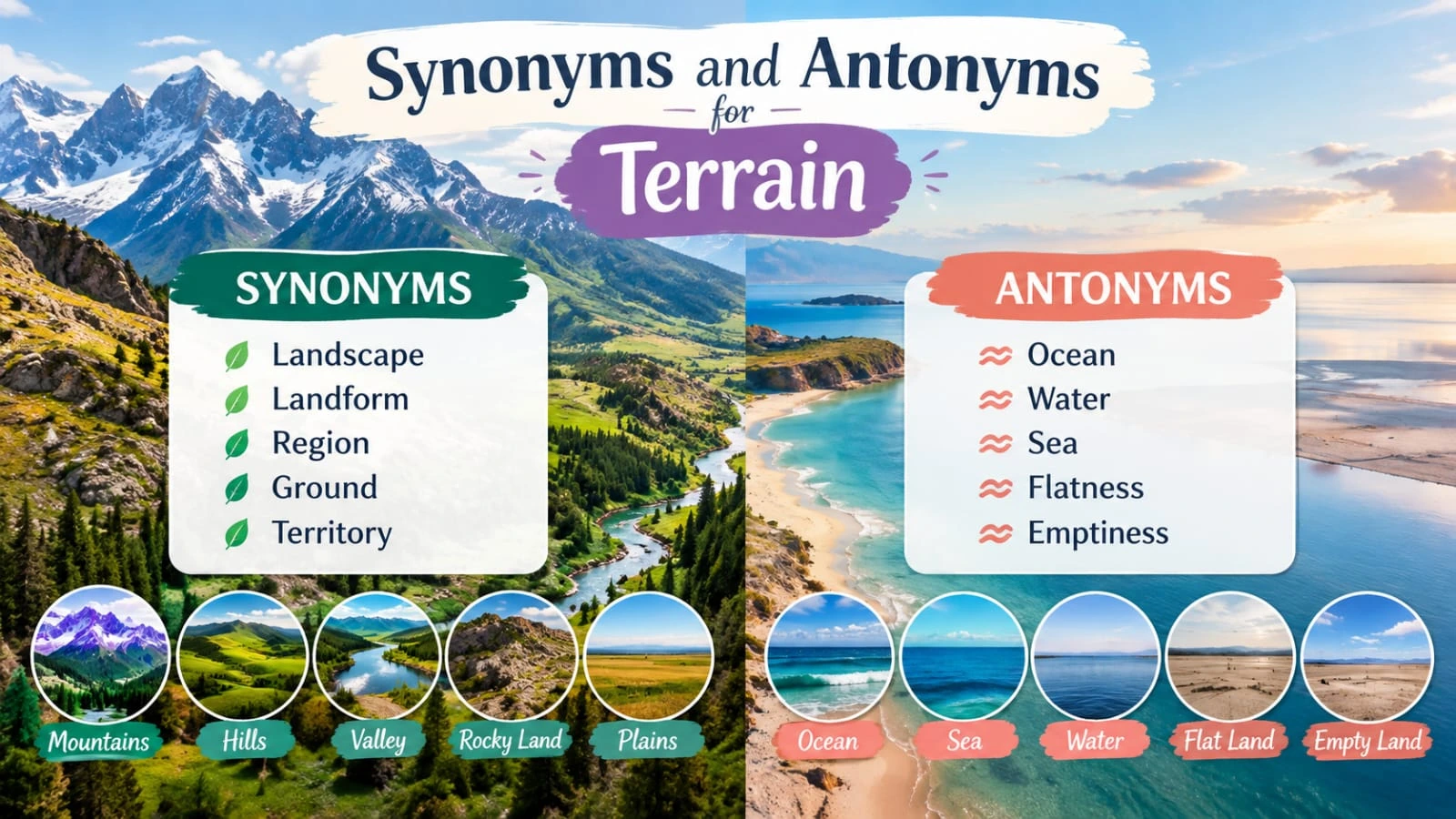
Terrain means a type or area of land, while its synonyms describe land or landscape and its contextual antonyms, such as water, describe contrasting environments.
Terrain does not have one exact universal antonym. The word usually means a particular type or stretch of land, especially when describing its physical features. In a land-versus-water context, water is a common contrast. Words such as flat, smooth, or level can contrast with rugged terrain in specific descriptions, but they are not true dictionary antonyms of terrain.
Quick Answer
Terrain means a particular area of land and its physical features, such as hills, valleys, rocks, or slopes. Common synonyms include landscape, ground, land, countryside, topography, and terrain area. Because terrain is a noun describing land, it has no single direct antonym. Depending on context, water may provide the clearest opposite contrast.
Terrain and Its Antonym
| Word | Meaning | Example |
| Terrain | A type or area of land with particular physical features | The hikers struggled across the rocky terrain. |
| Water | A liquid body or area covering land, such as a lake or sea | The route crossed water instead of dry terrain. |
| Flat | Having little or no variation in height | The cyclists preferred flat ground. |
| Level | Even and without slopes | The workers searched for a level surface. |
Important: Water, flat, and level are contextual contrasts rather than universal antonyms of terrain.
Meaning in Brief
Terrain: A particular area of land considered in terms of its physical features, such as its slope, surface, elevation, or natural formations.
Main contextual contrast: water an area covered by or consisting of water rather than dry land.
The word terrain is commonly used when discussing travel, geography, hiking, construction, military movement, agriculture, and outdoor activities.
What You’ll Learn
After reading this guide, you will know:
- The meaning of terrain
- Common synonyms for terrain
- Why terrain has no single direct antonym
- Which words can contrast with terrain in different contexts
- How to use terrain and its related words naturally
Common Synonyms for Terrain
The best synonym depends on what you mean by terrain. Some words are close synonyms, while others describe a broader or more specific aspect of land.
1. Landscape
Landscape refers to an area of land viewed in terms of its visible natural or built features.
Example:
The mountain landscape was covered with snow.
Landscape is one of the closest everyday alternatives to terrain, although it can include buildings and other human-made features.
2. Land
Land is a broad word for the solid surface of the Earth.
Example:
The farmers used the land for growing crops.
It is simpler and more general than terrain.
3. Ground
Ground refers to the surface of the Earth, especially the surface on which people walk, work, or build.
Example:
The wet ground made the trail difficult to cross.
Ground often focuses on the physical surface rather than the broader geographical character of an area.
4. Topography
Topography means the arrangement and physical features of an area of land, including hills, valleys, slopes, and elevation.
Example:
The map shows the topography of the region.
This is more technical and is especially useful in geography, surveying, and academic writing.
5. Countryside
Countryside refers to rural areas away from cities and large towns.
Example:
They drove through the beautiful countryside.
It can be a synonym for terrain only when the context is specifically about rural land.
6. Region
Region means a particular area or part of a country, continent, or larger geographical space.
Example:
The region has a dry climate.
It is broader than terrain and does not necessarily describe physical land features.
7. Area
Area is a general term for a particular part or space.
Example:
The rescue team searched the entire area.
It can replace terrain in some contexts but is much less specific.
8. Tract
Tract can mean an extended area of land.
Example:
A large tract of forest surrounds the village.
This word is useful in formal, geographical, and land-management contexts.
Choosing the Right Antonym
Unlike words such as hot/cold or early/late, terrain does not have a simple opposite pair.
That is because terrain names a type or area of land rather than describing a quality that can simply be reversed.
When Terrain Means Dry Land
When terrain is being contrasted with an area covered by water, water can be the clearest contextual opposite.
Example:
The soldiers moved across difficult terrain before reaching the water.
Here, terrain refers to land and water represents a different physical environment.
When Terrain Describes a Rough Surface
Words such as smooth, flat, and level may contrast with particular types of terrain.
Example:
The hikers left the rugged terrain and reached a flat area.
However, these words are not true antonyms of terrain. They describe qualities of the land.
When Terrain Means Uneven Ground
In some sentences, level ground can provide a useful contrast.
Example:
The construction team moved from steep terrain to level ground.
Again, level ground is a contextual contrast, not a direct antonym.
Understanding the Opposites
Water: a land-versus-water contrast
Water is useful when terrain refers to dry land or land that people can travel across.
Example:
The hikers crossed difficult terrain before reaching the lake.
The contrast here is between land and water.
Flat: a shape or surface contrast
Flat describes something with little variation in height.
Example:
The first part of the route had rugged terrain, but the rest was flat.
Flat does not mean the opposite of terrain. Instead, it contrasts with descriptions such as rugged terrain, mountainous terrain, or uneven terrain.
Level: an even-surface contrast
Level means even and without a noticeable slope.
Example:
The workers searched for level ground before setting up the equipment.
It is useful when the discussion focuses on the surface rather than the whole geographical area.
Smooth: a surface contrast
Smooth describes a surface without significant bumps, roughness, or irregularities.
Example:
The road became smoother after the team left the rocky terrain.
Like flat and level, smooth is a contextual contrast rather than a direct antonym.
Examples in Context
Here are natural examples showing how terrain and its related contrasts work:
- The hikers carefully crossed the rocky terrain.
- The vehicle was designed to handle rough terrain.
- The region contains mountainous terrain.
- The team struggled with the steep terrain.
- The road eventually led to a flat area.
- The construction crew needed level ground.
- The hikers stopped when the trail reached deep water.
- The map shows the topography of the entire region.
- The landscape changes dramatically near the coast.
- The soldiers trained to move across difficult terrain.
What Part of Speech Is It?
Terrain is a noun.
It commonly appears with adjectives that describe the type or condition of land:
- rough terrain
- rugged terrain
- rocky terrain
- steep terrain
- mountainous terrain
- uneven terrain
- flat terrain
- difficult terrain
- challenging terrain
The most natural structure is often:
adjective + terrain
For example:
The vehicle can travel across rugged terrain.
Common Errors to Avoid
Mistake 1: Treating water as the universal antonym
❌ Terrain is the opposite of water.
This is too broad.
✅ In a land-versus-water context, water can contrast with terrain.
The relationship depends on what terrain means in the sentence.
Mistake 2: Calling flat a direct antonym
❌ The antonym of terrain is flat.
This is incorrect because flat is an adjective, while terrain is a noun.
✅ Flat can contrast with rugged or uneven terrain.
Mistake 3: Using landscape in every sentence
Landscape is often a useful synonym, but it is not always interchangeable with terrain.
Terrain usually emphasizes the physical character of land.
Landscape can describe the overall visible scenery of an area.
Compare:
The vehicle can handle difficult terrain.
The mountain landscape was breathtaking.
Mistake 4: Assuming every synonym has exactly the same meaning
Words such as land, ground, area, region, and topography overlap with terrain, but each has its own meaning and typical uses.
A Useful Language Tip
When writing about geography or outdoor conditions, terrain is especially useful when you want to describe how the physical land affects movement or activity.
Compare:
- The land was beautiful. → general
- The terrain was difficult. → focuses on physical conditions
- The topography was complex. → more technical
- The landscape was beautiful. → focuses more on the overall scenery
Frequently Asked Questions
What is the opposite of terrain?
There is no single direct antonym for terrain. In a land-versus-water context, water can be a contextual opposite. When describing the surface of terrain, flat, level, or smooth may contrast with rugged or uneven terrain.
Is water an antonym of terrain?
Water can be a contextual contrast, but it is not a universal antonym of terrain. The relationship works when terrain refers to dry land being contrasted with a lake, river, sea, or other body of water.
What are the best synonyms for terrain?
Common synonyms and near-synonyms include landscape, land, ground, topography, countryside, region, area, and tract. The best choice depends on the specific context.
Is flat an antonym of terrain?
No. Flat is an adjective describing a surface with little variation in height. It can contrast with rugged or uneven terrain, but it is not a direct antonym of the noun terrain.
What is the difference between terrain and landscape?
Terrain usually emphasizes the physical characteristics of land, while landscape often refers to the overall appearance or scenery of an area. For example, rocky terrain focuses on the ground, while beautiful landscape focuses on the visual scene.
What to Remember
- Terrain means an area of land considered according to its physical features.
- It has no single universal antonym.
- Water can be a useful contextual contrast when discussing land versus water.
- Flat, level, and smooth can contrast with certain types of terrain but are not direct antonyms.
- Useful synonyms include landscape, land, ground, topography, countryside, region, area, and tract.
- Choose a synonym or contrast based on the exact meaning and context of the sentence.
Synonyms and Antonyms for Radiation

I’m Daniel Carter, a language enthusiast and content writer focused on the fascinating world of antonyms and vocabulary. I break down word meanings and opposites into simple, practical guides helping readers build a richer vocabulary, understand language more deeply, and speak or write with greater confidence.