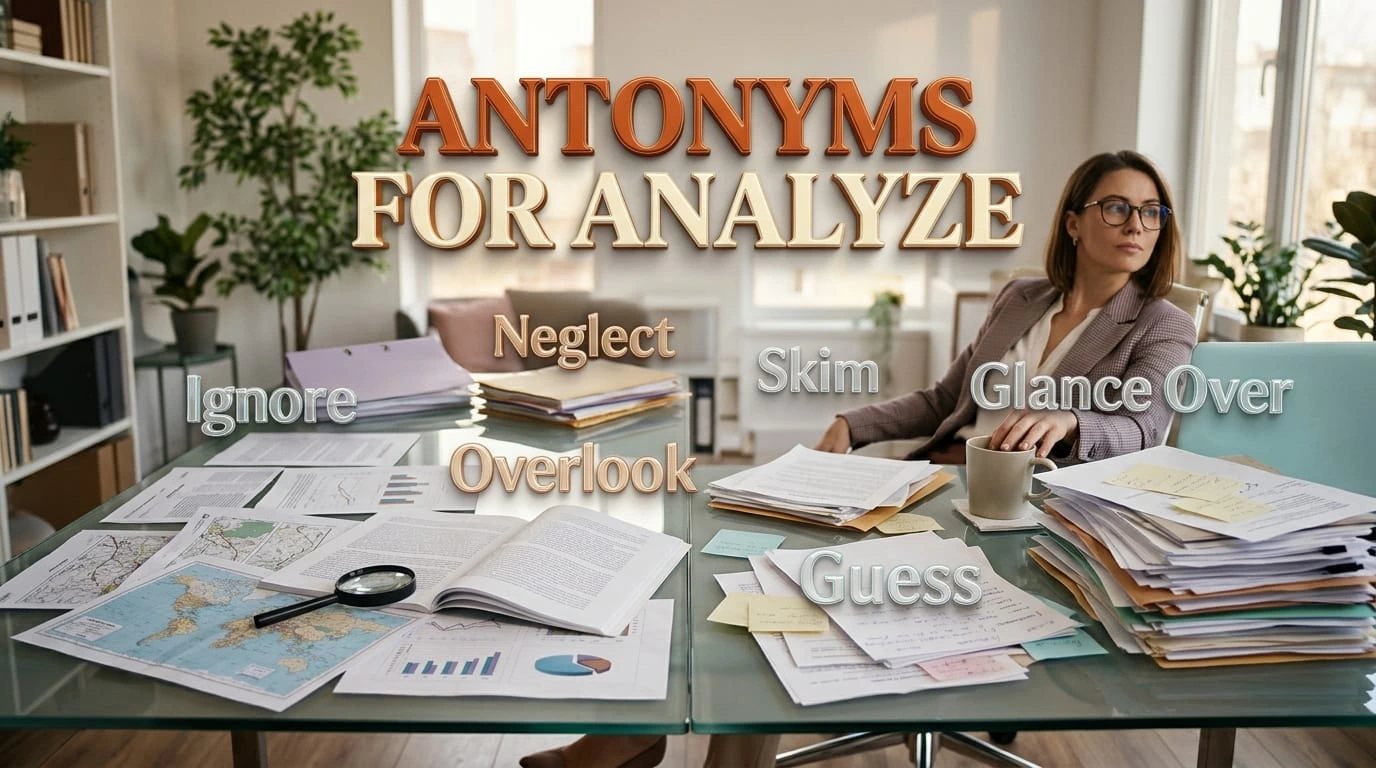
The most useful antonyms for analyze are synthesize, overlook, ignore, skim, and accept at face value. The best choice depends on the intended meaning.
What Is the Opposite of Analyze?
Quick Answer
The closest conceptual opposite of analyze is synthesize when the focus is on how information is handled. To analyze is to examine something by breaking it into parts. To synthesize is to combine separate parts or ideas into a whole.
Other opposites depend on the situation. Use ignore when someone pays no attention, skim when they read without examining details, and accept at face value when they do not question or investigate information.
Analyze vs. Its Main Opposite
| Word | Meaning | Example |
|---|---|---|
| Analyze | Examine something carefully by studying its parts | The students analyzed the poem. |
| Synthesize | Combine separate ideas or pieces of information into a whole | The students synthesized their research findings. |
Important distinction: Analyze and synthesize are contrasting intellectual processes, but they are not exact opposites in every situation. A person may analyze information first and then synthesize it.
Meaning in Brief
Analyze: To examine something carefully and systematically to understand its parts, meaning, structure, or nature.
Synthesize: To combine separate ideas, facts, or elements to create a connected whole.
Common Opposites of Analyze
Not every word below is a direct dictionary antonym. Some describe actions that contrast with analyzing in particular situations.
1. Synthesize
Meaning: To combine different ideas, facts, or pieces of information into a complete understanding.
Example: The researcher synthesized the results from several studies into one report.
Usage: This is the strongest conceptual contrast in academic writing. Analysis separates information into parts, while synthesis brings information together.
2. Ignore
Meaning: To give no attention to something or deliberately avoid considering it.
Example: The manager ignored the customer feedback instead of examining the complaints.
Usage: Use ignore when someone does not pay attention to information that could be analyzed.
3. Overlook
Meaning: To fail to notice or consider something.
Example: The editor overlooked an important detail in the report.
Usage: Unlike ignore, which can be deliberate, overlook often describes an accidental failure to notice something.
4. Skim
Meaning: To read or look through something quickly without studying its details.
Example: She skimmed the article instead of analyzing its arguments.
Usage: This is a useful contrast when discussing reading, research, and studying.
5. Glance
Meaning: To look at something briefly.
Example: He glanced at the data but did not analyze the results.
Usage: A glance involves a brief look rather than careful examination.
6. Guess
Meaning: To form an opinion or give an answer without enough information or careful reasoning.
Example: Rather than analyzing the figures, he guessed what the results might show.
Usage: Guess contrasts with analysis when a conclusion is reached without examining the available evidence.
7. Speculate
Meaning: To form ideas or opinions without having definite facts or sufficient evidence.
Example: The journalist speculated about the cause instead of analyzing the available evidence.
Usage: Speculation may involve reasoning, but it does not necessarily rely on systematic examination.
8. Assume
Meaning: To accept something as true without checking or proving it.
Example: Do not assume the figures are correct without analyzing the data.
Usage: Use assume when someone accepts an idea without investigating whether it is accurate.
9. Accept at Face Value
Meaning: To accept something as true without questioning or examining it.
Example: The reviewer accepted the claims at face value instead of analyzing the evidence.
Usage: This expression is particularly useful when discussing arguments, claims, reports, and information.
10. Neglect
Meaning: To fail to give something the attention or care it needs.
Example: The team neglected the research data instead of analyzing it carefully.
Usage: Neglect suggests a failure to give proper attention, often when attention is expected or necessary.
11. Bypass
Meaning: To avoid or go around a process, step, or requirement.
Example: The team bypassed the detailed analysis and moved straight to a decision.
Usage: This is a contextual opposite when someone skips the process of examining information.
12. Simplify
Meaning: To make something easier to understand by reducing its complexity.
Example: The teacher simplified the explanation rather than analyzing every part of the theory.
Usage: Simplify is not a direct antonym. It can contrast with detailed analysis when the goal is to reduce complexity rather than examine it.
Choosing the Right Antonym for Analyze
The best opposite depends on what the sentence means. Here is how to choose accurately.
When Analyze Means Examine Carefully
Use:
- Ignore
- Overlook
- Skim
- Glance
These words describe giving information less attention than careful analysis requires.
When Analyze Means Investigate or Study Evidence
Use:
- Guess
- Speculate
- Assume
- Accept at face value
These words describe reaching an idea or conclusion without a thorough examination of the evidence.
When Analyze Means Break Information Into Parts
Use:
- Synthesize
This is the clearest conceptual contrast. Analysis separates information into components, while synthesis combines information into a connected whole.
How These Antonyms Differ
Some opposites of analyze may seem similar, but they describe different actions.
| Word | Main Difference |
|---|---|
| Ignore | Give something no attention |
| Overlook | Fail to notice something |
| Skim | Read or examine quickly |
| Guess | Reach an answer without enough information |
| Assume | Accept something without checking |
| Speculate | Form ideas without definite evidence |
| Synthesize | Combine separate information into a whole |
For example, a student who skims a chapter reads it quickly. A student who ignores it gives it no attention. A student who guesses an answer does not reach it through careful analysis.
Examples in Context
Here are natural examples showing how analyze and its contextual opposites work in everyday English.
- Analyze: The scientist analyzed the results before publishing the study.
- Synthesize: The students synthesized information from five different sources.
- Ignore: You should not ignore important feedback from your teacher.
- Overlook: The researcher overlooked a small but important error.
- Skim: I only skimmed the report because I had very little time.
- Glance: She glanced at the document without reading it carefully.
- Guess: He guessed the answer instead of analyzing the question.
- Speculate: We should not speculate about the results before examining the evidence.
- Assume: Never assume that information is correct without checking it.
- Accept at face value: The reader accepted the statement at face value.
- Neglect: The company neglected the customer data during its review.
- Bypass: The team bypassed the analysis and made a quick decision.
Grammar and Word Forms
Analyze is a verb. It describes the action of examining something carefully.
Its common forms are:
- Base form: analyze
- Third-person singular: analyzes
- Past tense: analyzed
- Present participle: analyzing
- Noun: analysis
- Person who analyzes: analyst
The word analyze is commonly followed by a direct object.
Examples:
- Analyze the information.
- Analyze the results.
- Analyze the problem.
- Analyze the evidence.
The main contextual opposites are also verbs or verb phrases:
- Synthesize information
- Ignore the evidence
- Overlook a detail
- Skim a report
- Guess an answer
- Assume something is true
A Useful Language Tip
Do not replace analyze with synthesize automatically. In academic work, both actions are often necessary. First, you analyze individual sources or ideas. Then, you synthesize their findings to develop a broader understanding.
Common Errors to Avoid
1. Treating Every Contextual Opposite as a Direct Antonym
Ignore and synthesize do not mean the same thing. They contrast with different aspects of analyzing.
2. Confusing Skimming With Ignoring
Skimming means reading quickly. Ignoring means giving no attention. Someone who skims a report still looks at its content.
3. Using Guess When You Mean Speculate
A guess is often a quick answer without enough information. Speculation usually involves forming possible explanations or opinions without definite evidence.
4. Using Synthesize as a Universal Replacement
Synthesize is appropriate when the intended meaning is combining information. It does not mean simply avoiding analysis.
Frequently Asked Questions
What is the most common antonym of analyze?
Synthesize is the strongest conceptual opposite when analyze means breaking information into parts. It means combining separate ideas or elements into a complete whole. In other contexts, words such as ignore, overlook, and skim may be more appropriate.
Is synthesize the opposite of analyze?
Yes, synthesize is a recognized conceptual contrast to analyze. Analyze involves examining separate parts, while synthesize involves combining ideas or information into a whole. However, the two processes often work together.
What is the opposite of analyze in simple English?
In simple English, ignore or not examine can express the opposite when someone gives no attention to something. Skim is suitable when someone reads quickly without studying the details.
What is the opposite of analyze in academic writing?
Synthesize is often the best conceptual opposite in academic writing. It describes combining findings, arguments, or information from different sources. Depending on the sentence, speculate or assume may also provide a useful contrast.
Is overlook an antonym of analyze?
Overlook is a contextual opposite, not a direct antonym. It means failing to notice or consider something, whereas analyzing requires careful attention and examination.
Key Takeaways
The best antonym for analyze depends on the intended meaning:
- Synthesize: combine separate ideas into a whole.
- Ignore: give no attention to something.
- Overlook: fail to notice or consider something.
- Skim: read or examine something quickly.
- Guess: reach an answer without sufficient information.
- Assume: accept something without checking it.
Remember that analyze and synthesize describe contrasting but complementary ways of working with information. Choose the opposite that matches the action you want to express.
Antonyms for Primary Source: 5 Opposite Terms Explained

I’m Noreen Akbar, an English language researcher and content writer with a passion for words,their meanings, origins, and the subtle differences between them. I specialize in antonyms and vocabulary, creating clear, easy-to-follow guides that help readers expand their word power, sharpen their understanding of language, and express themselves with greater clarity and confidence.