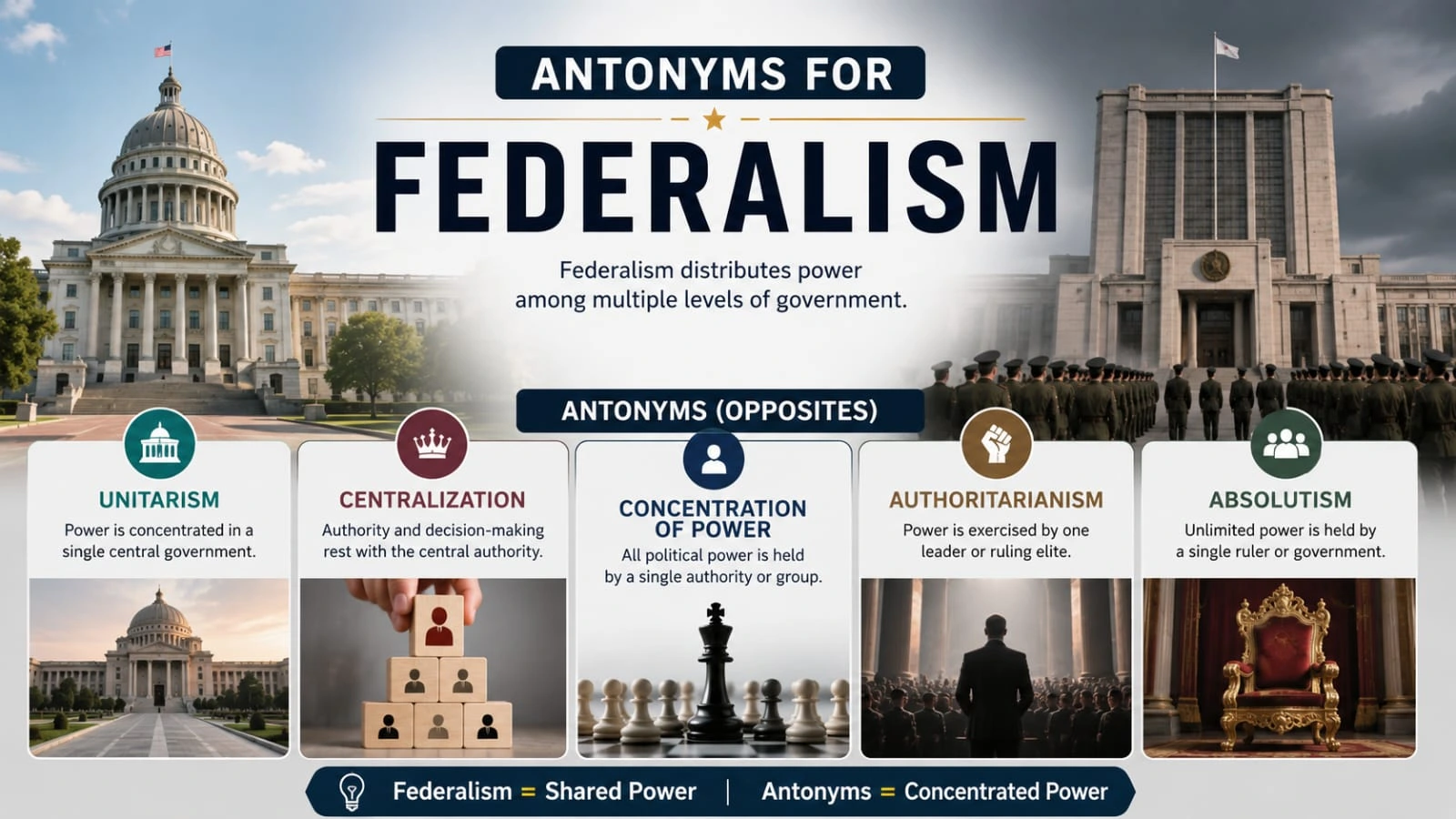
Common contrasts to federalism include unitarism, centralization, centralized government, unitary government, political centralization, and centralized authority, depending on the context.
Quick Answer
The strongest antonym of federalism is unitarism or a unitary system of government. Federalism divides constitutional authority between a central government and regional governments, while a unitary system places primary governing authority in the central government. Centralization is another useful opposite when the focus is on where political power is concentrated.
Quick Comparison
| Concept | Meaning | Main contrast |
| Federalism | Power is constitutionally shared between central and regional governments | Shared authority |
| Unitarism | Political authority is primarily concentrated in the central government | Central authority |
| Centralization | Decision-making power is concentrated at the center | Concentrated power |
| Unitary government | Regional governments exercise authority under the central government | Centralized structure |
One-Line Definition
Federalism: A system in which constitutional powers are divided between a national government and regional governments.
Main antonym: Unitarism a system in which political authority is primarily concentrated in the central government.
Core Antonyms and Contrasting Concepts
Because federalism describes a system of government, its opposites are usually political systems or concepts, rather than ordinary vocabulary antonyms.
1. Unitarism
Unitarism is the clearest conceptual opposite of federalism. It favors a political system in which the central government holds the primary constitutional authority.
Example:
The country moved from a federal structure toward a more unitary system.
2. Unitary System
A unitary system places ultimate constitutional authority mainly in the central government. Local or regional governments may have powers, but those powers generally depend on the central constitutional structure.
Example:
France is commonly described as a unitary state.
3. Centralization
Centralization means concentrating decision-making authority at the national or central level.
Example:
Greater centralization gave the national government more control over regional policies.
4. Centralized Government
A centralized government keeps significant political and administrative power at the center rather than constitutionally dividing it between different levels of government.
Example:
The centralized government established national rules for all regions.
5. Centralized Authority
Centralized authority emphasizes the concentration of governing power in one central authority.
Example:
The reform resulted in greater centralized authority.
6. Political Centralization
Political centralization describes the process or condition in which political power becomes concentrated in the central government.
Example:
Political centralization reduced the independence of regional governments.
7. Central Government Dominance
This phrase describes a structure in which the national government exercises substantially greater control over regional governments.
Example:
The new arrangement increased central government dominance over regional affairs.
8. Central Rule
Central rule emphasizes governance directed primarily from the national center rather than through constitutionally autonomous regions.
Example:
The territory was placed under direct central rule.
9. Unitary Government
A unitary government is another standard term for a governmental structure in which the central government retains ultimate constitutional authority.
Example:
The constitution establishes a unitary government rather than a federal one.
10. Centralized State
A centralized state concentrates important political powers within the national government.
Example:
The country developed into a highly centralized state.
11. Direct Central Control
Direct central control describes a situation in which the central government directly controls areas that might otherwise be administered by regional governments.
Example:
The province came under direct central control.
12. Administrative Centralization
Administrative centralization focuses specifically on concentrating administrative decision-making at the national level.
Example:
Administrative centralization made local agencies more dependent on national departments.
13. Political Unitarism
Political unitarism emphasizes the principle that political authority should remain primarily unified under the central government.
Example:
Political unitarism differs from federalism in how constitutional authority is distributed.
14. National Centralization
National centralization refers to shifting significant governing responsibilities toward the national government.
Example:
National centralization changed how regional policies were administered.
15. Central Supremacy
Central supremacy emphasizes the dominant position of the central government over regional authorities.
Example:
The constitutional arrangement gave the central government greater supremacy.
16. Concentrated Government
Concentrated government describes a governing structure where decision-making is held by a relatively central authority rather than distributed among autonomous levels.
Example:
A concentrated government can make nationwide decisions more uniformly.
17. Centralized Administration
Centralized administration means that major administrative decisions are made by central authorities.
Example:
Centralized administration reduced the discretion of local officials.
18. Direct Rule
Direct rule refers to governance in which an area is controlled directly by a higher authority instead of exercising substantial autonomous authority.
Example:
The region was placed under direct rule after the political transition.
19. Regional Dependence
Regional dependence can serve as a contextual contrast when discussing the autonomy of regional governments. Under this arrangement, regional authorities depend more heavily on the central government.
Example:
Greater regional dependence reduced local control over policy.
20. Centralized Political Structure
A centralized political structure places most important political authority at the center rather than constitutionally distributing it between national and regional governments.
Example:
The constitution created a centralized political structure instead of a federal one.
Federalism vs. Unitarism
The most useful comparison is between federalism and unitarism.
| Feature | Federalism | Unitarism |
| Main authority | Shared between levels of government | Primarily central |
| Regional governments | Constitutionally significant powers | Powers generally derive from the central system |
| Power distribution | Divided | Concentrated |
| Example description | Federal state | Unitary state |
| Key idea | Shared constitutional authority | Centralized authority |
The important distinction is where constitutional power is located. Federalism distributes authority between national and regional governments, while a unitary system concentrates ultimate authority at the national level.
Are Centralization and Federalism Exact Opposites?
Not always.
Centralization is best treated as a contextual opposite, not a perfect lexical antonym. A federal country can become more centralized while remaining federal. Likewise, a federal system can give its central government substantial powers without becoming a unitary state.
Therefore:
- Federalism ↔ Unitarism = strongest conceptual contrast
- Federalism ↔ Unitary system = strong structural contrast
- Federalism ↔ Centralization = contextual contrast
- Federalism ↔ Centralized government = contextual contrast
This distinction is important when writing about political science.
Examples in Sentences
Federalism
Federalism allows different levels of government to exercise constitutionally defined powers.
Unitarism
Unitarism emphasizes a unified political authority rather than constitutionally divided sovereignty.
Centralization
The government pursued greater centralization of public administration.
Unitary system
A unitary system gives the central government primary constitutional authority.
Centralized authority
The reform transferred more decision-making power to the central government.
Direct rule
The territory was temporarily placed under direct rule.
Grammar & Word Class
Federalism is a noun.
The main contrasting terms are also primarily nouns or noun phrases:
- Federalism: noun
- Unitarism: noun
- Centralization: noun
- Unitary system: noun phrase
- Centralized government: noun phrase
- Centralized authority: noun phrase
The adjective federal describes something relating to a federation or federal government, while unitary describes a system organized around central authority.
Word Formation
The word federalism ends in -ism, a suffix often used for systems, doctrines, or political ideologies.
- federal → federalism
- unitary → unitarism
- centralize → centralization
- centralized → describing something organized around a central authority
However, these words are not formed as simple prefix-based antonyms. Unitarism is the established conceptual counterpart to federalism in political theory.
Common Mistakes
❌ Mistake: Calling “centralization” the exact antonym
Centralization is always the antonym of federalism.
✅ Better:
Centralization can be a contextual contrast to federalism, while unitarism is the stronger conceptual opposite.
❌ Mistake: Assuming federalism means weak central government
Federalism does not necessarily mean that the central government is weak. Federal systems can give national governments substantial constitutional powers.
❌ Mistake: Treating every unitary state as completely locally controlled
A unitary state can still have powerful local or regional administrations. The key distinction concerns ultimate constitutional authority, not simply how much work local governments perform.
Expert Tip
When answering “What is the opposite of federalism?”, use unitarism or a unitary system first. Use centralization when the question is specifically about the concentration of political power.
Short Questions & Answers
What is the opposite of federalism?
The strongest conceptual opposite of federalism is unitarism, or a unitary system of government, where ultimate political authority is primarily concentrated in the central government.
What is the opposite of federal government?
The most useful structural opposite is a unitary government, where the central government holds ultimate constitutional authority rather than sharing constitutionally protected powers with regional governments.
Is centralization the opposite of federalism?
Centralization can be a contextual opposite, but it is not always an exact opposite. A federal state can become more centralized while remaining federal.
What is the difference between federalism and unitarism?
Federalism constitutionally divides authority between national and regional governments, while unitarism places ultimate political authority primarily with the central government.
Is “unitary” the antonym of “federal”?
Yes, unitary is the strongest structural contrast to federal when describing systems of government.
Key Takeaway
The best answer to “What is the opposite of federalism?” is unitarism or a unitary system of government. Federalism constitutionally distributes authority between national and regional governments, whereas a unitary system places ultimate authority primarily in the central government. Terms such as centralization, centralized government, and central rule can also express contrasting ideas, but they should be treated as contextual opposites rather than exact antonyms.
Antonyms for Silly: 25 Smart Opposites to Know

I’m Daniel Carter, a language enthusiast and content writer focused on the fascinating world of antonyms and vocabulary. I break down word meanings and opposites into simple, practical guides helping readers build a richer vocabulary, understand language more deeply, and speak or write with greater confidence.