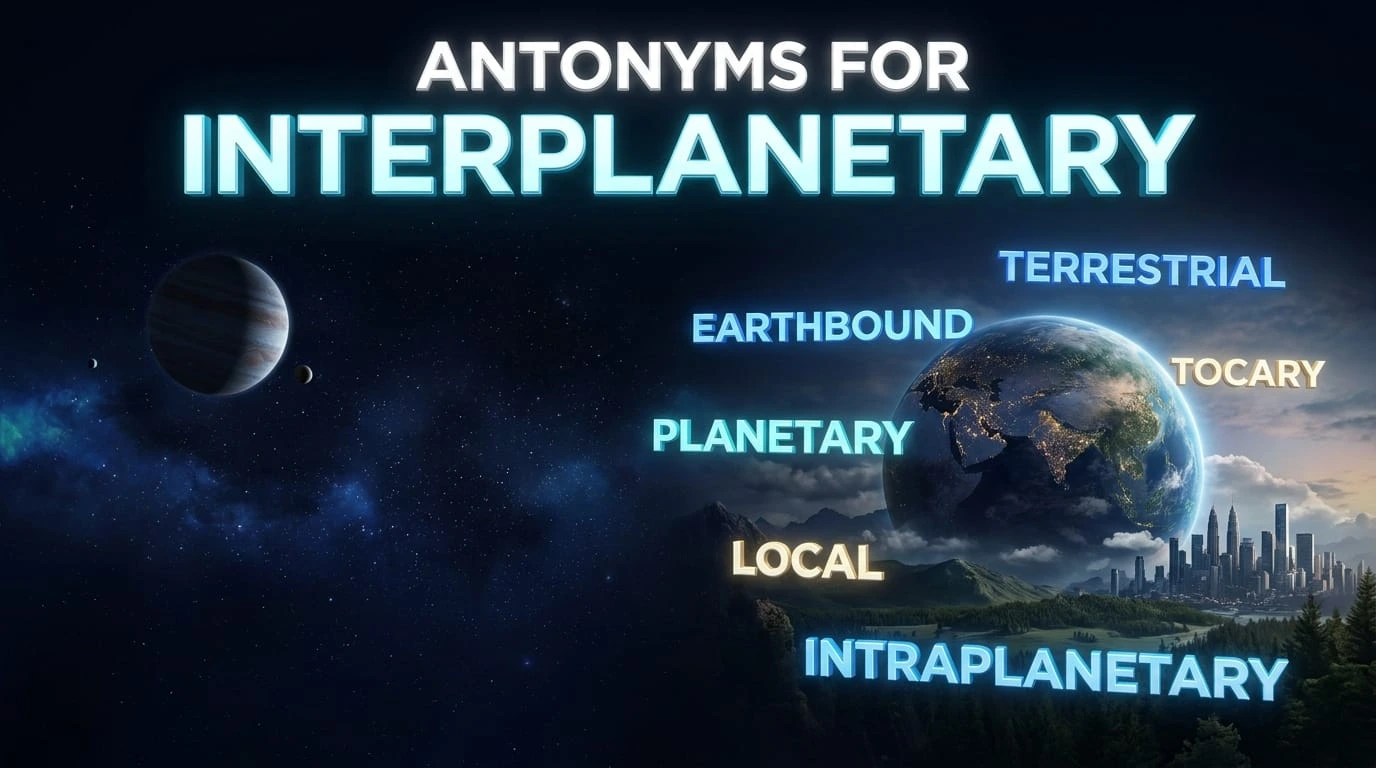
Common antonyms and contextual opposites for interplanetary include terrestrial, intraplanetary, Earth-based, Earthbound, ground-based, planetary, earthly, local, regional, and surface-based.
Quick Answer
Interplanetary means occurring, existing, or traveling between planets. There is no single universal antonym. Terrestrial is the best general contrast when the meaning is “related to Earth,” while intraplanetary is more precise for something occurring within one planet.
One-Line Definition
Interplanetary: Relating to or occurring between planets.
Main contextual opposite: Terrestrial relating to Earth rather than interplanetary space.
What You Will Learn
- The strongest contextual opposites of interplanetary
- The difference between terrestrial and intraplanetary
- Which alternatives work best in scientific writing
- How to use these contrasting terms naturally
Useful Antonyms and Contextual Opposites
1. Terrestrial
Relating to Earth or its land and environment.
Example: The experiment examined terrestrial organisms.
2. Intraplanetary
Occurring or existing within a single planet.
Example: The researchers investigated intraplanetary geological activity.
3. Earth-Based
Located or operated on Earth.
Example: The signal was monitored by an Earth-based observatory.
4. Earthbound
Restricted to Earth or unable to travel beyond it.
Example: The early equipment was entirely Earthbound.
5. Ground-Based
Operating from the ground rather than from space.
Example: Ground-based instruments provided additional observations.
6. Planetary
Relating to a particular planet rather than the space between planets.
Example: The mission collected detailed planetary data.
7. Earthly
Relating to Earth or life on Earth.
Example: The novel contrasts earthly concerns with cosmic events.
8. Surface-Based
Existing or operating on a planet’s surface.
Example: The rover communicated with surface-based equipment.
9. Local
Limited to a particular place instead of extending across planets.
Example: The project examined local environmental conditions.
10. Regional
Restricted to a particular geographical region.
Example: The researchers compared regional weather patterns.
11. Continental
Relating to a continent or its physical features.
Example: The study focused on continental climate variations.
12. Geographical
Connected with Earth’s places, regions, or physical features.
Example: The report identified several geographical differences.
13. Single-Planet
Limited to one planet rather than involving multiple planets.
Example: The model was designed for a single-planet environment.
14. Earth-Limited
Restricted to Earth’s environment or activities.
Example: The research remained Earth-limited throughout the project.
15. Localized
Restricted to a particular area.
Example: The environmental effects were highly localized.
16. Stationary
Remaining in one position rather than traveling between locations.
Example: The stationary instrument recorded changes continuously.
17. Grounded
Remaining on the ground instead of operating in space.
Example: The vehicle remained grounded during testing.
18. Terrestrial-Based
Based on or connected with Earth.
Example: Scientists combined satellite data with terrestrial-based measurements.
19. Earth-Restricted
Limited specifically to Earth.
Example: The initial tests were Earth-restricted.
20. Planet-Limited
Restricted to one planetary environment rather than involving movement between planets.
Example: The study was planet-limited and did not examine interplanetary conditions.
Accuracy note: Not all of these are strict dictionary antonyms. Terrestrial and intraplanetary provide the strongest semantic contrasts, while terms such as local, regional, and stationary work only in particular contexts.
Which Word Should You Use?
Choose the word according to the meaning you need:
- Terrestrial → when contrasting something with Earth and space.
- Intraplanetary → when contrasting “within a planet” with “between planets.”
- Earth-based → for research, equipment, or operations based on Earth.
- Earthbound → for something restricted to Earth.
- Ground-based → for observations or equipment operating from the ground.
- Planetary → when focusing on one planet or planetary characteristics.
Why Context Matters
The prefix inter- means between, so interplanetary literally refers to something between planets.
The prefix intra- means within, making intraplanetary a particularly precise contrast:
interplanetary → between planets
intraplanetary → within a planet
By contrast, terrestrial does not mean “within a planet.” It specifically refers to Earth. This makes it the better choice when the intended contrast is Earth versus space.
Grammar and Word Class
Interplanetary is an adjective.
It normally modifies nouns such as:
- interplanetary travel
- interplanetary space
- interplanetary mission
- interplanetary communication
Its main contextual opposites are also adjectives, including terrestrial, intraplanetary, Earth-based, Earthbound, ground-based, and planetary.
Common Mistakes
Mistake 1: Treating terrestrial as a perfect opposite
Terrestrial means “related to Earth,” not simply “not interplanetary.”
For example, terrestrial planet means a rocky planet, such as Earth or Mars. Therefore, terrestrial can have a different meaning depending on the sentence.
Mistake 2: Using intraplanetary for everything on Earth
Intraplanetary means within a planet, not specifically “on Earth.”
If you mean something related specifically to Earth, terrestrial or Earth-based is usually more appropriate.
Expert Tip
For precise vocabulary, think about the spatial relationship first: inter- = between, intra- = within, while terrestrial = relating to Earth.
Mini Quiz
1. Which word most precisely contrasts “between planets” with “within one planet”?
A. Terrestrial
B. Intraplanetary
C. Regional
Answer: B. Intraplanetary
2. Which word best describes something related to Earth?
A. Terrestrial
B. Interplanetary
C. Intraplanetary
Answer: A. Terrestrial
3. Which term is most suitable for an observatory operating from Earth?
A. Earth-based
B. Interplanetary
C. Intraplanetary
Answer: A. Earth-based
Short Questions & Answers
What is the opposite of interplanetary?
The best general contextual opposite is terrestrial when referring to Earth. Intraplanetary is more precise when the intended contrast is something occurring within one planet.
Is intraplanetary the opposite of interplanetary?
It is the closest structural contrast when interplanetary means “between planets.” Inter- means “between,” while intra- means “within.”
What is the simplest antonym for interplanetary?
Terrestrial is usually the simplest choice when you mean “related to Earth.”
Is Earth-based a true antonym?
Earth-based is a contextual contrast rather than a universal antonym. It works particularly well for research, equipment, observations, and operations conducted from Earth.
Key Takeaway
There is no single opposite that fits every use of interplanetary. Terrestrial is the most useful general contrast, while intraplanetary provides the most precise opposite when comparing between planets with within one plane.
Antonyms for Emergency: 20 Powerful Opposites

I’m Noreen Akbar, an English language researcher and content writer with a passion for words,their meanings, origins, and the subtle differences between them. I specialize in antonyms and vocabulary, creating clear, easy-to-follow guides that help readers expand their word power, sharpen their understanding of language, and express themselves with greater clarity and confidence.