The Opposite of Gesticulate at a Glance
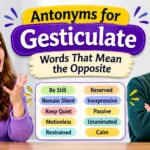
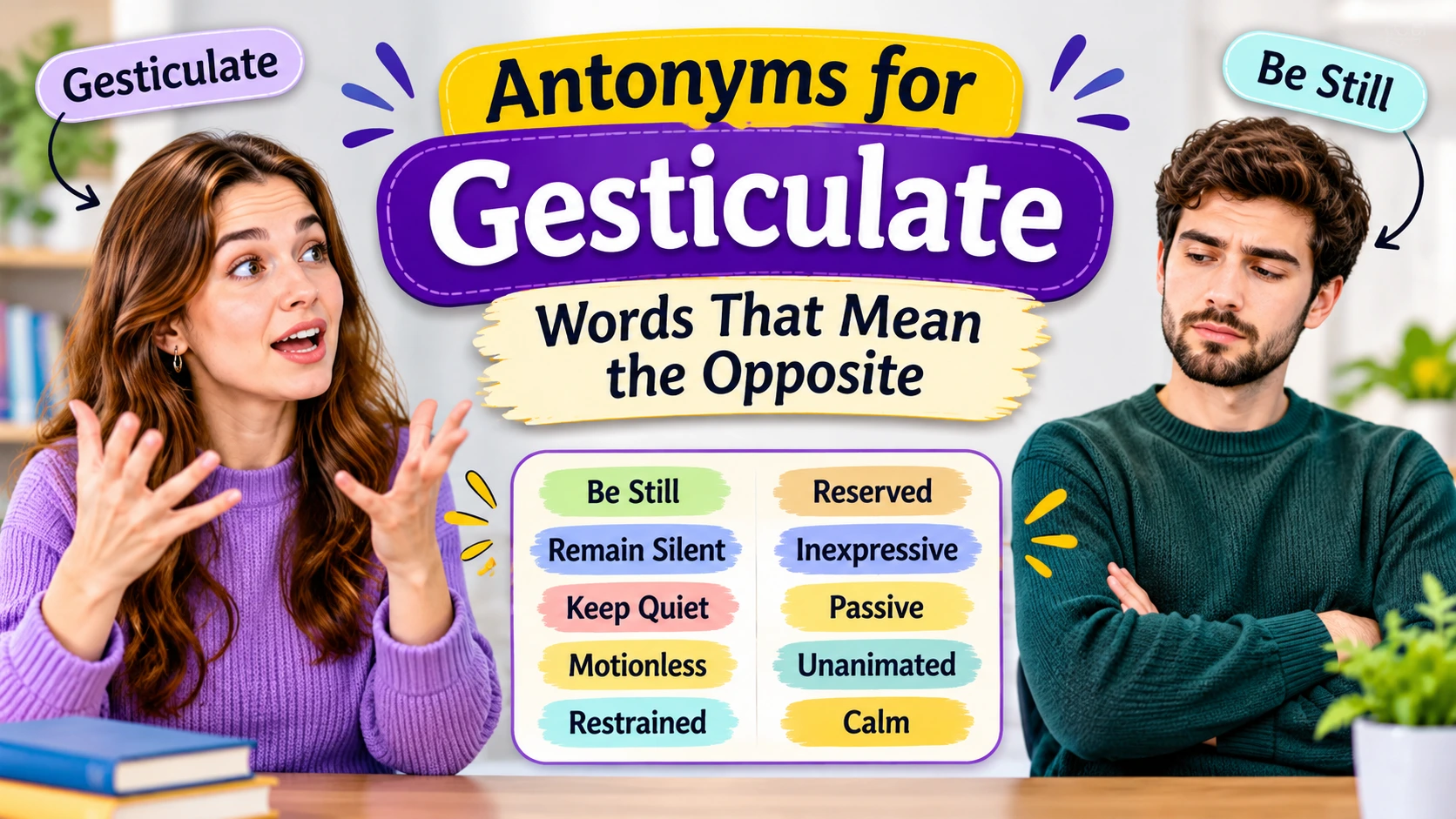
The opposite of gesticulate is to stay still and keep your hands quiet in other words, to stand motionless instead of making lively gestures while you speak. Words like ‘stand still’ and ‘remain motionless’ express that opposite most directly.
The Short Answer
The most common antonym of gesticulate is stand still. Gesticulate means making lively gestures with your hands and body, especially while speaking. Its opposite is the absence of that movement: staying in one place, keeping your body quiet, and letting your words do the work alone. Remain motionless is a stronger, more formal version of the same idea, while hold still is the short instruction form you hear in everyday life.
Gesticulate vs. Its Opposite
| Word | Meaning | Example |
|---|---|---|
| Gesticulate | To make lively gestures, especially when speaking | He gesticulated wildly as he told the story. |
| Stand still | To stay in one place without moving | The children were told to stand still for the photo. |
| Remain motionless | To stay completely without movement | The guard remained motionless at the door all night. |
| Hold still | To keep the body unmoving for a short time | Hold still while I take your picture. |
Gesticulate in One Line
To make lively gestures with the hands and body, especially while speaking.
Main antonym: Stand still to stay in one place without moving.
For the full dictionary entry, see gesticulate on Merriam-Webster.
What You’ll Learn
After reading this guide, you will know:
- The main antonym of gesticulate
- Other useful opposites and when each one fits
- How gesticulate differs from the general word gesture
- How to use these words correctly in sentences
Main Antonyms for Gesticulate
Stand still
to stay in one place without moving. This is the general, everyday opposite. “When the teacher entered, the class was told to stand still and listen.”
Remain motionless
to stay completely without movement. This is stronger and more formal than stand still. “The guard remained motionless at the door all night.”
Hold still
to keep the body unmoving, usually for a short time. This is the instruction form, often said to someone else. “Hold still while I take your photo.”
Suppress your gestures
to deliberately hold back hand movements. This fits when someone controls their gestures on purpose. “She suppressed her gestures and spoke in a calm, even voice.”
Sit still
to stay seated without fidgeting or moving around. This fits seated situations. “The children could not sit still during the long ceremony.”
Keep still
to avoid moving, often said as a warning or instruction. “Keep still, or the picture will come out blurred.”
Freeze
to stop moving suddenly, often from shock or surprise. This is a contextual opposite, because freezing is usually a reaction rather than a choice. “He froze when he heard the loud noise behind him.”
Antonyms by Context
The best opposite depends on what kind of gesticulating you mean.
If gesticulate means making gestures while speaking, use stand still, hold still, or speak without gestures. These describe the same moment with the movement removed.
If gesticulate means wild or exaggerated gesturing, the opposite is about manner rather than movement. Speak calmly or keep composed fit here, because they describe the same speech delivered without the drama.
If gesticulate means physical restlessness, use sit still or stay put. These fit situations where someone cannot settle, such as a long ceremony or a classroom.
How These Antonyms Differ
Stand still is neutral and general. It works almost anywhere. Remain motionless is formal and total: it suggests not even a small movement. Hold still is short and practical, usually spoken as an instruction. Suppress your gestures adds deliberate effort: the person could gesture but chooses not to. Freeze is sudden and reactive, not planned. Sit still only fits seated situations. Choosing between them is mostly about formality, duration, and whether the stillness is chosen or forced.
See the Antonyms in Action
- In conversation: “Stop waving your arms around and stand still for a second so I can understand you.”
- At school: “The teacher asked the class to sit still and listen to the story.”
- At work: “During the presentation, she suppressed her gestures and let the slides speak for themselves.”
- At the doctor’s: “Hold still, please, while I check your blood pressure.”
- In everyday life: “The cat remained motionless by the window, watching the birds outside.”
- In a story: “When the lights went out, everyone froze where they were standing.”
What Part of Speech Is It?
Gesticulate is an intransitive verb: it does not take a direct object. You gesticulate; you do not gesticulate something. Its useful opposites are verb phrases rather than single verbs, because English has no one-word verb that means “to not gesture”. Related forms keep the same pattern: motionless and still are adjectives, gesticulation is the noun for the act itself, and gesticulator is a person who gesticulates.
Words Connected to Gesticulate
Gesture is the general word, used as both a noun and a verb, for any movement of the hands or body that expresses something. Gesticulate is narrower and livelier: it suggests animated, sometimes exaggerated gestures, especially during speech. Gesticulation is the noun form, useful in formal writing: “His constant gesticulation distracted the audience.” Gesticulator names the person doing it, but it is rare and best kept for humorous or literary use.
Commonly Confused Opposites
- ❌ Incorrect: “He gesticulated still during the speech.” ✅ Correct: “He stood still during the speech.” Gesticulate and stillness contradict each other, so they cannot share one verb.
- ❌ Incorrect: “She gesticulated a nod at me.” ✅ Correct: “She nodded at me.” A nod is a single gesture, not the lively, ongoing movement gesticulate describes.
- ❌ Incorrect: “He tried to ungesticulate.” ✅ Correct: “He stopped gesticulating.” There is no word “ungesticulate” in English.
- ❌ Incorrect: “She gesticulated her hands gently.” ✅ Correct: “She gestured gently with her hands.” Small, calm movements are gestures; gesticulate implies animation.
Teacher’s Tip
If the gestures are the point of the sentence, use gesticulate. If the person is calm, remember that English has no single-word verb for the opposite. Reach for a phrase instead: stand still for general use, remain motionless for formal writing, and hold still when giving an instruction.
Quick Practice
- Choose the correct antonym: “During the national anthem, everyone was asked to ___.” A. gesticulate B. stand still C. wave — Answer: B. stand still, because the situation calls for respectful stillness, not movement.
- Fill in the blank: “The photographer said, ‘Please ___ while I take the picture.'” — Answer: hold still, the standard short instruction for a photograph.
- True or false: “Freeze is always a deliberate action.” — False. Freezing is usually a sudden reaction to shock or surprise, not a planned choice.
Common Questions About Gesticulate
What is the opposite of gesticulate?
The most direct opposite of gesticulate is to stand still or remain motionless — to speak without making gestures with your hands or body.
What is a stronger opposite of gesticulate?
Remain motionless is stronger than stand still, because it suggests complete stillness with no movement at all, while stand still can allow small movements.
Can ‘still’ always replace the opposite of gesticulate?
Not always. Still works as an adjective, as in ‘stand still,’ but gesticulate is a verb, so the cleanest verb-phrase opposites are stand still, remain motionless, and hold still.
What is the difference between gesticulate and gesture?
Gesture is the general word for any movement of the hands or body that expresses something. Gesticulate is more specific and often more dramatic: it means making lively, sometimes exaggerated gestures, especially while speaking.
Is gesticulate appropriate in formal writing?
Yes. Gesticulate is a standard, slightly formal verb. It suits essays, reports, and literary writing, though in casual speech most people simply say gesture.
What to Remember
The strongest opposite of gesticulate is stand still, with remain motionless as the formal, stronger version. The key lesson is that English expresses this opposite with phrases, not a single verb. Keep gesticulate for lively, animated gestures, and reach for stillness phrases when the movement stops.
Antonyms for Homicide: Rescue& Protection

I’m Noreen Akbar, an English language researcher and content writer with a passion for words,their meanings, origins, and the subtle differences between them. I specialize in antonyms and vocabulary, creating clear, easy-to-follow guides that help readers expand their word power, sharpen their understanding of language, and express themselves with greater clarity and confidence.