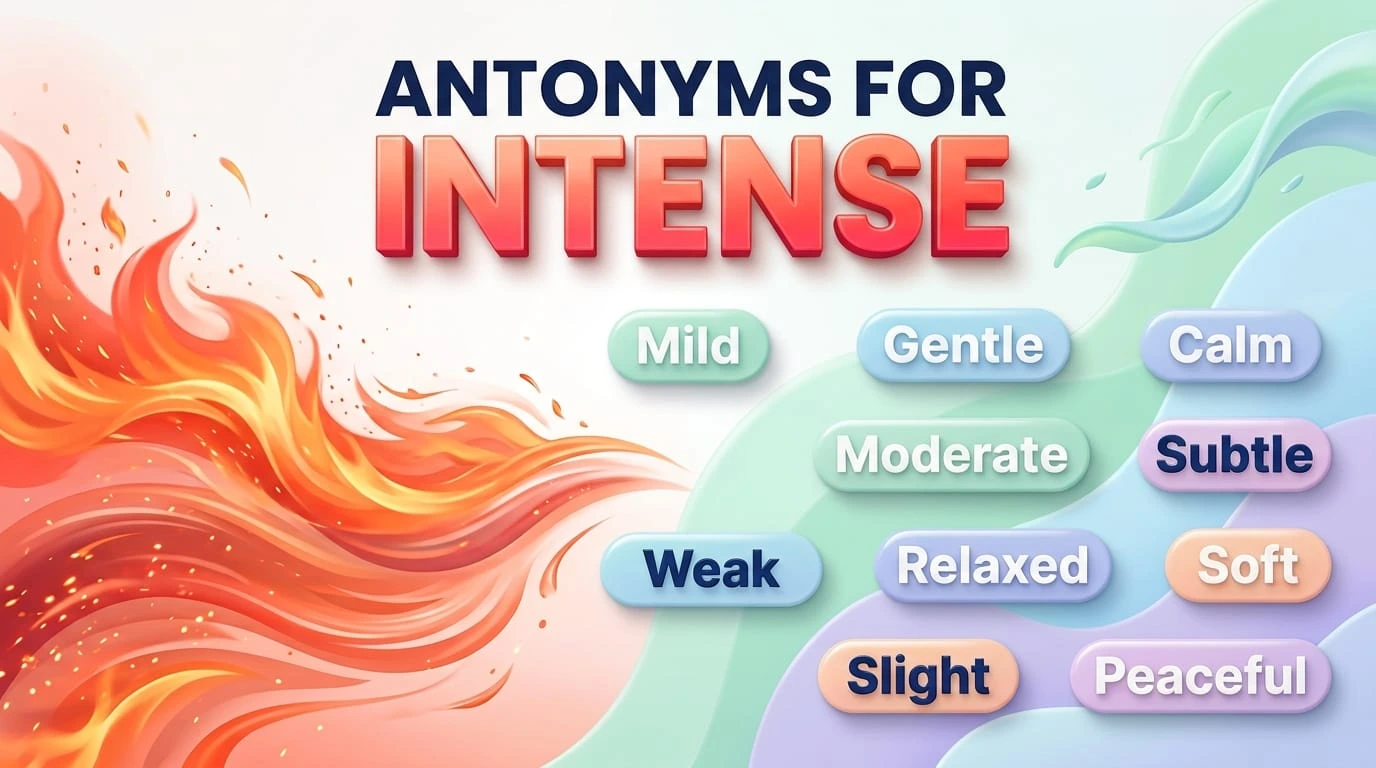
The most common antonyms for intense are mild, moderate, gentle, and weak, depending on the context. Intense describes something very strong, powerful, or extreme. I
The Short Answer
The best general antonym for intense is mild when describing something strong or severe, such as pain, heat, or a reaction. Moderate works for degree or amount, while weak is suitable when describing a lack of strength or force.
Intense vs. Its Opposites
| Word | Meaning | Example |
| Intense | Very strong or extreme | The team faced intense pressure. |
| Mild | Not severe or strong | She had a mild headache. |
| Moderate | Average or not excessive | The exercise requires moderate effort. |
| Gentle | Soft, calm, or not forceful | He spoke in a gentle voice. |
| Weak | Lacking strength or power | The signal was weak. |
| Slight | Small in degree | There was a slight change in temperature. |
| Subtle | Not obvious or strongly noticeable | The painting uses subtle colors. |
| Calm | Peaceful and without strong emotion | She remained calm during the discussion. |
| Relaxed | Free from tension or pressure | Everyone felt relaxed after the meeting. |
| Low | Small in amount, level, or intensity | The music played at a low volume. |
| Light | Not heavy, strong, or severe | He preferred a light workout. |
| Temperate | Moderate, avoiding extremes | The region has a temperate climate. |
Intense: Meaning in Brief
An adjective describing something that has a very high degree of strength, force, feeling, activity, or concentration.
Main antonym Mild: Something that is not strong, severe, or extreme.
What You’ll Learn
- The most useful antonyms for intense
- How the opposite changes with context
- The differences between mild, moderate, weak, and gentle
- How to use these words naturally in sentences
Main Antonyms for Intense
1. Mild
Meaning: Not strong, severe, or extreme.
Mild is one of the closest opposites of intense when describing pain, weather, flavors, symptoms, or reactions.
Example: The patient experienced mild pain after the procedure.
2. Moderate
Meaning: Neither very high nor very low; within reasonable limits.
Use moderate when talking about exercise, pressure, risk, growth, or the degree of something.
Example: The doctor recommended moderate exercise every day.
3. Gentle
Meaning: Soft, kind, or not forceful.
Gentle is especially useful for actions, voices, movements, and physical contact.
Example: She used a gentle touch to calm the frightened child.
4. Weak
Meaning: Lacking strength, force, power, or effectiveness.
Weak is a suitable opposite when intense refers to a powerful signal, force, smell, argument, or effort. It does not always mean the same as mild.
Example: The radio received a weak signal in the mountains.
5. Slight
Meaning: Small in amount, degree, or importance.
Use slight when something is barely noticeable or happens to a limited extent.
Example: There was a slight improvement in his performance.
6. Subtle
Meaning: Delicate, understated, or difficult to notice.
Subtle works well when describing colors, flavors, differences, hints, or effects that are not obvious or overpowering.
Example: The artist added subtle shades of blue to the painting.
7. Calm
Meaning: Peaceful and free from agitation or strong emotional disturbance.
When intense describes emotions, arguments, or situations, calm can express the opposite atmosphere.
Example: After an intense argument, both friends had a calm conversation.
8. Relaxed
Meaning: Free from stress, tension, or strict control.
Relaxed is useful when intense describes a demanding atmosphere, a serious discussion, or a tense situation.
Example: The meeting became more relaxed after the manager arrived.
9. Low
Meaning: At a small level, amount, or degree.
Low is a direct contextual opposite when talking about volume, intensity, heat, or activity levels.
Example: Please keep the music at a low volume.
10. Light
Meaning: Not heavy, strong, or severe.
Light works in phrases such as light exercise, light rain, and light pressure. The correct opposite depends on the noun being described.
Example: We went for a light walk instead of an intense workout.
11. Temperate
Meaning: Moderate and not subject to extreme conditions.
This word is more formal and commonly describes climates, behavior, or a balanced approach.
Example: The area is known for its temperate climate.
12. Unhurried
Meaning: Done without rushing or excessive urgency.
Unhurried can contrast with intense when the latter describes fast-paced activity or a demanding schedule. It is not a general antonym for every meaning of intense.
Example: They enjoyed an unhurried lunch on Sunday.
Choosing the Right Antonym for Intense
The word intense has several related meanings, so one opposite will not fit every sentence.
| If intense describes… | Best opposite choices | Example |
| Pain or symptoms | Mild, slight | The pain was mild. |
| Effort or exercise | Light, moderate | She chose a moderate workout. |
| Strength or force | Weak, gentle | A gentle breeze replaced the intense wind. |
| Emotions or conflict | Calm, relaxed | They moved from an intense debate to a calm discussion. |
| Colors or flavors | Subtle, mild | The sauce had a mild flavor. |
| Sound or activity level | Low | The speaker kept the volume low. |
| A fast-paced schedule | Unhurried | We enjoyed an unhurried afternoon. |
| Climate | Temperate, mild | The region has a mild climate. |
Understanding the Differences Between Opposites
Mild vs. moderate
Both words suggest less intensity, but mild often means not severe or strong, while moderate means neither extreme nor excessive.
- Mild: The child had a mild fever.
- Moderate: The hikers faced moderate difficulty on the trail.
Weak vs. gentle
Weak means lacking strength or power. Gentle means soft or not forceful and often has a positive meaning.
- Weak: The old battery produced a weak signal.
- Gentle: The nurse used a gentle touch.
Calm vs. relaxed
Calm focuses on peace and emotional control. Relaxed focuses on being free from tension or stress.
- Calm: She remained calm during the emergency.
- Relaxed: He felt relaxed after his vacation.
Slight vs. subtle
Slight refers to a small degree or amount. Subtle refers to something delicate or not easily noticed.
- Slight: There was a slight delay.
- Subtle: The perfume had a subtle fragrance.
Intense and Its Antonyms in Sentences
- The intense heat became mild by evening.
- She replaced the intense workout with a light walk.
- The debate was intense, but the follow-up discussion was calm.
- The machine produced an intense vibration, then a slight movement.
- His intense criticism was followed by a gentle suggestion.
- The intense flavor was replaced by something mild.
- They faced intense pressure at work but had a relaxed weekend.
- The bright, intense colors gave way to subtle shades.
- The storm brought intense winds before the weather became temperate.
- Instead of an intense schedule, they planned an unhurried day.
Grammar and Word Class
Intense is an adjective. Most of its contextual antonyms are also adjectives, so they can usually occupy the same position in a sentence.
- Before a noun: intense heat → mild heat
- After a linking verb: The pressure is intense → The pressure is moderate.
- With an adverb: intensely focused → calmly focused (the meaning changes slightly).
The adverb intensely can be contrasted with words such as mildly or slightly in suitable contexts, but these are not interchangeable in every sentence.
Common Antonym Mistakes
Mistake 1: Assuming weak always means the opposite of intense
A weak signal may contrast with an intense signal, but weak pain is often less natural than mild pain.
- Less natural: I have weak pain.
- Better: I have mild pain.
Mistake 2: Using moderate for every context
Moderate works well for levels, amounts, and degrees, but it may not fit emotional tone or physical touch.
- Natural: moderate exercise
- Natural: a gentle touch
- Less natural: a moderate touch, if you mean a soft or careful touch
Mistake 3: Confusing subtle with mild
A subtle color is understated or hard to notice; a mild color is not a standard description in many contexts. Use the word that matches the feature you mean.
Teacher’s Tip
Look at the noun that intense describes before choosing an opposite. For pain, choose mild; for effort, choose moderate or light; for emotions, choose calm; and for force, choose weak or gentle, depending on the meaning.
Quick Practice
Choose the best antonym in this sentence:
“After an intense workout, Mia chose a ______ activity to recover.”
A. extreme B. light C. powerful
Answer: B. light. A light activity requires less effort than an intense workout.
Frequently Asked Questions
What is the main antonym of intense?
The main antonym of intense is often mild, especially when describing pain, heat, flavor, or severity. Other opposites, including moderate, weak, and gentle, fit different contexts.
What is a stronger opposite of intense?
Mild is a strong general choice for something that is not severe or powerful. Weak may be more appropriate when the focus is on a lack of strength or force.
Is moderate the opposite of intense?
Yes, in contexts involving degree, effort, or level. Moderate means neither extreme nor excessive, making it useful for exercise, pressure, risk, and activity.
What is the opposite of intense emotions?
Depending on the sentence, possible opposites include calm, mild, and relaxed. Calm is especially suitable when contrasting strong emotions with peaceful or controlled feelings.
What is the opposite of intense pain?
Mild pain is the most natural opposite in everyday English. Slight pain can also work when the pain is small in degree.
Can subtle be used as an antonym for intense?
Yes, when intense describes something highly noticeable, vivid, or strong in effect. Subtle means delicate or understated, so it is useful for colors, flavors, scents, and differences.
Key Takeaways
- Mild is often the best general opposite of intense.
- Moderate describes a level that is not extreme.
- Weak focuses on a lack of strength or power.
- Gentle describes something soft or not forceful.
- Calm and relaxed are useful for emotional states and tense situations.
- The best antonym depends on the context and the noun being described.
Antonyms for Concerned: 10 Opposites With Examples

I’m Noreen Akbar, an English language researcher and content writer with a passion for words,their meanings, origins, and the subtle differences between them. I specialize in antonyms and vocabulary, creating clear, easy-to-follow guides that help readers expand their word power, sharpen their understanding of language, and express themselves with greater clarity and confidence.