What Is the Opposite of Fragile?
The most common antonym of fragile is strong, especially when describing something that can withstand force or damage. Depending on context, durable, sturdy, robust, tough, resilient, and stable can also express an opposite idea.
Quick Answer
Fragile means easily broken, damaged, weakened, or harmed.
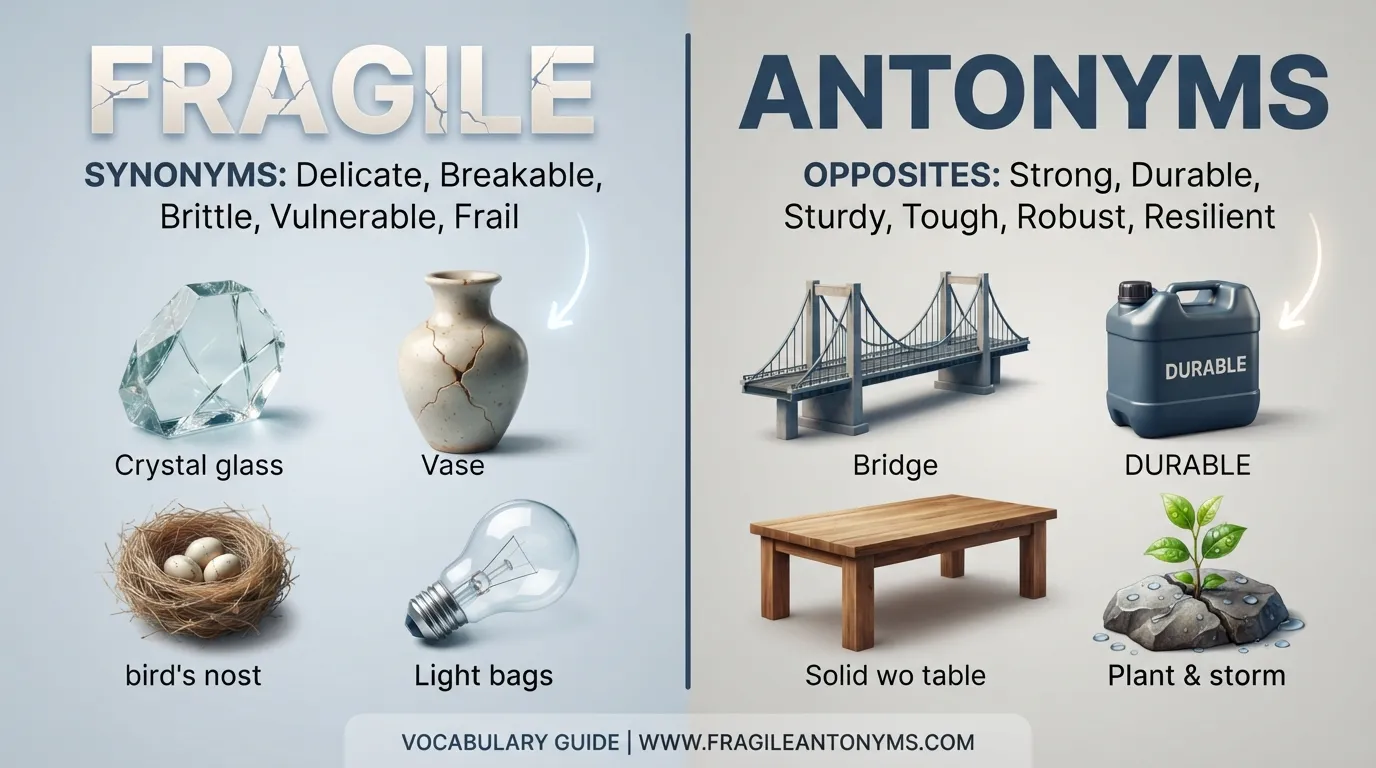
Common synonyms include delicate, breakable, brittle, vulnerable, and frail.
Common antonyms include strong, durable, sturdy, tough, robust, resilient, and stable.
The best opposite depends on what is being described. For example, a fragile glass is sturdy when it can resist breaking, while a fragile economy may be described as stable or robust.
Fragile vs. Its Opposites
| Word | Meaning | Example |
| Fragile | Easily broken, damaged, or harmed | The fragile vase needs careful handling. |
| Delicate | Easily damaged or requiring careful treatment | She arranged the delicate flowers. |
| Strong | Able to resist force, damage, or pressure | The bridge is strong enough to carry heavy vehicles. |
| Durable | Able to last without becoming damaged easily | These shoes are durable and made for daily use. |
| Resilient | Able to recover after difficulty or damage | The community proved resilient after the disaster. |
| Stable | Not likely to collapse, change, or become disturbed | The company has a stable financial position. |
Definition
Fragile: easily broken, damaged, weakened, or harmed.
Main antonym: strong able to resist force, pressure, damage, or difficulty.
What You’ll Learn
After reading this guide, you will know:
- The main synonyms of fragile
- The most useful antonyms of fragile
- How the opposite changes with context
- The difference between strong, durable, sturdy, robust, and resilient
- How to use these words naturally in sentences
Common Synonyms for Fragile
1. Delicate
Delicate describes something easily damaged or something that needs gentle treatment.
Example:
The antique painting is extremely delicate.
Usage: Often suggests that something is fine, sensitive, or easily affected rather than simply weak.
2. Breakable
Breakable means capable of being broken easily.
Example:
Keep these breakable items away from the children.
Usage: This is especially useful for physical objects.
3. Brittle
Brittle describes something that can break, crack, or shatter rather than bend.
Example:
The old plastic had become brittle with age.
Usage: It is particularly useful for materials.
4. Vulnerable
Vulnerable means easily harmed, attacked, affected, or damaged.
Example:
Young children are vulnerable to extreme weather.
Usage: Unlike breakable, it can describe people, groups, systems, and situations.
5. Frail
Frail usually describes someone or something physically weak and easily harmed.
Example:
The frail patient needed help walking.
Usage: It is commonly associated with physical weakness, especially in people.
6. Weak
Weak means lacking strength, power, or resistance.
Example:
The weak structure could not support the additional weight.
Usage: Weak is broader than fragile, but the two overlap when something cannot withstand pressure or damage.
Words That Mean the Opposite of Fragile
1. Strong
Strong is the broadest and most common antonym of fragile.
It describes something able to resist force, pressure, damage, or weakness.
Example:
The box is made from strong cardboard.
Best for: General physical strength and resistance.
2. Durable
Durable means able to last for a long time without becoming damaged or worn out easily.
Example:
The manufacturer uses durable materials for its outdoor furniture.
Best for: Products, materials, equipment, clothing, and objects designed to last.
Key distinction:
Something can be strong without necessarily being durable. Strong focuses on resistance to force, while durable emphasizes lasting over time.
3. Sturdy
Sturdy means physically strong, solid, and unlikely to break or fall apart.
Example:
We bought a sturdy wooden table for the kitchen.
Best for: Furniture, buildings, structures, containers, and physical objects.
Key distinction:
Sturdy often gives the idea of solid construction and physical stability.
4. Tough
Tough means able to withstand difficult conditions, force, damage, or rough treatment.
Example:
These boots are tough enough for long hikes.
Best for: Materials, clothing, equipment, people, and difficult conditions.
Key distinction:
Tough is often more informal and emphasizes the ability to withstand rough treatment.
5. Robust
Robust means strong, healthy, or able to function effectively under difficult conditions.
Example:
The company has a robust system for handling customer data.
Best for: Systems, economies, organizations, machines, plans, and abstract situations.
Key distinction:
Robust is especially useful in formal, technical, business, and academic writing.
6. Resilient
Resilient means able to recover, adapt, or continue functioning after difficulty, damage, or stress.
Example:
The resilient community recovered quickly after the flood.
Best for: People, communities, economies, organizations, and systems.
Key distinction:
Resilient is not simply the opposite of being physically breakable. It emphasizes recovery after difficulty.
7. Stable
Stable means unlikely to collapse, fail, change suddenly, or become disturbed.
Example:
The country’s financial system appears stable.
Best for: Situations, relationships, economies, systems, conditions, and structures.
Key distinction:
Stable is a contextual opposite of fragile, especially when fragile means uncertain or easily disrupted.
Choosing the Right Antonym
The best antonym depends on what fragile describes.
| If fragile describes… | A useful opposite is… | Why |
| A glass or vase | Sturdy | Not easily broken |
| A product | Durable | Designed to last |
| A material | Tough | Resists damage or rough treatment |
| A building or structure | Strong | Can withstand force |
| An economy | Robust | Performs strongly and withstands problems |
| A relationship | Stable | Not easily disrupted |
| A person after hardship | Resilient | Recovers from difficulty |
| A system | Robust | Continues working under pressure |
This is why there is no single perfect antonym for fragile in every sentence.
How These Antonyms Differ
Strong vs. Durable
Strong focuses on the ability to withstand force.
Durable focuses on lasting over time.
- The bridge is strong enough to carry the vehicles.
- These materials are durable enough for outdoor use.
Sturdy vs. Tough
Sturdy usually describes something solid and well-built.
Tough emphasizes resistance to damage or harsh treatment.
- The chair is sturdy.
- The hiking boots are tough.
Robust vs. Resilient
Robust suggests strength and the ability to continue working effectively.
Resilient emphasizes recovery or adaptation after difficulty.
- The company has a robust financial system.
- The company remained resilient after a major setback.
Stable vs. Strong
Stable means unlikely to change, collapse, or become disturbed.
Strong means able to withstand force, pressure, or opposition.
- The patient is in stable condition.
- The patient has a strong immune response.
These words may overlap, but they are not interchangeable in every context.
Examples in Context
Fragile and Its Synonyms
- The fragile glass ornament was wrapped in paper.
- The delicate flowers wilted in the heat.
- Be careful with these breakable dishes.
- The old rubber had become brittle.
- The injured animal was vulnerable to further harm.
- The olderly man looked frail after his illness.
Fragile and Its Antonyms
- The new container is durable enough for everyday use.
- We need a sturdy shelf for these heavy books.
- The workers built a strong structure.
- These boots are tough enough for rocky trails.
- The business has a robust operating system.
- The child showed a resilient attitude after the setback.
- Their relationship has become more stable over time.
What Part of Speech Is Fragile?
Fragile is an adjective.
It describes a person, object, condition, system, relationship, or situation.
Examples:
- a fragile vase
- a fragile ecosystem
- a fragile agreement
- a fragile economy
Its most useful synonyms and antonyms in this article are also adjectives:
Synonyms: delicate, breakable, brittle, vulnerable, frail, weak
Antonyms: strong, durable, sturdy, tough, robust, resilient, stable
Commonly Confused Opposites
One common mistake is treating every antonym of fragile as interchangeable.
❌ The fragile economy is very sturdy.
This sounds unnatural because sturdy is normally used for physical things such as furniture, structures, or objects.
✅ The economy is stable.
Or:
✅ The economy is robust.
Another issue is using resilient when the meaning is simply physical strength.
❌ This glass is resilient enough not to break.
✅ This glass is strong enough to resist pressure.
Resilient usually refers to the ability to recover or adapt after difficulty, rather than simply resisting physical force.
A Useful Language Tip
When choosing an antonym for fragile, ask:
“What kind of damage or weakness am I talking about?”
- Physical breakage → strong, sturdy, tough
- Long-lasting quality → durable
- System or economic strength → robust
- Recovery after difficulty → resilient
- Lack of instability → stable
This simple question can help you choose a more precise word.
Quick Practice
Choose the best opposite of fragile:
1. The company has a ______ financial system that can handle sudden changes.
A. delicate
B. robust
C. brittle
Answer: B. robust
Robust is appropriate because the sentence describes a system that can continue working effectively under difficult conditions.
2. We need a ______ suitcase that will survive frequent travel.
A. durable
B. frail
C. vulnerable
Answer: A. durable
Durable means able to withstand use and remain in good condition for a long time.
Frequently Asked Questions
What is the main antonym of fragile?
The main antonym of fragile is strong. It describes something that can withstand force, pressure, or damage rather than being easily broken or harmed.
What are the best synonyms for fragile?
Common synonyms include delicate, breakable, brittle, vulnerable, frail, and weak. The best choice depends on the context.
What are the strongest antonyms for fragile?
Useful strong opposites include strong, sturdy, durable, tough, and robust. For people or situations that recover from difficulty, resilient may be more precise.
Is durable the same as strong?
No. Strong usually describes resistance to force or pressure, while durable emphasizes the ability to remain usable and undamaged over time.
Can stable be an antonym of fragile?
Yes, in some contexts. When fragile means unstable or easily disrupted, stable can be a natural opposite. For example, a fragile relationship may become a stable relationship.
What to Remember
Fragile means easily broken, damaged, weakened, or harmed. Its most common general opposite is strong, but more precise choices depend on context.
- Strong → resists force or pressure
- Sturdy → solid and well-built
- Durable → lasts without wearing out easily
- Tough → withstands rough treatment
- Robust → performs strongly under difficult conditions
- Resilient → recovers after difficulty
- Stable → remains secure or unlikely to change suddenly
For synonyms, delicate, breakable, brittle, vulnerable, and frail are among the most useful choices.
Antonyms for Alone: 20 Opposite Words & Meanings

I’m Daniel Carter, a language enthusiast and content writer focused on the fascinating world of antonyms and vocabulary. I break down word meanings and opposites into simple, practical guides helping readers build a richer vocabulary, understand language more deeply, and speak or write with greater confidence.