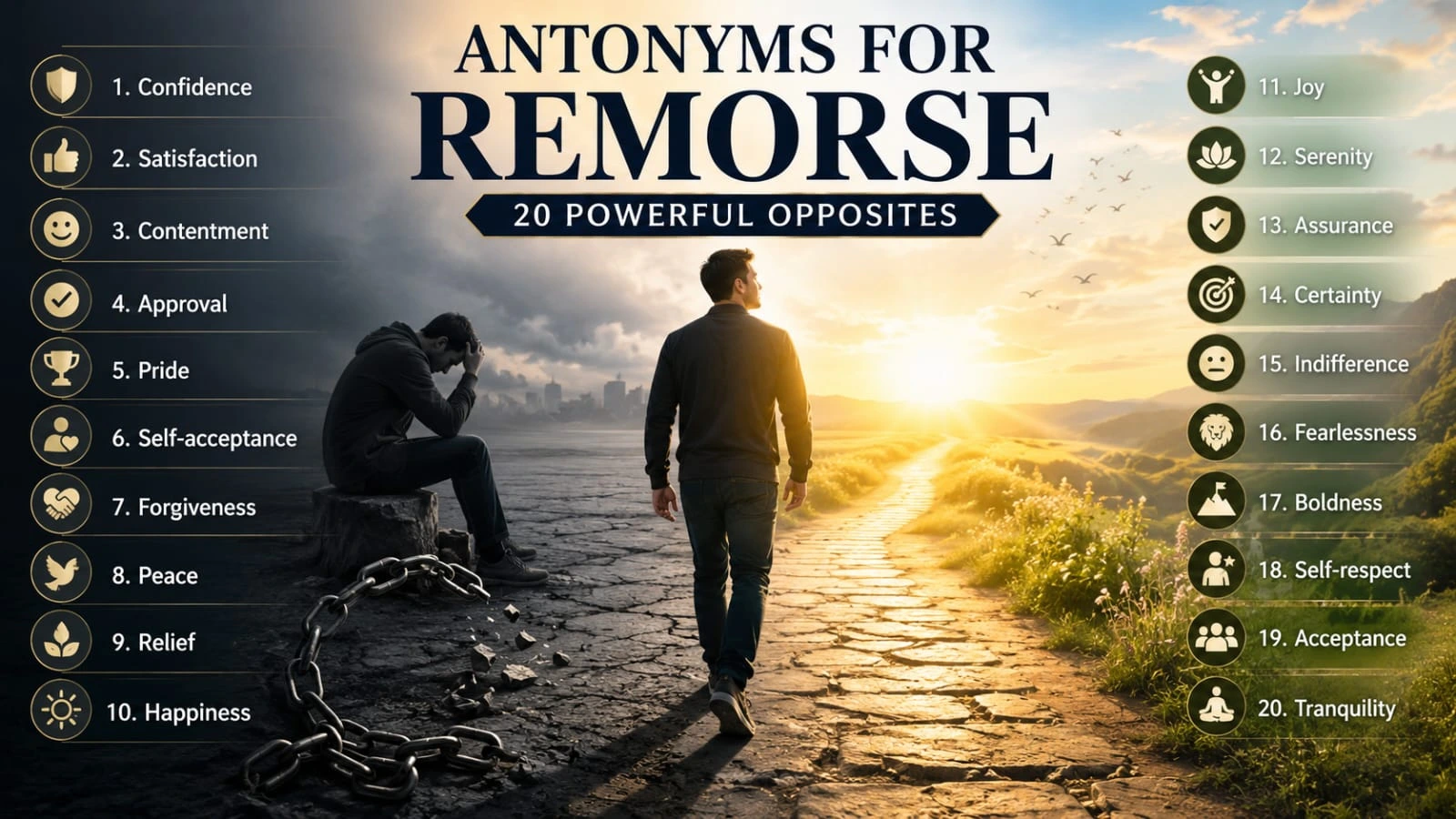
Antonyms for remorse include satisfaction, contentment, pride, approval, self-acceptance, confidence, peace of mind, relief, happiness, and lack of regret, depending on the context.
Imagine making an important decision and looking back on it years later. One person may wish they had acted differently and feel deep guilt about what happened. Another may look back with confidence, satisfaction, or even pride, believing they made the right choice. These contrasting reactions help explain the difference between remorse and its opposites.
Remorse is a strong feeling of regret and guilt about something you have done, especially when you believe your action was wrong or harmful. Its clearest contrast is therefore a lack of regret or guilt. However, English does not have one perfect single-word antonym that works in every situation.
Depending on the context, words such as satisfaction, pride, contentment, approval, confidence, relief, and self-acceptance can express an opposite emotional response. Some are direct contrasts, while others describe a positive state that leaves little room for remorse.
What Is the Opposite of Remorse?
The closest opposite of remorse is lack of regret being free from guilt or sorrow about something you have done. Among single words, satisfaction, contentment, pride, and self-approval can express contrasting feelings, but none is a universal replacement for remorse.
Quick Answer
Remorse means deep regret and guilt over a past action.
Its strongest opposite is the idea of having no regret or guilt about the action. Depending on the situation, these words can express a contrasting feeling:
- Satisfaction: feeling pleased with an action or result
- Contentment: feeling peaceful and satisfied
- Pride: feeling pleased about what you have done
- Self-approval: believing your own actions were acceptable
- Confidence: believing you made the right decision
- Relief: feeling freed from worry or guilt
- Self-acceptance: accepting yourself despite past mistakes
Remorse in One Line
Remorse: A deep feeling of guilt and regret about something wrong you have done.
Closest opposite: Lack of regret having no feeling of guilt or sorrow about a past action.
20 Antonyms and Contextual Opposites for Remorse
Not every word below is a strict dictionary antonym. Some are contextual opposites because they describe the emotional state that contrasts with regret and guilt.
1. Satisfaction
Satisfaction is a feeling of pleasure or fulfillment with something you have done or achieved.
Example:
She felt satisfaction after making the difficult but necessary decision.
This can contrast strongly with remorse because satisfaction suggests that you are pleased rather than regretful about an action.
2. Contentment
Contentment means a peaceful feeling of satisfaction with a situation.
Example:
He looked back on his decision with contentment rather than regret.
Contentment is a gentle emotional contrast to remorse rather than a direct one-to-one antonym.
3. Pride
Pride is a feeling of pleasure and satisfaction about your own actions, achievements, or qualities.
Example:
She felt pride in how she handled the difficult situation.
Pride can be particularly strong as a contrast when someone feels good about an action that they might otherwise regret.
4. Self-Approval
Self-approval means feeling that your own actions or decisions were acceptable or right.
Example:
He remembered the decision with self-approval rather than guilt.
This is a useful conceptual opposite because remorse involves judging your past behavior negatively.
5. Confidence
Confidence is a strong belief in yourself or in the correctness of your actions or decisions.
Example:
She defended her decision with confidence and had no regrets.
Confidence is not a direct antonym of remorse, but it can describe the opposite reaction to a questionable decision.
6. Relief
Relief is the feeling of happiness or relaxation that comes when worry, fear, or distress disappears.
Example:
He felt enormous relief after realizing that nobody had been harmed.
Relief can contrast with remorse when someone initially fears they have done something wrong but later discovers that they have not.
7. Happiness
Happiness is a positive emotional state involving pleasure or satisfaction.
Example:
She looked back on the experience with happiness instead of regret.
This is a broad emotional contrast rather than a precise antonym.
8. Approval
Approval means a positive opinion of or acceptance of something.
Example:
The manager expressed approval of the employee’s decision.
Approval contrasts with remorse when an action is viewed as acceptable rather than wrong.
9. Acceptance
Acceptance can mean coming to terms with something without continuing to feel distress about it.
Example:
With time, he reached acceptance about his past decision.
Acceptance is especially useful when discussing emotional recovery from regret.
10. Self-Acceptance
Self-acceptance means accepting yourself, including your imperfections and past experiences.
Example:
Self-acceptance helped her move beyond guilt about the past.
Unlike remorse, self-acceptance does not involve continually judging yourself for a past action.
11. Forgiveness
Forgiveness means releasing resentment, anger, or blame toward someone.
Example:
Forgiveness allowed him to stop dwelling on the mistake.
Forgiveness can be a conceptual opposite of continued remorse, particularly when someone has moved beyond guilt.
12. Self-Forgiveness
Self-forgiveness means letting go of excessive guilt or blame toward yourself for a past mistake.
Example:
Self-forgiveness helped her accept that she could not change the past.
This is especially relevant when discussing remorse after making a mistake.
13. Peace of Mind
Peace of mind describes a calm mental state without troubling worry or guilt.
Example:
After making the right choice, he finally had peace of mind.
It contrasts with the emotional distress that often accompanies remorse.
14. Tranquility
Tranquility means a state of calmness and freedom from disturbance.
Example:
She found tranquility after resolving her concerns about the past.
Tranquility is a broader emotional opposite rather than a direct lexical antonym.
15. Unconcern
Unconcern means a lack of worry, anxiety, or concern.
Example:
His unconcern surprised everyone who expected him to feel guilty.
This can contrast with remorse when the focus is on absence of emotional distress.
16. Indifference
Indifference means a lack of interest, concern, or emotional reaction.
Example:
She showed indifference toward the criticism and did not express regret.
Indifference is not necessarily positive, so it should not be treated as a synonym for satisfaction or happiness.
17. Acceptance of Responsibility
Acceptance of responsibility means acknowledging your role in something and dealing with its consequences.
Example:
His acceptance of responsibility helped him move forward.
This is an important distinction: accepting responsibility does not mean feeling remorse. A person can accept responsibility without experiencing deep regret.
18. Reconciliation
Reconciliation means restoring harmony after disagreement or conflict.
Example:
Their reconciliation brought peace after years of resentment.
It can contrast with prolonged remorse when the emotional focus shifts from guilt toward resolution and restored relationships.
19. Approval of One’s Actions
Approval of one’s actions means believing that what you did was acceptable or justified.
Example:
She looked back on the decision with approval of her actions.
This is one of the clearest conceptual contrasts with remorse because remorse involves believing that your past action was wrong.
20. Lack of Regret
Lack of regret is the clearest phrase for describing the absence of remorse.
Example:
He spoke about the decision with no regret.
Unlike some of the other words on this list, this phrase directly addresses the central meaning of remorse.
Which Antonym Is the Best?
If you need a precise opposite, use lack of regret or no regret.
If you need a single noun, the best choice depends on the sentence:
| Word | Best used when… |
| Satisfaction | You feel pleased with what you did |
| Contentment | You feel peacefully satisfied |
| Pride | You feel good about your actions or achievement |
| Self-approval | You consider your own actions acceptable |
| Confidence | You believe your decision was right |
| Relief | Worry or guilt has disappeared |
| Self-acceptance | You have accepted yourself and your past |
| Indifference | You feel little or no concern |
| Lack of regret | You simply do not regret the action |
Remorse vs. Regret
Remorse and regret are closely related, but remorse is usually stronger.
Regret means wishing that something had happened differently.
Remorse involves a deeper sense of guilt, responsibility, or moral distress about something you have done.
Compare:
I regret missing the meeting.
This does not necessarily involve guilt.
She felt remorse for hurting her friend.
Here, the feeling involves both regret and guilt.
Therefore, an opposite of regret does not always perfectly express the opposite of remorse.
Remorse vs. Satisfaction
These two can create a particularly clear emotional contrast.
Remorse: “I wish I had not done that.”
Satisfaction: “I am pleased with what I did.”
For example:
He felt remorse after insulting his colleague.
versus
He felt satisfaction after successfully resolving the dispute.
The emotional directions are almost completely opposite, but satisfaction is not the universal antonym of remorse.
Remorse vs. Pride
Pride can be an especially strong contextual opposite when someone evaluates a past action positively.
Remorse: negative judgment of one’s past behavior.
Pride: positive judgment of one’s achievement or behavior.
Example:
She felt remorse about how she treated her sister.
She felt pride in how she defended her sister.
The two words express opposite emotional evaluations of past behavior.
Remorse vs. Self-Forgiveness
These words describe different stages of dealing with a mistake.
Remorse keeps attention on guilt and regret.
Self-forgiveness involves releasing excessive self-blame after acknowledging the mistake.
For example:
He remained trapped in remorse over his mistake.
Eventually, he found self-forgiveness and moved forward.
Self-forgiveness is therefore better understood as a response to remorse than as a strict dictionary antonym.
Can “Indifference” Be an Antonym of Remorse?
Sometimes, but only in a specific context.
Indifference means a lack of concern or emotional involvement. A person who feels remorse cares deeply about what they have done, while an indifferent person may feel little emotional reaction.
However, indifference does not mean that someone believes their action was good or correct.
So:
- Remorse: “I deeply regret what I did.”
- Indifference: “I do not particularly care about what I did.”
- Satisfaction: “I am pleased with what I did.”
These are three different emotional positions.
Grammar and Word Class
Remorse is a noun.
Most of the main words used as its opposites or contextual contrasts are also nouns:
- remorse: noun
- satisfaction: noun
- contentment: noun
- pride: noun
- approval: noun
- confidence: noun
- relief: noun
- acceptance: noun
- forgiveness: noun
- indifference: noun
The adjective form remorseful can also be contrasted with words such as proud, satisfied, content, or unconcerned.
Remorseful: She felt remorseful about her actions.
Proud: She felt proud of what she had accomplished.
Common Mistakes
Mistake 1: Calling “happiness” the exact antonym
Happiness is a positive emotion, but it is not the exact lexical opposite of remorse.
A more precise answer is lack of regret.
Mistake 2: Treating “indifference” as a positive opposite
Indifference means not caring, not necessarily feeling good about an action.
If someone is pleased with an action, satisfaction or pride is more appropriate.
Mistake 3: Confusing forgiveness with lack of remorse
A person can feel remorse and later forgive themselves.
She felt remorse but eventually reached self-forgiveness.
Therefore, forgiveness is better described as a response or resolution to remorse than a direct antonym.
Mistake 4: Assuming regret and remorse are identical
They overlap, but remorse usually carries a stronger sense of guilt or moral responsibility.
Expert Tip
When answering “What is the antonym of remorse?”, start with lack of regret rather than forcing a single-word answer. Then choose a word such as pride, satisfaction, contentment, or indifference according to the emotional context.
Mini Practice
Choose the best word:
After realizing that she had made the right decision, she felt ______ rather than remorse.
A. satisfaction
B. guilt
C. regret
Answer: A. Satisfaction
Satisfaction fits because she felt pleased with her decision rather than guilty or regretful about it.
Short Questions & Answers
What is the direct antonym of remorse?
The closest direct opposite of remorse is lack of regret or no regret. Remorse involves deep regret and guilt, while a lack of regret means you do not feel sorry for what you did.
What is a strong opposite of remorse?
Satisfaction or pride can be strong contextual opposites when someone feels pleased with an action instead of guilty about it. However, neither is a universal antonym in every context.
Is satisfaction the opposite of remorse?
Satisfaction can contrast with remorse when someone feels pleased rather than regretful about an action. However, the most precise opposite is lack of regret, because satisfaction adds a positive emotional meaning.
Is indifference an antonym of remorse?
Indifference can be a contextual opposite because it describes a lack of concern or emotional reaction. However, it does not mean that someone approves of their actions or feels happy about them.
What is the opposite of remorse and regret?
The clearest opposite is lack of regret or having no regrets. Depending on the context, satisfaction, pride, contentment, or self-approval can describe a more positive response.
Key Takeaway
Remorse is a deep feeling of guilt and regret about something you have done. Its most precise opposite is lack of regret, but English offers several contextual contrasts. Satisfaction and pride suggest feeling positive about an action, while contentment suggests peaceful satisfaction. Indifference means a lack of concern, and self-forgiveness describes moving beyond guilt rather than directly opposing it. The best choice depends on the exact emotion you want to express.
Antonyms for Dull: 25 Words for Every Context

I’m Noreen Akbar, an English language researcher and content writer with a passion for words,their meanings, origins, and the subtle differences between them. I specialize in antonyms and vocabulary, creating clear, easy-to-follow guides that help readers expand their word power, sharpen their understanding of language, and express themselves with greater clarity and confidence.