An orator is a person who speaks confidently and effectively in public. There is no single exact antonym for orator, but words such as listener, audience member, silent person, and reluctant speaker can express contrasting roles or behaviors.
What Is the Opposite of Orator?
The most useful contextual opposite of orator is listener. An orator delivers a speech, while a listener receives and pays attention to it. Other possible opposites include audience member, non-speaker, and reticent person, depending on the sentence.
Orator and Its Opposite: Quick Comparison
| Word | Meaning | Example |
| Orator | A skilled public speaker | The orator impressed the crowd. |
| Listener | Someone who listens | The listener enjoyed the speech. |
| Audience member | Someone who attends and listens to a speech | An audience member asked a question. |
| Non-speaker | Someone who does not speak in a particular situation | The non-speaker chose not to address the group. |
| Reticent person | Someone who is reluctant to speak | The reticent student avoided the microphone. |
| Taciturn person | Someone who speaks very little | The taciturn man rarely joined conversations. |
What Does Orator Mean?
An orator is a person who delivers speeches skillfully, especially in public. Orators often use clear language, persuasive arguments, and confident delivery to inform, inspire, or convince an audience.
Example: The talented orator persuaded the audience with a powerful speech.
An orator is usually associated with speaking, while the contrasting role may involve listening, remaining silent, or avoiding public speaking.
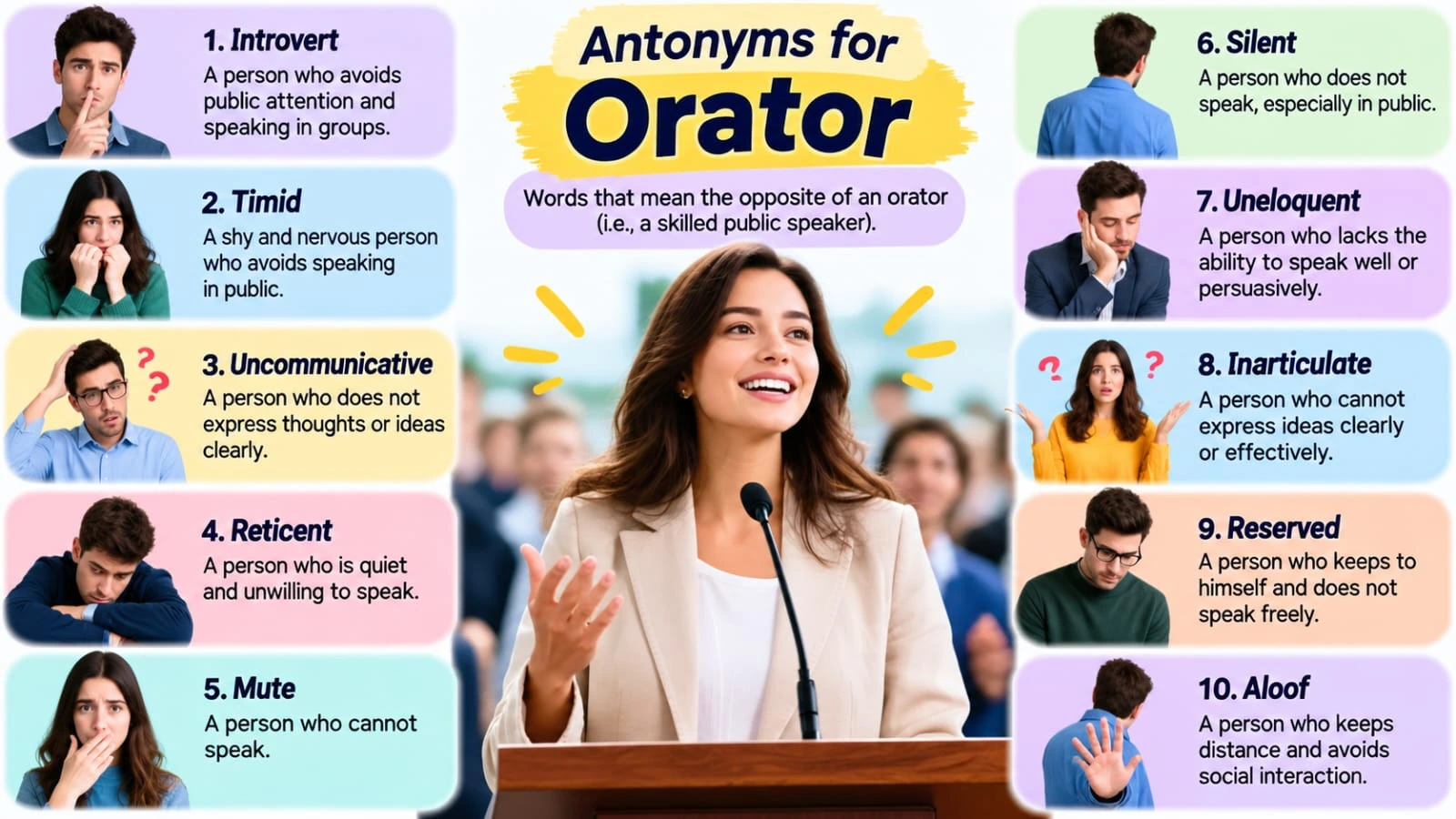
15 Useful Antonyms for Orator
These words express different contrasts with an orator. Some describe the opposite role in a speech, while others describe people who speak little or avoid speaking.
1. Listener
A listener is someone who hears and pays attention to what another person says. In a speech, the listener takes the receiving role rather than delivering the speech.
Example: The orator spoke passionately, and every listener paid attention.
2. Audience Member
An audience member is a person who attends a speech, presentation, or public event.
Example: Each audience member applauded the orator at the end.
3. Silent Person
A silent person is someone who is not speaking at a particular time.
Example: The orator addressed the room while one silent person sat in the back.
4. Non-Speaker
A non-speaker is someone who does not speak in a particular situation or activity. The term is context-dependent rather than a direct opposite of orator.
Example: The meeting included several speakers and a few non-speakers.
5. Introvert
An introvert is someone who tends to prefer quieter settings or smaller social interactions. Introverts can still be excellent public speakers, so this is not a direct antonym.
Example: Although she was an introvert, she became a confident orator.
6. Mute Person
A mute person is someone who cannot speak or does not use spoken language. The term should be used carefully and respectfully; not speaking does not necessarily mean someone cannot communicate.
Example: The event provided written materials for attendees who did not use spoken communication.
7. Observer
An observer watches or notices what happens rather than actively participating.
Example: The orator presented his argument while the observer took notes.
8. Spectator
A spectator watches an event, performance, or activity.
Example: The orator stood on the stage while the spectators listened.
9. Reticent Person
A reticent person is reserved and reluctant to share thoughts or speak freely.
Example: Unlike the outgoing orator, his reticent colleague rarely spoke at meetings.
10. Taciturn Person
A taciturn person speaks very little. This word describes a person’s usual manner of speaking rather than their public-speaking ability.
Example: The taciturn professor surprised everyone with a long, engaging speech.
11. Quiet Person
A quiet person generally speaks little or behaves calmly. A quiet person may still speak confidently when necessary.
Example: The quiet student listened carefully to the experienced orator.
12. Reluctant Speaker
A reluctant speaker is someone who does not want to speak, particularly before a group.
Example: The reluctant speaker needed encouragement before addressing the class.
13. Speechless Person
A speechless person is temporarily unable or unwilling to speak, often because of surprise, shock, or strong emotion.
Example: The audience was speechless after hearing the unexpected announcement.
14. Private Individual
A private individual prefers to keep personal matters out of public view. This contrasts with an orator’s public role only in some contexts.
Example: The private individual avoided the spotlight, while the orator welcomed public attention.
15. Reserved Person
A reserved person tends to be quiet, restrained, or cautious about expressing feelings and opinions.
Example: The reserved employee listened as the orator explained the proposal.
Understanding the Differences Between These Opposites
Not all these words are true antonyms. They describe different kinds of contrast.
| Type of contrast | Best word | Why it fits |
| Speaking vs. listening | Listener | Describes the other side of a speech |
| Speaker vs. attendee | Audience member | Identifies the recipient of a speech |
| Speaking vs. silence | Silent person | Emphasizes the absence of speech |
| Eloquent vs. reluctant to speak | Reluctant speaker | Contrasts willingness to address others |
| Talkative vs. speaking very little | Taciturn person | Describes a low tendency to speak |
| Public speaking vs. reserved behavior | Reticent person | Highlights reluctance to express oneself |
Important: Listener is generally the clearest contextual opposite of orator. Taciturn, reticent, and reserved describe personal characteristics, not the direct opposite of being a skilled public speaker.
Orator and Its Antonyms in Example Sentences
Here are additional examples showing how these words work in everyday English.
- The orator inspired the crowd, while the listeners remained attentive.
- Every audience member waited for the orator to begin.
- The reluctant speaker felt nervous about presenting the report.
- The reticent student preferred listening to speaking in class.
- The taciturn manager rarely spoke during meetings.
- The observer watched the debate without joining it.
- The reserved employee allowed the orator to lead the discussion.
- The spectators applauded when the speech ended.
These examples demonstrate that the appropriate word depends on the situation, not simply on whether someone speaks.
Grammar and Word Class
Orator is a countable noun. Its plural form is orators.
- Singular: The orator delivered a speech.
- Plural: The orators discussed public speaking.
Most of the words listed above are also nouns, including listener, spectator, observer, and audience member.
Some related adjectives describe speaking behavior:
- Taciturn: speaking very little.
- Reticent: reluctant to speak or reveal thoughts.
- Reserved: restrained in expressing feelings or opinions.
- Silent: not speaking.
These adjectives can describe an orator’s audience or another person’s behavior, but they do not necessarily mean that the person lacks public-speaking skills.
Frequently Asked Questions
1. What is the opposite of orator?
The most useful contextual opposite is listener, because an orator delivers a speech while a listener receives it. Other options depend on the intended contrast.
2. What is the antonym of orator in one word?
Listener is a suitable one-word contextual opposite. However, it is not a strict dictionary antonym.
3. Is introvert an antonym of orator?
No. An introvert may prefer quieter settings but can still be an effective orator. The words describe different characteristics.
4. What is the difference between an orator and a listener?
An orator delivers a speech, often to inform or persuade an audience. A listener pays attention to the speech and receives its message.
5. Is taciturn the opposite of orator?
Not exactly. Taciturn describes someone who speaks very little, whereas orator describes someone skilled at public speaking. A taciturn person may still be an effective speaker when needed.
6. What is a synonym for orator?
Common synonyms include speaker, speechmaker, public speaker, and rhetorician. The best choice depends on the context.
Conclusion
The most useful contextual antonym for orator is listener. Other words, including audience member, reluctant speaker, reticent person, and taciturn person, express different contrasts related to listening, silence, or speaking habits.
Choose the word that best matches your intended meaning rather than treating every term as a direct antonym.
Antonyms for Gingerly: Opposites to Know

I’m Daniel Carter, a language enthusiast and content writer focused on the fascinating world of antonyms and vocabulary. I break down word meanings and opposites into simple, practical guides helping readers build a richer vocabulary, understand language more deeply, and speak or write with greater confidence.