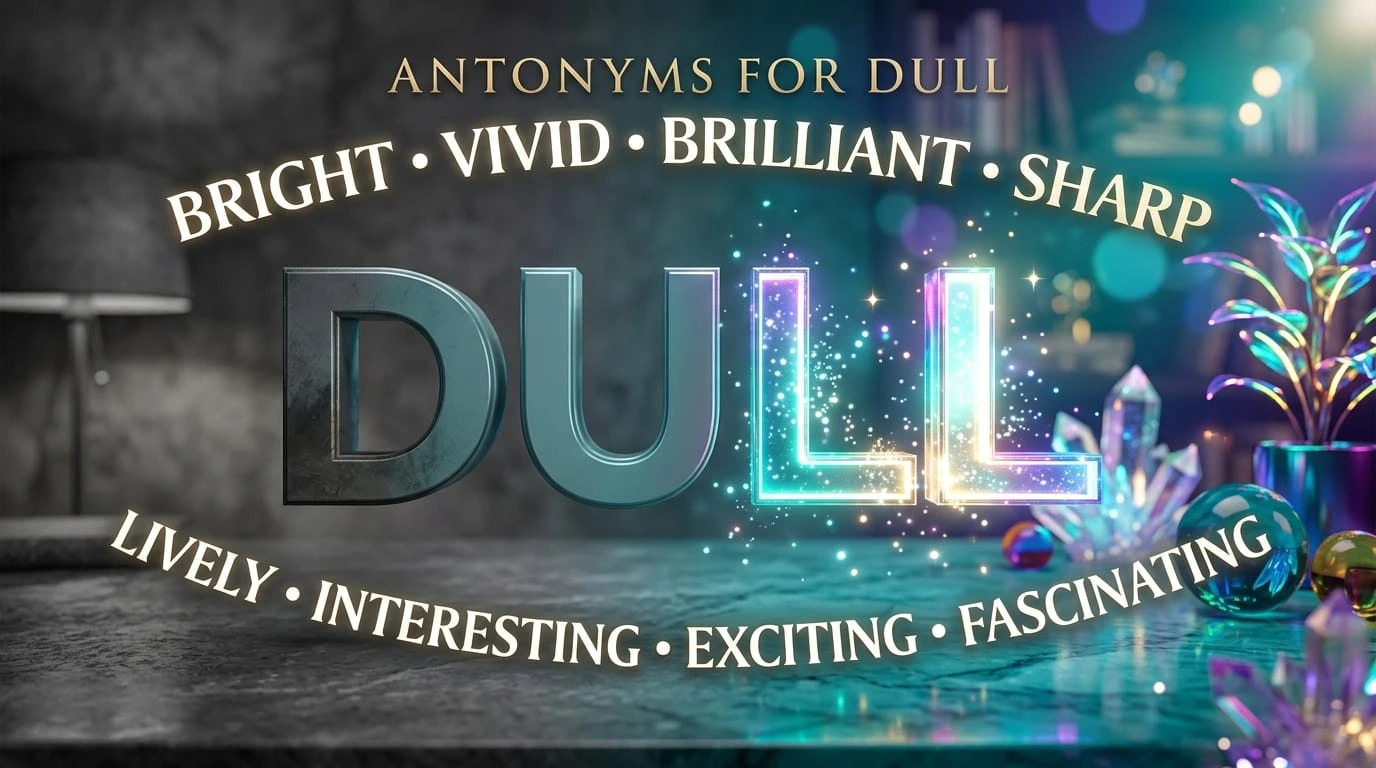
Antonyms for dull include bright, vivid, lively, exciting, interesting, sharp, brilliant, colorful, energetic, stimulating, and engaging, depending on the meaning and context.
What Is the Opposite of Dull?
The most common antonym of dull is interesting when dull means boring or lacking excitement. However, the best opposite changes with context. Bright works for dull colors or light, sharp can oppose a dull blade, and lively or energetic can describe someone who is not dull or lifeless.
Quick Answer
Dull has several meanings, so it does not have one universal opposite.
- Dull = boring: interesting, exciting, engaging
- Dull = lacking brightness: bright, vivid, brilliant
- Dull = lacking energy: lively, energetic, animated
- Dull = not sharp: sharp, keen
- Dull = lacking intelligence or quickness: clever, sharp, perceptive
Quick Comparison
| Meaning of dull | Best antonym | Example |
| Boring | Interesting | The lecture was interesting. |
| Lacking excitement | Exciting | We watched an exciting match. |
| Lacking brightness | Bright | She wore a bright yellow dress. |
| Lacking color | Vivid | The painting has vivid colors. |
| Lacking energy | Lively | The party was lively. |
| Not sharp | Sharp | This knife is sharp. |
| Slow to understand | Clever | She is clever and quick to learn. |
Dull: Simple Definition
Dull: Not interesting, exciting, bright, energetic, sharp, or mentally stimulating, depending on the context.
Main antonym: Interesting, something that holds your attention and makes you want to know more.
Useful Antonyms for Dull
Here are 25 useful opposites, grouped by meaning rather than treating them as interchangeable.
When Dull Means Boring
1. Interesting
Something that attracts attention or keeps you engaged.
Example: The book was so interesting that I finished it in one evening.
2. Exciting
Something that creates enthusiasm, anticipation, or strong interest.
Example: The final minutes of the game were exciting.
3. Engaging
Something that captures and holds your attention.
Example: The teacher gave an engaging presentation.
4. Fascinating
Extremely interesting or absorbing.
Example: We heard a fascinating story about the old city.
5. Entertaining
Something that gives enjoyment or amusement.
Example: The movie was entertaining from beginning to end.
6. Stimulating
Something that encourages thought, interest, or mental activity.
Example: The discussion was stimulating and informative.
7. Captivating
So interesting that it holds your complete attention.
Example: The speaker gave a captivating performance.
8. Intriguing
Interesting because it is unusual, mysterious, or thought-provoking.
Example: She made an intriguing suggestion.
When Dull Means Lacking Energy or Life
9. Lively
Full of energy, activity, and enthusiasm.
Example: The restaurant has a lively atmosphere on weekends.
10. Energetic
Having a lot of physical or mental energy.
Example: The energetic children played outside all afternoon.
11. Animated
Showing a lot of enthusiasm, movement, or emotion.
Example: He became animated while talking about his favorite subject.
12. Vibrant
Full of life, energy, or activity.
Example: The city has a vibrant cultural scene.
13. Spirited
Showing enthusiasm, courage, or lively energy.
Example: The team had a spirited discussion before the match.
When Dull Means Lacking Brightness or Color
14. Bright
Giving off or reflecting a lot of light; it can also describe strong colors.
Example: She painted the walls a bright blue.
15. Vivid
Very strong, clear, or bright in color or appearance.
Example: The artist used vivid shades of red and orange.
16. Brilliant
Extremely bright or impressive.
Example: Brilliant sunlight filled the room.
17. Colorful
Having many bright or noticeable colors.
Example: The children made a colorful mural.
18. Radiant
Shining brightly or appearing full of light.
Example: The garden looked radiant in the morning sun.
When Dull Means Not Sharp
19. Sharp
Having a fine edge that can cut easily.
Example: Be careful the knife is very sharp.
20. Keen
Having a sharp edge or point; it can also describe strong perception or interest.
Example: The carpenter used a keen blade to cut the wood.
When Dull Describes Mental Ability
21. Clever
Quick to understand, learn, or solve problems.
Example: Maya is clever and quickly understood the puzzle.
22. Intelligent
Having a good ability to learn, understand, and reason.
Example: He is an intelligent student who asks thoughtful questions.
23. Sharp
Quick to notice, understand, or respond to things.
Example: She has a sharp mind and remembers details easily.
24. Alert
Quick to notice what is happening around you.
Example: The security guard remained alert throughout the night.
25. Perceptive
Good at noticing and understanding things that others may miss.
Example: Her perceptive comments improved the discussion.
Are All These Words Direct Antonyms of Dull?
No. This is an important distinction.
Interesting is a strong opposite when dull means boring. Bright is a better opposite when dull describes light or color. Sharp is the natural opposite when dull describes an edge or blade.
Words such as fascinating, captivating, vibrant, and perceptive are more context-specific. They express a contrasting quality rather than replacing dull in every sentence.
For example:
- ❌ The dull knife was interesting.
- ✅ The dull knife was sharp.
But:
- ❌ The dull lecture was sharp.
- ✅ The dull lecture was interesting.
This is why choosing an antonym based on meaning and context is more accurate than simply memorizing a list.
Dull vs. Interesting
The most common contrast is dull vs. interesting.
| Dull | Interesting |
| Boring | Engaging |
| Does not hold attention | Holds attention |
| Unexciting | Appealing or exciting |
| Tedious | Stimulating |
Example:
The first chapter was dull, but the second chapter was interesting.
Here, interesting is the clearest opposite because dull refers to a lack of interest.
Dull vs. Bright
When dull describes color or light, bright is usually the better antonym.
Dull: The room had dull gray walls.
Bright: The room had bright yellow walls.
You can also use vivid, brilliant, or radiant, depending on exactly what you want to describe.
Dull vs. Lively
When dull describes an atmosphere, event, place, or person lacking energy, lively is a natural opposite.
Dull: The party was dull and quiet.
Lively: The party was lively and full of conversation.
Vibrant, animated, and energetic can also work, but their use depends on the subject.
Dull vs. Sharp
This pair has a completely different meaning.
When dull describes a knife, pencil, blade, or other edge, sharp is the direct opposite.
Example:
The old pencil is dull, but this new pencil is sharp.
The same word sharp can also describe intelligence:
She has a sharp mind.
So context determines which meaning is intended.
Grammar and Word Class
Dull is primarily an adjective.
Most of its common antonyms are also adjectives:
- dull → interesting
- dull → exciting
- dull → bright
- dull → lively
- dull → sharp
- dull → clever
- dull → vivid
This makes them easy to compare in sentences.
Dull: The presentation was dull.
Interesting: The presentation was interesting.
Dull: The colors look dull.
Vivid: The colors look vivid.
Common Mistakes
Mistake 1: Using one antonym for every meaning
Not every opposite works in every context.
❌ The dull knife is interesting.
✅ The dull knife is sharp.
Mistake 2: Assuming “exciting” is always the opposite
Exciting works well when dull means boring or unexciting, but it does not work for a dull color or dull blade.
❌ The dull blue became exciting.
✅ The dull blue became bright.
Mistake 3: Confusing “bright” with “intelligent”
Bright can mean intelligent in some contexts, but it can also refer to light or color.
She is a bright student.
Here, bright means intelligent.
The room has bright lights.
Here, bright refers to light.
Expert Tip
When choosing an antonym for dull, first ask: “Dull in what way?” If the answer is boring, choose interesting or engaging. If it is not bright, choose bright or vivid. If it is not sharp, choose sharp.
Short Questions & Answers
What is the most common antonym of dull?
The most common antonym of dull is interesting when dull means boring or uninteresting. Other opposites, such as bright, lively, and sharp, apply to different meanings.
What is the opposite of dull in color?
Bright is the most common opposite of dull when talking about color. Vivid and brilliant can also work when describing strong or intense colors.
What is the opposite of a dull knife?
The opposite of a dull knife is a sharp knife. Here, dull means that the blade has lost its cutting edge.
What is the opposite of a dull person?
Depending on the intended meaning, interesting, lively, energetic, engaging, or animated may work. If dull means slow to understand, clever or sharp may be more appropriate.
Can “interesting” replace “dull” in every sentence?
No. Interesting is mainly the opposite of dull when dull means boring. It cannot replace dull when the word refers to a blunt blade, muted color, or lack of brightness.
Key Takeaways
The best antonym for dull depends on what dull means in the sentence. Interesting is the strongest everyday opposite when something is boring. For colors and light, use bright or vivid; for energy, use lively or energetic; and for a blunt edge, use sharp. Choosing the right opposite for the context makes your English more precise and natural.
Antonyms for Intentional: What’s the Opposite?

I’m Moazama Akbar, an English language researcher and content writer with a passion for helping people build stronger vocabulary and language skills. I create clear, well-researched guides on antonyms, opposite words, and word meanings, designed to make English learning simple, practical, and enjoyable for students, writers, and learners everywhere.