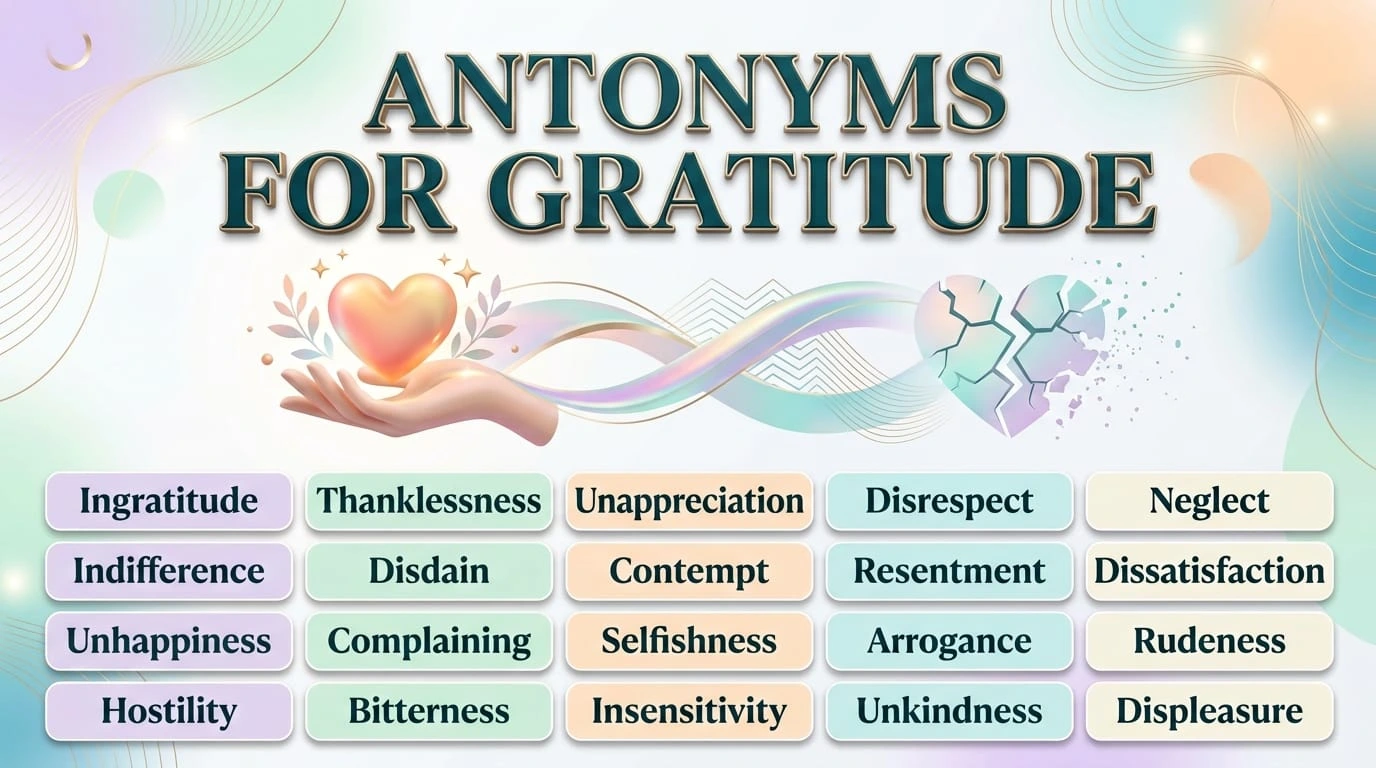
The main antonyms for gratitude are ingratitude, thanklessness, and ungratefulness. Gratitude means feeling thankful for kindness or help, while ingratitude means failing to appreciate what others have done.
Quick Answer: What Is the Opposite of Gratitude?
Ingratitude is the most direct opposite of gratitude. It describes a lack of appreciation for kindness, help, or benefits received. Thanklessness and ungratefulness have similar meanings, while resentment and indifference describe related feelings that may occur when gratitude is absent.
Gratitude vs. Its Opposite
| Word | Meaning | Example |
| Gratitude | Thankfulness and appreciation | She expressed gratitude for their help. |
| Ingratitude | Failure to appreciate kindness | His ingratitude hurt his friends. |
| Thanklessness | Lack of thankfulness | Her thanklessness disappointed the team. |
| Ungratefulness | The quality of not being grateful | His ungratefulness surprised his parents. |
| Indifference | Lack of interest or concern | He showed indifference toward their efforts. |
Gratitude in One Line
A feeling of thankfulness and appreciation for kindness, help, or something valuable received.
Main antonym Ingratitude: A failure to feel or show appreciation for kindness or benefits received.
Main Antonyms for Gratitude
These words express a lack of thankfulness in different ways. The first three are the closest opposites; the others are contextual alternatives rather than exact antonyms in every situation.
1. Ingratitude
Meaning: A failure to appreciate or acknowledge kindness, help, or benefits received.
Example: His ingratitude upset the people who had supported him.
Best used when: Someone fails to appreciate what others have done for them. It is the strongest and most direct noun antonym of gratitude.
2. Thanklessness
Meaning: The state of being unthankful or failing to express thanks.
Example: Her thanklessness disappointed the volunteers who helped her.
Best used when: You want to emphasize a lack of thanks or acknowledgment.
3. Ungratefulness
Meaning: The quality of not being grateful for help, kindness, or gifts.
Example: The child’s ungratefulness became clear when he complained about the thoughtful gift.
Best used when: Describing someone’s behavior or attitude toward kindness received.
4. Resentment
Meaning: A feeling of bitterness or anger about something perceived as unfair or hurtful.
Example: Instead of showing gratitude for the opportunity, he expressed resentment about the extra work.
Best used when: A person responds to help or a benefit with bitterness. Resentment is not always the opposite of gratitude, but it can contrast with appreciation in some situations.
5. Indifference
Meaning: A lack of interest, concern, or emotional response.
Example: She showed indifference toward the sacrifices her family had made.
Best used when: Someone appears unconcerned about another person’s kindness or effort.
6. Dissatisfaction
Meaning: A feeling that something is not good enough or does not meet expectations.
Example: Despite receiving generous support, he continued to express dissatisfaction.
Best used when: The focus is on being unhappy with what one receives rather than appreciating it.
7. Discontent
Meaning: A state of unhappiness or dissatisfaction.
Example: His discontent overshadowed any appreciation for the help he received.
Best used when: A person remains unhappy despite receiving something beneficial.
8. Disdain
Meaning: A feeling that someone or something is unworthy of respect.
Example: She treated their generous offer with disdain instead of gratitude.
Best used when: Someone responds to kindness with contempt or disrespect. It is a stronger and more negative attitude than simple thanklessness.
9. Selfishness
Meaning: Caring mainly about one’s own needs or interests rather than those of others.
Example: His selfishness prevented him from acknowledging the team’s hard work.
Best used when: Self-centered behavior makes it difficult for someone to appreciate other people’s efforts. It is a related concept, not a direct antonym.
10. Arrogance
Meaning: An exaggerated sense of one’s own importance or superiority.
Example: Her arrogance made her act as though she deserved everyone’s help.
Best used when: Someone considers assistance their right rather than something to appreciate. Arrogance does not always mean ingratitude.
11. Neglect
Meaning: A failure to give proper attention, care, or consideration.
Example: His neglect of their efforts made the volunteers feel unappreciated.
Best used when: Someone fails to acknowledge or respond to another person’s kindness. It is an indirect, contextual opposite.
12. Disrespect
Meaning: A lack of respect or consideration for someone.
Example: Ignoring the time and effort she had given was a sign of disrespect.
Best used when: A person’s response to kindness is rude or dismissive rather than appreciative.
13. Complaining
Meaning: Expressing dissatisfaction or annoyance about something.
Example: Instead of thanking his hosts, he spent the evening complaining about the food.
Best used when: Someone focuses on what they dislike instead of recognizing what they have received. It is a behavior that may show ingratitude, not a direct noun antonym.
14. Hostility
Meaning: Unfriendly, aggressive, or antagonistic behavior.
Example: He responded with hostility rather than gratitude when his colleague offered help.
Best used when: The response to kindness involves open opposition or aggression.
15. Contempt
Meaning: A strong feeling that someone or something is worthless or beneath consideration.
Example: He treated their generous assistance with contempt.
Best used when: The response shows strong disrespect toward the person offering help. Contempt is much stronger than a simple lack of thanks.
Choosing the Right Antonym for Gratitude
Not every word on this list has the same meaning as ingratitude. Choose according to what you want to express.
- Lack of thankfulness: Ingratitude, thanklessness, ungratefulness
- Lack of concern: Indifference
- Unhappiness with what was received: Dissatisfaction, discontent
- Bitterness or anger: Resentment
- Disrespect toward kindness: Disdain, contempt, disrespect
- Self-centered behavior: Selfishness, arrogance
- A negative response to help: Complaining, hostility
For example, “His ingratitude hurt his friends” directly suggests that he failed to appreciate them. “His indifference hurt his friends” suggests that he seemed unconcerned. The meanings overlap in some situations, but they are not interchangeable.
Understanding the Differences Between Key Opposites
Ingratitude vs. Thanklessness
Both words describe a lack of gratitude. Ingratitude is often more formal and can suggest a failure to appreciate a meaningful favor. Thanklessness emphasizes not being thankful or not expressing thanks.
- Ingratitude: Her ingratitude toward her mentor was disappointing.
- Thanklessness: His thanklessness showed when he failed to thank the volunteers.
Ungratefulness vs. Indifference
Ungratefulness means failing to appreciate something received. Indifference means showing little interest or concern.
- Ungratefulness: He criticized the gift without appreciating the thought behind it.
- Indifference: He barely reacted when his friends offered to help.
A person can be indifferent without deliberately rejecting someone’s kindness.
Resentment vs. Dissatisfaction
Resentment usually involves bitterness or anger, often toward a person or situation. Dissatisfaction means being unhappy with an outcome or experience.
- Resentment: She felt resentment toward the colleague who took credit for her work.
- Dissatisfaction: He expressed dissatisfaction with the service he received.
Neither word automatically means a person is ungrateful. The surrounding context determines whether the word contrasts with gratitude.
Gratitude and Its Antonyms in Sentences
Here are natural examples showing how these words work in everyday situations.
- Gratitude: I feel deep gratitude for your support.
- Ingratitude: His ingratitude disappointed the people who helped him.
- Thanklessness: Her thanklessness was obvious when she ignored their efforts.
- Ungratefulness: The ungratefulness he showed toward his parents hurt them.
- Resentment: She responded with resentment instead of appreciation.
- Indifference: His indifference made the volunteers feel unnoticed.
- Dissatisfaction: He expressed dissatisfaction despite receiving extra assistance.
- Discontent: Her discontent prevented her from enjoying the thoughtful gift.
- Disdain: He viewed the offer with disdain.
- Selfishness: His selfishness stopped him from recognizing others’ sacrifices.
- Arrogance: Her arrogance made her take everyone’s support for granted.
- Neglect: His neglect of their efforts left the team discouraged.
- Disrespect: Failing to acknowledge their work showed disrespect.
- Complaining: She kept complaining instead of thanking her hosts.
- Hostility: He met their offer of help with hostility.
- Contempt: He showed contempt for the people who had supported him.
Grammar and Word Class
Gratitude is an uncountable noun. Its most direct antonym, ingratitude, is also an uncountable noun.
| Word | Word class | Common usage |
| Gratitude | Noun | Express gratitude |
| Ingratitude | Noun | Show ingratitude |
| Thanklessness | Noun | A sense of thanklessness |
| Ungratefulness | Noun | An act of ungratefulness |
| Indifference | Noun | Show indifference |
| Resentment | Noun | Feel resentment |
| Ungrateful | Adjective | An ungrateful response |
| Grateful | Adjective | A grateful person |
Related adjective forms can help you vary your writing:
- Grateful: Thankful or appreciative.
- Ungrateful: Not showing gratitude.
- Thankful: Feeling or expressing thanks.
- Indifferent: Showing little interest or concern.
- Resentful: Feeling bitterness or anger.
Examples:
- She was grateful for the support.
- He was ungrateful for the support.
- She remained indifferent to their efforts.
Common Mistakes to Avoid
Mistake 1: Treating every related word as an exact antonym
Incorrect assumption: Resentment always means the opposite of gratitude.
Better understanding: Resentment means bitterness or anger. It can contrast with gratitude in a specific situation, but the two words are not universal opposites.
Mistake 2: Confusing ingratitude with disrespect
Ingratitude is a failure to appreciate kindness or benefits. Disrespect is a failure to show proper regard for someone. A person can be ungrateful without being openly disrespectful.
Mistake 3: Using “ungratefulness” as an adjective
Incorrect: He was ungratefulness for the gift.
Correct: He was ungrateful for the gift.
Also correct: His ungratefulness hurt the giver.
Use ungrateful to describe a person or behavior, and ungratefulness as a noun.
Teacher’s Tip
If you need one reliable antonym for gratitude, choose ingratitude. It directly describes a lack of appreciation. Use indifference for a lack of concern and resentment for bitterness. This distinction makes your writing more precise.
Quick Practice: Choose the Correct Antonym
1. She failed to appreciate the help her friends gave her.
A. Gratitude
B. Ingratitude
C. Kindness
Answer: B. Ingratitude — it means failing to appreciate kindness or help.
2. He showed little interest in the sacrifices others had made.
A. Indifference
B. Appreciation
C. Thankfulness
Answer: A. Indifference — it describes a lack of interest or concern.
3. She felt bitter toward the person who had treated her unfairly.
A. Gratitude
B. Resentment
C. Unanimity
Answer: B. Resentment — it means bitterness or anger about a situation.
Frequently Asked Questions
What is the opposite of gratitude?
The most direct opposite of gratitude is ingratitude, which means failing to appreciate kindness, help, or benefits received. Thanklessness and ungratefulness are also close antonyms.
What are five antonyms for gratitude?
Five useful antonyms or contextual opposites are ingratitude, thanklessness, ungratefulness, indifference, and resentment. The first three directly relate to a lack of thankfulness, while the last two describe related attitudes.
What is a stronger word for ingratitude?
Thanklessness and ungratefulness are close alternatives. For a stronger negative attitude, disdain or contempt may fit when someone responds to kindness with disrespect, but these words have different meanings.
Is ungratefulness the same as ingratitude?
They are very similar. Both describe a failure to appreciate kindness or benefits. Ingratitude often sounds more formal, while ungratefulness is a more transparent noun form of the adjective ungrateful.
What is the opposite of a grateful person?
The most natural word is an ungrateful person. You can also say a thankless person, although thankless may sound more formal or literary in some contexts.
What is the difference between gratitude and appreciation?
Gratitude is thankfulness for kindness, help, or something received. Appreciation can mean recognizing the value of something, understanding its quality, or feeling thankful. Gratitude is therefore a more specific kind of appreciation.
Key Takeaways
- Ingratitude is the most direct antonym of gratitude.
- Thanklessness and ungratefulness are close alternatives.
- Indifference describes a lack of concern, while resentment suggests bitterness.
- Words such as disdain, contempt, and hostility express stronger negative attitudes, not exact antonyms.
- Choose the word that matches the behavior or feeling you want to describe.
Antonyms for Popular: 15 Useful Opposites

I’m Moazama Akbar, an English language researcher and content writer with a passion for helping people build stronger vocabulary and language skills. I create clear, well-researched guides on antonyms, opposite words, and word meanings, designed to make English learning simple, practical, and enjoyable for students, writers, and learners everywhere.