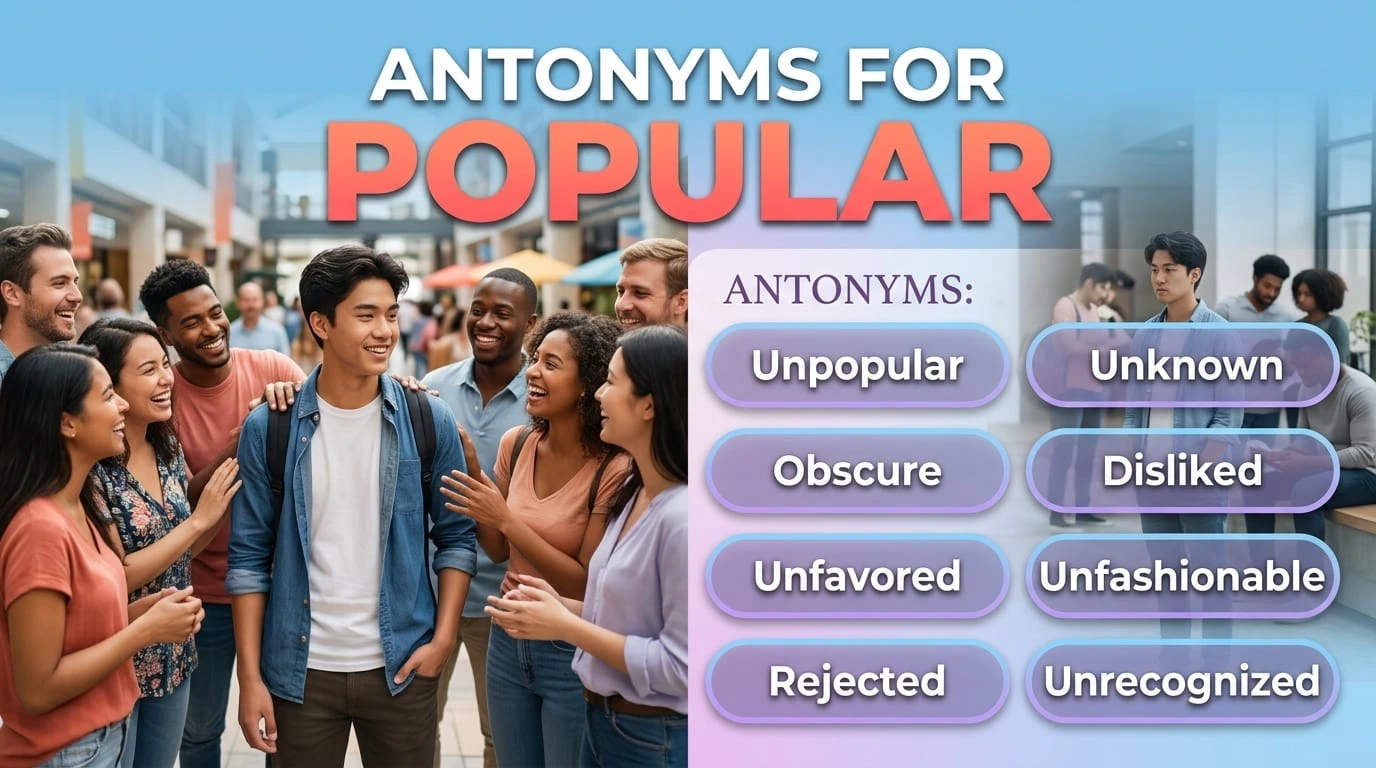
The most common antonym of popular is unpopular. It describes a person, idea, product, or activity that many people do not like or support. When popular means common or widespread, its opposites include uncommon, rare, and unusual.
Answer in Brief
Use unpopular when something is not liked by many people. Choose obscure or little-known when it is not widely known, and uncommon or rare when it does not occur often. The correct opposite depends on what popular means in your sentence.
Popular and Its Main Opposites
| Word | Meaning | Example |
| Popular | Liked by many people | The singer is popular with teenagers. |
| Unpopular | Not liked by many people | The singer became unpopular after the scandal. |
| Uncommon | Not often found or seen | This is an uncommon family name. |
| Rare | Not found or happening often | The museum has a rare painting. |
| Obscure | Not widely known or understood | He discovered an obscure poet. |
| Unfashionable | Not currently in style | That style is now considered unfashionable. |
Meaning in Brief
Popular: An adjective describing someone or something that is liked, enjoyed, supported, or followed by many people.
Main antonym Unpopular: Not liked, enjoyed, or supported by many people.
The word popular can also mean widespread or common, as in a popular belief. In that sense, an opposite such as uncommon or unusual may fit better than unpopular.
What This Guide Covers
- Common opposites of popular and their meanings.
- How to choose an antonym for people, ideas, trends, and things.
- The differences between unpopular, obscure, and uncommon.
- Examples showing how to use each opposite naturally.
Common Opposites of Popular
These alternatives are grouped by meaning. Some are direct antonyms, while others work only in specific contexts.
1. Unpopular (Adjective)
Meaning: Not liked or supported by many people.
Example: The new school rule became unpopular with students.
Best used when: Describing a person, decision, policy, product, or activity that people do not favor. This is the clearest general antonym of popular.
2. Disliked (Adjective)
Meaning: Not liked by someone or by a group of people.
Example: The character is disliked by most viewers.
Best used when: Focusing on people’s feelings about someone or something. Unlike unpopular, it can describe dislike even within a small group.
3. Rejected (Adjective)
Meaning: Not accepted, approved, or chosen.
Example: The proposal was rejected by the committee.
Best used when: Discussing ideas, plans, applications, suggestions, or candidates that people refuse to accept. It does not mean the same as unpopular in every situation.
4. Unaccepted (Adjective)
Meaning: Not accepted or approved by a person or group.
Example: The proposal remained unaccepted after several meetings.
Best used when: Emphasizing a lack of acceptance rather than a lack of general interest. In everyday English, rejected or not accepted is often more natural.
5. Obscure (Adjective)
Meaning: Not well known or understood by many people.
Example: She enjoys reading obscure books by lesser-known authors.
Best used when: Describing a person, place, subject, or work that receives little public attention. An obscure person is not necessarily disliked.
6. Unknown (Adjective)
Meaning: Not known or recognized by someone or a wider group.
Example: The artist was unknown outside her hometown.
Best used when: Something has little or no recognition. Use unknown when awareness is the issue, not whether people like it.
7. Little-Known (Adjective)
Meaning: Known by only a small number of people.
Example: The documentary reveals a little-known fact about the explorer.
Best used when: Describing people, facts, places, or works that have limited recognition. It is usually milder than obscure.
8. Uncommon (Adjective)
Meaning: Not often found, seen, or experienced.
Example: Green eyes are uncommon in some populations.
Best used when: Popular means common or widespread, rather than liked by people.
9. Rare (Adjective)
Meaning: Existing or happening only in small numbers or on few occasions.
Example: The shop sells rare coins from different countries.
Best used when: Describing something unusual because it is scarce or infrequent. Rare does not automatically mean unpopular.
10. Unusual (Adjective)
Meaning: Different from what is normal, common, or expected.
Example: She chose an unusual design for her website.
Best used when: Contrasting an ordinary or widely seen thing with something different. An unusual choice can still be very popular.
11. Unfashionable (Adjective)
Meaning: Not considered stylish or popular at the present time.
Example: That clothing style was once fashionable but is now unfashionable.
Best used when: Talking about clothing, design, tastes, habits, or trends.
12. Out of Fashion (Adjective Phrase)
Meaning: No longer considered fashionable or trendy.
Example: The old pattern has gone out of fashion.
Best used when: Something was once fashionable but is no longer in style. It relates to trends, not necessarily to whether people like the item itself.
13. Out of Favor (Adjective Phrase)
Meaning: No longer liked, approved of, or supported by a person or group.
Example: The policy fell out of favor with voters.
Best used when: Discussing ideas, public figures, policies, or practices that have lost support.
14. Forgotten (Adjective)
Meaning: No longer remembered or given attention.
Example: The work of the forgotten writer was rediscovered years later.
Best used when: Something has lost public attention or remembrance. It is a contextual opposite of being widely recognized, not a direct antonym of popular in every sense.
15. Unloved (Adjective)
Meaning: Not loved, cared for, or valued.
Example: The old public garden felt unloved and neglected.
Best used when: Emphasizing a lack of affection or care. It is more emotional than unpopular and may describe a person, place, or thing that is neglected.
Which Antonym Fits the Context?
The meaning of popular changes slightly depending on the sentence. Choose an opposite that matches the idea you want to express.
| Context | Meaning of popular | Best opposites | Example |
| People or personalities | Liked by many people | Unpopular, disliked | The new coach was unpopular with the team. |
| Products or entertainment | Enjoyed or chosen by many | Unpopular, little-known | The little-known film attracted few viewers. |
| Ideas or beliefs | Shared or accepted by many | Unaccepted, rejected, uncommon | The theory was uncommon at the time. |
| Trends and style | Widely liked or fashionable | Unfashionable, out of fashion | The design is now out of fashion. |
| Names or things | Common or widespread | Uncommon, rare, unusual | They chose an uncommon name. |
| Public support | Approved of by a group | Out of favor, unpopular | The proposal fell out of favor with voters. |
The key distinction is between being liked, being known, and being common. An item can be well known without being liked, or uncommon without being disliked.
How These Antonyms Differ
Unpopular vs. Disliked
Unpopular usually means that many people do not like or support someone or something. Disliked focuses more directly on negative feelings.
- The unpopular rule was removed. Many people opposed the rule.
- The rule was disliked by most students. The sentence emphasizes their feelings.
Obscure vs. Unknown
Obscure means not widely known or easy to understand. Unknown means not known or recognized.
- The author is obscure. Few people know the author’s work.
- The author is unknown to me. I do not know the author.
Uncommon vs. Rare
Both words describe things that are not often found. Rare often suggests that something is especially scarce or difficult to find, while uncommon means it is not usual or widespread.
- The bird is uncommon in this region.
- The museum owns a rare first edition.
Unfashionable vs. Unpopular
Unfashionable means not in style. Unpopular means not liked or supported by many people. Something can be unfashionable but still well liked by some people.
- The jacket is unfashionable, but she loves wearing it.
- The jacket is unpopular with most customers.
Examples in Context
Here are a few more examples that show how the antonyms work in everyday English.
- School: The student was unpopular at first but soon made new friends.
- Entertainment: The band released an album that remained little-known outside its home country.
- Shopping: The store stopped selling an unpopular product.
- Fashion: The old design became unfashionable after a few years.
- Ideas: The suggestion was rejected during the meeting.
- Vocabulary: The teacher explained an uncommon word to the class.
Grammar and Word Forms
Popular is an adjective, and most of its opposites are adjectives too.
| Word | Part of speech | Example |
| Popular | Adjective | A popular singer |
| Unpopular | Adjective | An unpopular decision |
| Uncommon | Adjective | An uncommon name |
| Popularity | Noun | The singer’s popularity grew. |
| Unpopularity | Noun | The policy’s unpopularity was clear. |
| Popularly | Adverb | The phrase is popularly used. |
| Unpopularly | Adverb | Rare and usually awkward; rephrase where possible. |
Word Formation and Prefixes
The most direct opposite is formed by adding un- to popular:
- Popular: Liked or supported by many people.
- Unpopular: Not liked or supported by many people.
The prefix un- often gives an adjective a negative meaning, as in happy/unhappy and fair/unfair. However, it cannot be added to every adjective to create a natural antonym. For the other senses of popular, words such as uncommon or unfashionable are more appropriate.
Common Errors to Avoid
Mistake 1: Using unpopular when you mean rare.
❌ This is an unpopular bird species — if you only mean that few of these birds exist.
✅ This is a rare bird species.
Mistake 2: Using obscure to mean disliked.
❌ The policy was obscure with voters — if you mean voters did not like it.
✅ The policy was unpopular with voters.
Mistake 3: Assuming an unusual thing cannot be popular.
An unusual song, design, or product can still be loved by many people. Unusual describes how something differs from what is expected; it does not necessarily describe public opinion.
Teacher’s Tip
Ask yourself: “Does popular mean liked, widely known, or common here?” If it means liked, choose unpopular. If it means widely known, try obscure or little-known. If it means common, choose uncommon or rare. This simple check helps you select a natural antonym.
Quick Practice
Choose the best opposite of popular in this sentence:
The researcher studied a little-known custom that was not common in other regions.
A. Unpopular
B. Uncommon
C. Disliked
Answer: B. Uncommon. The sentence refers to something not widely found, rather than something people dislike.
Common Questions About Popular and Its Antonyms
What is the opposite of popular?
The most direct opposite of popular is unpopular, meaning not liked or supported by many people. For things that are not common, uncommon or rare may be more suitable.
Is unpopular the same as uncommon?
No. Unpopular means not liked by many people, while uncommon means not often found or seen. An uncommon product may still be very popular with the people who use it.
What is the opposite of popular in fashion?
Unfashionable or out of fashion works best when something is no longer considered stylish. Unpopular is more suitable when people do not like or support something.
Can something be unusual and popular at the same time?
Yes. Something can be unusual because it is different from what people expect and still be popular because many people like it. The two words describe different qualities.
Key Takeaways
Unpopular is the clearest general antonym for popular when discussing approval or public opinion. For other meanings, choose more specific words: obscure for limited recognition, uncommon for something not widespread, and unfashionable for something out of style. Selecting the opposite according to context makes your writing more accurate and natural.
Antonyms for Adhere: Opposites by Context

I’m Noreen Akbar, an English language researcher and content writer with a passion for words,their meanings, origins, and the subtle differences between them. I specialize in antonyms and vocabulary, creating clear, easy-to-follow guides that help readers expand their word power, sharpen their understanding of language, and express themselves with greater clarity and confidence.