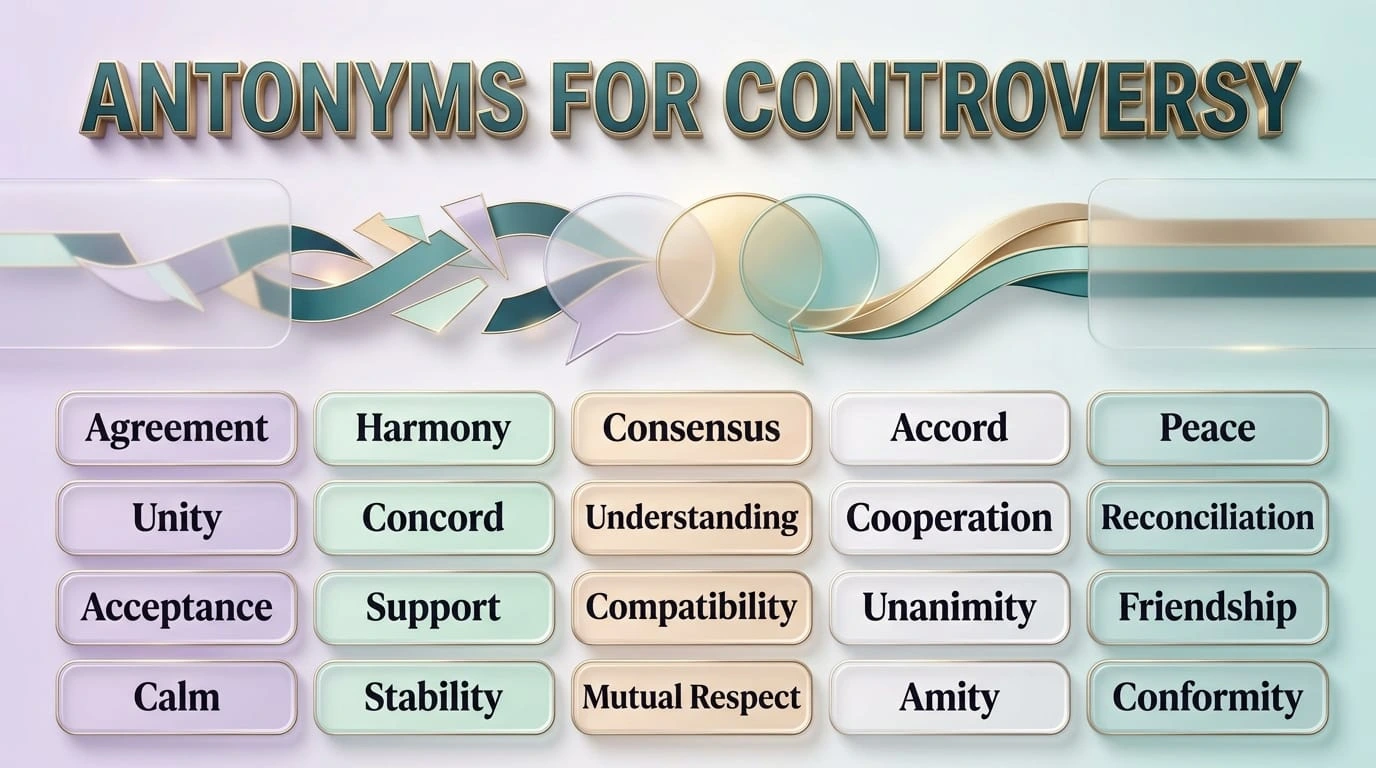
The most suitable antonyms for controversy include agreement, consensus, harmony, and accord. These words describe situations where people share opinions, reach a common decision, or live without serious disagreement.
Quick Answer: What Is the Opposite of Controversy?
The closest everyday antonym for controversy is agreement, although consensus and harmony may fit better in specific contexts. Controversy involves disagreement, debate, or public dispute, while its opposites suggest shared views, mutual understanding, or peaceful relations.
Controversy and Its Main Opposites
| Word | Meaning | Example |
| Controversy | Public disagreement or debate | The policy caused controversy. |
| Agreement | A shared opinion or decision | The team reached an agreement. |
| Consensus | General agreement among a group | The committee reached a consensus. |
| Harmony | Peaceful relations or lack of conflict | The neighbors lived in harmony. |
| Accord | Formal agreement or understanding | Both sides reached an accord. |
Meaning in Brief
Controversy: A disagreement or debate, often involving strong opposing opinions about a subject.
Main antonyms: Agreement means sharing an opinion or decision; consensus means general agreement within a group.
Common Opposites of Controversy
These 15 words can express the opposite of controversy in suitable contexts. They are not all exact opposites, so choose the word that best matches your intended meaning.
1. Agreement
Meaning: A situation in which people share the same opinion or accept a decision.
Example: After a long discussion, both parties reached an agreement.
Best used when: People who previously disagreed accept the same terms or opinion.
2. Consensus
Meaning: General agreement among members of a group.
Example: The committee reached a consensus on the new rules.
Best used when: A group makes a collective decision without major disagreement.
3. Harmony
Meaning: A state of peace, cooperation, or good relations.
Example: The community lived in harmony despite their different backgrounds.
Best used when: You want to emphasize peaceful relationships rather than debate.
4. Accord
Meaning: An agreement, especially one reached between groups, organizations, or countries.
Example: The two countries signed an accord to settle the dispute.
Best used when: The context is formal, diplomatic, or official.
5. Unity
Meaning: The state of being joined together or sharing a common purpose.
Example: The campaign encouraged unity instead of public division.
Best used when: People come together around a shared goal.
6. Concurrence
Meaning: Agreement or shared judgment.
Example: The proposal received concurrence from all members of the board.
Best used when: Writing in formal, professional, or academic contexts.
7. Understanding
Meaning: A shared interpretation, acceptance, or awareness between people.
Example: Open communication helped the neighbors reach an understanding.
Best used when: A disagreement is resolved through communication.
8. Cooperation
Meaning: Working together toward a shared goal.
Example: Cooperation between the departments prevented further conflict.
Best used when: The focus is on teamwork rather than opposing views.
9. Concord
Meaning: Agreement or peaceful relations.
Example: The leaders worked to maintain concord between the two communities.
Best used when: You need a formal or literary word for agreement and peace.
10. Compatibility
Meaning: The ability to exist, work, or fit together without serious conflict.
Example: The two groups discovered compatibility in their long-term goals.
Best used when: Ideas, interests, systems, or people can work together successfully.
11. Unanimity
Meaning: Complete agreement among everyone involved.
Example: The motion passed with unanimity among the committee members.
Best used when: Every member agrees, rather than merely most members.
12. Reconciliation
Meaning: The restoration of friendly relations after disagreement or conflict.
Example: The meeting encouraged reconciliation between the rival groups.
Best used when: A controversy has damaged relationships and people work to repair them.
13. Peace
Meaning: A state without fighting, hostility, or disturbance.
Example: Both sides chose peace over another public dispute.
Best used when: The controversy involves hostility, tension, or conflict.
14. Settlement
Meaning: An agreement that resolves a dispute or problem.
Example: The settlement ended the controversy surrounding the contract.
Best used when: A disagreement is formally resolved.
15. Approval
Meaning: Acceptance or a favorable opinion of something.
Example: The proposal received widespread approval from the community.
Best used when: Controversy means public criticism or opposition to a proposal. Approval is a contextual opposite, not a direct antonym in every sentence.
Choosing the Right Antonym
The opposite of controversy changes slightly with the situation. A public debate, a personal disagreement, and a disputed policy do not always have the same natural opposite.
- For disagreement: Use agreement or accord.
- For group decisions: Use consensus or unanimity.
- For peaceful relationships: Use harmony, concord, or peace.
- For resolving a dispute: Use settlement or reconciliation.
- For public support: Use approval or acceptance.
- For working together: Use cooperation or unity.
For example, “The controversy ended” can mean the dispute stopped. “The parties reached an agreement” explains how it ended. These sentences are related, but they do not mean exactly the same thing.
Understanding Each Antonym
Agreement vs. Consensus
Agreement can refer to two people accepting the same idea or terms. Consensus usually refers to a general agreement within a group.
- Agreement: We reached an agreement about the schedule.
- Consensus: The entire committee reached a consensus on the plan.
Harmony vs. Unity
Harmony emphasizes peaceful relations, while unity emphasizes togetherness or a shared purpose.
- Harmony: The residents maintained harmony in the neighborhood.
- Unity: The team showed unity during the campaign.
Accord vs. Settlement
An accord is an agreement, often formal. A settlement specifically resolves a dispute or claim.
- Accord: The organizations signed an accord.
- Settlement: The settlement resolved the legal dispute.
Consensus vs. Unanimity
A consensus means general agreement, but unanimity means everyone agrees. A group can reach a consensus even if a few members still have reservations.
Controversy and Its Antonyms in Sentences
Here are practical examples showing how these words work in everyday, academic, and professional writing.
- Controversy: The new school policy sparked controversy among parents.
- Agreement: The parents reached an agreement with the school.
- Consensus: The teachers reached a consensus on the revised curriculum.
- Harmony: The residents worked together to restore harmony.
- Accord: The two organizations reached an accord.
- Unity: The event promoted unity among community members.
- Concurrence: The recommendation received concurrence from the review panel.
- Understanding: A calm conversation helped them reach an understanding.
- Cooperation: Cooperation helped the teams avoid further conflict.
- Concord: The leaders encouraged concord between the communities.
- Compatibility: The discussion revealed compatibility between their goals.
- Unanimity: The proposal passed with unanimity.
- Reconciliation: Reconciliation helped repair the strained relationship.
- Peace: Both sides agreed to maintain peace.
- Settlement: A settlement brought the dispute to an end.
- Approval: The revised plan received approval from most residents.
Grammar and Word Class
Controversy is a countable noun. Its plural form is controversies.
Examples:
- The controversy attracted media attention.
- Several controversies surrounded the decision.
Most antonyms listed above are also nouns, but they differ in meaning and grammatical use.
| Noun | Common phrase | Example |
| Agreement | reach an agreement | They reached an agreement. |
| Consensus | reach a consensus | The group reached a consensus. |
| Harmony | live in harmony | The neighbors live in harmony. |
| Accord | reach an accord | Both sides reached an accord. |
| Unanimity | with unanimity | The motion passed with unanimity. |
| Settlement | reach a settlement | The parties reached a settlement. |
Do not force an antonym into a sentence simply because its meaning seems opposite. The surrounding words and intended meaning should guide your choice.
Common Errors to Avoid
Mistake 1: Treating every antonym as interchangeable
Incorrect: “The controversy reached harmony.”
Better: “The controversy ended, and the two groups restored harmony.”
Controversy refers to a dispute or debate, while harmony describes peaceful relations.
Mistake 2: Confusing consensus with unanimity
Consensus means general agreement. Unanimity means everyone agrees.
Example: The committee reached a consensus, although two members still had concerns.
Mistake 3: Using approval as a universal opposite
Approval is useful when the issue is public support or criticism, but it does not always oppose controversy.
Example: The proposal received approval, avoiding the public backlash that many expected.
Mistake 4: Assuming controversy always means hostility
A controversy may involve a serious public debate without personal hostility. In such cases, agreement or consensus may be more appropriate than peace.
Teacher’s Tip
When choosing an antonym for controversy, identify what caused the controversy. If people disagree, use agreement and If a group needs a shared decision, use consensus. If relationships are strained, use harmony or reconciliation. This makes your writing more precise.
Quick Practice: Choose the Best Antonym
1. After several meetings, the committee finally reached a general agreement.
A. Controversy
B. Consensus
C. Dispute
Answer: B. Consensus — it means general agreement among a group.
2. The two communities worked to restore peaceful relationships.
A. Harmony
B. Controversy
C. Opposition
Answer: A. Harmony — it describes peaceful and cooperative relations.
3. The legal dispute ended when both sides accepted the terms.
A. Debate
B. Settlement
C. Division
Answer: B. Settlement — it resolves a dispute through agreed terms.
Frequently Asked Questions
What is the opposite of controversy?
The most useful general opposites are agreement, consensus, and harmony. Agreement describes shared views, consensus means general agreement within a group, and harmony emphasizes peaceful relations.
What is a stronger antonym for controversy?
There is no single stronger antonym for every context. Unanimity expresses complete agreement, while reconciliation emphasizes repairing relations after conflict.
Is consensus the same as agreement?
Not exactly. Agreement can involve two or more people accepting the same idea or terms. Consensus usually refers to general agreement within a group.
Can harmony be an antonym for controversy?
Yes, in contexts involving conflict or strained relationships. Harmony describes peaceful relations, whereas controversy involves disagreement or debate. However, harmony is not a direct substitute in every sentence.
What is the opposite of a controversial issue?
Depending on the context, you could say an issue is uncontroversial, widely accepted, or undisputed. These expressions are often more natural than using a noun such as agreement.
What is the difference between controversy and conflict?
Controversy usually involves disagreement, debate, or competing opinions about an issue. Conflict is broader and can include clashes between people, interests, or groups. Agreement may oppose controversy, while peace or cooperation may better oppose conflict.
Key Takeaways
- Agreement is a useful general opposite of controversy.
- Consensus describes general agreement within a group.
- Harmony emphasizes peaceful relationships.
- Unanimity means complete agreement from everyone involved.
- Settlement and reconciliation are useful when a controversy or dispute is being resolved.
- Choose the antonym that fits the exact meaning and context.
Antonyms for Exhausted: 25 Opposite Words to Know

I’m Daniel Carter, a language enthusiast and content writer focused on the fascinating world of antonyms and vocabulary. I break down word meanings and opposites into simple, practical guides helping readers build a richer vocabulary, understand language more deeply, and speak or write with greater confidence.