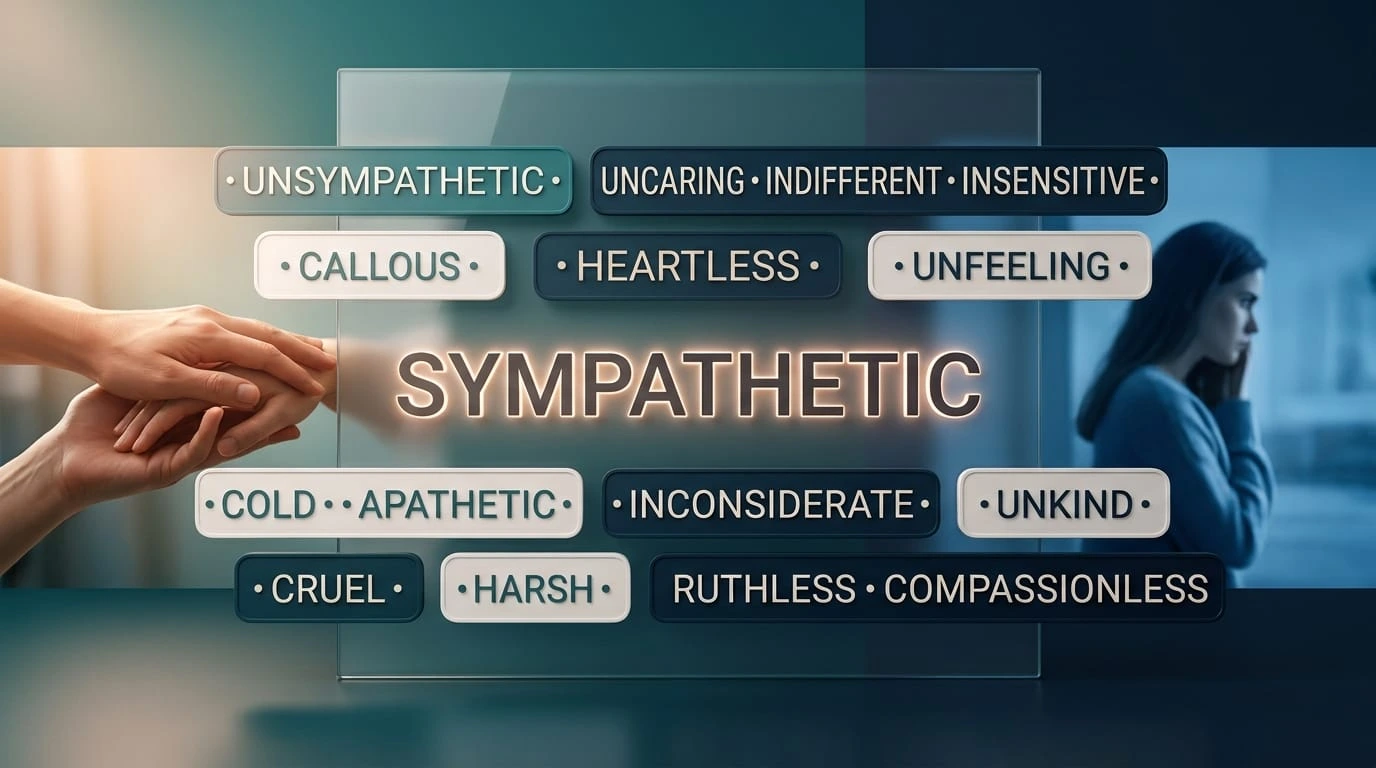
The strongest antonyms for sympathetic include unsympathetic, indifferent, uncaring, insensitive, unfeeling, apathetic, cold, callous, harsh, and inconsiderate.
Quick Answer
The most direct antonym of sympathetic is unsympathetic. It describes someone who does not show understanding, concern, or compassion toward another person’s feelings or difficulties. Other useful opposites include indifferent, uncaring, insensitive, apathetic, cold, callous, harsh, and inconsiderate.
Sympathetic vs. Its Main Opposites
| Word | Meaning | Example |
| Sympathetic | Showing understanding or concern for someone’s feelings | She was sympathetic when I told her about the problem. |
| Unsympathetic | Showing little or no understanding or concern | His response was unsympathetic. |
| Indifferent | Showing little interest or concern | She seemed indifferent to their concerns. |
| Insensitive | Failing to consider another person’s feelings | His comment was insensitive. |
| Uncaring | Showing little concern for others | His uncaring attitude upset the team. |
| Callous | Showing a lack of concern for other people’s suffering | The remark sounded callous. |
One-Line Definition
Sympathetic: showing understanding, concern, or compassion toward someone else’s feelings or difficulties.
Main antonym: Unsympathetic: showing little or no understanding, concern, or compassion.
What You’ll Learn
After reading this guide, you will understand:
- The main antonym of sympathetic
- Other useful opposite words
- How indifferent, insensitive, uncaring, and callous differ
- Which antonym fits different situations
- How to use these words naturally
22 Antonyms for Sympathetic
Because sympathetic has several closely related meanings, these words are not all interchangeable. Some are direct opposites, while others are stronger or more context-specific.
1. Unsympathetic
Unsympathetic is the clearest direct opposite of sympathetic. It describes someone who does not show understanding or concern for another person’s difficulties.
Example:
The manager seemed unsympathetic to the employee’s situation.
2. Indifferent
Indifferent means showing little interest, concern, or emotional involvement.
Example:
He was indifferent to her complaints.
Difference: An indifferent person may simply not care, while an unsympathetic person may fail to understand or support someone.
3. Uncaring
Uncaring describes someone who shows little concern for other people.
Example:
His uncaring response made the situation worse.
4. Insensitive
Insensitive describes someone who does not recognize or consider another person’s feelings.
Example:
It was insensitive to joke about her loss.
5. Unfeeling
Unfeeling describes someone who appears to lack emotion, compassion, or concern.
Example:
His unfeeling response surprised everyone.
6. Apathetic
Apathetic means showing little interest, enthusiasm, or concern.
Example:
The students seemed apathetic about the issue.
7. Cold
Cold can describe an emotionally distant or unfriendly attitude.
Example:
She gave him a cold response when he asked for help.
8. Callous
Callous is a strong word for someone who shows little concern about other people’s suffering.
Example:
His callous remark hurt the grieving family.
9. Harsh
Harsh describes behavior, words, or treatment that is severe, cruel, or lacking kindness.
Example:
The teacher’s harsh response discouraged the student.
10. Inconsiderate
Inconsiderate means failing to think about other people’s feelings, needs, or circumstances.
Example:
It was inconsiderate to cancel the meeting without telling anyone.
11. Compassionless
Compassionless means lacking compassion for people who are suffering or experiencing difficulty.
Example:
The decision appeared compassionless to those affected.
12. Merciless
Merciless means showing no pity or mercy.
Example:
The merciless criticism left the new employee discouraged.
13. Unkind
Unkind describes behavior that lacks kindness or consideration.
Example:
That was an unkind thing to say.
14. Unsupportive
Unsupportive describes someone who does not provide encouragement, help, or emotional support.
Example:
Her family was unsupportive of her decision.
15. Hostile
Hostile means unfriendly, antagonistic, or openly opposed.
Example:
He received a hostile response from the audience.
This is a stronger opposite than simply being unsympathetic.
16. Antagonistic
Antagonistic describes someone who actively opposes or shows hostility toward another person or group.
Example:
His antagonistic attitude made cooperation difficult.
17. Dismissive
Dismissive describes an attitude that treats someone’s concerns as unimportant or unworthy of attention.
Example:
The doctor was dismissive of her concerns.
18. Neglectful
Neglectful describes someone who fails to give appropriate care or attention.
Example:
The neglectful response left the customer without help.
19. Aloof
Aloof describes someone who appears emotionally distant or detached.
Example:
He remained aloof when his colleagues discussed their problems.
20. Detached
Detached describes someone who is emotionally removed from a situation.
Example:
She sounded detached when discussing the difficult experience.
21. Self-centered
Self-centered describes someone who focuses mainly on themselves rather than considering others.
Example:
His self-centered behavior made it difficult for him to understand her perspective.
22. Cruel
Cruel describes behavior that intentionally causes pain or shows no concern for suffering.
Example:
The cruel comment was completely unnecessary.
Note: Cruel is much stronger than unsympathetic and should not be treated as an exact replacement.
Contextual Antonyms for Sympathetic
The best opposite depends on what sympathetic means in the sentence.
If “sympathetic” means compassionate
Use:
- uncaring
- unfeeling
- callous
- compassionless
- merciless
Example:
She was sympathetic toward the victims.
Opposite:
She was callous toward the victims.
If “sympathetic” means understanding
Use:
- unsympathetic
- insensitive
- dismissive
- inconsiderate
Example:
He was sympathetic to my concerns.
Opposite:
He was dismissive of my concerns.
If “sympathetic” means emotionally supportive
Use:
- unsupportive
- indifferent
- uncaring
- cold
Example:
Her friends were sympathetic during the difficult period.
Opposite:
Her friends were unsupportive during the difficult period.
If “sympathetic” means emotionally connected or responsive
Use:
- detached
- aloof
- indifferent
- apathetic
Example:
He was sympathetic to the emotional needs of others.
Opposite:
He appeared detached from their emotional needs.
Sympathetic vs. Unsympathetic
Sympathetic and unsympathetic form the clearest opposite pair.
- Sympathetic → understanding and concerned
- Unsympathetic → lacking understanding or concern
Example:
The counselor was sympathetic to her situation.
The supervisor was unsympathetic to her situation.
If you need a straightforward antonym in everyday writing, unsympathetic is usually the safest choice.
Sympathetic vs. Indifferent
These words are related but not identical.
Indifferent focuses on a lack of interest or concern.
Unsympathetic focuses more directly on a lack of understanding or compassion.
Compare:
He was indifferent to their problems.
This suggests he did not care much.
He was unsympathetic to their problems.
This suggests he did not show understanding or compassion.
Sympathetic vs. Insensitive
Insensitive is especially useful when someone’s words or actions fail to consider another person’s feelings.
She was sympathetic when I told her the news.
His response was insensitive.
An insensitive person may not intend to be cruel, but their behavior fails to account for how others feel.
Sympathetic vs. Callous
Callous is much stronger than unsympathetic.
Someone who is unsympathetic may simply fail to show understanding.
Someone who is callous appears unconcerned about another person’s pain or suffering.
Example:
His response was unsympathetic.
This sounds relatively neutral.
His response was callous.
This strongly criticizes his lack of concern.
Sympathetic vs. Empathetic
These two words are often confused, but they are not exact opposites.
Sympathetic generally means showing concern or understanding for another person’s situation.
Empathetic emphasizes understanding or sharing another person’s feelings from their perspective.
For example:
She was sympathetic toward her friend.
She was empathetic toward her friend’s feelings.
The opposite of sympathetic is not necessarily unempathetic. Depending on the intended meaning, unsympathetic, insensitive, indifferent, or uncaring may be more natural.
Example Sentences
Here are natural examples using different antonyms:
- The manager was unsympathetic to the employee’s request.
- He seemed indifferent to their concerns.
- Her comment was insensitive.
- The organization was criticized for its uncaring response.
- His callous attitude shocked everyone.
- She became apathetic about the situation.
- The counselor’s response was anything but cold.
- It was inconsiderate to ignore their needs.
- His dismissive attitude frustrated the customer.
- The supervisor was unsupportive when the employee needed help.
- The doctor sounded detached during the conversation.
- His aloof manner made people reluctant to approach him.
- The criticism seemed unnecessarily harsh.
- The decision appeared compassionless to the affected families.
Grammar and Word Class
Sympathetic is an adjective.
Most of its useful antonyms are also adjectives:
- sympathetic → unsympathetic
- sympathetic → indifferent
- sympathetic → insensitive
- sympathetic → uncaring
- sympathetic → unfeeling
- sympathetic → apathetic
- sympathetic → callous
- sympathetic → inconsiderate
- sympathetic → dismissive
- sympathetic → unsupportive
Common patterns
We commonly say:
- sympathetic to someone’s situation
- sympathetic toward someone
- sympathetic about a problem in some contexts
Examples:
She was sympathetic to his situation.
He was sympathetic toward the new employee.
For opposites, common patterns include:
He was indifferent to their concerns.
She was insensitive to his feelings.
They were dismissive of her complaints.
The manager was unsympathetic to the request.
Common Mistakes
Mistake 1: Treating “indifferent” and “unsympathetic” as exact equivalents
They overlap, but their focus differs.
- Indifferent = little interest or concern
- Unsympathetic = little understanding or compassion
Mistake 2: Using “cruel” as the normal opposite
Cruel is much stronger than unsympathetic.
Someone can be unsympathetic without deliberately trying to hurt anyone.
Mistake 3: Assuming “cold” always means unsympathetic
Cold can describe emotional distance, an unfriendly manner, or a lack of warmth. It is a contextual opposite rather than an exact antonym in every sentence.
Mistake 4: Confusing unsympathetic with unsupportive
Someone may understand your feelings but still disagree with or refuse to support your decision.
Therefore:
- unsympathetic → lacks understanding or compassion
- unsupportive → does not provide encouragement or support
Expert Tip
When choosing an antonym for sympathetic, identify what kind of support is missing. If someone doesn’t understand your feelings, use insensitive or unsympathetic; if they don’t care, use indifferent or uncaring. If they show a particularly hard-hearted attitude toward suffering, callous is stronger and more precise.
Mini Quiz
Choose the best antonym for sympathetic in each sentence.
1. The counselor was very ___ toward the student’s difficulties.
A. sympathetic
B. callous
C. compassionate
Answer: B. callous
Why? Callous describes a lack of concern for another person’s suffering.
2. The manager seemed ___ to the employee’s concerns.
A. indifferent
B. supportive
C. sympathetic
Answer: A. indifferent
Why? Indifferent means showing little interest or concern.
3. His joke about her loss was extremely ___.
A. understanding
B. insensitive
C. sympathetic
Answer: B. insensitive
Why? Insensitive describes behavior that fails to consider another person’s feelings.
Short Questions & Answers
What is the opposite of sympathetic?
The most direct opposite of sympathetic is unsympathetic, meaning lacking understanding, concern, or compassion for another person’s situation.
What is a stronger antonym for sympathetic?
Callous is a stronger antonym when someone shows a particularly harsh lack of concern for another person’s suffering. It is stronger than simply being unsympathetic.
Is indifferent the same as unsympathetic?
Not exactly. Indifferent means showing little interest or concern, while unsympathetic more specifically suggests a lack of understanding or compassion.
What is the opposite of a sympathetic person?
Depending on the intended meaning, a sympathetic person’s opposite could be unsympathetic, insensitive, uncaring, indifferent, callous, or unfeeling.
What is the opposite of sympathetic behavior?
Possible opposites include unsympathetic, insensitive, uncaring, inconsiderate, and callous behavior, depending on the situation.
Is “insensitive” a good antonym for sympathetic?
Yes, when sympathetic means understanding and considering another person’s feelings. Insensitive describes someone who fails to consider those feelings.
Key Takeaway
Unsympathetic is the clearest general antonym of sympathetic, but context matters. Choose indifferent for a lack of concern, insensitive for a lack of awareness of feelings, uncaring for a lack of concern, unsupportive for a lack of encouragement, and callous when the lack of compassion is especially strong.
Antonyms for Silly: 25 Smart Opposites to Know

I’m Daniel Carter, a language enthusiast and content writer focused on the fascinating world of antonyms and vocabulary. I break down word meanings and opposites into simple, practical guides helping readers build a richer vocabulary, understand language more deeply, and speak or write with greater confidence.