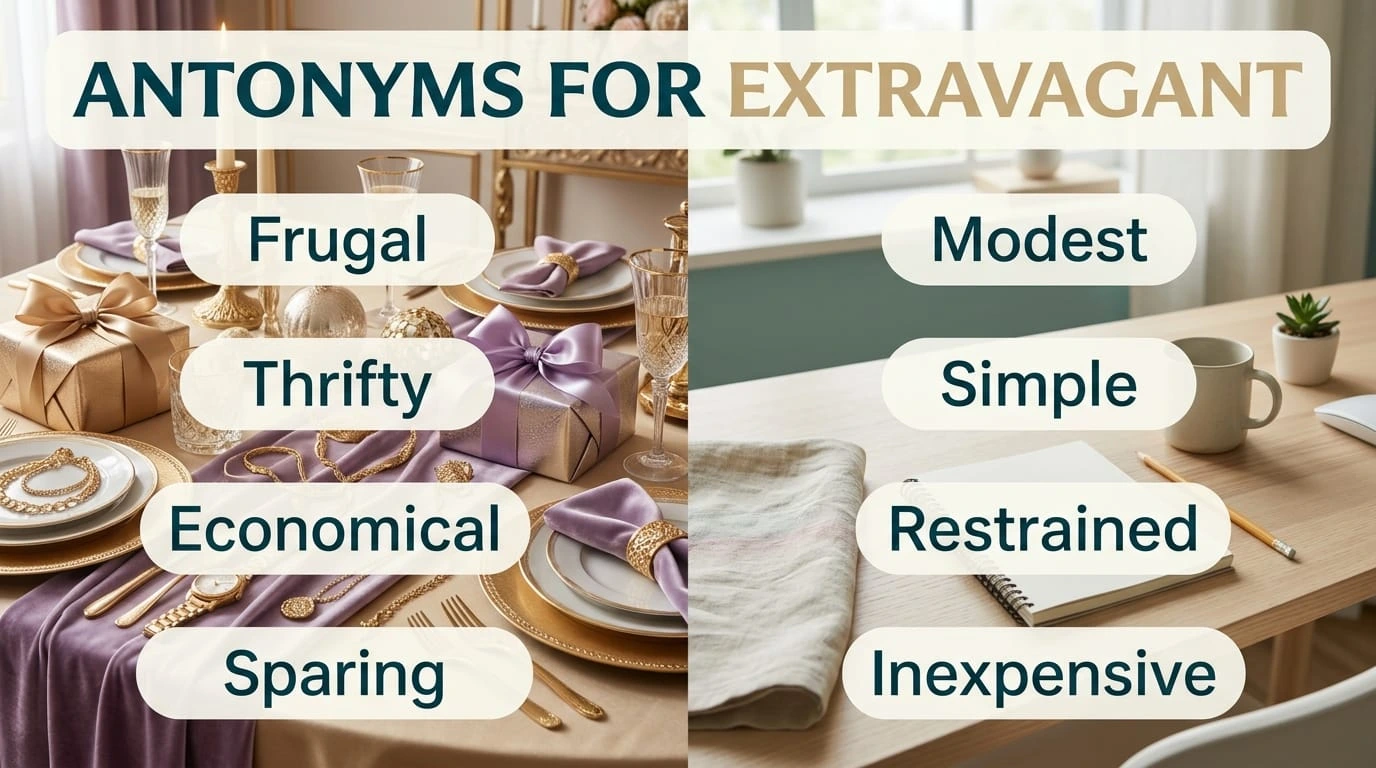
The most common antonym for extravagant is frugal, especially when talking about spending money. Other useful opposites include thrifty, economical, modest, restrained, and reasonable.
The Short Answer
Frugal is the strongest everyday opposite of extravagant when the word describes someone who spends too much. For an expensive item, inexpensive may fit better. For an elaborate design or an excessive claim, simple, restrained, or reasonable can express the opposite more naturally.
Extravagant vs. Its Opposite
| Word | Meaning | Example |
| Extravagant | Spending or using more than is needed or reasonable | They planned an extravagant wedding. |
| Frugal | Careful about spending money | They chose a frugal wedding plan. |
| Economical | Avoiding unnecessary cost or waste | They chose an economical venue. |
| Modest | Not excessive in size, cost, or ambition | They held a modest celebration. |
| Restrained | Controlled and not overly showy | The room had a restrained design. |
| Reasonable | Fair, sensible, or within acceptable limits | The hotel charged a reasonable price. |
Meaning in Brief
Extravagant: An adjective describing spending, costs, designs, or behavior that goes beyond what is necessary, reasonable, or practical.
Main antonym Frugal: Careful with money and resources, avoiding unnecessary spending or waste.
The word can also describe extreme claims, excessive praise, or an overly elaborate style. In these cases, reasonable, restrained, or simple may be more accurate than frugal.
What You’ll Learn
- The most useful antonyms for extravagant.
- How to select opposites for spending, price, style, and claims.
- The difference between frugal, economical, and cheap.
- How to use each word naturally in a sentence.
Common Opposites of Extravagant
The following antonyms cover the main meanings of extravagant. They are grouped by practical use because not every opposite works in every sentence.
1. Frugal (Adjective)
Meaning: Careful about spending money and avoiding waste.
Example: My parents are frugal and save part of their income each month.
Best used when: Describing a person, household, or spending habit.
2. Thrifty (Adjective)
Meaning: Good at managing money and finding ways to avoid waste.
Example: She is thrifty and always compares prices before shopping.
Best used when: You want to praise someone for being careful with money.
3. Economical (Adjective)
Meaning: Using money, time, or resources efficiently without unnecessary waste.
Example: The family chose an economical car that uses less fuel.
Best used when: Talking about products, choices, methods, or resource use.
4. Prudent (Adjective)
Meaning: Showing good judgment, especially when managing money or making decisions.
Example: Buying only what she needed was a prudent choice.
Best used when: Emphasizing wisdom and careful planning rather than simply spending less.
5. Sparing (Adjective)
Meaning: Using or giving only a small amount of something.
Example: The designer made sparing use of gold decorations.
Best used when: Describing limited use of money, materials, words, or decorations.
6. Inexpensive (Adjective)
Meaning: Not costing much money.
Example: We found an inexpensive dress for the event.
Best used when: Describing a product or service with a low price. Unlike frugal, it says little about a person’s spending habits.
7. Affordable (Adjective)
Meaning: Priced at a level someone can reasonably pay.
Example: The couple found an affordable venue for their wedding.
Best used when: The focus is on what someone can comfortably pay, rather than whether an item is luxurious.
8. Modest (Adjective)
Meaning: Not excessive in size, cost, amount, or ambition.
Example: They hosted a modest dinner instead of a lavish party.
Best used when: Describing budgets, homes, celebrations, expectations, or amounts.
9. Simple (Adjective)
Meaning: Not elaborate, complicated, or decorated with many extra details.
Example: She preferred a simple wedding dress without extra ornaments.
Best used when: Contrasting an elaborate or luxurious style with something plain and uncomplicated.
10. Plain (Adjective)
Meaning: Without decoration or extra features; simple in appearance.
Example: The room had plain furniture instead of extravagant decorations.
Best used when: Focusing on appearance or design. It can sound less flattering than simple.
11. Restrained (Adjective)
Meaning: Controlled and not excessive or overly showy.
Example: The hotel used restrained décor rather than bright gold finishes.
Best used when: Describing design, behavior, praise, emotion, or presentation.
12. Moderate (Adjective)
Meaning: Within reasonable limits, without being too much or too little.
Example: The family kept its celebration costs moderate.
Best used when: Discussing spending levels, prices, demands, or amounts.
13. Reasonable (Adjective)
Meaning: Fair, sensible, and not excessive.
Example: The shop offered a reasonable price for the quality.
Best used when: Describing costs, demands, expectations, arguments, or claims.
14. Sensible (Adjective)
Meaning: Showing practical judgment and good sense.
Example: Choosing a smaller car was a sensible decision for their budget.
Best used when: Contrasting a practical choice with unnecessary spending or an unwise decision.
15. Austere (Adjective)
Meaning: Very plain, simple, or without luxury.
Example: The room had an austere design with bare walls and basic furniture.
Best used when: Describing a strict, bare, or unadorned style. It can suggest a lack of comfort, so it is not always a positive alternative.
Choosing the Right Antonym
The best opposite changes with the meaning of extravagant. A person may spend extravagantly, a product may be extravagantly priced, and a speaker may make extravagant claims. Each use needs a different contrast.
| Context | Meaning of extravagant | Best antonyms | Example |
| Spending | Using too much money | Frugal, thrifty, prudent | He became more frugal with his salary. |
| Cost | More expensive than necessary | Inexpensive, affordable, reasonable | We found a reasonably priced alternative. |
| Design or lifestyle | Luxurious, elaborate, or showy | Simple, modest, restrained, plain | The room had a simple, elegant design. |
| Claims or praise | Excessive or beyond what is justified | Reasonable, moderate, restrained, realistic | She made a realistic estimate of the cost. |
| Use of resources | Using more than needed | Economical, sparing | The new system makes economical use of water. |
The distinction matters because frugal describes careful spending, while simple describes a style. Reasonable is a stronger fit for claims or prices that are not excessive. These differences reflect the word’s established uses in English dictionaries.
How These Antonyms Differ
Frugal vs. Thrifty
Both words describe careful money management. Frugal emphasizes avoiding unnecessary spending, while thrifty often suggests finding practical ways to save.
- Frugal: He avoids expensive restaurants.
- Thrifty: She buys quality items during sales.
Economical vs. Inexpensive
Economical means cost-effective or efficient. Inexpensive simply means low in price.
- Economical: This car uses very little fuel.
- Inexpensive: This car costs less than the other model.
An item can be inexpensive but poor quality. Something economical offers good value or avoids waste.
Modest vs. Restrained
Modest means limited in size, cost, or ambition. Restrained means controlled and not overly elaborate or expressive.
- Modest: They planned a modest birthday party.
- Restrained: The designer used restrained colors and decorations.
Cheap vs. Frugal
These words are not exact substitutes. Cheap can mean low-priced, but it can also suggest poor quality. When describing a person, it may suggest unwillingness to spend or give. Frugal usually presents careful spending in a more positive way.
Extravagant and Its Antonyms in Sentences
Here are natural examples showing how the right opposite changes with the situation.
- Spending: Instead of an extravagant shopping habit, she developed a frugal approach to money.
- A purchase: They replaced the extravagant gift with an affordable one.
- A celebration: The couple chose a modest wedding instead of a lavish event.
- Interior design: The hotel replaced extravagant decorations with a simple, restrained style.
- A claim: The company replaced its extravagant promise with a reasonable estimate.
- Resources: The factory adopted an economical method to reduce water waste.
Grammar and Word Forms
Extravagant is an adjective. Most of its common antonyms in this guide are adjectives, too.
| Word | Word class | Common use |
| Extravagant | Adjective | An extravagant lifestyle |
| Frugal | Adjective | A frugal person |
| Economical | Adjective | An economical choice |
| Modest | Adjective | A modest budget |
| Extravagance | Noun | The cost of the extravagance |
| Extravagantly | Adverb | Spending extravagantly |
| Frugally | Adverb | Living frugally |
| Economically | Adverb | Using resources economically |
The related words extravagance and extravagantly come from extravagant. The word’s history traces it to Medieval Latin extravagari, meaning to wander beyond or outside bounds—a useful clue to its modern sense of going beyond reasonable limits.
Common Errors to Avoid
1. Using frugal for every meaning
Incorrect: The room had a frugal design.
Better: The room had a simple design.
Frugal is mainly about spending and using resources carefully; simple is more natural for a design.
2. Treating cheap as a perfect opposite
Incorrect: She is cheap with money when you mean to praise her careful spending.
Better: She is frugal with money.
Cheap can sound critical when used to describe a person.
3. Confusing reasonable with inexpensive
A reasonable price is fair or acceptable, even if it is not the lowest price. An inexpensive product costs relatively little. Choose the word that matches your meaning.
A Useful Language Tip
Choose an antonym based on the noun that follows it. A frugal person, an inexpensive item, a modest budget, a restrained design, and a reasonable claim all sound natural because each adjective matches its context.
Test Your Knowledge
Choose the best antonym to complete the sentence.
The family avoided an extravagant holiday and planned a ______ trip instead.
A. frugal
B. ornate
C. excessive
Answer: A. frugal. It describes careful spending and avoiding unnecessary costs.
Frequently Asked Questions
What is the opposite of extravagant?
The most common opposite is frugal when extravagant describes spending too much money. Depending on the context, modest, economical, simple, or reasonable may be more accurate.
Is frugal the same as cheap?
No. Frugal usually describes careful spending and avoiding waste, while cheap can mean low-priced or suggest poor quality. When used to describe a person, cheap can sound critical.
What is the opposite of an extravagant style?
Simple, plain, restrained, and modest can describe a style that is not luxurious or overly decorated. The best word depends on whether you mean appearance, cost, or overall design.
Can economical replace frugal?
Sometimes. Economical often describes a product, method, or choice that avoids waste or offers good value. Frugal more often describes a person’s habits or approach to spending money.
What to Remember
Frugal is usually the best starting point when you need an antonym for extravagant in a sentence about spending. For other meanings, choose a more precise opposite: inexpensive for price, simple for design, modest for scale, and reasonable for claims or demands. The right word makes your meaning clearer and your writing more natural.
Antonyms for Commerce: 10 Opposite Words

I’m Moazama Akbar, an English language researcher and content writer with a passion for helping people build stronger vocabulary and language skills. I create clear, well-researched guides on antonyms, opposite words, and word meanings, designed to make English learning simple, practical, and enjoyable for students, writers, and learners everywhere.