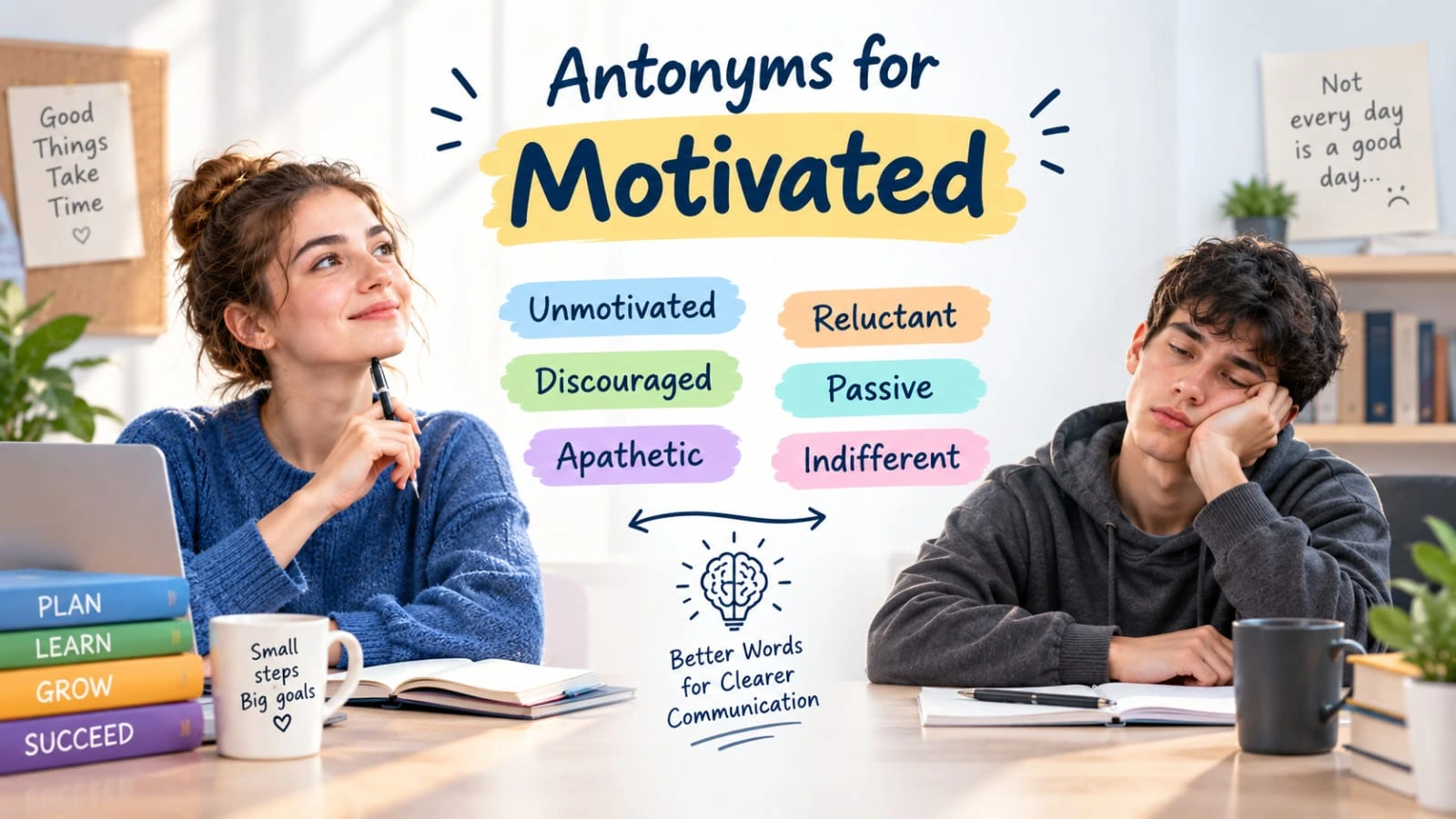
The most common antonyms for motivated are unmotivated, discouraged, apathetic, indifferent, unwilling, reluctant, passive, and disinterested.
Quick Answer
The strongest and most direct antonym of motivated is unmotivated. Depending on the situation, other opposites include discouraged when someone has lost confidence, apathetic when they lack interest, and reluctant when they are unwilling to act.
Quick Comparison
| Word | Meaning | Example |
|---|---|---|
| Motivated | Eager and willing to achieve something | She is motivated to improve her English. |
| Unmotivated | Lacking desire or energy to act | He felt unmotivated after repeated failures. |
| Discouraged | Having lost confidence or enthusiasm | She became discouraged after the poor result. |
| Apathetic | Showing little interest or concern | The students seemed apathetic about the activity. |
| Reluctant | Unwilling or hesitant to do something | He was reluctant to join the project. |
One-Line Definition
Motivated: Having a strong reason, desire, or willingness to do something.
Main antonym: Unmotivated: Lacking the desire, energy, or reason to take action.
Useful Antonyms for Motivated
1. Unmotivated
Meaning: Lacking the desire, energy, or enthusiasm to do something.
Example:
She felt unmotivated to study after a long day at work.
Usage: This is the most direct and general opposite of motivated.
2. Discouraged
Meaning: Having lost confidence, hope, or enthusiasm because of difficulties or failure.
Example:
He felt discouraged after receiving a low grade.
Usage: Best when something has reduced someone’s motivation.
3. Apathetic
Meaning: Showing little interest, enthusiasm, or concern.
Example:
The employee seemed apathetic about the new project.
Usage: Stronger than simply being unmotivated because it suggests a lack of interest or concern.
4. Indifferent
Meaning: Not caring much about something.
Example:
She was indifferent to the outcome of the competition.
Usage: Focuses on lack of concern rather than lack of energy.
5. Reluctant
Meaning: Unwilling or hesitant to do something.
Example:
He was reluctant to speak in front of the class.
Usage: Appropriate when someone does not want to take a particular action.
6. Unwilling
Meaning: Not wanting or agreeing to do something.
Example:
The student was unwilling to participate in the discussion.
7. Passive
Meaning: Not taking action or showing initiative.
Example:
Instead of contributing ideas, he remained passive during the meeting.
Usage: Describes behavior rather than someone’s internal motivation.
8. Disinterested
Meaning: Not interested in something.
Example:
The audience appeared disinterested in the presentation.
9. Listless
Meaning: Lacking energy, enthusiasm, or interest.
Example:
The team looked listless during the second half of the match.
10. Unenthusiastic
Meaning: Showing little excitement or eagerness.
Example:
She was unenthusiastic about the proposed changes.
11. Hesitant
Meaning: Slow or uncertain about taking action.
Example:
He was hesitant to apply for the position.
12. Aimless
Meaning: Having no clear purpose, direction, or goal.
Example:
Without a clear plan, the project became aimless.
13. Apathetic
Meaning: Showing little emotional involvement or interest.
Example:
Some students became apathetic toward their studies.
Note: Apathetic and indifferent are close, but they are not always interchangeable. Apathetic often suggests a lack of enthusiasm or emotional response, while indifferent emphasizes not caring about the outcome.
14. Uninterested
Meaning: Not wanting to know about or become involved in something.
Example:
He was uninterested in joining the after-school club.
15. Uncommitted
Meaning: Not fully dedicated or willing to support a goal or activity.
Example:
The team struggled because several members were uncommitted to the plan.
16. Reluctant
Meaning: Not willing to do something readily.
Example:
She was reluctant to change her study routine.
17. Demoralized
Meaning: Having lost confidence, hope, or enthusiasm.
Example:
The players felt demoralized after several consecutive losses.
18. Defeated
Meaning: Feeling that one has failed or cannot succeed.
Example:
After several unsuccessful attempts, he felt defeated.
19. Inactive
Meaning: Not taking part in an activity or not taking action.
Example:
The normally active group became inactive during the project.
20. Sluggish
Meaning: Moving or acting with little energy or speed.
Example:
He felt sluggish and found it difficult to begin his work.
Contextual Differences
Not every antonym of motivated means exactly the same thing. The best choice depends on why someone is not motivated.
When someone lacks desire or drive
Use:
- Unmotivated
- Listless
- Unenthusiastic
- Sluggish
Example:
After working for several hours, she became unmotivated and needed a break.
When someone has lost confidence
Use:
- Discouraged
- Demoralized
- Defeated
Example:
He became discouraged after failing the exam twice.
When someone does not care
Use:
- Apathetic
- Indifferent
- Uninterested
Example:
She was indifferent to whether the proposal was accepted.
When someone does not want to act
Use:
- Reluctant
- Unwilling
- Hesitant
Example:
The child was reluctant to answer the question.
When someone does not take initiative
Use:
- Passive
- Inactive
- Uncommitted
Example:
The manager wanted employees to be active rather than passive during meetings.
Motivated vs. Its Opposites
The word motivated describes a person who has a reason, desire, or enthusiasm to act. Its opposites can describe different reasons for a lack of action.
For example:
- Unmotivated → lacks drive.
- Discouraged → has lost confidence.
- Apathetic → lacks interest or concern.
- Reluctant → does not want to act.
- Passive → does not take initiative.
- Indifferent → does not care about the result.
This distinction is useful because saying someone is unmotivated is not always the same as saying they are reluctant or apathetic.
Grammar and Word Class
Motivated is usually an adjective.
- She is motivated to succeed.
- He became discouraged after the setback.
- They were reluctant to participate.
- The workers seemed unenthusiastic.
The most direct negative form is unmotivated, formed with the prefix un-.
Common patterns
motivated to + verb
She is motivated to learn.
reluctant to + verb
He is reluctant to speak.
unwilling to + verb
They are unwilling to cooperate.
discouraged by + noun
She was discouraged by the result.
Common Mistake
Do not treat every word meaning “not motivated” as a perfect replacement for unmotivated.
❌ He was reluctant because he had no energy to work.
✅ He was unmotivated because he had no desire to work.
Reluctant means unwilling or hesitant, while unmotivated means lacking motivation or drive.
Expert Tip
Choose the antonym according to the reason for the lack of motivation. If someone has lost confidence, use discouraged; if they do not care, use apathetic or indifferent; if they simply lack drive, unmotivated is usually the best choice.
Short Questions & Answers
What is the most common antonym of motivated?
The most common and direct antonym of motivated is unmotivated, meaning lacking the desire, energy, or enthusiasm to do something.
Is discouraged the same as unmotivated?
Not exactly. Discouraged usually means that someone has lost confidence or enthusiasm because of a setback, while unmotivated simply means lacking motivation.
What is the opposite of motivated at work?
Depending on the situation, useful opposites include unmotivated, unenthusiastic, passive, uncommitted, and apathetic.
What is a strong opposite of motivated?
Demoralized can be a strong contextual opposite when someone has lost confidence, hope, or enthusiasm after repeated difficulties.
Is reluctant an antonym of motivated?
Reluctant can function as a contextual opposite when motivation means willingness to take a particular action. However, it specifically means hesitant or unwilling, not simply lacking motivation.
Key Takeaways
The best general antonym for motivated is unmotivated. Other useful opposites describe different situations: discouraged suggests lost confidence, apathetic suggests little interest, reluctant suggests unwillingness, and passive suggests a lack of initiative. Choosing the right word makes your English more precise.
Antonyms for Opposed: What Words Mean the Reverse?

I’m Daniel Carter, a language enthusiast and content writer focused on the fascinating world of antonyms and vocabulary. I break down word meanings and opposites into simple, practical guides helping readers build a richer vocabulary, understand language more deeply, and speak or write with greater confidence.