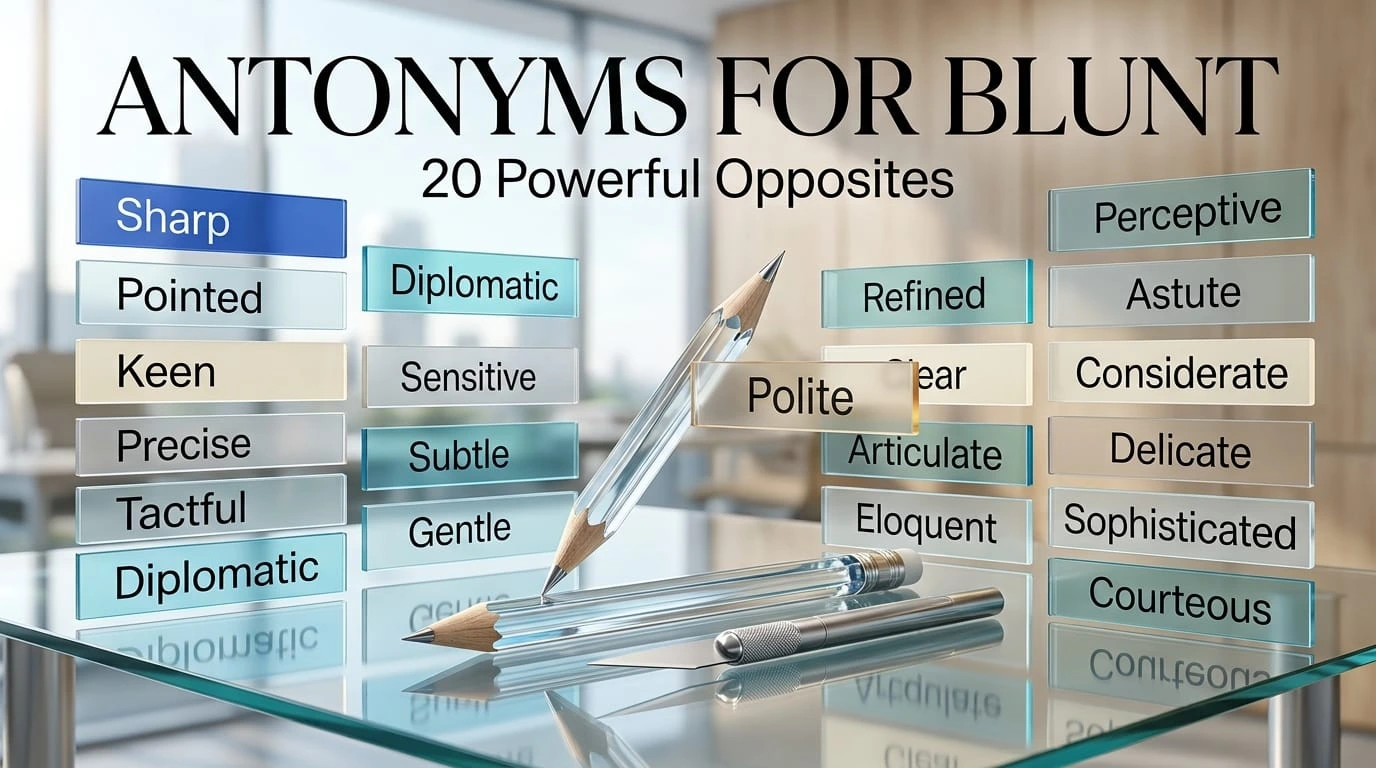
Common antonyms for blunt include sharp, pointed, tactful, diplomatic, subtle, gentle, polished, precise, direct, keen, sharp-edged, and penetrating, depending on whether blunt describes an object, speech, personality, or effect.
What Is the Opposite of Blunt?
The strongest antonym of blunt depends on how the word is being used. For a physical object, the opposite is usually sharp or pointed. For speech or behavior, tactful, diplomatic, or gentle may be better opposites. When blunt means to weaken an effect, intensify or sharpen can express the opposite.
Quick Answer
Sharp is the most common opposite of blunt when talking about the edge or point of an object. However, blunt also describes direct speech, insensitive behavior, or a weakened effect. In those contexts, tactful, diplomatic, subtle, pointed, sharpen, and intensify may be appropriate opposites.
Quick Comparison
| Word | Meaning | Example |
|---|---|---|
| Blunt | Having no sharp edge or being very direct | The knife has a blunt edge. |
| Sharp | Having a fine edge or point | The knife has a sharp blade. |
| Tactful | Careful not to offend others | She gave a tactful response. |
| Diplomatic | Careful and skillful in dealing with people | He gave a diplomatic answer. |
| Pointed | Expressing something clearly and strongly | She asked a pointed question. |
| Sharpen | To make something sharper or more effective | The debate sharpened his argument. |
One-Line Definition
Blunt: Having a dull edge or point, or expressing something in a very direct way.
Main antonym: Sharp having a fine edge or point, or showing quickness and precision.
Useful Antonyms for Blunt
1. Sharp
Sharp is the clearest antonym when blunt describes an object with a dull edge.
The old scissors were blunt, but the new ones are sharp.
It can also describe a person who is mentally quick or perceptive.
She has a sharp mind and notices small details.
2. Pointed
Pointed describes something with a sharp physical point. It can also describe language that is deliberately clear, forceful, or critical.
He used a pointed question to challenge the speaker.
3. Keen
Keen can contrast with blunt when referring to a sharp edge, strong perception, or mental alertness.
The hunter carried a knife with a keen edge.
4. Tactful
When blunt describes speech that may be too direct or insensitive, tactful is a useful opposite.
Instead of being blunt, she gave a tactful response.
5. Diplomatic
Diplomatic is appropriate when someone communicates carefully to avoid conflict or offense.
His diplomatic answer prevented the discussion from becoming an argument.
6. Sensitive
Sensitive can contrast with blunt when describing a person’s awareness of other people’s feelings.
She was sensitive to how her comments might affect her colleague.
7. Considerate
Considerate emphasizes thoughtfulness toward other people’s feelings.
He was considerate when explaining the mistake.
8. Gentle
Gentle can contrast with blunt when communication is soft, careful, or less harsh.
She used a gentle tone when delivering the criticism.
9. Polite
Polite is a useful contextual opposite when blunt describes speech that sounds rude or overly direct.
He was polite rather than blunt when discussing the problem.
10. Courteous
Courteous means showing good manners and respect toward others.
The manager remained courteous even during the disagreement.
11. Subtle
Subtle contrasts with blunt when an idea or message is expressed indirectly rather than openly.
Her subtle criticism was easy to miss.
12. Indirect
Indirect can be an opposite of blunt in communication because it avoids stating something in the most direct way.
He gave an indirect answer instead of saying no.
13. Diplomatic
Diplomatic is especially useful in professional or sensitive situations where a blunt statement could cause tension.
She took a diplomatic approach to the disagreement.
14. Nuanced
Nuanced describes communication that recognizes fine distinctions rather than presenting something in an overly simple or forceful way.
His nuanced explanation considered both sides of the issue.
15. Delicate
Delicate can contrast with blunt communication when the subject requires careful handling.
The doctor used delicate language to discuss the difficult subject.
16. Refined
Refined may contrast with bluntness when discussing polished language, manners, or expression.
Her refined style made the criticism sound less harsh.
17. Precise
Precise can contrast with blunt when the intended meaning is accurate and carefully expressed.
The report used precise language to explain the findings.
18. Articulate
Articulate describes someone who expresses ideas clearly and effectively. It can contrast with a blunt communication style when the focus is on careful expression.
He was articulate when explaining the complicated issue.
19. Sharp-edged
Sharp-edged is a physical contrast to a blunt object.
Be careful with the sharp-edged piece of metal.
It can also describe something figuratively harsh or forceful, so context matters.
20. Penetrating
Penetrating can describe a sharp physical quality or an insight that reaches deeply into a subject.
She asked a penetrating question about the research.
21. Sharpen
When blunt is used as a verb meaning “to make less sharp,” its direct opposite is sharpen.
The tool became blunt after years of use, so he sharpened it.
22. Intensify
When blunt means to reduce the force or effect of something, intensify can express the opposite idea.
The new evidence intensified the public debate.
Blunt Antonyms by Context
Because blunt has more than one meaning, choosing the right antonym depends on the sentence.
When blunt describes an object
Use:
- sharp
- pointed
- keen
- sharp-edged
Example:
The blunt blade could not cut the rope.
Opposite:
The sharp blade cut through the rope easily.
When blunt describes speech
Use:
- tactful
- diplomatic
- polite
- courteous
- gentle
- subtle
- indirect
- nuanced
Example:
His blunt comment upset his coworker.
Opposite:
His tactful comment made the discussion easier.
When blunt describes a person
Use:
- tactful
- sensitive
- considerate
- diplomatic
- polite
Example:
She can be blunt when giving feedback.
Opposite:
She is tactful when giving feedback.
When blunt is a verb
If blunt means to make something less sharp, use:
sharpen
The repeated use blunted the blade.
The mechanic sharpened the blade.
If blunt means to reduce an effect, use contextual words such as:
- intensify
- strengthen
- heighten
- increase
The medication blunted the pain.
The injury intensified the pain.
Blunt vs. Sharp
Blunt and sharp are the clearest opposites when talking about physical objects.
- Blunt = lacking a sharp edge or point
- Sharp = having a fine edge or point
The pencil is blunt.
The pencil is sharp.
This contrast also works figuratively in some situations:
He gave a blunt answer.
She gave a sharp and perceptive response.
However, sharp does not always mean “polite.” If you are talking specifically about someone’s communication style, tactful or diplomatic may be a more precise opposite of blunt.
Blunt vs. Tactful
These words are especially useful when discussing communication.
Blunt communication states something very directly and may sound harsh.
Tactful communication considers how the listener may feel and chooses words carefully.
Compare:
Blunt: Your presentation was confusing.
Tactful: Your presentation could be clearer in a few places.
Both statements communicate criticism, but the second is more tactful.
Blunt vs. Diplomatic
Diplomatic is stronger than simply being polite. It suggests handling a difficult or sensitive situation skillfully.
The manager was blunt about the company’s problems.
The manager was diplomatic when discussing the company’s problems.
For workplace writing, diplomatic is often a better contrast with blunt than nice or friendly.
Grammar and Word Class
Blunt can function as both an adjective and a verb.
As an adjective
The knife is blunt.
He was blunt about the problem.
Useful adjective opposites include:
- sharp
- pointed
- tactful
- diplomatic
- gentle
- subtle
- precise
As a verb
The constant use blunted the blade.
Useful verb opposites include:
- sharpen
- strengthen
- intensify
- heighten
- increase
The correct antonym depends on which meaning of blunt is being used.
Common Mistakes
❌ Using “sharp” for every meaning
She was sharp when she told him his work was terrible.
If you mean she communicated carefully and avoided offense, tactful or diplomatic is a better opposite of blunt.
✅ Better
She was tactful when she told him his work needed improvement.
❌ Treating “polite” and “blunt” as perfect opposites
A person can be blunt but polite. Being direct does not automatically mean being rude.
✅ Better
Blunt describes directness, while polite describes manners. They can overlap, but they are not exact opposites in every situation.
Expert Tip
Don’t automatically choose sharp as the opposite of blunt. First identify the meaning. If blunt describes a knife, use sharp. If it describes someone’s communication style, tactful or diplomatic is usually more precise.
Mini Practice
Choose the best antonym for blunt:
1. The chef replaced the blunt knife with a ____ one.
A. diplomatic
B. sharp
C. subtle
Answer: B. sharp
2. Instead of giving a blunt response, the manager gave a ____ explanation.
A. tactful
B. pointed
C. keen
Answer: A. tactful
Short Questions & Answers
What is the main antonym of blunt?
The main antonym of blunt is sharp, especially when describing the edge or point of an object.
What is the opposite of blunt when talking about a person?
When blunt describes someone’s communication style, tactful, diplomatic, or considerate can be appropriate opposites.
What is the opposite of blunt speech?
The best opposite depends on the context. Tactful, diplomatic, gentle, and subtle are useful contrasts.
Is sharp the opposite of blunt?
Yes. Sharp is the clearest opposite when blunt describes an object that lacks a sharp edge or point.
What is the verb opposite of blunt?
When blunt means “to make less sharp,” the direct verb opposite is sharpen.
Can polite be the opposite of blunt?
Polite can contrast with blunt when bluntness is perceived as rude, but it is not a perfect antonym. Tactful or diplomatic is often more precise.
Key Takeaways
The best antonym for blunt depends on its meaning. Sharp is the strongest opposite for physical objects, while tactful, diplomatic, gentle, and subtle work better for communication. When blunt is a verb meaning to reduce sharpness, sharpen is the direct opposite.
Antonyms for Silly: 25 Smart Opposites to Know

I’m Moazama Akbar, an English language researcher and content writer with a passion for helping people build stronger vocabulary and language skills. I create clear, well-researched guides on antonyms, opposite words, and word meanings, designed to make English learning simple, practical, and enjoyable for students, writers, and learners everywhere.