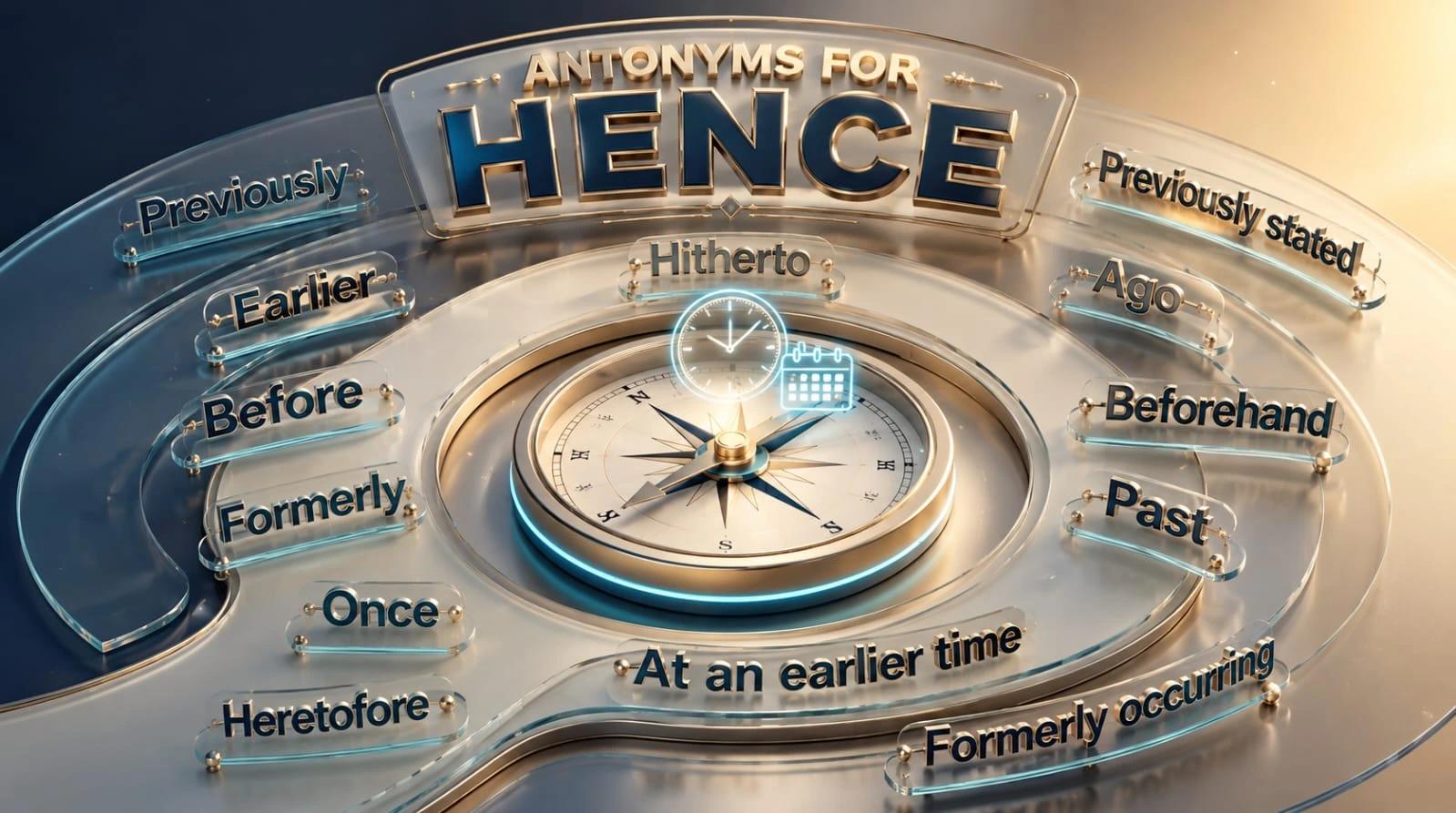
Common contextual antonyms for hence include previously, before, earlier, formerly, there, then, until now, from the past, and at an earlier time, depending on how hence is used.
Quick Answer
Hence does not have one direct antonym. It usually means “from now” or “for this reason,” so its opposite depends on the context. For time, words such as previously, earlier, and before can contrast with hence. For cause and result, phrases such as despite this or regardless of this may provide the opposite idea.
Quick Comparison
| Word | Meaning | Example |
|---|---|---|
| Hence | From now or from this point; therefore | The train leaves hence in two hours. |
| Earlier | At a previous time | The train left earlier today. |
| Before | At a time preceding another time | I had seen him before. |
| Therefore | For that reason | It was raining; therefore, we stayed inside. |
| Despite this | Regardless of the stated fact | It was raining; despite this, we went outside. |
One-Line Definition
Hence: An adverb meaning “from now,” “from this time,” or “for this reason.”
Main contextual opposite: Earlier referring to a time before the present or a stated point.
Core Antonyms and Contrasting Words
1. Earlier
Meaning: At a time before now or before another stated time.
Example:
She arrived earlier than expected.
Best context: Use it as a time-based contrast to hence.
2. Before
Meaning: At or during a time earlier than another time.
Example:
I had visited the city before.
Best context: Useful when contrasting future distance with past time.
3. Previously
Meaning: At an earlier time.
Example:
The issue had been discussed previously.
Best context: Common in formal and academic writing.
4. Formerly
Meaning: In the past, but not now.
Example:
The building was formerly a school.
Best context: Best when something was true in the past but has changed.
5. Earlier on
Meaning: At an earlier point in a period or process.
Example:
We discussed this problem earlier on.
6. In the Past
Meaning: During a time before the present.
Example:
People used this method in the past.
7. Until Now
Meaning: Up to the present time.
Example:
Until now, we had no reason to worry.
Note: This is not a strict antonym, but it can contrast with future-oriented hence in some contexts.
8. From Then
Meaning: Starting from a previous or specified time.
Example:
From then, everything changed.
9. At That Time
Meaning: During a particular past period.
Example:
At that time, the town was much smaller.
10. Back Then
Meaning: At a particular time in the past.
Example:
Back then, we had no internet access.
11. There
Meaning: In or at that place.
Example:
She had lived there for several years.
Note: This only contrasts with hence when hence is being understood in an old or directional sense.
12. Elsewhere
Meaning: In or to another place.
Example:
The documents were stored elsewhere.
13. Despite This
Meaning: Regardless of the fact just mentioned.
Example:
The weather was poor. Despite this, the event continued.
Best context: This can contrast with hence when hence means “therefore.”
14. Nevertheless
Meaning: In spite of what has just been said.
Example:
The task was difficult; nevertheless, she completed it.
15. Nonetheless
Meaning: Despite that fact.
Example:
The plan was risky. Nonetheless, they accepted it.
16. Regardless
Meaning: Without being affected by something.
Example:
Regardless of the cost, they continued.
17. Irrespective
Meaning: Without considering or being affected by something.
Example:
The rule applies irrespective of age.
18. Instead
Meaning: As an alternative to something.
Example:
We did not take the bus. Instead, we walked.
19. Conversely
Meaning: In an opposite or contrasting way.
Example:
The first method is cheap. Conversely, the second is expensive.
20. On the Contrary
Meaning: Used to introduce an idea that is opposite to what was just stated.
Example:
I did not find the task boring. On the contrary, I enjoyed it.
Contextual Antonyms of Hence
The important thing to remember is that hence has two main modern uses, and they need different contrasting expressions.
When hence means “from now”
Example:
The meeting will begin hence in one hour.
Possible contrasting time expressions include:
- earlier
- before
- previously
- formerly
- in the past
- back then
These point backward rather than forward.
When hence means “therefore”
Example:
The road was closed; hence, we took another route.
There is no perfect one-word antonym. The contrasting idea can be expressed with:
- despite this
- nevertheless
- nonetheless
- regardless
- instead
- on the contrary
These expressions introduce contrast rather than a result.
Is There a True Antonym for Hence?
Not really. Hence is unusual because its meaning changes with context. When it means “from now,” a past-time word such as earlier or previously can provide the clearest contrast. When it means “therefore,” a contrast marker such as nevertheless or despite this is usually more natural than a supposed direct antonym.
Grammar and Word Class
Hence is an adverb.
It is mainly used in two ways:
1. Time
The results will be available three days hence.
Here, hence means three days from now.
2. Result or reason
The road was blocked; hence, the delay.
Here, hence means therefore or for this reason.
Its contrasting words are not always the same because they depend on which meaning is being used.
Common Mistake
A common mistake is assuming that “therefore” is the opposite of hence.
❌ Therefore is the antonym of hence.
✅ Hence can mean “therefore,” so words such as “nevertheless” or “despite this” may express a contrasting idea.
Therefore and hence are actually close in meaning when both introduce a result.
Expert Tip
When you need an opposite for hence, first replace it mentally with “from now” or “therefore.” Then choose the contrasting expression. This simple test prevents most incorrect antonym choices.
Short Questions & Answers
What is the opposite of hence?
There is no single direct antonym. Earlier, before, and previously work as contextual opposites when hence refers to future time.
Is therefore the opposite of hence?
No. Therefore and hence can both mean “for this reason” or “as a result,” so they are similar rather than opposite.
What is the opposite of hence in time?
For the time-related meaning, earlier, before, previously, and formerly can provide the clearest contrast.
What is the opposite of hence meaning therefore?
There is no exact one-word antonym. Nevertheless, despite this, and nonetheless can introduce a contrasting idea.
Is hence still used in modern English?
Yes. Hence is still correct, but it is more common in formal, literary, or concise writing than in everyday conversation.
Conclusion
Hence is a useful but slightly formal English word with more than one meaning. It can refer to a point in the future, as in “two weeks hence,” or introduce a result, as in “hence the problem.” Because of these different meanings, it does not have one universal antonym. Earlier, before, previously, and formerly work well for its time-related meaning, while nevertheless, despite this, and nonetheless can express contrast when hence means “therefore.” The key is to look at the sentence before choosing an opposite. Understanding this difference will help you use hence and its contrasting expressions more naturally and accurately.
5 Antonyms for Life You Should Know

I’m Moazama Akbar, an English language researcher and content writer with a passion for helping people build stronger vocabulary and language skills. I create clear, well-researched guides on antonyms, opposite words, and word meanings, designed to make English learning simple, practical, and enjoyable for students, writers, and learners everywhere.