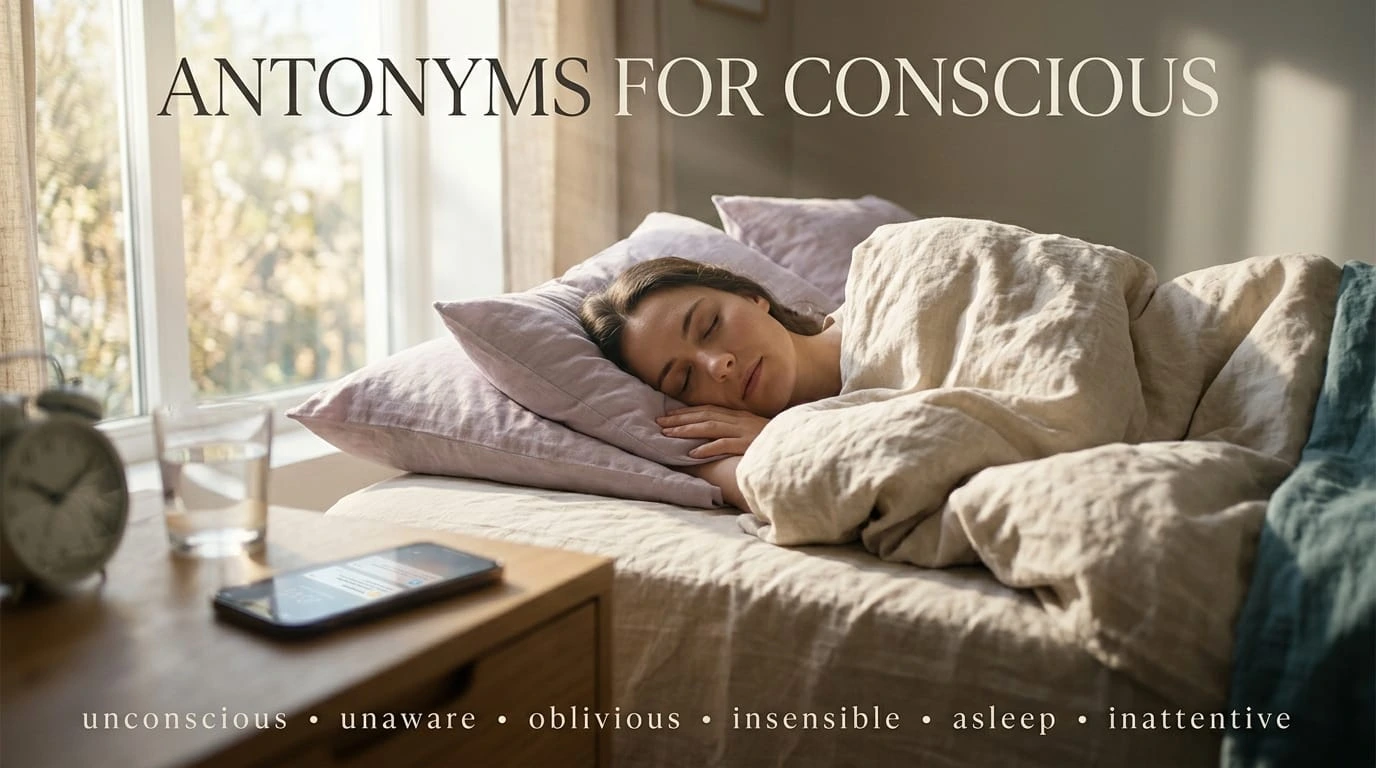
The opposite of conscious is usually “unconscious,” meaning not awake or not aware of what is happening. Depending on context, other antonyms include unaware, oblivious, inattentive, asleep, ignorant, and unmindful.
The Opposite of Conscious at a Glance
The most direct antonym of conscious is unconscious. However, conscious has several related meanings, so the appropriate opposite can change with context.
- Conscious → Unconscious: awake/aware → not awake or not aware
- Conscious → Unaware: aware → not aware
- Conscious → Oblivious: noticing → completely unaware
- Conscious → Asleep: awake → sleeping
- Conscious → Inattentive: paying attention → not paying attention
At a Glance
| Word | Meaning | Example |
| Conscious | Awake and aware | She was conscious of the noise. |
| Unconscious | Not awake or aware | The injured man was unconscious. |
| Unaware | Not knowing about something | He was unaware of the change. |
| Oblivious | Completely unaware | She was oblivious to the warning. |
| Asleep | Not awake | The baby was asleep. |
| Inattentive | Not paying attention | The student was inattentive during class. |
Meaning in Brief
Conscious: aware of your surroundings, thoughts, actions, or feelings; also meaning awake rather than unconscious.
Main antonym: Unconscious not awake, or not aware of something.
What This Guide Covers
After reading this guide, you will understand:
- The strongest antonym of conscious
- Different opposites for different meanings
- How unconscious, unaware, and oblivious differ
- How to use these antonyms naturally in sentences
- Which opposite works best in formal and everyday English
Common Opposites of Conscious
Here are the most useful antonyms of conscious, ranked by how naturally they contrast with its different meanings.
1. Unconscious
Unconscious is the most direct antonym of conscious. It can mean not awake or not aware.
Example:
The patient became unconscious after the accident.
Best for: physical state, awareness, and mental awareness.
2. Unaware
Unaware means not knowing or not realizing something. It is a strong opposite when conscious means aware of a fact or situation.
Example:
She was unaware of the changes to the schedule.
Best for: lack of knowledge or awareness.
3. Oblivious
Oblivious means completely unaware of something, often while it is obvious to others.
Example:
He was oblivious to the noise around him.
Best for: strong or complete lack of awareness.
4. Asleep
Asleep is an appropriate contextual opposite when conscious means awake.
Example:
The child was asleep when the phone rang.
Best for: physical states of being awake versus sleeping.
5. Inattentive
Inattentive means failing to give attention to something.
Example:
The inattentive student missed several important instructions.
Best for: situations involving concentration or attention.
6. Ignorant
Ignorant means lacking knowledge about something. It can contrast with conscious awareness, but it is not a universal antonym of conscious.
Example:
He was ignorant of the risks involved.
Best for: lack of knowledge, especially in formal contexts.
7. Unmindful
Unmindful means not paying attention to or not considering something.
Example:
She was unmindful of the consequences of her decision.
Best for: formal or literary writing.
8. Unobservant
Unobservant describes someone who fails to notice things.
Example:
The unobservant driver failed to notice the warning sign.
Best for: lack of noticing or awareness.
9. Distracted
Distracted means unable to concentrate because your attention is focused elsewhere.
Example:
He was too distracted to notice the message.
Best for: temporary lack of attention.
10. Negligent
Negligent means failing to give proper care or attention. It can oppose conscious only in certain contexts involving deliberate care or consideration.
Example:
The company was negligent about basic safety procedures.
Best for: responsibility and attention rather than general awareness.
Different Meanings, Different Opposites
The opposite of conscious changes depending on what the word means in a sentence.
When conscious means “awake”
The clearest opposite is:
- Unconscious
- Asleep
Example:
The patient was conscious after the operation.
→ The patient was unconscious after the operation.
When conscious means “aware”
The best opposites include:
- Unaware
- Oblivious
- Unmindful
- Ignorant
Example:
She was conscious of the danger.
→ She was unaware of the danger.
When conscious means “paying attention”
Useful opposites include:
- Inattentive
- Distracted
- Unobservant
Example:
He was conscious of the instructions.
→ He was inattentive to the instructions.
When conscious means “deliberate or intentional”
In some contexts, unintentional, accidental, or involuntary may provide the appropriate contrast.
Example:
The movement was conscious and deliberate.
→ The movement was involuntary.
These are contextual opposites rather than direct dictionary antonyms of conscious.
Understanding Each Antonym
Not all antonyms of conscious are interchangeable.
Unconscious is the strongest direct opposite. It can describe someone who is not awake or something done without awareness.
Unaware is more specific to knowledge. Someone can be awake and alert but still be unaware of something.
Oblivious is stronger than unaware and often suggests that someone completely fails to notice something.
Asleep refers specifically to the physical state of sleeping. It should not replace unconscious in every situation.
Inattentive focuses on attention. An inattentive person may be fully awake and conscious but simply not paying attention.
See the Antonyms in Action
Here are natural examples showing how these words work.
- The injured player remained conscious after the fall.
→ The injured player became unconscious after the fall. - Maria was conscious of the loud music.
→ Maria was unaware of the loud music. - He was conscious of everyone watching him.
→ He was oblivious to everyone watching him. - The baby was conscious when her mother entered.
→ The baby was asleep when her mother entered. - The teacher noticed that several students were conscious of the instructions.
→ Several students were inattentive to the instructions. - She was conscious of the possible consequences.
→ She was unmindful of the possible consequences. - The driver was conscious of the warning sign.
→ The driver was unobservant and missed the warning sign. - He made a conscious decision to apologize.
→ His reaction was unintentional.
What Part of Speech Is It?
Conscious is an adjective.
Most of its common antonyms are also adjectives:
- conscious → unconscious
- conscious → unaware
- conscious → oblivious
- conscious → inattentive
- conscious → unmindful
- conscious → unobservant
- conscious → distracted
Some related words belong to different grammatical categories:
- consciousness noun
- unconsciousness noun
- consciously adverb
- unconsciously adverb
A Closer Look at Usage
A useful distinction is that conscious of commonly means aware of something.
Correct:
She was conscious of the problem.
When you mean “not aware,” use unaware of:
Correct:
She was unaware of the problem.
With oblivious, to is commonly used:
Correct:
He was oblivious to the danger.
These patterns help prevent awkward or incorrect substitutions.
The Prefix Pattern
The most direct antonym is formed with the prefix un-:
conscious → unconscious
However, English does not form every antonym by simply adding un-. Words such as unaware, unmindful, and unobservant are established words with their own meanings and usage patterns.
Commonly Confused Opposites
Unconscious vs. Unaware
These words are related but not identical.
- Unconscious can mean not awake.
- Unaware means not knowing or realizing something.
Example:
The man was unconscious after the accident.
The man was unaware of the danger.
Unconscious vs. Subconscious
Subconscious is not a simple antonym of conscious.
The subconscious refers to mental processes that operate below ordinary conscious awareness. Something subconscious can influence a person without being consciously noticed.
Unaware vs. Oblivious
Unaware simply means not knowing.
Oblivious usually suggests a much stronger failure to notice or recognize something.
Example:
I was unaware of the meeting.
He was oblivious to the chaos around him.
Teacher’s Tip
When choosing an antonym for conscious, first ask what conscious means in the sentence: awake, aware, attentive, or deliberate. Then choose the opposite that matches that exact meaning.
Quick Antonym Quiz
1. Which word is the strongest direct opposite of “conscious” when someone is not awake?
A. Inattentive
B. Unconscious
C. Distracted
Answer: B. Unconscious
2. Which word best means “not aware of something”?
A. Unaware
B. Asleep
C. Distracted
Answer: A. Unaware
3. Which word suggests someone is completely unaware of what is happening around them?
A. Oblivious
B. Awake
C. Attentive
Answer: A. Oblivious
Frequently Asked Questions
What is the opposite of conscious?
The most direct opposite of conscious is unconscious. It can mean not awake or not aware. Other contextual opposites include unaware, oblivious, asleep, inattentive, and unmindful.
What is a stronger opposite of conscious?
Unconscious is the strongest direct opposite when conscious means awake or aware. Oblivious can be a stronger contextual opposite when conscious means aware of something.
Is unaware the same as unconscious?
No. Unaware means not knowing or realizing something, while unconscious can mean not awake or not mentally aware.
Is asleep an antonym of conscious?
Asleep can be a contextual antonym when conscious means awake. However, it is not the best opposite in every context.
Is subconscious an antonym of conscious?
No. Subconscious is not a straightforward antonym. It describes mental processes that occur below ordinary conscious awareness.
What to Remember
The best antonym for conscious depends on the meaning:
- Unconscious → not awake or not aware
- Unaware → not knowing
- Oblivious → completely unaware
- Asleep → sleeping
- Inattentive → not paying attention
- Unmindful → not considering or noticing
- Distracted → unable to focus
- Unintentional / involuntary → not deliberate, in specific contexts
The key is simple: match the antonym to the exact sense of “conscious” being used.
Antonyms for Cognitive: 12 Natural Alternatives

I’m Moazama Akbar, an English language researcher and content writer with a passion for helping people build stronger vocabulary and language skills. I create clear, well-researched guides on antonyms, opposite words, and word meanings, designed to make English learning simple, practical, and enjoyable for students, writers, and learners everywhere.