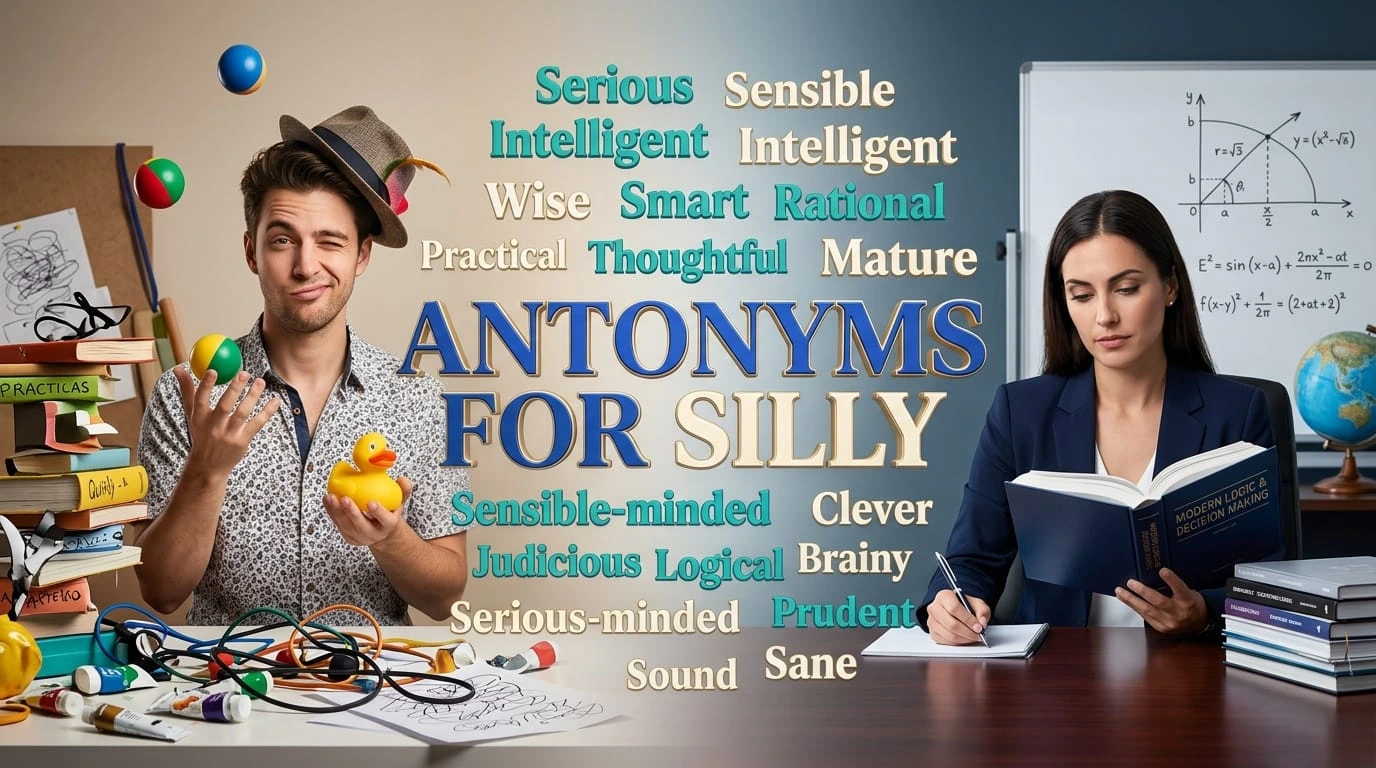
The strongest antonyms for silly are serious, sensible, wise, rational, reasonable, intelligent, mature, thoughtful, practical, logical, responsible, and level-headed.
Quick Answer
The most common antonym of silly is serious. However, several other words can express the opposite depending on the context. Sensible works well for ideas and decisions, wise for judgment, rational for logical thinking, and mature for responsible behavior.
So, while serious is the closest general opposite, it is not always the best replacement.
Silly vs. Its Opposites
| Word | Meaning | Example |
| Silly | Foolish, playful, or lacking good judgment | That was a silly mistake. |
| Serious | Not foolish, playful, or joking | She gave a serious answer. |
| Sensible | Showing good judgment | He made a sensible choice. |
| Wise | Showing sound judgment and experience | Her advice was wise. |
| Rational | Based on logic and reason | We need a rational solution. |
| Mature | Responsible and sensible in behavior | He handled the situation maturely. |
What Does “Silly” Mean?
Silly is an adjective used for someone or something that lacks good sense, seems foolish, or is playful in a way that may not be appropriate.
For example:
- That was a silly question.
- The children were being silly.
- It would be silly to waste so much money.
- She made a silly mistake.
The opposite changes slightly according to meaning. If silly means foolish, sensible or wise may be the best antonym. If it means playful or joking, serious is usually the better opposite.
25 Antonyms for Silly
1. Serious
Serious is the most common general antonym of silly. It describes someone or something that is not playful, foolish, or joking.
Example:
He became serious when the meeting started.
2. Sensible
Sensible means showing good judgment and practical thinking. It is especially useful as the opposite of a silly decision or idea.
Example:
Buying a cheaper car was a sensible decision.
3. Wise
Wise describes someone who demonstrates good judgment, knowledge, or experience.
Example:
It was wise to ask for advice before making a decision.
4. Rational
Rational means based on reason and logical thinking rather than foolish or emotional reactions.
Example:
We need a rational explanation for what happened.
5. Reasonable
Reasonable describes something that makes sense and can be justified logically.
Example:
That sounds like a reasonable suggestion.
6. Intelligent
Intelligent means showing a good ability to understand, learn, or reason.
Example:
She asked an intelligent question during the discussion.
7. Mature
Mature describes responsible, sensible behavior, especially when contrasted with childish or foolish behavior.
Example:
He gave a mature response to the criticism.
8. Thoughtful
Thoughtful means showing careful consideration of people, situations, or consequences.
Example:
That was a thoughtful decision.
9. Practical
Practical means suitable for real situations and focused on what will actually work.
Example:
She offered a practical solution to the problem.
10. Logical
Logical describes thinking or reasoning that follows a clear and sensible pattern.
Example:
His explanation was logical and easy to understand.
11. Responsible
Responsible describes someone who acts carefully and accepts their duties or consequences.
Example:
A responsible employee checks the details before submitting a report.
12. Level-headed
Level-headed describes someone who remains calm and makes sensible decisions.
Example:
She stayed level-headed during the emergency.
13. Rational-minded
Rational-minded describes a person who tends to think logically and reasonably.
Example:
He is rational-minded and rarely makes decisions impulsively.
14. Serious-minded
Serious-minded describes someone who approaches matters with seriousness and purpose.
Example:
She is serious-minded when it comes to her studies.
15. Thoughtful-minded
Thoughtful-minded can describe someone who considers matters carefully rather than acting foolishly or carelessly.
Example:
His thoughtful approach helped the team avoid mistakes.
16. Careful
Careful describes someone who pays attention and avoids unnecessary mistakes or risks.
Example:
Be careful when making an important financial decision.
17. Considerate
Considerate describes someone who thinks about other people’s feelings and needs.
Example:
It was considerate of her to check whether everyone was comfortable.
18. Judicious
Judicious means showing good judgment, especially when making decisions.
Example:
The manager took a judicious approach to the problem.
19. Prudent
Prudent means showing careful judgment and avoiding unnecessary risks.
Example:
Saving some money for emergencies is a prudent choice.
20. Sound
Sound can describe an idea, decision, or judgment that is sensible and reliable.
Example:
The committee made a sound decision.
21. Well-considered
Well-considered describes something carefully thought about before a decision is made.
Example:
Her proposal was well-considered and practical.
22. Serious-minded
Serious-minded emphasizes a focused and purposeful attitude rather than a playful or foolish one.
Example:
He is serious-minded about his career.
23. Sensible-minded
Sensible-minded describes someone who generally thinks and acts sensibly.
Example:
She is sensible-minded and considers the consequences first.
24. Disciplined
Disciplined describes someone who controls their behavior and follows a sensible plan instead of acting carelessly.
Example:
A disciplined approach helped him finish the project on time.
25. Astute
Astute means quick to understand situations and make intelligent judgments.
Example:
The astute manager noticed the problem immediately.
Choosing the Right Antonym for “Silly”
Not every antonym of silly works in every sentence. The best word depends on what silly means in context.
For a silly person
Use:
- wise
- intelligent
- sensible
- mature
- level-headed
- astute
Example:
❌ He is silly about important decisions.
✅ He is wise about important decisions.
For a silly idea
Use:
- sensible
- reasonable
- rational
- logical
- practical
- sound
Example:
❌ That’s a silly idea.
✅ That’s a reasonable idea.
For silly behavior
Use:
- serious
- mature
- responsible
- thoughtful
- disciplined
Example:
❌ His silly behavior annoyed everyone.
✅ His mature behavior impressed everyone.
For a silly mistake
Use:
- careful
- thoughtful
- well-considered
- judicious
Example:
❌ I made a silly mistake.
✅ I should have been more careful.
Strongest Antonyms for silly by Context
| If “silly” describes… | Best antonyms |
| A person | Wise, sensible, intelligent |
| An idea | Rational, reasonable, logical |
| A decision | Sensible, prudent, judicious |
| Behavior | Mature, responsible, serious |
| A mistake | Careful, thoughtful |
| A joke or attitude | Serious |
| A plan | Practical, sound, well-considered |
Serious vs. Sensible
Serious and sensible are two of the most useful antonyms for silly, but they are not interchangeable in every situation.
She gave me a serious answer.
Sensible focuses on good judgment or practicality.
She gave me a sensible answer.
A person can be serious without being sensible, and someone can be sensible without being serious.
Silly vs. Wise
Wise is a particularly strong opposite when silly means foolish or lacking judgment.
Compare:
- He made a silly decision.
- He made a wise decision.
The contrast is clear: silly suggests poor judgment, while wise suggests good judgment.
However, wise is not normally the opposite of silly when silly means playful.
The children were being silly.
The natural opposite here would be:
The children became serious.
Silly vs. Rational
Rational is especially useful when talking about reasoning, arguments, beliefs, or decisions.
- a silly argument → a rational argument
- a silly explanation → a rational explanation
- a silly decision → a rational decision
For everyday conversation, sensible or reasonable may sound more natural than rational.
Grammar and Word Class
Silly is an adjective.
It can describe:
- a person
- an idea
- a question
- a mistake
- behavior
- a decision
- a situation
Most of its useful antonyms are also adjectives, including serious, sensible, wise, rational, reasonable, intelligent, mature, practical, logical, and responsible.
The related adverbs can also be useful:
- silly → sillily is possible but uncommon
- sensible → sensibly
- wise → wisely
- rational → rationally
- serious → seriously
- logical → logically
Common Mistakes
Mistake 1: Assuming “serious” is always the best antonym
Not necessarily.
If you mean a silly idea, sensible or reasonable may be more accurate.
❌ We need a serious solution.
✅ We need a sensible solution.
Mistake 2: Using “intelligent” for every context
Intelligent refers mainly to mental ability. It does not always mean responsible or sensible.
She is intelligent but sometimes makes careless decisions.
So intelligent can be an antonym of silly when silly means foolish, but it is not a universal replacement.
Mistake 3: Treating “silly” as always negative
Silly can also describe playful or humorous behavior.
My little brother was being silly.
In this context, serious is a better opposite than wise or rational.
Example Sentences
Here are natural examples showing different antonyms:
- Instead of making a silly decision, she made a sensible one.
- His serious expression showed that he was no longer joking.
- She gave me wise advice.
- We need a rational explanation.
- That is a reasonable request.
- He offered a practical solution.
- The manager made a sound decision.
- She remained level-headed during the crisis.
- His mature response surprised everyone.
- The proposal was carefully considered and well-considered.
Expert Tip
Think about what kind of “silly” you mean before choosing an antonym. If it describes playfulness, choose serious. If it describes poor judgment, choose sensible, wise, or reasonable.
Short Questions & Answers
What is the opposite of silly?
The most common opposite of silly is serious. However, sensible, wise, rational, reasonable, and mature can be better depending on the context.
What is a strong antonym for silly?
Sensible is a strong antonym when silly means foolish or lacking good judgment. Serious is stronger when silly means playful or joking.
Is “serious” the exact opposite of “silly”?
Not always. Serious is the closest general opposite, but words such as sensible and wise may express a more precise contrast when discussing judgment or decisions.
What is the opposite of a silly idea?
The best choices include sensible, reasonable, rational, logical, practical, and sound.
What is the opposite of a silly person?
Depending on the intended meaning, good choices include wise, sensible, intelligent, mature, and level-headed.
What is the opposite of silly behavior?
Serious, mature, responsible, thoughtful, or disciplined can work depending on the situation.
Key Takeaway
Serious is the strongest general antonym for silly, but context determines the most accurate choice. Use sensible for good judgment, wise for sound judgment, rational for logical thinking, mature for responsible behavior, and practical for workable ideas or solutions. Choosing the right antonym makes your writing more precise and natural.
Antonyms for Texture: 25 Opposite Words Explained

I’m Noreen Akbar, an English language researcher and content writer with a passion for words,their meanings, origins, and the subtle differences between them. I specialize in antonyms and vocabulary, creating clear, easy-to-follow guides that help readers expand their word power, sharpen their understanding of language, and express themselves with greater clarity and confidence.