The Main Antonym Explained
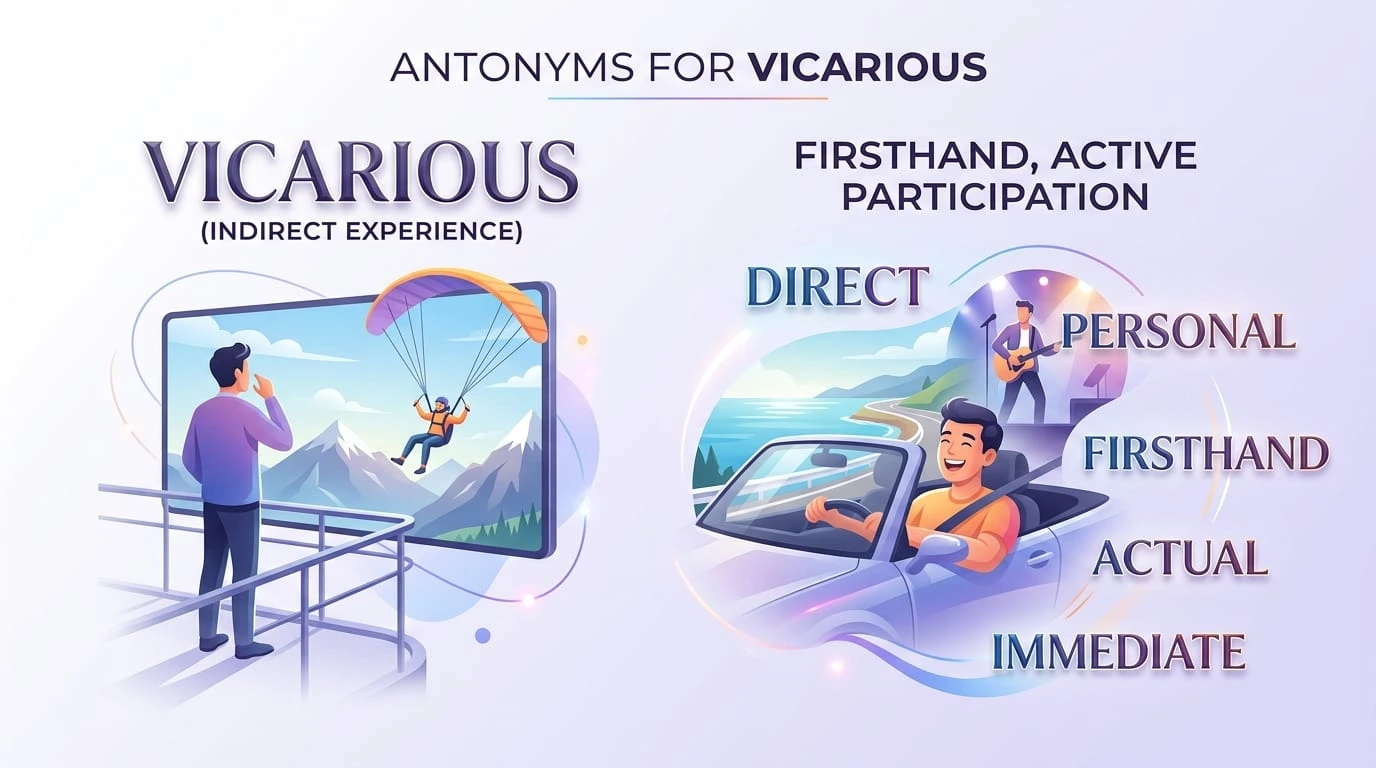
The strongest antonym of vicarious is firsthand, meaning experienced personally rather than through another person. Depending on context, useful opposites include direct, personal, experiential, in-person, and self-experienced. These words emphasize that someone gains knowledge, feelings, or experience directly instead of indirectly through another person.
The Short Answer
The most common antonym for vicarious is firsthand.
Vicarious describes something experienced indirectly through another person, while firsthand describes something experienced personally or directly.
For example:
- Vicarious: She experienced the excitement vicariously through her brother’s stories.
- Firsthand: She experienced the excitement firsthand during the trip.
Other contextual opposites include direct, personal, experiential, in-person, and self-experienced.
Vicarious and Its Antonym
| Word | Meaning | Example |
| Vicarious | Experienced indirectly through another person | He enjoyed the team’s victory vicariously through his son. |
| Firsthand | Experienced personally or directly | She learned about the accident firsthand. |
| Direct | Involving immediate personal experience or contact | We received direct information from the witness. |
| Personal | Relating to one’s own experience | He shared his personal experience of living abroad. |
Meaning in Brief
Vicarious: Experienced, felt, or imagined through another person rather than directly.
Main antonym: Firsthand Experienced personally through one’s own direct involvement.
The word vicarious is usually an adjective. It often describes emotions, experiences, knowledge, pleasure, or suffering that a person experiences indirectly.
What This Guide Covers
After reading this guide, you will know:
- The strongest antonym of vicarious
- What vicarious means
- The difference between vicarious and firsthand experiences
- Other useful opposites for different contexts
- How to use these antonyms naturally in sentences
- Which words are true opposites and which are only contextual alternatives
Common Opposites of Vicarious
1. Firsthand
Firsthand is the clearest and most natural opposite of vicarious.
It means experiencing or learning something personally rather than receiving the experience through another person.
Example:
I learned about the difficult working conditions firsthand.
Vicarious: You experience something through someone else.
Firsthand: You experience it yourself.
2. Direct
Direct can contrast with vicarious when something comes through personal or immediate experience rather than another person’s experience.
Example:
The journalist had direct experience of the situation.
The word is especially useful when discussing information, contact, observation, or experience.
3. Personal
Personal emphasizes that an experience belongs to the individual who experienced it.
Example:
She spoke from personal experience about the challenges of teaching abroad.
It is a contextual antonym rather than a perfect dictionary opposite.
4. Experiential
Experiential relates to learning or understanding through one’s own experience.
Example:
The course uses experiential learning instead of relying only on other people’s accounts.
This word is more common in educational and academic writing.
5. In-Person
In-person emphasizes direct physical participation or presence.
Example:
The students attended the workshop in person instead of watching it through someone else’s experience.
It can contrast with vicarious participation in certain situations.
6. Self-Experienced
Self-experienced means experienced personally by the individual.
Example:
His conclusions came from self-experienced challenges rather than secondhand stories.
This expression is understandable but less common than firsthand or personal.
7. Immediate
Immediate can work as a contextual opposite when vicarious refers to something experienced indirectly or at a distance.
Example:
The emergency required immediate, direct involvement rather than observation from a distance.
It is not a universal antonym, so it should be used only where the context supports the contrast.
8. Participatory
Participatory describes involvement in an activity rather than merely experiencing it through someone else.
Example:
The program uses a participatory approach that allows students to take part directly.
This is particularly useful in education, research, and group activities.
9. Involved
Involved may contrast with vicarious when the intended meaning is active personal participation.
Example:
She was directly involved in the project rather than following it through her colleague.
10. Personal Experience
Personal experience is a useful phrase when contrasting one’s own experience with a vicarious experience.
Example:
His advice came from personal experience, not from watching others face the same problem.
11. Directly Experienced
Directly experienced clearly emphasizes personal involvement.
Example:
The effects of the storm were directly experienced by residents in the area.
This phrase is particularly useful when clarity matters more than vocabulary variety.
12. First-Person
First-person can be a contextual opposite when discussing narratives or accounts based on the speaker’s own experience.
Example:
The documentary includes first-person accounts from people who witnessed the event.
It should not be treated as a universal antonym of vicarious.
13. Hands-On
Hands-on means involving active personal participation or practical experience.
Example:
Students gained hands-on experience instead of learning only from other people’s descriptions.
This is especially useful in education, training, and practical work.
14. Self-Directed
Self-directed can contrast with vicarious learning in some educational contexts because it emphasizes the learner’s own active process.
Example:
The students completed a self-directed project based on their own investigation.
However, self-directed is not a direct antonym of vicarious in every context.
15. Actual Experience
Actual experience can emphasize what someone has personally experienced rather than imagined or experienced indirectly.
Example:
The training combines theoretical knowledge with actual experience.
Like personal, this is a contextual contrast rather than a perfect lexical antonym.
Choosing the Right Antonym
The best opposite of vicarious depends on what you are describing.
When vicarious means experienced through another person
Use:
- firsthand
- direct
- personal
- self-experienced
Example:
She heard about the expedition vicariously through her friends.
Better direct contrast:
She experienced the expedition firsthand.
When vicarious refers to indirect learning
Use:
- experiential
- hands-on
- participatory
- firsthand
Example:
Instead of learning vicariously from documentaries, students gained hands-on experience.
When vicarious refers to indirect participation
Use:
- in-person
- direct
- involved
- participatory
Example:
He followed the event online, while his sister attended it in person.
How These Antonyms Differ
Not every word in an antonym list has exactly the same meaning as vicarious.
Firsthand is the strongest general opposite because it specifically contrasts personal experience with indirect experience.
Direct emphasizes an immediate connection or experience.
Personal focuses on one’s own experience.
Experiential emphasizes learning or understanding through experience.
Hands-on highlights active practical participation.
In-person focuses mainly on physical presence.
This distinction matters because replacing vicarious with any of these words without considering the sentence can change the intended meaning.
Examples in Context
Vicarious vs. Firsthand
Vicarious:
He enjoyed the excitement vicariously by watching his daughter compete.
Firsthand:
He experienced the excitement firsthand when he joined the competition.
Vicarious vs. Direct
Vicarious:
She understood the situation through her friend’s story.
Direct:
She gained direct knowledge of the situation from the people involved.
Vicarious vs. Personal
Vicarious:
His feelings about parenthood came partly from watching his brother raise children.
Personal:
His views about parenthood changed after his own personal experience.
Vicarious vs. Experiential
Vicarious:
The students learned about laboratory work by watching demonstrations.
Experiential:
The students learned through experiential activities in the laboratory.
Vicarious vs. Hands-On
Vicarious:
The trainees watched an expert perform the procedure.
Hands-on:
The trainees received hands-on practice with the procedure.
See the Antonyms in Action
Here are several natural sentences using the strongest opposites:
- She learned about the culture firsthand during her visit.
- We received direct information from the witnesses.
- His opinion was based on personal experience.
- The students preferred hands-on learning.
- The workshop provided an experiential approach to language learning.
- They attended the conference in person.
- The volunteers were actively involved in the project.
- The research included first-person accounts from participants.
- The training encouraged participatory learning.
- He understood the problem better after gaining direct experience.
What Part of Speech Is It?
Vicarious is an adjective.
Examples:
- vicarious experience
- vicarious pleasure
- vicarious excitement
- vicarious learning
- vicarious satisfaction
Its most natural antonym, firsthand, is also commonly used as an adjective and adverb.
Adjective:
She had firsthand knowledge of the situation.
Adverb:
He experienced the event firsthand.
Other useful opposites, such as direct, personal, experiential, and participatory, are also commonly used as adjectives.
A Useful Language Tip
When you need one clear opposite for vicarious, choose firsthand.
For example:
I know about the experience vicariously through my friend.
becomes:
I know about the experience firsthand because I experienced it myself.
Firsthand makes the direct-versus-indirect contrast especially clear.
Commonly Confused Opposites
A common mistake is treating every word associated with direct experience as a perfect antonym of vicarious.
For example, personal is often a useful contextual opposite, but it does not always mean the exact opposite of vicarious.
Similarly, in-person means physically present, while firsthand specifically emphasizes personal experience or knowledge.
Therefore:
- Firsthand = personally experienced or obtained
- Direct = immediate or without an intermediary
- Personal = belonging to or involving oneself
- In-person = physically present
- Hands-on = actively and practically involved
Questions About Vicarious and Its Antonyms
What is the opposite of vicarious?
The most common opposite of vicarious is firsthand. Vicarious experiences happen indirectly through another person, while firsthand experiences happen through your own direct experience.
What are the five antonyms?
Five useful antonyms or contextual opposites of vicarious are firsthand, direct, personal, experiential, and hands-on. Among these, firsthand is the clearest general antonym.
What is another word for “vicarious”?
There is no single replacement that works in every sentence. Depending on context, indirect, secondhand, sympathetic, or derived through another person may express related meanings. The best choice depends on the exact use of vicarious.
What does vicarious mean?
Vicarious means experiencing something indirectly through another person rather than experiencing it yourself. For example, a parent may feel vicarious excitement while watching their child compete.
What is an example of vicarious?
A simple example is: “She felt vicarious excitement while watching her brother receive the award.” She experiences the excitement through her brother’s achievement rather than receiving the award herself.
What are 10 antonyms?
Ten useful contextual opposites of vicarious are firsthand, direct, personal, experiential, in-person, participatory, involved, hands-on, first-person, and directly experienced. They are not all interchangeable, so the sentence context determines which is most appropriate.
What are 100 antonyms list?
There are not 100 natural, exact antonyms of vicarious. Producing such a list would require including phrases or words that are only loosely related to the opposite concept. A shorter list of accurate contextual opposites is more useful for learning and writing.
What to Remember
The central contrast is simple:
Vicarious = experienced indirectly through another person.
Firsthand = experienced personally and directly.
Among the available opposites, firsthand is usually the best choice when you need a clear, natural antonym. Words such as direct, personal, experiential, hands-on, and in-person can be useful when the context calls for a more specific contrast.
The key is not to treat every contextual opposite as interchangeable with firsthand.
Antonyms for Exhausted: 25 Opposite Words to Know

I’m Noreen Akbar, an English language researcher and content writer with a passion for words,their meanings, origins, and the subtle differences between them. I specialize in antonyms and vocabulary, creating clear, easy-to-follow guides that help readers expand their word power, sharpen their understanding of language, and express themselves with greater clarity and confidence.