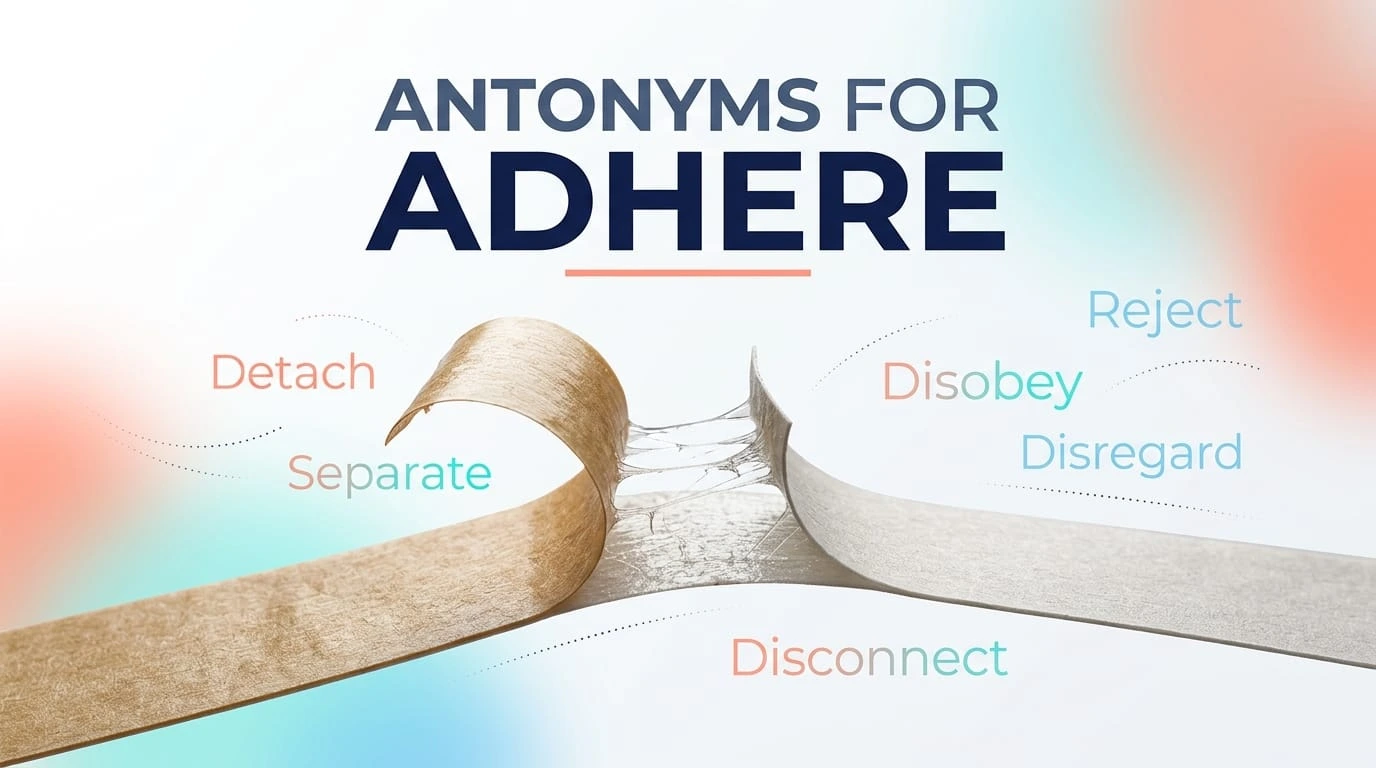
The strongest antonyms for adhere are detach, separate, disobey, violate, disregard, and deviate. The correct opposite depends on meaning: detach or separate contrasts with physical sticking, while disobey, violate, or deviate from contrasts with following a rule, agreement, principle, or standard.
The Opposite of Adhere at a Glance
Adhere means either to stick firmly to something or to follow a rule, agreement, principle, or plan closely. Therefore, its opposite changes with context. For physical attachment, detach and separate are strong opposites. For rules and principles, disobey, violate, and deviate from are more appropriate.
Quick Answer
The best antonym for adhere depends on how the word is being used:
- Detach to remove something that is attached
- Separate to move apart or disconnect
- Disobey to fail to follow a rule or command
- Violate to break a rule, agreement, or principle
- Disregard to ignore or pay no attention to something
- Deviate to move away from a rule, standard, plan, or expected course
- Depart from to move away from an established rule, practice, or plan
Adhere and Its Main Opposites
| Word | Meaning | Example |
| Adhere | To stick to something or follow something closely | The label adhered to the bottle. |
| Detach | To remove or become separated from something attached | She detached the label from the bottle. |
| Separate | To move or keep things apart | The workers separated the two parts. |
| Disobey | To fail to follow a rule or command | He disobeyed the safety instructions. |
| Violate | To break a rule, agreement, or principle | The company violated the agreement. |
| Deviate | To move away from a standard, plan, or rule | The team deviated from the original plan. |
Meaning in Brief
Adhere: to stick firmly to something, or to follow a rule, agreement, principle, or plan closely.
Main physical antonym: Detach to remove or become separated from something attached.
Main behavioral antonym: Disobey to fail or refuse to follow a rule or command.
What You’ll Learn
- The most accurate antonyms for adhere
- Why the opposite changes according to context
- The difference between detach, disobey, violate, and deviate
- How to use these words naturally in sentences
- Which antonym works best with adhere to
Common Opposites of Adhere
1. Detach
Detach is a strong antonym when adhere means to stick or remain physically attached to something.
Example:
The sticker adhered firmly to the glass.
→ The sticker was detached from the glass.
Best context: Labels, stickers, parts, objects, physical attachment, and surfaces.
2. Separate
Separate means to move things apart or disconnect things that were together.
Example:
The two pieces adhered to each other.
→ The two pieces were separated.
Unlike detach, separate does not always imply that one object was physically attached to another. It can simply mean making things distinct or apart.
3. Disobey
Disobey is a natural opposite when adhere to means to follow a rule, order, or instruction.
Example:
All employees must adhere to the safety rules.
→ Employees must not disobey the safety rules.
Best context: Commands, rules, instructions, laws, and authority.
4. Violate
Violate means to break or fail to respect a rule, agreement, law, principle, or standard.
Example:
The organization agreed to adhere to the contract.
→ The organization later violated the contract.
Violate is stronger than simply failing to follow something. It often suggests a serious breach.
5. Disregard
Disregard means to ignore something or treat it as unimportant.
Example:
The researchers adhered to the established guidelines.
→ The researchers disregarded the established guidelines.
This is especially useful when someone knowingly pays little or no attention to a rule, recommendation, warning, or instruction.
6. Deviate
Deviate means to move away from an established path, standard, rule, plan, or expectation.
Example:
The project team adhered to the original plan.
→ The project team deviated from the original plan.
Important: We normally say deviate from, not deviate to.
7. Depart From
Depart from means to move away from an established method, practice, plan, or standard.
Example:
The school adhered to its traditional teaching method.
→ The school departed from its traditional teaching method.
This expression is particularly useful in formal and academic writing.
8. Abandon
Abandon means to give up or leave something completely.
It can serve as a contextual opposite of adhere when adherence means remaining committed to a plan, practice, or course of action.
Example:
The company adhered to its original strategy.
→ The company abandoned its original strategy.
However, abandon is not a direct opposite of every use of adhere. It is mainly useful when the idea of continued commitment is important.
Choosing the Right Antonym
When adhere means “stick physically”
Use:
- detach
- separate
- disconnect
Example:
The tape adhered to the wall.
→ The tape detached from the wall.
Here, detach is more precise than disobey or deviate because the sentence describes physical attachment.
When adhere means “follow a rule”
Use:
- disobey
- violate
- disregard
Example:
Drivers must adhere to traffic regulations.
→ Drivers must not violate traffic regulations.
When adhere means “follow a plan or standard”
Use:
- deviate from
- depart from
- abandon
Example:
The researchers adhered to the approved procedure.
→ The researchers deviated from the approved procedure.
How These Antonyms Differ
The antonyms of adhere are not interchangeable.
Detach focuses on physical separation.
Separate focuses on moving things apart.
Disobey focuses on failing to follow a command or rule.
Violate focuses on breaking a rule, law, agreement, or principle.
Disregard focuses on ignoring or failing to consider something.
Deviate from focuses on moving away from an established path, plan, or standard.
Depart from often has a formal meaning of moving away from an established practice or approach.
Abandon focuses on giving up or leaving something behind, rather than simply failing to follow it.
Adhere and Its Antonyms in Sentences
- The label adhered firmly to the package.
→ The label detached from the package. - The two surfaces adhered to each other.
→ The two surfaces were separated. - Students must adhere to the examination rules.
→ Students must not disobey the examination rules. - The company agreed to adhere to the contract.
→ The company later violated the contract. - The employee adhered to the safety guidelines.
→ The employee disregarded the safety guidelines. - The team adhered to the original strategy.
→ The team deviated from the original strategy. - The new design departed from the traditional approach rather than adhering to it.
- The organization abandoned the policy it had previously followed.
Grammar and Word Forms
Adhere is primarily an intransitive verb. It commonly appears with to:
- adhere to a rule
- adhere to a policy
- adhere to a principle
- adhere to a plan
- adhere to a surface
Examples:
- We must adhere to the rules.
- The material adhered to the surface.
Some of its antonyms have different grammatical patterns:
- detach something from something
- separate A from B
- disobey a rule
- violate a law
- disregard a warning
- deviate from a plan
- depart from a standard
A Closer Look at Usage
One important distinction is the preposition.
We say:
adhere to the rules
but:
deviate from the rules
and:
depart from the original plan
So, although these words form a semantic contrast, they do not use the same grammatical structure.
Common Antonym Mistakes
Mistake 1: Treating “disobey” as the opposite in every context
❌ The sticker disobeyed the wall.
✅ The sticker detached from the wall.
Why? Disobey applies to people or entities capable of following commands, not ordinary physical objects.
Mistake 2: Using “detach” for rules
❌ Employees should detach from company policies.
✅ Employees should adhere to company policies.
If someone breaks or ignores a policy, use violate, disregard, or disobey, depending on the context.
Mistake 3: Using “deviate” without “from”
❌ The team deviated the plan.
✅ The team deviated from the plan.
Mistake 4: Assuming “abandon” always means the opposite of adhere
Abandon can contrast with adherence to a plan or course of action, but it does not work as a general opposite for physical attachment or every use of adhere.
One Tip to Remember
Think of adhere as having two main ideas:
STICK TO → DETACH / SEPARATE
FOLLOW → DISOBEY / VIOLATE / DEVIATE FROM
This simple distinction helps you choose the right antonym instead of treating every opposite as interchangeable.
Quick Antonym Quiz
1. The company must ___ the safety regulations.
A. detach
B. adhere to
C. separate
Answer: B. adhere to
2. The researchers ___ from the approved procedure.
A. deviated
B. adhered
C. attached
Answer: A. deviated
3. The sticker was firmly attached but later ___.
A. disobeyed
B. detached
C. violated
Answer: B. detached
4. The company broke the terms of the agreement. Which word fits best?
A. violated
B. adhered
C. attached
Answer: A. violated
Frequently Asked Questions
What is the opposite of adhere?
The opposite of adhere depends on its meaning. Detach and separate are suitable when adhere means to stick physically. Disobey, violate, disregard, and deviate from are suitable when it means to follow a rule, principle, plan, or standard.
What is the strongest antonym of adhere?
There is no single strongest antonym for every context. Detach is a strong opposite for physical attachment, while disobey, violate, or deviate from may be stronger choices when adhere to means following rules or standards.
Is disobey an antonym of adhere?
Yes, but only in the context of following a command, rule, or instruction. For example, adhere to the rules contrasts naturally with disobey the rules.
What is the opposite of “adhere to the rules”?
Depending on the intended meaning, good opposites include disobey the rules, violate the rules, disregard the rules, or deviate from the rules. Violate often suggests a more serious breach.
What is the opposite of “adhere to a plan”?
Deviate from a plan, depart from a plan, or abandon a plan can work, depending on whether someone merely moves away from the plan or gives it up completely.
What to Remember
Adhere has more than one important meaning, so its antonym must match the context.
- Adhere → detach when something is physically attached.
- Adhere → separate when things are joined and then moved apart.
- Adhere to → disobey when someone fails to follow a command.
- Adhere to → violate when a rule, law, agreement, or principle is broken.
- Adhere to → disregard when something is ignored.
- Adhere to → deviate from when someone moves away from a plan, standard, or established course.
- Adhere to → depart from when someone moves away from an established practice or approach.
The key is to choose the antonym based on what “adhere” means in the sentence, not simply select one word as its universal opposite.
Antonyms for Nonchalant: 10 Strong Opposites

I’m Noreen Akbar, an English language researcher and content writer with a passion for words,their meanings, origins, and the subtle differences between them. I specialize in antonyms and vocabulary, creating clear, easy-to-follow guides that help readers expand their word power, sharpen their understanding of language, and express themselves with greater clarity and confidence.