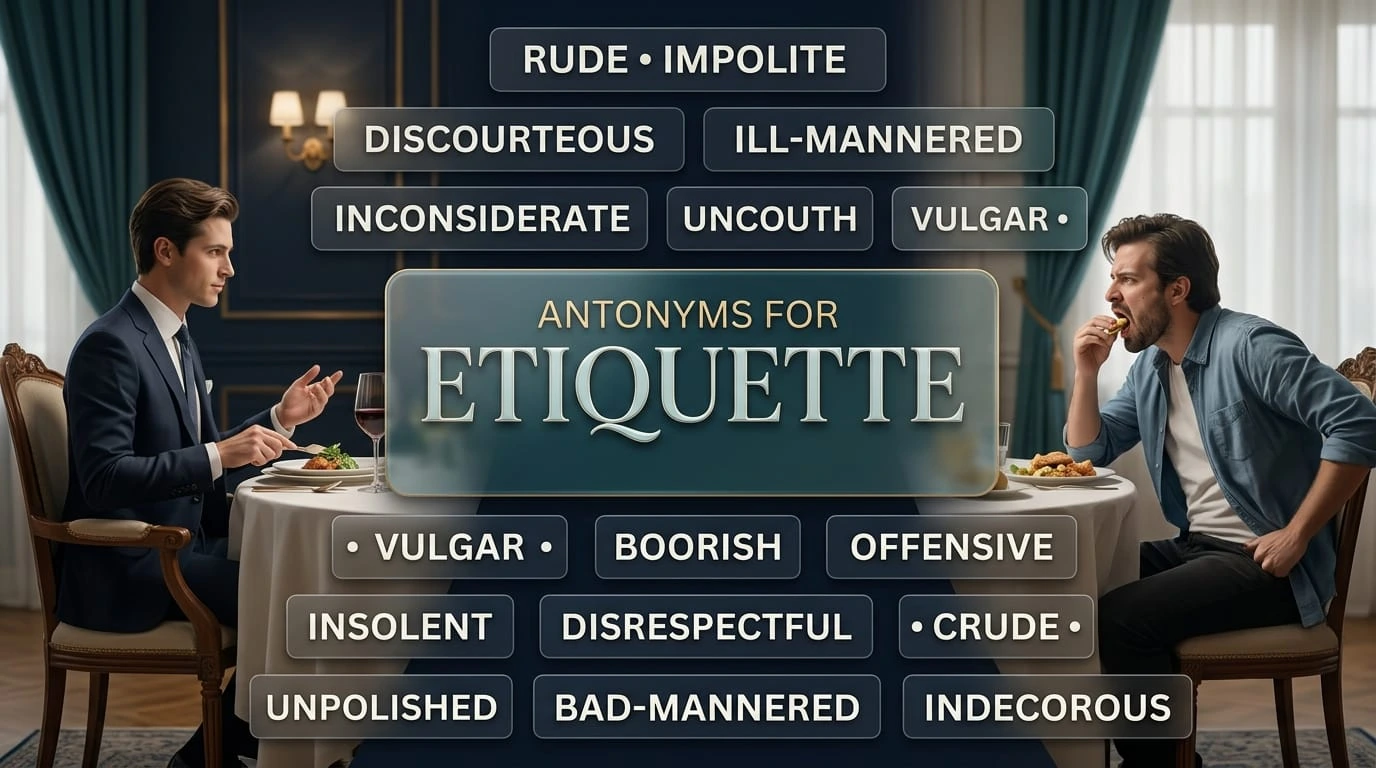
Antonyms for etiquette include rudeness, discourtesy, impoliteness, disrespect, bad manners, incivility, informality, thoughtlessness, inconsideration, and misconduct, depending on the context.
What Is the Opposite of Etiquette?
The closest opposites of etiquette are rudeness, bad manners, discourtesy, and impoliteness. Etiquette refers to accepted rules of polite and appropriate behavior, while its opposites describe behavior that ignores, violates, or lacks those social standards.
Quick Answer
Etiquette means the customary rules for polite and socially acceptable behavior.
There is no single perfect antonym because etiquette is a noun describing a system or standard of behavior. The best opposite depends on what you want to emphasize:
- Rudeness: behavior that is not polite
- Impoliteness: lack of politeness
- Discourtesy: lack of courtesy or consideration
- Disrespect: lack of proper regard for others
- Bad manners: behavior that breaks expected social rules
- Incivility: rude or discourteous behavior
- Inconsideration: failure to think about others’ feelings or needs
Etiquette in One Line
Etiquette: The accepted rules and customs for polite behavior in a particular social or professional setting.
Main opposite: Rudeness behavior that is impolite or offensive.
Etiquette vs. Its Opposites
| Word | Meaning | Example |
|---|---|---|
| Etiquette | Accepted rules of polite behavior | Good dining etiquette matters at formal events. |
| Rudeness | Behavior that is not polite | Interrupting someone repeatedly can be rude. |
| Impoliteness | Lack of polite behavior | His impoliteness surprised the guests. |
| Discourtesy | Lack of courtesy or consideration | The customer complained about the employee’s discourtesy. |
| Disrespect | Lack of proper respect | Speaking over your manager may seem disrespectful. |
| Bad manners | Behavior that violates social expectations | Chewing loudly is often considered bad manners. |
20 Antonyms and Contrasting Words for Etiquette
Because etiquette describes standards of appropriate behavior rather than a simple quality, some words below are direct contextual opposites rather than strict dictionary antonyms.
1. Rudeness
Rudeness is behavior that is impolite, offensive, or lacking in consideration.
Example:
His rudeness toward the waiter made everyone uncomfortable.
This is one of the clearest opposites of etiquette when etiquette means polite social behavior.
2. Impoliteness
Impoliteness means a lack of politeness or good manners.
Example:
Interrupting someone while they are speaking may be seen as impoliteness.
It is a particularly straightforward contrast with polite etiquette.
3. Discourtesy
Discourtesy means a lack of courtesy, politeness, or consideration.
Example:
The guest apologized for his discourtesy.
This word is more formal than rudeness and works well in professional or formal writing.
4. Disrespect
Disrespect means a lack of respect for another person, group, rule, or authority.
Example:
Talking loudly during the ceremony could show disrespect.
Disrespect is broader than simply breaking a rule of etiquette.
5. Bad Manners
Bad manners refers to behavior that does not follow accepted standards of politeness.
Example:
Leaving the table without saying goodbye was considered bad manners.
This is one of the most natural everyday expressions for behavior opposite to good etiquette.
6. Incivility
Incivility means rude, discourteous, or socially unacceptable behavior.
Example:
The meeting became tense because of the participants’ incivility.
It is somewhat more formal and is common in discussions about workplace or public behavior.
7. Inconsideration
Inconsideration means failing to think about other people’s feelings, needs, or convenience.
Example:
Playing loud music late at night shows inconsideration toward the neighbors.
It contrasts with etiquette when etiquette requires consideration for others.
8. Thoughtlessness
Thoughtlessness means failing to consider how your actions affect other people.
Example:
His thoughtlessness caused unnecessary inconvenience for the entire team.
It can describe poor social behavior without necessarily implying deliberate rudeness.
9. Discourteousness
Discourteousness refers to the quality of being discourteous or lacking courtesy.
Example:
The employee was criticized for his discourteousness toward customers.
This is a formal noun and is less common in everyday conversation than rudeness.
10. Uncivil Behavior
Uncivil behavior means behavior that lacks politeness, respect, or consideration.
Example:
The manager asked the employees to avoid uncivil behavior during disagreements.
It is useful when discussing social or professional interactions.
11. Misconduct
Misconduct means inappropriate or unacceptable behavior, especially in a professional or official setting.
Example:
The company investigated the employee’s alleged misconduct.
Misconduct is broader and can involve behavior much more serious than simply breaking etiquette rules.
12. Impropriety
Impropriety means behavior that is inappropriate or does not meet accepted standards.
Example:
The official was accused of professional impropriety.
This is a formal word and is useful when the issue involves social, professional, or ethical standards.
13. Inappropriateness
Inappropriateness refers to behavior or conduct that is unsuitable for a particular situation.
Example:
The inappropriateness of his joke became obvious when the room went silent.
Etiquette is highly dependent on context, so inappropriate behavior can directly contrast with proper etiquette.
14. Insensitivity
Insensitivity means a lack of awareness or concern for other people’s feelings.
Example:
Her comment was criticized for its insensitivity.
This contrasts with etiquette when polite behavior requires emotional awareness and consideration.
15. Aggression
Aggression means hostile or forceful behavior toward another person.
Example:
His aggressive response made a simple disagreement worse.
Aggression is stronger than ordinary rudeness and should not be treated as a normal synonym for bad etiquette.
16. Hostility
Hostility means unfriendly, antagonistic, or openly negative behavior.
Example:
The conversation quickly turned into hostility.
Hostility can violate expectations of respectful social interaction, but it is much stronger than ordinary impoliteness.
17. Disregard
Disregard means a lack of attention or respect for something.
Example:
His disregard for the meeting rules annoyed the other participants.
This can describe ignoring etiquette or social expectations rather than actively behaving rudely.
18. Noncompliance
Noncompliance means failure or refusal to follow a rule or requirement.
Example:
Noncompliance with the event’s dress requirements caused problems at the entrance.
This is a contextual opposite, especially when etiquette involves following established rules.
19. Informality
Informality means a relaxed style that does not follow formal conventions.
Example:
The invitation encouraged informality rather than traditional formal etiquette.
Important: informality is not necessarily negative. A casual setting may intentionally have relaxed etiquette.
20. Social Unconventionality
Social unconventionality means behavior that does not follow customary or traditional social expectations.
Example:
His social unconventionality made his behavior unusual at the formal dinner.
This does not necessarily mean the person is rude. It simply means the behavior differs from established conventions.
Which Word Is the Best Antonym of Etiquette?
If you need the most natural everyday opposite, choose rudeness or bad manners.
For formal writing, discourtesy and incivility are useful choices.
If the focus is on ignoring rules, words such as disregard or noncompliance may fit better.
If the behavior is simply casual rather than formal, informality can be appropriate—but it is not necessarily a negative opposite.
Best Choices by Context
| Context | Best opposite |
|---|---|
| Everyday conversation | Rudeness |
| Polite behavior | Impoliteness |
| Formal writing | Discourtesy |
| Respect | Disrespect |
| Social rules | Bad manners |
| Workplace behavior | Incivility |
| Lack of consideration | Inconsideration |
| Ignoring rules | Disregard |
| Failure to follow requirements | Noncompliance |
| Casual behavior | Informality |
Is Rudeness the Exact Opposite of Etiquette?
Not exactly.
Etiquette is a set of accepted rules or customs for appropriate behavior. Rudeness is behavior that is impolite or offensive.
So the relationship is:
Etiquette → rules for polite behavior
Rudeness → behavior that violates or ignores polite behavior
This makes rudeness a very natural contextual antonym, even though the two words are different grammatical and conceptual types.
Etiquette vs. Bad Manners
Bad manners may be the most natural phrase when talking about everyday social behavior.
Compare:
Good etiquette means waiting your turn to speak.
Interrupting people repeatedly is bad manners.
Here, bad manners clearly describes behavior that goes against expected etiquette.
Etiquette vs. Incivility
Incivility is a stronger and more formal term for rude or discourteous behavior.
It is particularly useful in contexts such as:
- workplace communication
- public discussions
- customer service
- professional relationships
- disagreements
For example:
The company has a policy against workplace incivility.
You would generally choose incivility over rudeness when you want a more formal tone.
Etiquette vs. Informality
These words require special care.
Informality does not automatically mean poor etiquette.
A casual family dinner may have informal etiquette, while a wedding reception may follow formal etiquette.
Therefore:
Informality can contrast with formal etiquette.
But:
Informality does not necessarily mean bad manners.
This distinction is important because etiquette changes according to the situation.
Grammar and Word Class
Etiquette is an uncountable noun.
Examples:
- dining etiquette
- workplace etiquette
- social etiquette
- email etiquette
- business etiquette
You normally say:
Good etiquette is important.
Not:
❌ Good etiquettes are important.
Its common contrasting words are also mainly nouns:
- rudeness
- impoliteness
- discourtesy
- disrespect
- incivility
- inconsideration
- thoughtlessness
Common Mistakes
Mistake 1: Treating “informality” as bad manners
Informality simply means a less formal style.
❌ Informality always means poor etiquette.
✅ Informality can mean relaxed or less formal behavior.
Mistake 2: Using “misconduct” for every etiquette mistake
Misconduct is generally more serious than ordinary bad manners.
❌ Forgetting to say “thank you” is always misconduct.
✅ Forgetting to say “thank you” may be considered poor manners or impoliteness.
Mistake 3: Assuming rudeness and disrespect are identical
They overlap, but they are not exactly the same.
Rudeness focuses on impolite behavior.
Disrespect focuses on a lack of respect.
Someone can be rude without deliberately showing disrespect toward a particular person.
Mistake 4: Making “noncompliance” a universal antonym
Noncompliance is mainly about not following a rule or requirement. It is appropriate only when etiquette involves an established rule or expectation.
Expert Tip
Think of etiquette as the standard and rudeness as a violation of that standard. This makes it easier to choose the right opposite: use rudeness for general behavior, discourtesy for formal contexts, and disrespect when the issue specifically involves respect.
Mini Quiz
Which word best describes behavior that lacks courtesy?
A. Etiquette
B. Discourtesy
C. Formality
Answer: B. Discourtesy
Discourtesy specifically refers to a lack of courtesy or polite behavior.
Short Questions & Answers
What is the main antonym of etiquette?
The closest everyday antonyms of etiquette are rudeness, impoliteness, bad manners, and discourtesy. The best choice depends on the context.
Is rudeness the opposite of etiquette?
Rudeness is a natural contextual opposite of etiquette. Etiquette describes accepted standards of polite behavior, while rudeness describes behavior that is impolite or violates those standards.
What is a formal antonym for etiquette?
Discourtesy and incivility are useful formal terms for behavior that lacks the politeness and consideration associated with etiquette.
Is bad manners an antonym of etiquette?
Yes, bad manners can describe behavior that goes against accepted etiquette. It is especially natural in everyday English.
Is informality the opposite of etiquette?
Not exactly. Informality means a relaxed or less formal style. It can contrast with formal etiquette, but informal behavior is not necessarily rude or inappropriate.
Key Takeaways
Etiquette refers to accepted rules and customs for polite behavior. Its strongest everyday opposites are rudeness, impoliteness, bad manners, and discourtesy. Other words such as disrespect, incivility, inconsideration, and impropriety describe specific ways people may fail to follow social expectations. Because etiquette is context-dependent, the best antonym depends on whether you are discussing politeness, respect, formality, or rule-following.
Antonyms for Remorse: 20 Opposite Words & Phrases

I’m Moazama Akbar, an English language researcher and content writer with a passion for helping people build stronger vocabulary and language skills. I create clear, well-researched guides on antonyms, opposite words, and word meanings, designed to make English learning simple, practical, and enjoyable for students, writers, and learners everywhere.