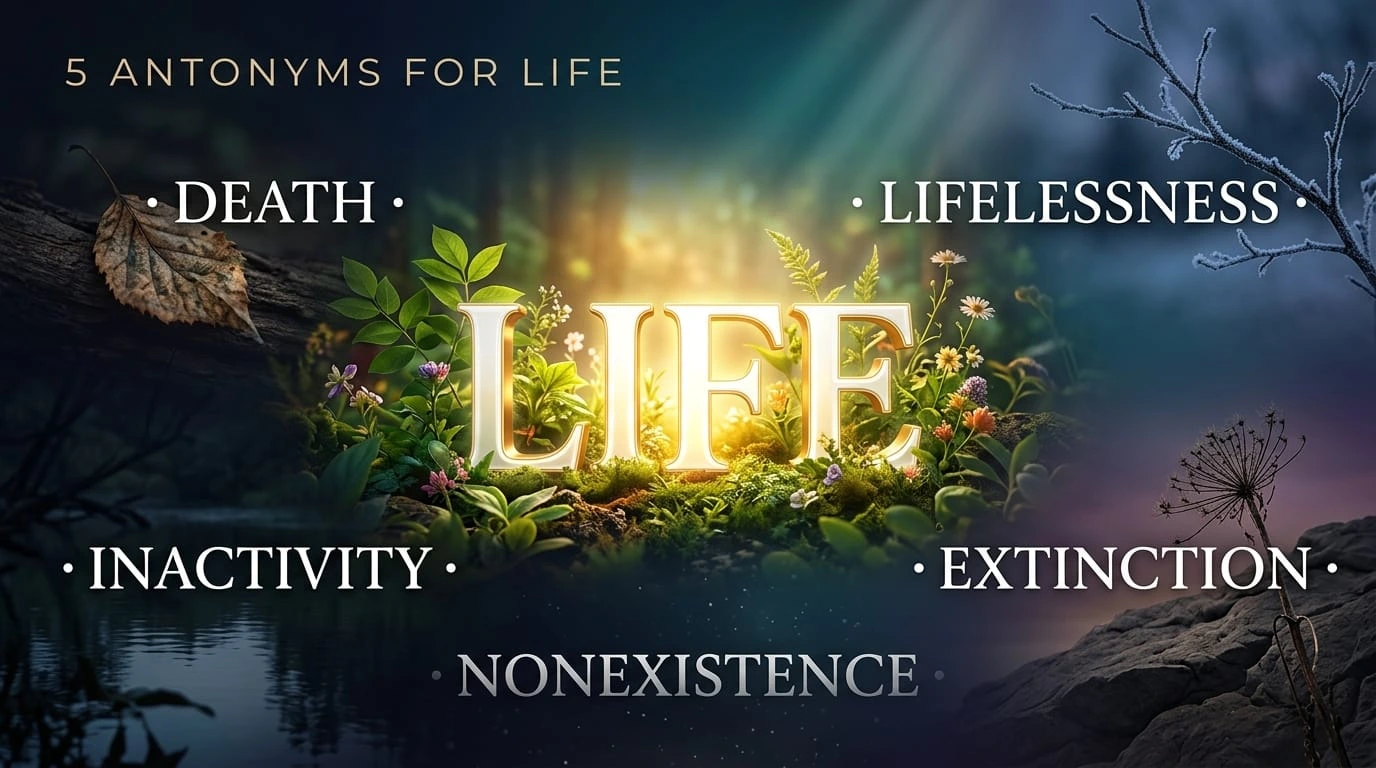
Antonyms for life include death, nonexistence, lifelessness, deadness, and inactivity, although the best opposite depends on whether life refers to existence, vitality, energy, or activity.
What Is the Opposite of Life?
The most direct antonym of life is death, meaning the end of a living state. Other opposites can apply in specific contexts, such as nonexistence for existence, lifelessness for the absence of life, and inactivity when life refers to movement, activity, or energy.
Quick Answer
Death is the strongest and most widely recognized antonym of life.
However, English uses different opposites depending on what life means:
- Life → Death when referring to being alive
- Life → Nonexistence when referring to existence
- Life → Lifelessness when referring to the absence of living qualities
- Life → Deadness when describing a lack of vitality or feeling
- Life → Inactivity when life means activity or movement
Quick Comparison
| Word | Opposite of life in this context | Meaning |
| Life | Death | The state of no longer being alive |
| Life | Nonexistence | The state of not existing |
| Life | Lifelessness | Absence of life or vitality |
| Life | Deadness | Lack of energy, feeling, or vitality |
| Life | Inactivity | Lack of action or activity |
Life: One-Line Definition
Life: The state of being alive, existing as a living organism, or showing vitality and activity.
Main antonym: Death the permanent end of life.
5 Antonyms for Life
1. Death
Death is the clearest and most direct antonym of life. It refers to the end of the biological functions that sustain a living organism.
Example:
The story explores the contrast between life and death.
This is the antonym to use when you are talking about whether someone or something is alive or dead.
2. Nonexistence
Nonexistence means the state of not existing. It can contrast with life when life is being discussed as a state of existence.
Example:
The philosopher debated whether consciousness continues after death or returns to nonexistence.
Unlike death, nonexistence focuses on not existing rather than specifically ending biological life.
3. Lifelessness
Lifelessness means a complete absence of life, vitality, or animation.
Example:
The abandoned building had an eerie sense of lifelessness.
It is especially useful when describing a place, object, atmosphere, or appearance that lacks signs of life.
4. Deadness
Deadness describes a lack of life, energy, movement, emotion, or responsiveness.
Example:
The deadness of the town made it feel deserted.
This word can be literal, but it is often figurative. For example, a conversation, atmosphere, or environment can have a sense of deadness without literally being dead.
5. Inactivity
Inactivity means a lack of action, movement, or activity.
Example:
Long periods of inactivity can make the body feel weak.
Inactivity is not a direct antonym of biological life. It is a contextual opposite when life is being used to describe activity, movement, or an active state.
Life vs. Death: The Main Opposite
When someone asks, “What is the antonym of life?”, the expected answer is usually death.
These two words form a natural conceptual pair:
Life → Death
Examples:
- Life begins, and eventually death comes.
- The novel explores themes of life and death.
- Scientists study the processes that distinguish life from death.
Because death directly contrasts with being alive, it should normally be your first choice.
Life vs. Nonexistence
These words are related but not identical.
Life describes a living state, while nonexistence describes the absence of existence altogether.
For example:
The question concerns whether consciousness exists after death or ends in nonexistence.
You would not normally replace death with nonexistence in every sentence. Death is specifically connected with the end of life, while nonexistence has a broader meaning.
Life vs. Lifelessness
Lifelessness is useful when you want to emphasize that something shows no signs of life or vitality.
Compare:
- Death: The person experienced death.
- Lifelessness: The landscape was marked by lifelessness.
The second example focuses more on the appearance or quality of lacking life than on the event of death itself.
Life vs. Deadness
Deadness is broader and often more figurative than lifelessness.
You might describe:
- the deadness of a deserted street
- the deadness of an old relationship
- the deadness of an atmosphere
- the deadness of someone’s expression
Here, deadness suggests that something lacks energy, emotion, movement, or vitality.
Life vs. Inactivity
Inactivity is the most context-dependent word on this list.
Life and inactivity are not true opposites in every situation. A living person can be inactive.
For example:
The patient was alive but remained inactive.
So use inactivity only when life is being used in the sense of activity or energetic movement.
Are These All Direct Antonyms of Life?
No. This distinction is important for accurate vocabulary use.
Death is the direct and conventional antonym of life. The other four words represent contextual opposites or contrasting concepts rather than universal antonyms.
| Word | Relationship to “life” |
| Death | Direct antonym |
| Nonexistence | Contextual opposite |
| Lifelessness | Contextual opposite |
| Deadness | Contextual/figurative opposite |
| Inactivity | Contextual contrast |
This means you should not automatically substitute any of these five words for life.
Example Sentences
Here are natural examples showing how the words differ:
- Life: Life can change unexpectedly.
- Death: The poem reflects on life and death.
- Nonexistence: The theory discusses existence and nonexistence.
- Lifelessness: The empty field had an unusual lifelessness.
- Deadness: There was a strange deadness in the room.
- Inactivity: The doctor warned him against prolonged inactivity.
Grammar and Word Class
The target word life is a noun.
Its main antonym death is also a noun.
| Word | Word class |
| Life | Noun |
| Death | Noun |
| Nonexistence | Noun |
| Lifelessness | Noun |
| Deadness | Noun |
| Inactivity | Noun |
This makes these words useful for direct noun-to-noun comparisons.
Life is precious.
Death is inevitable.
Common Mistakes
Mistake 1: Treating every opposite as a direct antonym
It is inaccurate to say that inactivity is always the opposite of life.
❌ Inactivity is the direct opposite of life.
✅ Death is the direct antonym of life.
Mistake 2: Using “nonexistence” when you mean “death”
The words have different meanings.
❌ The patient’s nonexistence was confirmed by the doctor.
✅ The patient’s death was confirmed by the doctor.
Nonexistence is much broader and does not specifically refer to the biological end of a person.
Mistake 3: Confusing lifelessness with death
Lifelessness can describe something that appears empty or without vitality. It does not always refer to an actual death.
The lifelessness of the deserted village was striking.
Here, the word describes the atmosphere rather than stating that someone died.
Expert Tip
If the question is simply “What is the antonym of life?”, choose death. Use the other words only when the sentence calls for a more specific meaning such as absence of existence, vitality, or activity.
Short Questions & Answers
What is the main antonym of life?
The main antonym of life is death. Life describes the state of being alive, while death refers to the end of that living state.
What are five antonyms for life?
Five useful opposites or contextual contrasts are death, nonexistence, lifelessness, deadness, and inactivity. However, death is the only clear direct antonym among these.
Is death the opposite of life?
Yes. Death is the standard and most direct antonym of life.
Is nonexistence the opposite of life?
Nonexistence can contrast with life when life is discussed as a state of existence, but it is not as direct an antonym as death.
What is the opposite of life and death?
Life and death are commonly treated as opposite concepts. Life refers to being alive, while death refers to the end of life.
Key Takeaway
The best answer to “What is the antonym of life?” is death. Words such as nonexistence, lifelessness, deadness, and inactivity can express related contrasts, but they do not work as universal replacements. Choosing the right opposite depends on the exact meaning of life in the sentence.
Antonyms for Brilliant: What’s the Opposite of Brilliant?

I’m Daniel Carter, a language enthusiast and content writer focused on the fascinating world of antonyms and vocabulary. I break down word meanings and opposites into simple, practical guides helping readers build a richer vocabulary, understand language more deeply, and speak or write with greater confidence.