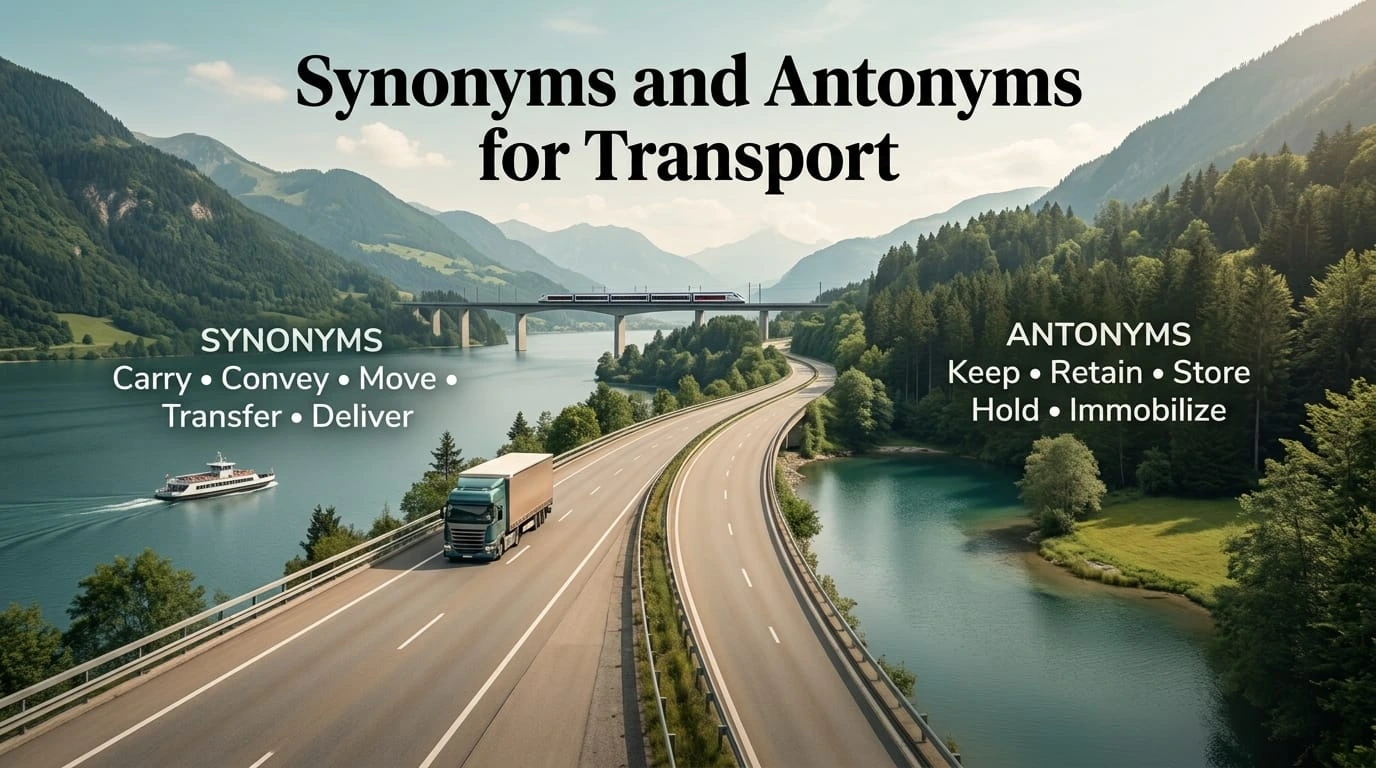
Synonyms for transport include move, carry, convey, and deliver, while antonyms include keep, retain, remain, and immobilize.
What Is the Opposite of Transport?
The strongest antonyms for transport depend on its meaning. When transport means moving something or someone, useful opposites include keep, retain, leave, and immobilize. When it refers to a transport system, immobility or lack of movement gives the clearest contrast.
Quick Answer
Transport means to move people or things from one place to another. Its synonyms include carry, convey, move, transfer, deliver, ship, ferry, and haul.
Its antonyms depend on context. Keep, retain, leave, stay, and immobilize can express the opposite idea when something is not moved.
Quick Word Comparison
| Word | Meaning | Example |
| Transport | Move someone or something from one place to another | Trucks transport goods. |
| Carry | Take something from one place to another | She carried the bag home. |
| Convey | Move or communicate something | Pipes convey water. |
| Transfer | Move something or someone to another place | They transferred the patient. |
| Retain | Keep something instead of moving or giving it away | The company retained the equipment. |
| Immobilize | Stop something from moving | The device immobilized the vehicle. |
Transport: Meaning in Brief
Transport: to move people or goods from one place to another.
As a noun, transport can mean a system or method used to move people or goods.
Public transport is often cheaper than driving.
As a verb, it means to move someone or something.
Trucks transport food across the country.
The word can therefore have slightly different synonyms and opposites depending on how it is used.
What You’ll Learn
After reading this guide, you will know:
- The main synonyms for transport
- Useful alternatives for different situations
- The main antonyms and why context matters
- How to use these words naturally
- The difference between transport, carry, convey, transfer, and deliver
Common Synonyms for Transport
1. Carry
Carry means to take something from one place to another, usually while holding or supporting it.
Workers carried the boxes into the building.
It is common in everyday English.
2. Convey
Convey means to move something from one place to another. It can also mean to communicate an idea or feeling.
Pipes convey water to nearby homes.
Convey is more formal than carry.
3. Move
Move is one of the broadest synonyms for transport.
The company moved the equipment to another site.
It can refer to people, objects, vehicles, or goods.
4. Transfer
Transfer means to move a person or thing from one place, person, or system to another.
The patient was transferred to another hospital.
It is common in business, healthcare, education, and administration.
5. Deliver
Deliver means to take something to the person or place where it is wanted.
The company delivers packages across the city.
Unlike transport, deliver often focuses on the destination.
6. Ship
Ship means to send or transport goods, often over a long distance.
The company ships products worldwide.
It is especially common in business and logistics.
7. Ferry
Ferry means to transport people or goods from one place to another, often across water.
The boat ferries passengers across the river.
It can also be used for repeated transportation between two places.
8. Haul
Haul means to pull or transport something, often something heavy.
The truck hauled the heavy machinery to the site.
It is more informal than transport.
9. Take
Take can mean to move someone or something to another place.
I will take the documents to the office.
It is extremely common in everyday English.
10. Transfer
Transfer is especially useful when something moves from one location, system, or person to another.
The data was transferred to a new computer.
It is often more precise than the general verb transport.
Useful Antonyms to Know
There is no single perfect antonym for transport in every sentence.
The best opposite changes with the meaning.
Keep
Keep can contrast with transport when something remains where it is instead of being moved.
We will keep the equipment here instead of transporting it elsewhere.
Retain
Retain means to continue to have or keep something.
The company decided to retain the equipment rather than transport it to another branch.
It is more formal than keep.
Leave
It can mean to allow someone or something to remain in a place.
Leave the boxes here instead of transporting them.
This is a natural opposite in everyday situations.
Stay
Stay means to remain in the same place.
The passengers stayed at the station instead of being transported to another location.
It normally applies to people or living things rather than objects.
Immobilize
Immobilize means to prevent something from moving.
The damaged vehicle was immobilized on the roadside.
This is a stronger opposite when the focus is on stopping movement.
Remain
Remain means to stay in the same place or condition.
The equipment remained in the warehouse.
It provides a useful contrast with the idea of transportation.
Stationary
Stationary means not moving.
The vehicle remained stationary throughout the inspection.
It is an adjective, so it cannot replace the verb transport directly.
Immobility
Immobility means a state of not being able to move.
The accident caused temporary immobility.
This works as a noun when discussing the opposite state of movement.
Choosing the Right Antonym
The opposite of transport changes according to what you mean.
When transport means “move”
Use words such as:
- keep
- retain
- leave
- remain
Example:
They transported the furniture to the new house.
Opposite idea:
They kept the furniture in the old house.
When transport means “cause to move”
Immobilize can be a stronger contrast.
The security system immobilized the vehicle.
Here, something is actively prevented from moving.
When transport refers to movement in general
Words such as stationary and immobility can express the opposite state.
The vehicle was stationary.
This does not mean transport is grammatically interchangeable with stationary. It simply describes the contrasting idea of no movement.
Understanding Each Synonym
Not every synonym for transport works in every sentence.
| Synonym | Best Context | Example |
| Carry | Everyday movement | Carry the bag upstairs. |
| Move | General use | Move the table outside. |
| Convey | Formal or technical writing | Pipes convey water. |
| Transfer | People, data, money, systems | Transfer the files. |
| Deliver | Taking something to its destination | Deliver the package. |
| Ship | Goods and commerce | Ship the order today. |
| Ferry | Repeated trips, often by boat | Ferry passengers across the river. |
| Haul | Heavy objects or goods | Haul the equipment away. |
This distinction matters because replacing transport with any synonym can change the exact meaning.
Transport and Its Antonyms in Context
Here are natural examples showing the contrast.
Transport vs Keep
The company transported the machines to another factory.
The company kept the machines at its main factory.
Transport vs Leave
Please transport these boxes to the storage room.
Please leave these boxes here.
Transport vs Remain
The goods were transported to another warehouse.
The goods remained in the original warehouse.
Transport vs Immobilize
The system was designed to transport the vehicle.
The safety device was designed to immobilize the vehicle.
Examples in Context
At Work
Our logistics team transports products from the warehouse to stores.
A suitable synonym is:
Our logistics team delivers products to stores.
At School
The buses transport students to school.
A more general alternative is:
The buses carry students to school.
In Business
The company ships goods to customers around the world.
Here, ships is more specific than the general word transports.
In Science
A conveyor belt conveys materials through the factory.
The word conveys sounds more technical and formal.
In Everyday Conversation
Can you take these books to my room?
Here, take is much more natural than transport.
What Part of Speech Is Transport?
Transport can function as both a noun and a verb.
Transport as a Verb
It means to move someone or something.
Trucks transport goods.
Transport as a Noun
It can mean the process, system, or means of moving people or goods.
Public transport is convenient.
In American English, transportation is often used where British English uses transport as a noun.
For example:
Public transport is widely used in the UK.
Public transportation is widely used in the US.
This is a related regional difference rather than a difference in the basic meaning.
How These Words Differ
Some words are close to transport, but their focus is different.
Transport focuses on moving something from one place to another.
Carry often suggests physically holding or supporting something.
Deliver focuses on reaching the intended destination.
Transfer focuses on moving something between places, people, systems, or organizations.
Ship is strongly associated with sending goods.
Ferry suggests repeated transportation, often across water.
Convey is more formal and is common in technical contexts.
Choosing the right word makes your writing more precise.
Commonly Confused Opposites
Using “stationary” as a direct verb
❌ The workers stationary the boxes.
✅ The workers kept the boxes in the warehouse.
Stationary is an adjective. It means not moving.
Using “retain” for every situation
Retain means keep or continue to have something. It does not always describe physical location.
The company retained its employees.
So, it is not a universal opposite of transport.
Assuming “immobilize” always works
Immobilize specifically means to stop movement.
It is useful when something is actively prevented from moving, but it is not the natural opposite in every context.
A Useful Language Tip
Think of transport as a movement word.
Then ask yourself:
“Is the opposite about keeping something in place, leaving it behind, remaining somewhere, or stopping movement?”
Your answer will help you choose the most accurate antonym.
Quick Practice
Choose the best word:
The company decided to ______ the equipment at the old warehouse instead of moving it.
A. transport
B. retain
C. ferry
Answer: B. retain
Retain means to keep something rather than move or remove it.
Questions About Transport and Its Antonyms
What is the most common synonym for transport?
Common synonyms include move, carry, convey, transfer, deliver, ship, and take. The best choice depends on the sentence and context.
What is the opposite of transport?
There is no single antonym for every use. Keep, leave, retain, remain, and immobilize can express contrasting ideas depending on the context.
Is immobilize the opposite of transport?
It can be when the meaning focuses on stopping movement. However, immobilize is not a universal antonym of transport.
What is another word for transport in business?
Useful business alternatives include ship, deliver, transfer, move, and convey. Ship and deliver are especially common in logistics.
What is the difference between transport and convey?
Both can mean to move something from one place to another. Convey is often more formal or technical, while transport is broader and more common.
What is the difference between transport and deliver?
Transport focuses on moving something. Deliver usually emphasizes taking it to its intended destination or recipient.
Key Takeaways
- Transport means to move people or things from one place to another.
- Useful synonyms include move, carry, convey, transfer, deliver, ship, ferry, and haul.
- The best antonym depends on the context.
- Keep, retain, leave, remain, and immobilize can express different opposite ideas.
- Choose the synonym or antonym that matches the exact meaning of your sentence.
Understanding these small differences will make your vocabulary more precise and natural.
Antonyms for Code: Opposites by Context

I’m Noreen Akbar, an English language researcher and content writer with a passion for words,their meanings, origins, and the subtle differences between them. I specialize in antonyms and vocabulary, creating clear, easy-to-follow guides that help readers expand their word power, sharpen their understanding of language, and express themselves with greater clarity and confidence.