Quick Answer
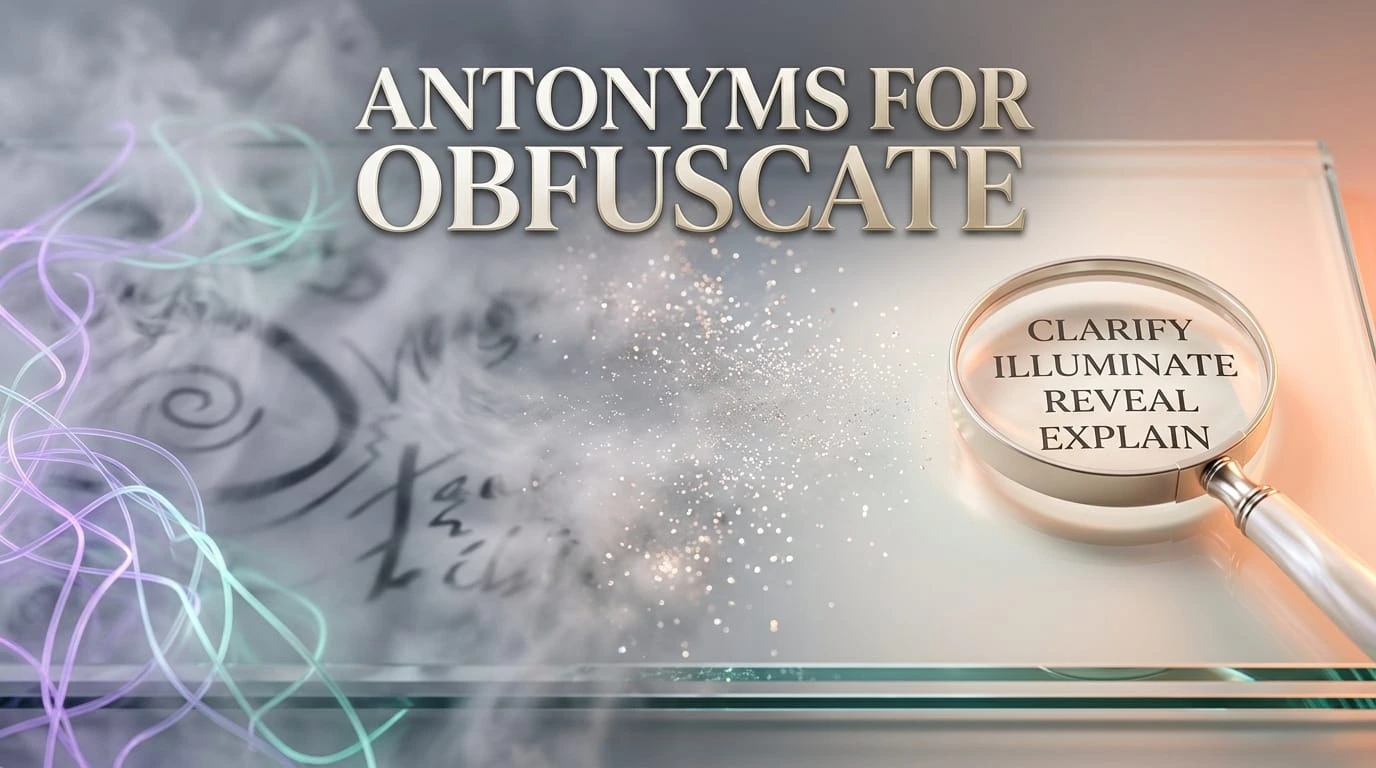
- Clarify
- Explain
- Elucidate
- Simplify
- Illuminate
- Demystify
- Reveal
- Disclose
- Uncover
- Make clear
What Does Obfuscate Mean?
The verb obfuscate means to make something unclear, confusing, or difficult to understand. It can describe complicated language, deliberately hidden information, or explanations that make an issue harder to follow.
For example:
- Obfuscate: The report used technical language to obfuscate the facts.
- Opposite: The report clarified the facts with simple language.
The best antonym depends on the situation. If someone makes an explanation easier to understand, clarify or simplify may fit. If someone reveals information that was hidden, disclose or uncover may be more appropriate.
12 Best Antonyms for Obfuscate
Here are 12 useful words that express the opposite of obfuscate.
| Antonym | Meaning | Example Sentence |
| Clarify | To make something easier to understand | The teacher clarified the difficult concept. |
| Explain | To make an idea understandable | The guide explained the rules clearly. |
| Elucidate | To explain something in a clear, detailed way | The professor elucidated the complex theory. |
| Simplify | To make something less complicated | The editor simplified the instructions. |
| Illuminate | To help someone understand something | The evidence illuminated the main issue. |
| Reveal | To make something previously unknown visible or known | The investigation revealed the truth. |
| Disclose | To make information known, especially information that was private | The company disclosed its financial results. |
| Uncover | To discover or expose something hidden | The journalist uncovered the facts. |
| Demystify | To make something mysterious or difficult easier to understand | The article demystified artificial intelligence. |
| Explain plainly | To communicate an idea in straightforward language | The lawyer explained the terms plainly. |
| Make clear | To remove uncertainty or confusion | The manager made the expectations clear. |
| Decipher | To work out the meaning of something difficult to understand | Researchers deciphered the ancient message. |
Note: These words are context-dependent opposites, not exact substitutes in every sentence. For example, disclose focuses on revealing information, while simplify focuses on reducing complexity.
Understanding the Differences Between Obfuscate and Its Opposites
Choosing the right antonym helps you express the precise meaning you intend.
1. Clarify vs. Obfuscate
Clarify means to make an idea, statement, or situation easier to understand. It is one of the closest opposites of obfuscate when the issue is confusion.
- Obfuscate: The speaker obfuscated the instructions with vague language.
- Clarify: The speaker clarified the instructions with specific examples.
Use clarify when you want to remove uncertainty or confusion.
2. Simplify vs. Obfuscate
Simplify means to make something less complicated or easier to manage. It is especially useful when discussing writing, processes, instructions, or technical concepts.
- Obfuscate: The manual obfuscated the process with unnecessary details.
- Simplify: The manual simplified the process into three steps.
Use simplify when the main problem is complexity.
3. Explain vs. Obfuscate
Explain means to make something understandable by providing information or details.
- Obfuscate: The presenter obfuscated the results with confusing terminology.
- Explain: The presenter explained the results in everyday language.
Use explain when someone needs information to understand an idea.
4. Reveal vs. Obfuscate
Reveal means to make something known that was previously hidden or unknown.
- Obfuscate: The official attempted to obfuscate the facts.
- Reveal: The investigation revealed the facts.
Use reveal when the focus is on bringing hidden information to light.
5. Elucidate vs. Obfuscate
Elucidate is a more formal word meaning to explain or make something clear. It is common in academic, professional, and analytical writing.
- Obfuscate: The article obfuscated the central argument.
- Elucidate: The article elucidated the central argument with clear evidence.
Use elucidate when you want a formal alternative to clarify or explain.
Antonyms for Obfuscate in Different Contexts
The most suitable antonym depends on what is being made unclear.
| Context | Best Antonym | Example |
| Confusing language | Clarify | The writer clarified the confusing paragraph. |
| Complicated instructions | Simplify | The technician simplified the instructions. |
| Difficult academic ideas | Elucidate | The researcher elucidated the theory. |
| Hidden information | Reveal | The report revealed important details. |
| Private information being made public | Disclose | The organization disclosed the findings. |
| A mysterious subject | Demystify | The tutorial demystified the process. |
| Uncertainty or doubt | Make clear | The announcement made the decision clear. |
| A coded or difficult message | Decipher | The analyst deciphered the message. |
Example Sentences Using Antonyms of Obfuscate
These examples show how the antonyms work naturally in everyday and professional English.
- Clarify: Please clarify your statement so everyone understands your point.
- Explain: The teacher explained the answer step by step.
- Elucidate: The scientist elucidated the findings during the presentation.
- Simplify: We simplified the application process for new users.
- Illuminate: The new evidence illuminated the reasons behind the decision.
- Reveal: The documentary revealed the truth about the historical event.
- Disclose: The company agreed to disclose the relevant information.
- Uncover: The audit uncovered several accounting errors.
- Demystify: The guide demystified the process of learning a new language.
- Make clear: The principal made the school rules clear to all students.
- Explain plainly: The doctor explained the instructions plainly.
- Decipher: The historian deciphered the difficult inscription.
How to Choose the Right Antonym
Use these simple guidelines to select the most accurate opposite of obfuscate.
- Choose clarify when removing confusion is the main goal.
- Choose simplify when reducing complexity is important.
- Choose explain when providing information helps someone understand.
- Choose elucidate for formal or academic explanations.
- Choose reveal when making something hidden or unknown visible.
- Choose disclose when information is formally or deliberately shared.
- Choose uncover when discovering something concealed is involved.
- Choose demystify when making a complicated or mysterious subject easier to understand.
- Choose decipher when working out the meaning of a difficult message or code.
Remember that obfuscate can refer to either making an idea confusing or deliberately concealing information. Its antonym should match the intended meaning.
Frequently Asked Questions
What is the closest antonym for obfuscate?
Clarify is one of the closest antonyms for obfuscate when the meaning is to make something confusing or difficult to understand. Simplify and explain are also suitable in many contexts.
What is a simple opposite of obfuscate?
Make clear is a simple, everyday opposite of obfuscate. For example, “The writer made the instructions clear” expresses the opposite of making them confusing.
Is clarify the opposite of obfuscate?
Yes. Clarify is a strong antonym when obfuscate means to make an idea or statement unclear. However, when obfuscate means to conceal information, words such as reveal or disclose may be more precise.
What is a formal antonym for obfuscate?
Elucidate is a formal antonym when the intended meaning is to explain something clearly. It is particularly useful in academic and professional writing.
What is the opposite of obfuscate in writing?
In writing, useful opposites include clarify, simplify, explain, and elucidate. These words describe making language, arguments, and ideas easier to follow.
What is the opposite of deliberately obfuscating the truth?
Depending on the context, reveal, disclose, expose, or tell the truth may express the opposite. Reveal emphasizes making something known, while disclose often suggests formally sharing information.
Conclusion
The best antonyms for obfuscate include clarify, explain, elucidate, simplify, reveal, disclose, uncover, and demystify. Although these words share the general idea of removing confusion or concealment, each has a distinct use.
For everyday writing, choose clarify or simplify. For academic explanations, use elucidate. When hidden information becomes known, reveal or disclose may be more accurate. Selecting the right word will make your writing clearer and more precise.
Antonyms for Contrary: 20 Opposites and Their Meanings

I’m Daniel Carter, a language enthusiast and content writer focused on the fascinating world of antonyms and vocabulary. I break down word meanings and opposites into simple, practical guides helping readers build a richer vocabulary, understand language more deeply, and speak or write with greater confidence.