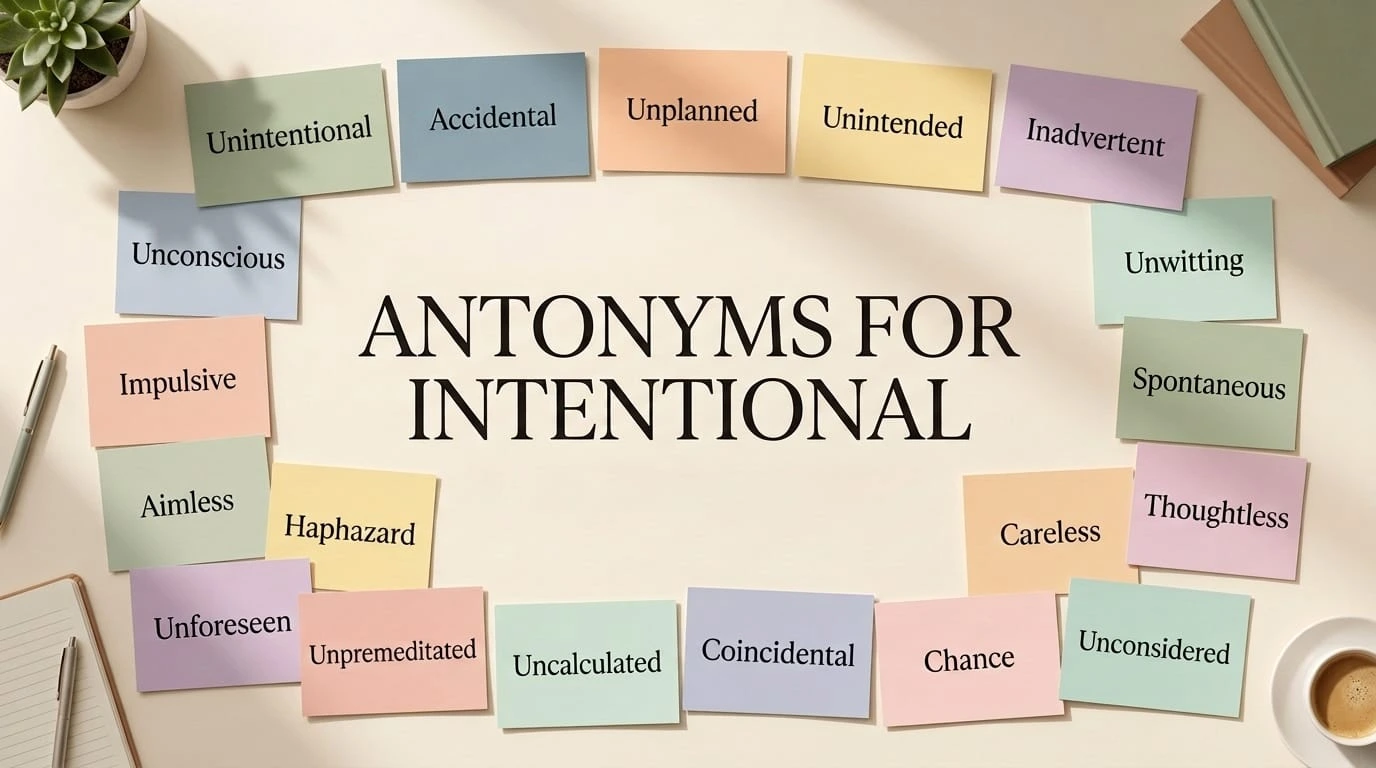
Antonyms for intentional include accidental, unintentional, unintended, and inadvertent words that describe actions done without purpose or planning.
Intentional means done deliberately, with a clear purpose or plan. Imagine accidentally sending a message to the wrong person. You did not plan or mean to send it, so the action was unintentional. The word intentional is common in everyday English because we often need to explain whether something was planned or happened by chance. Learning its antonyms helps English learners describe accidents, mistakes, spontaneous actions, and actions without a clear purpose. It also helps writers avoid repeating the same word and choose a more exact alternative. In this guide, we will explore the meaning, examples, grammar, history, pronunciation, and word formation of intentional. You will also learn 30 useful antonyms, their meanings, examples, semantic categories, and common usage differences.
Meaning of Intentional
Definition
Intentional (Adjective): done deliberately, knowingly, or with a particular purpose.
Examples
- Her decision to leave was intentional.
- He made an intentional effort to arrive early.
Connotative Meaning
Connotation (the feeling or idea associated with a word beyond its basic meaning) can vary with context.
- Positive tone: Can suggest careful planning, purpose, commitment, or thoughtfulness.
- Negative tone: Can suggest deliberate wrongdoing or harm when used in a negative context.
- Neutral tone: Simply describes something done deliberately or on purpose.
Etymology
The word intentional comes from intent, which traces back to Latin intendere, meaning “to stretch toward” or “to direct toward.” The idea developed into directing the mind or purpose toward something.
- Old English (450–1100): The modern word intentional was not used in Old English. Ideas of purpose and deliberate action were expressed through other words.
- Middle English (1100–1500): Words related to intent and purpose entered and developed in English through French and Latin influence.
- Modern English (1500–Present): Intentional developed into the common adjective used for actions, decisions, behavior, and effects that are done deliberately or on purpose.
Pronunciation (IPA)
- IPA: /ɪnˈten.ʃən.əl/
- Syllables: in-ten-tion-al
The main stress falls on “ten.”
Affixation Pattern of Intentional
- Root: intent
- Prefix: None
- Suffix: -ion and -al
- Word formations: intent → intention → intentional
Word Formations
- Intent (noun): a purpose or aim
- Intent (adjective): strongly focused on something
- Intend (verb): to plan or mean to do something
- Intended (adjective): planned or meant
- Intending (adjective/participle): planning or meaning to do something
- Intention (noun): a plan or purpose
- Intentional (adjective): done deliberately
- Intentionally (adverb): deliberately or on purpose
- Unintentional (adjective): not done deliberately
- Unintentionally (adverb): without intending to do something
30 Antonyms of Intentional With Meaning & Examples
1. Unintentional (Adjective)
Meaning: Not done deliberately or on purpose.
Examples:
- The mistake was unintentional.
- His comment was completely unintentional.
2. Unintended (Adjective)
Meaning: Not planned, expected, or meant to happen.
Examples:
- The decision had an unintended result.
- The damage was unintended.
3. Accidental (Adjective)
Meaning: Happening by chance rather than through deliberate action.
Examples:
- The meeting was an accidental encounter.
- The broken glass was accidental.
4. Inadvertent (Adjective)
Meaning: Done without realizing or intending to do it.
Examples:
- He made an inadvertent error.
- The remark was inadvertent, not deliberate.
5. Unplanned (Adjective)
Meaning: Not arranged or decided beforehand.
Examples:
- We made an unplanned stop.
- Their visit was completely unplanned.
6. Spontaneous (Adjective)
Meaning: Happening naturally without prior planning.
Examples:
- We took a spontaneous trip.
- Her decision was spontaneous.
7. Unpremeditated (Adjective)
Meaning: Not thought about or planned beforehand.
Examples:
- His response was unpremeditated.
- The action appeared unpremeditated.
8. Impulsive (Adjective)
Meaning: Done suddenly without careful thought or planning.
Examples:
- Buying the car was an impulsive decision.
- His impulsive reaction surprised everyone.
9. Unconsidered (Adjective)
Meaning: Done without enough thought or careful consideration.
Examples:
- It was an unconsidered decision.
- She later regretted her unconsidered response.
10. Thoughtless (Adjective)
Meaning: Done without thinking carefully about the effect on others.
Examples:
- His thoughtless comment upset her.
- Leaving without saying goodbye was thoughtless.
11. Unconscious (Adjective)
Meaning: Done without deliberate awareness or intention.
Examples:
- She made an unconscious movement.
- His smile was an unconscious reaction.
12. Automatic (Adjective)
Meaning: Happening without conscious thought or deliberate control.
Examples:
- His response was almost automatic.
- She gave an automatic reaction.
13. Instinctive (Adjective)
Meaning: Done naturally or without conscious planning.
Examples:
- His response was instinctive.
- She made an instinctive movement.
14. Involuntary (Adjective)
Meaning: Happening without conscious control or choice.
Examples:
- Blinking is an involuntary action.
- His reaction was involuntary.
15. Uncontemplated (Adjective)
Meaning: Not considered or thought about beforehand.
Examples:
- The outcome was uncontemplated.
- It was an uncontemplated consequence of the decision.
16. Aimless (Adjective)
Meaning: Having no clear purpose or direction.
Examples:
- He took an aimless walk around the city.
- Their discussion became aimless.
17. Purposeless (Adjective)
Meaning: Having no specific purpose or goal.
Examples:
- The activity seemed purposeless.
- He disliked the purposeless routine.
18. Random (Adjective)
Meaning: Happening without a particular plan, pattern, or purpose.
Examples:
- It was a random choice.
- We met through a random encounter.
19. Haphazard (Adjective)
Meaning: Done without a clear plan or order.
Examples:
- The files were arranged in a haphazard way.
- Their approach was haphazard.
20. Arbitrary (Adjective)
Meaning: Based on personal choice rather than a clear reason or plan.
Examples:
- The decision seemed arbitrary.
- They used an arbitrary method to select the winner.
21. Casual (Adjective)
Meaning: Done without careful planning or serious purpose.
Examples:
- It was a casual suggestion.
- Their meeting was casual and unplanned.
22. Unsystematic (Adjective)
Meaning: Done without a clear or organized method.
Examples:
- The research was unsystematic.
- His approach was unsystematic and difficult to follow.
23. Improvised (Adjective)
Meaning: Created or done without preparation.
Examples:
- She gave an improvised speech.
- The team used an improvised solution.
24. Unprepared (Adjective)
Meaning: Not ready because there was little or no preparation.
Examples:
- He was unprepared for the question.
- The presentation felt unprepared.
25. Reactive (Adjective)
Meaning: Responding to an event rather than acting according to a prior plan.
Examples:
- The company took a reactive approach.
- His response was reactive, not planned.
26. Unpremeditatedly (Adverb)
Meaning: Without planning or thinking about something beforehand.
Examples:
- He acted unpremeditatedly.
- She responded unpremeditatedly to the question.
27. Accidentally (Adverb)
Meaning: By chance and not deliberately.
Examples:
- I accidentally deleted the file.
- She accidentally called the wrong number.
28. Unknowingly (Adverb)
Meaning: Without knowing or realizing something.
Examples:
- He unknowingly broke the rule.
- She unknowingly shared incorrect information.
29. Unwittingly (Adverb)
Meaning: Without being aware of what you are doing or its consequences.
Examples:
- He unwittingly caused confusion.
- She unwittingly revealed the secret.
30. Unintentionally (Adverb)
Meaning: Without meaning or intending to do something.
Examples:
- I unintentionally offended him.
- She unintentionally interrupted the meeting.
Prototype Meaning
The most typical meaning of intentional is done on purpose or with a clear aim. When people hear this word, they usually imagine an action that someone has consciously planned or chosen. Therefore, its strongest opposite is unintentional, which describes something that happens without deliberate purpose.
Prototype Categorization
| Semantic Category | Antonyms | Best Used For |
| Direct Lack of Intention | unintentional, unintended, inadvertent, accidental | Mistakes, actions, results |
| Lack of Planning | unplanned, spontaneous, unpremeditated, improvised | Events, decisions, actions |
| Lack of Thought | impulsive, unconsidered, thoughtless, unconscious | Reactions, choices, comments |
| Lack of Purpose | aimless, purposeless, random, haphazard | Actions, activities, behavior |
| Lack of Organization | unsystematic, arbitrary, casual | Methods, decisions, approaches |
| Natural or Automatic Action | instinctive, involuntary, automatic, reactive | Reactions and behavior |
| Unaware Action | unknowingly, unwittingly, unintentionally, accidentally | Mistakes and consequences |
This categorization helps writers choose the most precise antonym instead of using unintentional for every situation.
Antonyms of Intentional
The strongest general antonym is unintentional. Other useful opposites include:
- Unintentional: not done deliberately
- Unintended: not planned or meant
- Accidental: happening by chance
- Inadvertent: done without realizing
- Unplanned: not arranged beforehand
- Impulsiv: done suddenly without careful thought
- Aimless: without a clear purpose
- Purposeless: without a specific goal
Short Questions and Answers
What does intentional mean?
Intentional means done deliberately, knowingly, or with a particular purpose.
When should intentional be used?
Use intentional when an action, decision, or result is planned, deliberate, or done on purpose.
Is intentional positive or negative?
Intentional is neutral by itself. It can have a positive or negative tone depending on the action being described.
How is intentional different from similar words?
Intentional means done on purpose, while deliberate often emphasizes careful thought or choice. Planned focuses on preparation, while purposeful emphasizes having a clear aim.
What is the strongest antonym of intentional?
Unintentional is the clearest and most direct antonym of intentional.
Is accidental the same as unintentional?
They are closely related, but not always identical. Accidental emphasizes something happening by chance, while unintentional simply means it was not meant or planned.
Conclusion
Learning the antonyms of intentional helps you describe actions and events more accurately. Unintentional is the clearest opposite, while accidental works well for things that happen by chance, inadvertent describes actions done without realizing, and unplanned focuses on a lack of preparation. Other words such as spontaneous, impulsive, aimless, purposeless, and instinctive express different kinds of actions that lack deliberate planning or purpose. Understanding these differences can improve both everyday communication and formal writing. Instead of using one opposite in every sentence, choose the word that matches the exact situation. Practicing these words regularly will expand your vocabulary, reduce repetition, and help you communicate your ideas with greater confidence.
Antonyms for Sympathetic: Words With Opposite Meanings

I’m Noreen Akbar, an English language researcher and content writer with a passion for words,their meanings, origins, and the subtle differences between them. I specialize in antonyms and vocabulary, creating clear, easy-to-follow guides that help readers expand their word power, sharpen their understanding of language, and express themselves with greater clarity and confidence.