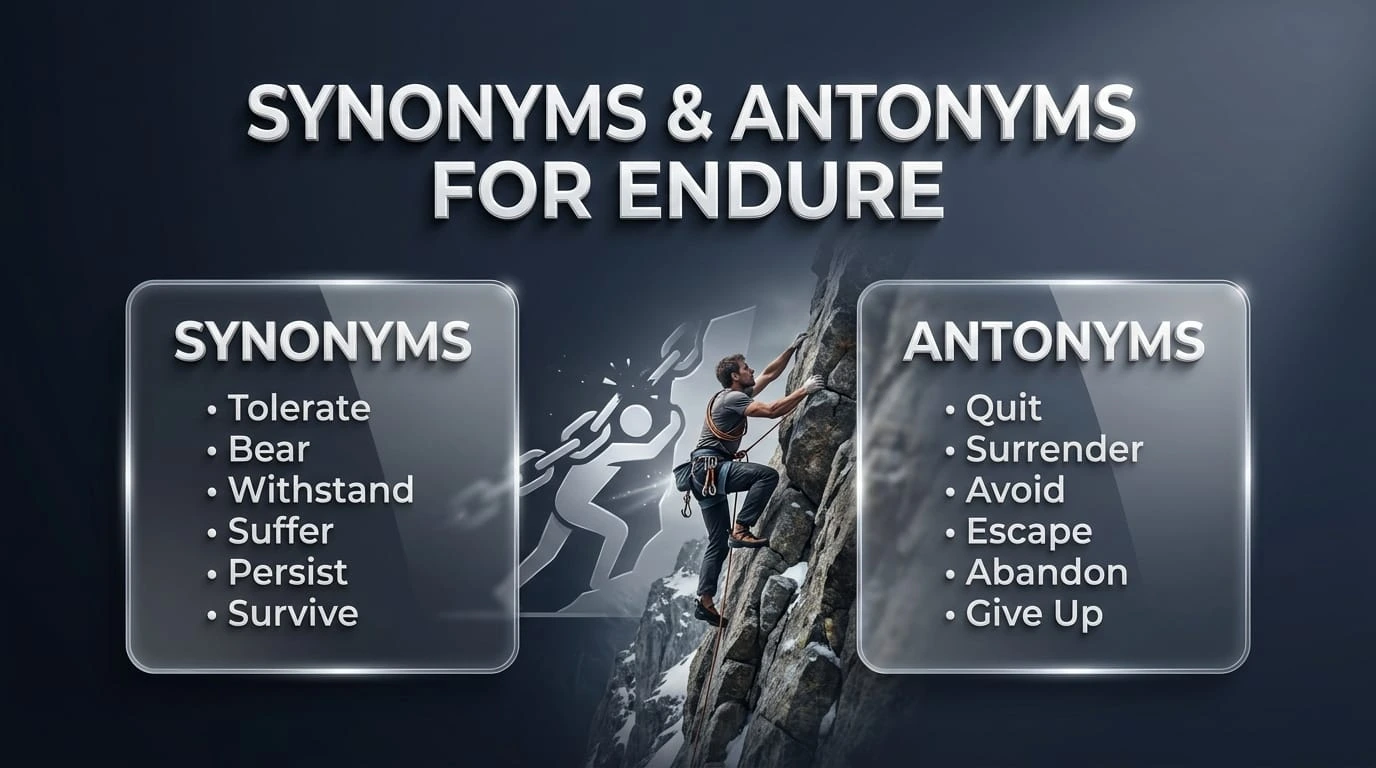
Synonyms for endure include bear, tolerate, withstand, suffer, survive, persist, and persevere; opposites include quit, surrender, escape, avoid, abandon, and give up.
Have you ever wanted to describe someone who keeps going through pain, difficulty, or a challenging situation? Endure is a powerful word, but using the same word repeatedly can make your writing feel predictable.
Whether you are describing a student facing a difficult exam, an athlete pushing through exhaustion, or someone dealing with a long-term problem, different words can express similar ideas. However, the best synonym depends on what endure means in the sentence.
What Is the Opposite of Endure?
The strongest opposite of endure depends on the context. When endure means continuing through difficulty, quit, give up, surrender, or succumb can express the opposite. When it means tolerating something unpleasant, avoid, reject, or escape may be more appropriate.
Quick Answer
Endure means to continue experiencing something difficult, painful, or unpleasant without giving up, or to remain in existence for a long time.
Common synonyms include bear, tolerate, withstand, suffer, survive, persist, and persevere.
Common antonyms include quit, give up, surrender, abandon, escape, avoid, and succumb.
The best choice depends on the meaning of endure in the sentence.
Quick Comparison
| Word | Meaning | Example |
| Endure | Continue through something difficult | She endured years of hardship. |
| Bear | Tolerate pain or difficulty | He could barely bear the pain. |
| Withstand | Remain strong against pressure | The building withstood the storm. |
| Tolerate | Accept something unpleasant | She cannot tolerate loud noise. |
| Quit | Stop doing something | He quit the difficult program. |
One-Line Definition
Endure: To continue experiencing something difficult, painful, or unpleasant without giving up.
Main opposite: Give up; to stop trying or continuing because something has become too difficult.
15 Synonyms for Endure
1. Bear
Meaning: To tolerate or experience something difficult without giving up.
Example:
She could barely bear the pain after the accident.
Best for: Pain, sadness, and unpleasant experiences.
2. Tolerate
Meaning: To accept something unpleasant without reacting strongly.
Example:
I cannot tolerate such rude behavior.
Best for: Behavior, noise, conditions, and annoying situations.
3. Withstand
Meaning: To remain strong despite pressure, force, or damage.
Example:
The bridge was designed to withstand strong winds.
Best for: Physical forces, pressure, and difficult conditions.
4. Suffer
Meaning: To experience pain, hardship, or something unpleasant.
Example:
Many people suffered during the economic crisis.
Difference: Suffer emphasizes experiencing pain, while endure often emphasizes continuing through it.
5. Survive
Meaning: To continue living or existing despite danger or difficulty.
Example:
The hikers survived the harsh winter conditions.
Best for: Disasters, danger, illness, and serious hardship.
6. Persist
Meaning: To continue doing something despite difficulty or opposition.
Example:
She persisted despite repeated failures.
Difference: Persist focuses on continuing an effort; endure often focuses on experiencing hardship.
7. Weather
Meaning: To successfully get through a difficult situation.
Example:
The company weathered the financial crisis.
Best for: Crises, difficult periods, and challenging circumstances.
8. Sustain
Meaning: To continue supporting or maintaining something over time.
Example:
The athlete could not sustain that level of effort for long.
Best for: Effort, activity, pressure, or long-term conditions.
9. Experience
Meaning: To go through or live through an event or situation.
Example:
The family experienced several difficult years.
Difference: Experience is neutral and does not necessarily imply suffering.
10. Undergo
Meaning: To experience something, especially something difficult or necessary.
Example:
The patient had to undergo several tests.
Best for: Procedures, treatments, and major changes.
11. Abide
Meaning: To tolerate or accept something unpleasant.
Example:
I cannot abide dishonest behavior.
Best for: Formal or somewhat old-fashioned expressions.
12. Stomach
Meaning: To tolerate something unpleasant or offensive.
Example:
I cannot stomach the smell of spoiled food.
Best for: Informal situations involving disgust or strong dislike.
13. Take
Meaning: To tolerate or handle a difficult situation.
Example:
She can take a lot of pressure without complaining.
Best for: Informal everyday English.
14. Outlast
Meaning: To continue longer than someone or something else.
Example:
The old building outlasted several newer structures.
Difference: Outlast focuses on lasting longer rather than suffering through difficulty.
15. Persevere
Meaning: To continue trying despite difficulty or failure.
Example:
He persevered until he finally passed the exam.
Best for: Determination and continued effort.
15 Antonyms for Endure
Because endure has several meanings, these are contextual opposites, rather than 15 universal antonyms.
1. Quit
To stop doing something.
He quit the training program when it became too difficult.
2. Give Up
To stop trying because something is difficult.
She refused to give up despite the setbacks.
3. Surrender
To stop resisting or fighting.
The soldiers refused to surrender.
4. Succumb
To stop resisting a powerful force or influence.
The team eventually succumbed to the pressure.
5. Abandon
To leave something or stop supporting it.
They abandoned the project after several problems.
6. Escape
To get away from something unpleasant or dangerous.
The family managed to escape the dangerous situation.
7. Avoid
To stay away from something unpleasant or unwanted.
She avoided unnecessary conflict.
8. Evade
To deliberately avoid or escape something.
He tried to evade responsibility for the mistake.
9. Reject
To refuse to accept something.
The workers rejected the unfair conditions.
10. Resist
To oppose or fight against something.
She resisted the pressure to leave.
Note: Resist is not a complete antonym because someone can resist something while still enduring it.
11. Cease
To stop.
The heavy rain finally ceased.
12. Stop
To end an action or activity.
The workers stopped when conditions became unsafe.
13. Relinquish
To give up or let go of something.
He finally relinquished control of the company.
14. Yield
To stop resisting and give way.
The committee eventually yielded to the pressure.
15. Enjoy
To take pleasure in something.
Instead of enduring the long journey, they actually enjoyed it.
Context note: Enjoy is an opposite only when endure refers to experiencing something unpleasant.
Endure: Synonyms and Antonyms by Context
When Endure Means “Tolerate”
Useful synonyms:
- Bear
- Tolerate
- Abide
- Stomach
- Take
Possible contrasts:
- Reject
- Avoid
- Escape
She could not endure the constant noise.
Here, tolerate is a natural replacement:
She could not tolerate the constant noise.
When Endure Means “Survive Hardship”
Useful synonyms:
- Withstand
- Survive
- Weather
- Suffer
- Undergo
Possible contrasts:
- Succumb
- Surrender
- Escape
The village endured severe flooding.
A contextual contrast could be:
The village escaped the worst of the flooding.
When Endure Means “Continue Despite Difficulty”
Useful synonyms:
- Persist
- Persevere
- Sustain
- Bear
- Survive
Possible contrasts:
- Quit
- Abandon
- Give up
She endured years of difficult training.
A contrasting sentence would be:
She quit after only a few months.
When Endure Means “Last”
Useful synonyms:
- Outlast
- Persist
- Survive
- Remain
- Continue
Possible contrasts:
- Cease
- Stop
- End
- Disappear
Their friendship endured for decades.
A contrasting sentence would be:
Their friendship ended after a few years.
Important Usage Differences
Not every synonym can replace endure in every sentence.
- Bear emphasizes tolerating pain or difficulty.
- Withstand suggests resistance to pressure, force, or damage.
- Tolerate means accepting something unpleasant.
- Persevere focuses on continuing an effort.
- Survive emphasizes remaining alive or existing.
- Outlast means lasting longer than something else.
The same principle applies to antonyms. Quit works well for stopping an effort, while escape works better when someone gets away from a difficult situation.
Grammar and Word Class
Endure is primarily a verb.
They endured the hardship.
She endured years of criticism.
Many useful synonyms and antonyms are also verbs:
Synonyms: bear, tolerate, withstand, suffer, survive, persist, weather, sustain, undergo, persevere.
Antonyms: quit, surrender, abandon, escape, avoid, reject, cease, stop, yield.
The noun form is endurance:
Her endurance impressed the entire team.
Word Family
- Endure: verb
- Endured: past tense/past participle
- Enduring: adjective/present participle
- Endurance: noun
- Endurable: adjective
Examples:
The athlete endured the pain.
Her endurance was remarkable.
Their friendship proved enduring.
Common Mistakes
Mistake 1: Treating Every Synonym as Identical
Bear, tolerate, withstand, and persevere overlap with endure, but they emphasize different ideas.
The walls withstood the storm. ✅
She persevered despite repeated failures. ✅
Mistake 2: Using “Withstand” Everywhere
Withstand is especially natural for force, pressure, damage, and difficult conditions.
The roof withstood the storm. ✅
For emotional difficulty, bear or endure may be more natural:
She endured years of grief. ✅
Mistake 3: Confusing Persist With Endure
Persist usually focuses on continuing an effort:
He persisted in his studies.
Endure can focus on experiencing hardship:
He endured years of hardship.
Mistake 4: Assuming Escape Is Always the Opposite
Escape is a contextual opposite, not a universal antonym. Someone can escape a problem, but they can also endure it.
Expert Tip
When choosing a synonym for endure, ask:
Am I emphasizing tolerance, resistance, survival, or continued effort?
Use tolerate for acceptance, withstand for resistance, survive for continued existence, and persevere for continued effort.
Practice Quiz
1. The old bridge was built to ______ strong winds.
A. withstand
B. quit
C. abandon
Answer: A. withstand — It describes resistance to a physical force.
2. She refused to ______ despite several failures.
A. surrender
B. persevere
C. escape
Answer: B. persevere — It means continuing despite difficulty.
3. I cannot ______ the constant noise.
A. tolerate
B. outlast
C. surrender
Answer: A. tolerate — It means accepting or putting up with something unpleasant.
Short Questions & Answers
What is the main synonym of endure?
One of the closest common synonyms is bear, especially when endure means tolerating pain, difficulty, or something unpleasant.
What is the strongest antonym of endure?
There is no single strongest antonym for every context. Give up, quit, surrender, and succumb are strong opposites when endure means continuing despite hardship.
Is tolerate a synonym for endure?
Yes. Tolerate can replace endure when the meaning is accepting something unpleasant without reacting strongly.
Is survive the same as endure?
Not exactly. Survive emphasizes continuing to live or exist despite danger or hardship, while endure emphasizes continuing through a difficult experience.
What is the noun form of endure?
The main noun form is endurance, meaning the ability to continue through difficulty, pain, or demanding conditions.
Conclusion
Endure has several meanings, so the best synonym or antonym depends on context.
For tolerance, use words such as bear or tolerate and for resistance, withstand is often stronger. For survival, choose survive or weather and for continued effort, persist or persevere may be more precise.
Likewise, quit, give up, surrender, succumb, avoid, and escape can express different kinds of opposition to endure.
The key is not simply finding an opposite word. It is choosing the word that expresses the exact relationship and meaning you need.
Antonyms for Sympathetic: Words With Opposite Meanings

I’m Daniel Carter, a language enthusiast and content writer focused on the fascinating world of antonyms and vocabulary. I break down word meanings and opposites into simple, practical guides helping readers build a richer vocabulary, understand language more deeply, and speak or write with greater confidence.