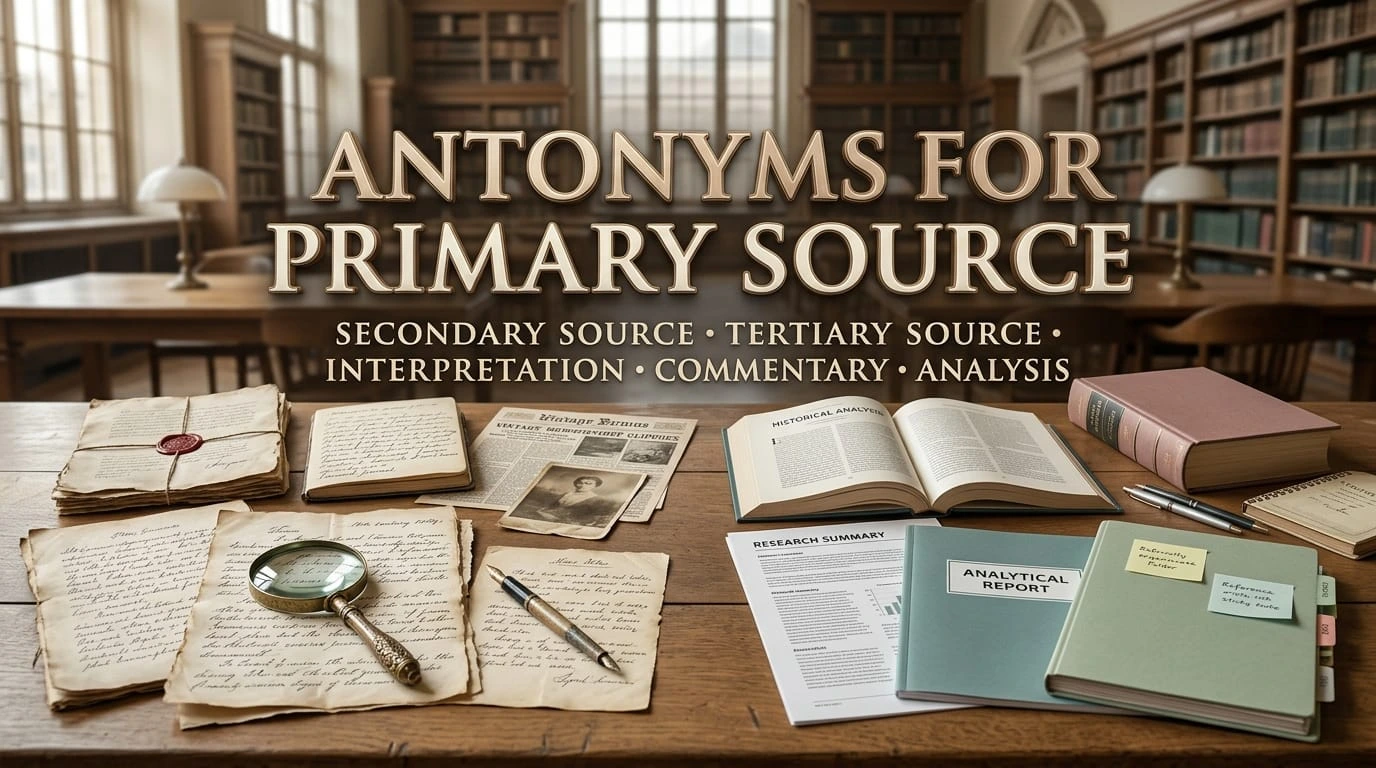
Quick Answer
- Secondary source
- Tertiary source
- Interpretation
- Summary
- Commentary
The most useful opposite of “primary source” is usually “secondary source.”
Primary Source vs. Its Opposite
| Term | Meaning | Example |
|---|---|---|
| Primary source | Original, first-hand evidence | A diary written during a war |
| Secondary source | Analysis of original evidence | A history book about the war |
| Tertiary source | A summary of existing information | An encyclopedia entry |
| Interpretation | An explanation of evidence | An expert’s analysis of a letter |
| Commentary | Opinions about an original source | A review of a published speech |
Primary Source in One Line
An original record or piece of evidence created by someone directly involved in, or connected to, an event or subject.
Main contextual opposite: Secondary source material that examines, explains, or interprets primary sources.
Main Antonyms and Related Opposites of Primary Source
1. Secondary Source
A source that discusses, analyzes, or interprets information from primary sources.
Example: A research article analyzing historical letters is a secondary source.
2. Tertiary Source
A resource that collects, summarizes, or organizes information from primary and secondary sources.
Example: An encyclopedia entry about World War II is generally a tertiary source.
3. Interpretation
An explanation of the meaning or importance of original information.
Example: The historian’s interpretation helped readers understand the old document.
4. Summary
A brief account of information taken from a longer source.
Example: The student used a summary instead of reading the complete original report.
5. Commentary
An explanation, opinion, or discussion about an original text, event, or subject.
Example: The newspaper published commentary on the president’s original speech.
How These Terms Differ
Not every term above is a direct antonym.
- Secondary source is the clearest contrast in academic research.
- Tertiary source organizes information from other sources.
- Interpretation focuses on explaining evidence.
- Summary presents the main points in a shorter form.
- Commentary adds discussion or opinion about the original material.
Examples in Context
- The interview transcript served as a primary source for the research.
- The textbook provided a secondary source about the historical event.
- The encyclopedia offered a tertiary source for background information.
- The professor shared an interpretation of the original document.
- The article included commentary on the published speech.
Grammar and Word Class
The phrase primary source is a noun phrase.
- Primary: Adjective describing something original or first in importance.
- Source: Noun referring to the origin of information or evidence.
- Secondary source: Noun phrase describing material that analyzes or discusses original evidence.
- Tertiary source: Noun phrase describing a resource that summarizes or organizes information.
Common Mistake to Avoid
Do not assume that every secondary source is unreliable or less valuable than a primary source. They serve different purposes. A primary source provides original evidence, while a secondary source helps explain and understand that evidence.
Frequently Asked Questions
What is the main antonym of primary source?
The most common contextual opposite is secondary source, which analyzes or interprets original information.
Is tertiary source an antonym of primary source?
It is a contrasting source category, but not a direct antonym. Tertiary sources usually summarize or organize information from other sources.
What is an example of a secondary source?
A history textbook discussing original letters, photographs, and historical records is an example of a secondary source.
Are primary and secondary sources opposites?
They are contrasting categories of information sources. Primary sources provide original evidence, while secondary sources interpret or analyze it.
What is the difference between a primary and secondary source?
A primary source gives first-hand evidence, while a secondary source explains, analyzes, or discusses that evidence.
Key Takeaways
A primary source provides original evidence, while a secondary source interprets or analyzes it. A tertiary source summarizes information from existing sources. For most academic writing, secondary source is the best contextual opposite of primary source.
Antonyms for Inhibit: 10 Powerful Words That Unlock Action

I’m Noreen Akbar, an English language researcher and content writer with a passion for words,their meanings, origins, and the subtle differences between them. I specialize in antonyms and vocabulary, creating clear, easy-to-follow guides that help readers expand their word power, sharpen their understanding of language, and express themselves with greater clarity and confidence.