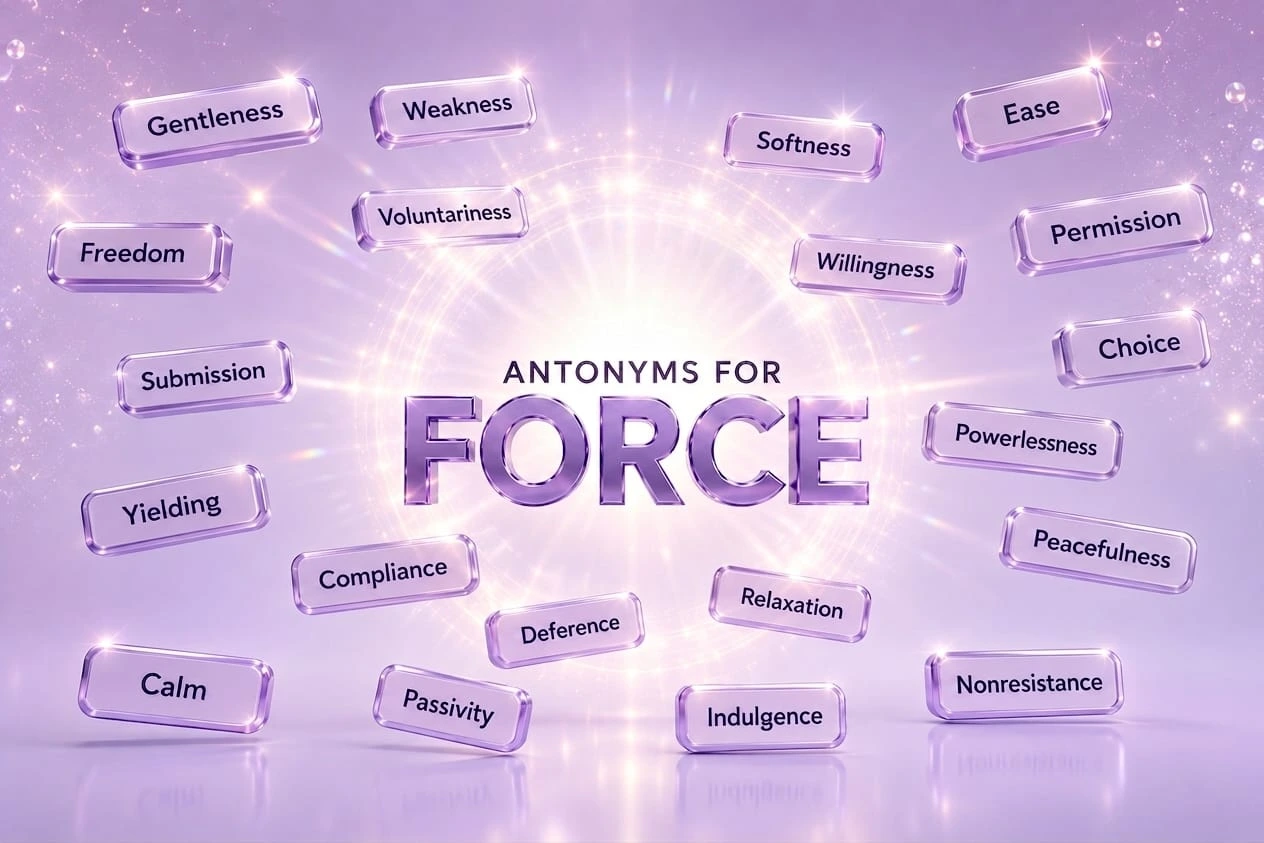
Common antonyms for force include weakness, gentleness, freedom, choice, consent, persuasion, cooperation, resistance, restraint, and relaxation, depending on the meaning and context.
Force is a powerful word with several meanings. I remember seeing it used in very different situations: a parent may force a child to do something, a strong wind may force a door open, and a police officer may use force to control a dangerous situation. These examples show why finding one opposite for force is not always simple. The best antonym depends on what force means in the sentence. Learning these opposites is useful for English learners because it helps them express ideas such as freedom, choice, gentleness, and resistance more clearly. Writers can also use precise alternatives instead of repeating the same words. In this guide, we will explore the main meanings of force, its contextual antonyms, examples, grammar, word formation, common mistakes, and useful differences between closely related words.
Quick Answer
The most natural antonym for force depends on the meaning. For physical power, weakness or gentleness may work; for making someone do something, choice, consent, freedom, or persuasion are stronger opposites. When force means pushing against something, resistance can be the contrasting idea.
Quick Comparison
| Word | Meaning | Example |
|---|---|---|
| Force | Power used to make something happen or someone act | They used force to open the door. |
| Gentleness | Soft and careful behavior without harsh power | She handled the child with gentleness. |
| Choice | The freedom to decide | Everyone should have a choice. |
| Consent | Permission given freely | The treatment requires the patient’s consent. |
| Persuasion | Changing someone’s mind through reasons rather than pressure | He used persuasion, not force. |
One-Line Definition
Force: Power, pressure, or strength used to make something happen or make someone do something.
Main contextual antonym: Choice the freedom to decide without being forced.
What You Will Learn
After reading this guide, you will understand:
- The main meanings of force
- Its strongest contextual antonyms
- Why choice and consent can oppose forced action
- Why weakness and gentleness fit different meanings
- How to use these antonyms naturally in sentences
22 Antonyms for Force
1. Choice (Noun)
Meaning: The freedom to decide what you want to do.
Example:
You should have the choice to accept or reject the offer.
Best context: Use choice when force means taking away someone’s freedom to decide.
2. Consent (Noun)
Meaning: Permission that someone gives freely.
Example:
The procedure cannot begin without the patient’s consent.
Best context: Consent is a strong opposite when force involves acting without someone’s permission.
3. Freedom (Noun)
Meaning: The ability to act or decide without control or pressure.
Example:
Everyone deserves the freedom to make personal decisions.
Best context: Use freedom when force means control or coercion.
4. Voluntariness (Noun)
Meaning: The quality of being done willingly rather than under pressure.
Example:
The agreement must be based on voluntariness.
Best context: This is useful in formal or academic writing.
5. Willingness (Noun)
Meaning: A readiness to do something by choice.
Example:
Her willingness to help made the task easier.
Best context: Willingness contrasts with being forced to act.
6. Persuasion (Noun)
Meaning: The act of changing someone’s mind through reasons or encouragement.
Example:
He used persuasion instead of pressure.
Best context: Use persuasion when someone is encouraged rather than forced.
7. Cooperation (Noun)
Meaning: The act of working together willingly.
Example:
The project succeeded through cooperation.
Best context: Cooperation contrasts with using force to get a result.
8. Agreement (Noun)
Meaning: A shared decision or acceptance between people.
Example:
The plan was completed through mutual agreement.
Best context: This works when force means imposing something on another person.
9. Negotiation (Noun)
Meaning: A discussion used to reach an agreement.
Example:
The two sides solved the problem through negotiation.
Best context: Negotiation is an alternative to forcing an outcome.
10. Diplomacy (Noun)
Meaning: The use of careful communication to solve disagreements peacefully.
Example:
The dispute was settled through diplomacy.
Best context: This is especially useful when discussing conflict, politics, or international relations.
11. Resistance (Noun)
Meaning: Opposition to a force, action, or influence.
Example:
The wall provided strong resistance to the pressure.
Best context: Resistance is a contextual opposite when force means pushing or exerting power against something.
Note: Resistance is not a universal antonym of force. It is the opposing reaction to force.
12. Restraint (Noun)
Meaning: Control that prevents someone from using excessive power or action.
Example:
The officer showed restraint during the difficult situation.
Best context: Use restraint when the opposite idea is holding back instead of using force.
13. Gentleness (Noun)
Meaning: A soft, calm, and careful way of treating someone or something.
Example:
She lifted the injured bird with gentleness.
Best context: Gentleness contrasts with physical force or harsh treatment.
14. Softness (Noun)
Meaning: A lack of hardness or harsh physical impact.
Example:
The material has a pleasant softness.Best context: This can contrast with force when discussing physical impact or touch.
15. Weakness (Noun)
Meaning: A lack of physical strength or power.
Example:
The storm lost its strength and showed signs of weakness.
Best context: Weakness is a useful opposite when force means physical strength or power.
16. Powerlessness (Noun)
Meaning: The state of having little or no power to act.
Example:
The victims felt a sense of powerlessness.
Best context: This contrasts with force as a source of power, although it does not mean “gentle.”
17. Peace (Noun)
Meaning: A state without fighting, violence, or conflict.
Example:
The leaders chose peace instead of violence.
Best context: Use peace when force refers to violence or military action.
18. Nonviolence (Noun)
Meaning: The practice of avoiding physical violence or force.
Example:
The movement was committed to nonviolence.
Best context: This is a direct contextual opposite when force means physical violence.
19. Calmness (Noun)
Meaning: A peaceful state without strong agitation or aggression.
Example:
She responded to the argument with calmness.
Best context: Calmness can contrast with forceful or aggressive behavior.
20. Relaxation (Noun)
Meaning: A state of being free from physical or mental tension.
Example:
The exercise promotes relaxation rather than physical strain.
Best context: This works when force refers to physical tension or exertion.
21. Inaction (Noun)
Meaning: A lack of action.
Example:
The problem became worse because of continued inaction.
Best context: Inaction can contrast with force when force means taking strong or direct action.
22. Surrender (Noun)
Meaning: The act of stopping resistance and giving in.
Example:
The soldiers chose surrender instead of continuing the fight.
Best context: This can contrast with force in conflict situations, especially when one side stops using resistance or aggression.
Contextual Antonyms of Force
The word force has several important meanings, so its opposite changes with the context.
When force means physical power
Use:
- Weakness
- Powerlessness
- Gentleness
- Softness
Example:
The machine uses great force to crush the material.
→ The opposite idea may be weakness or lack of physical power.
When force means making someone do something
Use:
- Choice
- Freedom
- Consent
- Willingness
- Voluntariness
Example:
She was forced to sign the document.
→ She should have had the choice to sign it.
When force means pressure or influence
Use:
- Persuasion
- Negotiation
- Diplomacy
- Agreement
- Cooperation
Example:
They used force to get the group to agree.
→ They could have used persuasion or negotiation instead.
When force means violence
Use:
- Peace
- Nonviolence
- Restraint
- Calmness
Example:
The protesters rejected the use of force.
→ They supported nonviolence.
When force means physical exertion
Use:
- Relaxation
- Inaction
- Rest
Example:
The exercise requires a lot of physical force.
→ Relaxation requires releasing physical tension.
Force vs. Its Main Antonyms
Force vs. Choice
Force removes or limits someone’s freedom to decide. Choice gives the person the ability to decide freely.
- Force: They forced him to attend.
- Choice: They gave him a choice about attending.
Force vs. Consent
Force involves pressure or compulsion, while consent means freely giving permission.
- Force: The action was taken without permission.
- Consent: The person agreed freely.
Force vs. Persuasion
Force pushes someone toward an outcome, while persuasion tries to change their mind through reasons.
- Force: They forced the customer to sign.
- Persuasion: They persuaded the customer to sign.
Force vs. Gentleness
Force can involve strong physical power. Gentleness involves soft and careful treatment.
- Force: He pulled the door open with force.
- Gentleness: She touched the injured animal with gentleness.
Force vs. Weakness
Force can mean physical strength or power. Weakness means a lack of strength or power.
- Force: The wind had enough force to knock down a tree.
- Weakness: The weakened wind could barely move the leaves.
Grammar and Word Class
Force can be both a noun and a verb.
As a noun
Force means power, strength, or pressure.
The storm had enough force to damage the roof.
Common noun antonyms include:
- weakness
- gentleness
- resistance
- restraint
- peace
As a verb
Force means to make someone do something or make something happen through pressure or power.
They forced him to leave.
Common contextual opposites include:
- allow
- persuade
- encourage
- invite
- release
The exact opposite depends on what force means in the sentence.
Word Formation
The word force comes from Old French force, meaning strength or power, and is related to Latin fortis, meaning strong.
Its word family includes:
- force noun/verb
- forced adjective/past participle
- forceful adjective
- forcefully adverb
- forcer noun, a person or thing that forces
- enforce verb
- enforcement noun
- reinforce verb
- reinforcement noun
The prefix en- in enforce changes the meaning and should not be treated as a simple antonym-forming prefix.
Common Mistakes
Mistake 1: Treating one word as the universal antonym
❌ The opposite of force is always weakness.
✅ The opposite of force depends on its meaning.
If force means physical strength, weakness can work. If it means coercion, choice or consent may be better.
Mistake 2: Using resistance as a direct antonym everywhere
❌ Choice is the only form of resistance to force.
✅ Resistance can oppose physical force, while choice can oppose coercion.
Resistance is a contextual opposite, not a universal antonym.
Mistake 3: Confusing persuasion with force
❌ The teacher forced the student by explaining the benefits.
✅ The teacher persuaded the student by explaining the benefits.
Persuasion changes someone’s decision through reasons rather than compulsion.
Expert Tip
When choosing an antonym for force, first ask: “Force of what?” If it means physical power, think weakness or gentleness; if it means coercion, think choice, consent, or freedom; if it means violence, think peace or nonviolence.
Mini Quiz
Choose the best antonym
The manager forced the employee to accept the new schedule.
A. Weakness
B. Choice
C. Resistance
Answer: B. Choice
Here, force means making someone do something against their preference, so choice provides the clearest contrast.
Fill in the blank
The doctor explained that the procedure would only happen with the patient’s ______.
Answer: consent
Consent means freely giving permission, making it a strong opposite of forced action.
Short Questions & Answers
What is the opposite of force?
There is no single opposite in every context. Choice, consent, freedom, gentleness, weakness, and peace can all work depending on the meaning of force.
What is the strongest antonym of force?
For force meaning coercion, choice or consent provides one of the clearest contrasts because both involve freely deciding or agreeing.
Is weakness the opposite of force?
Weakness can be an antonym when force means physical strength or power, but it does not work well when force means coercion or violence.
Is persuasion the opposite of force?
Persuasion can contrast with force when both describe ways of influencing someone’s decision. Persuasion uses reasons or encouragement, while force uses pressure or compulsion.
Can resistance be an antonym of force?
Yes, in some physical contexts. Resistance describes opposition to a force, but it is not a universal antonym of the word.
Conclusion
The best antonym for force depends on what the word means in a sentence. When force refers to physical power, weakness and gentleness can provide a clear contrast; it means coercion, choice, consent, freedom, and willingness are more accurate. When it refers to violence, peace and nonviolence work well. Understanding these differences helps you choose words that express your exact meaning instead of using an antonym that only partly fits. For English learners and writers, this small distinction can make sentences more natural and precise. Whenever you see force, look at the context first, then choose the opposite concept that truly matches it.
Antonyms for Etiquette: 20 Opposite Words Explained

I’m Daniel Carter, a language enthusiast and content writer focused on the fascinating world of antonyms and vocabulary. I break down word meanings and opposites into simple, practical guides helping readers build a richer vocabulary, understand language more deeply, and speak or write with greater confidence.