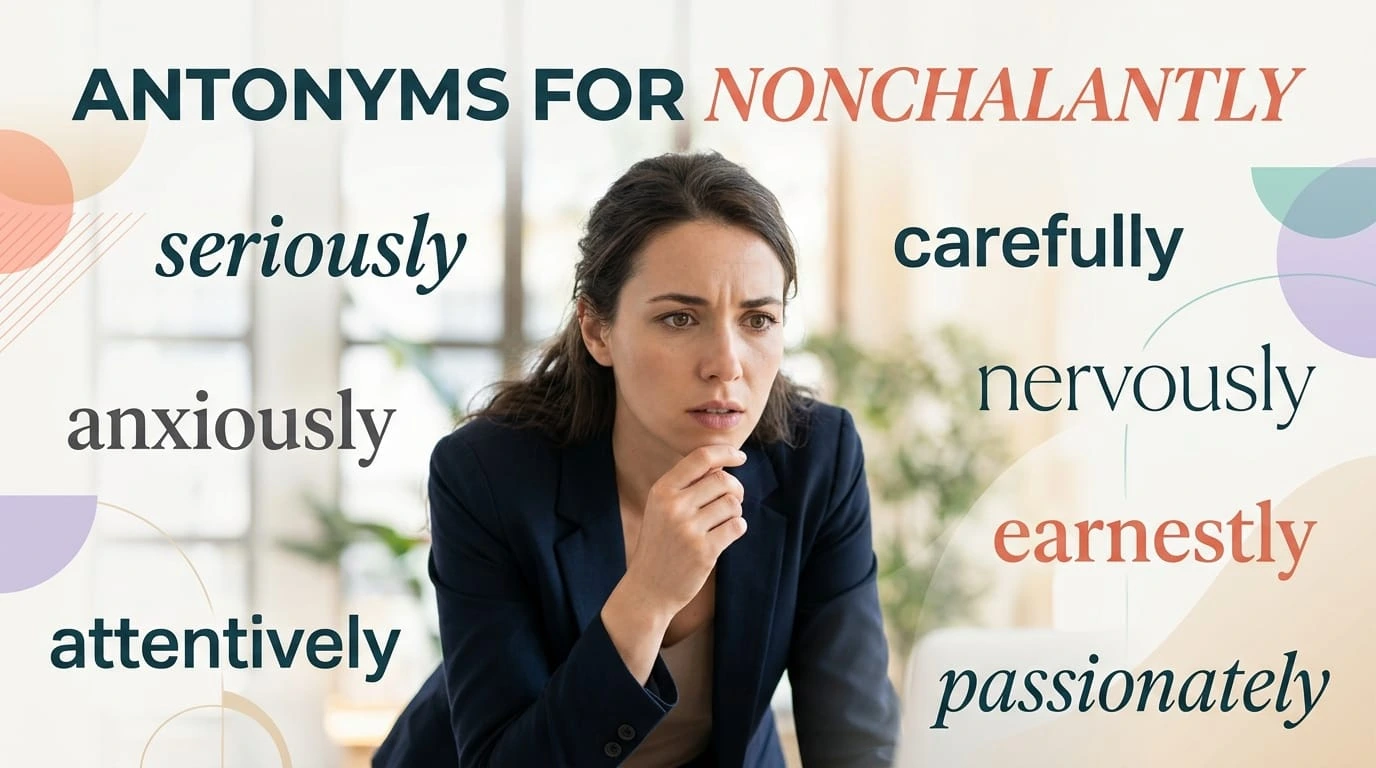
The main antonyms for nonchalantly are anxiously, nervously, seriously, concernedly, cautiously, and attentively.
The Short Answer
The best antonym for nonchalantly depends on the situation.
- Anxiously with worry or nervousness
- Nervously with visible tension or unease
- Seriously in an earnest or grave manner
- Attentively with focused attention
- Cautiously with care because of possible danger or risk
Among these, anxiously and nervously are particularly strong opposites when nonchalantly means acting without worry or concern.
Quick Word Comparison
| Word | Meaning | Example |
| Nonchalantly | In a calm, casual, unconcerned way | He nonchalantly walked away. |
| Anxiously | In a worried or uneasy way | She waited anxiously for the result. |
| Nervously | In a tense or apprehensive way | He nervously entered the room. |
| Seriously | In an earnest or grave way | She seriously considered the warning. |
| Attentively | With careful attention | He listened attentively to the teacher. |
| Cautiously | With care to avoid danger or mistakes | She cautiously opened the door. |
Nonchalantly: Meaning in Brief
Nonchalantly: in a calm, casual, or unconcerned manner, especially when a situation might normally cause worry or excitement.
Main antonym: Anxiously in a worried, uneasy, or nervous manner.
What You’ll Learn
- The main antonyms of nonchalantly
- How these opposites differ in meaning
- Which antonym works best in different contexts
- How to use each word naturally in sentences
- Why anxiously is not always interchangeable with seriously or cautiously
Useful Antonyms to Know
1. Anxiously
Anxiously is one of the strongest contextual antonyms of nonchalantly. It means behaving with worry, nervousness, or unease.
Example:
She waited anxiously for the doctor to call.
Nonchalantly: He nonchalantly dismissed the problem.
Anxiously: He anxiously worried about the problem.
2. Nervously
Nervously means in a tense, worried, or apprehensive manner. It is especially useful when someone’s behavior visibly shows nervousness.
Example:
He nervously checked the clock before the interview.
Best context: Fear, tension, uncertainty, interviews, meetings, or unfamiliar situations.
3. Seriously
Seriously can contrast with nonchalantly when the latter means treating something casually or without sufficient concern.
Example:
The manager seriously discussed the safety issue with the staff.
Here, seriously emphasizes an earnest or grave attitude rather than casual behavior.
4. Attentively
Attentively means with careful and focused attention. It can oppose nonchalantly when the latter describes a careless or unconcerned manner.
Example:
The students listened attentively to the instructions.
Best context: Listening, observing, studying, or following instructions.
5. Cautiously
Cautiously means carefully and with awareness of possible danger, mistakes, or problems.
Example:
She cautiously approached the unfamiliar dog.
It contrasts with nonchalantly when someone handles a potentially risky situation in a casual manner.
6. Concernedly
Concernedly means in a manner showing concern or worry. It is less common in everyday English than anxiously or worriedly, but it can function as a contextual opposite.
Example:
The teacher looked at the injured student concernedly.
Usage note: Prefer with concern or anxiously in many ordinary sentences because they sound more natural.
7. Earnestly
Earnestly means in a sincere, serious, or determined manner.
Example:
She earnestly asked him to reconsider his decision.
It contrasts with nonchalantly when the focus is on treating something casually versus sincerely and seriously.
8. Carefully
Carefully means with attention and caution to avoid mistakes or problems.
Example:
He carefully read the contract before signing it.
This can oppose nonchalantly when the original action suggests a casual lack of concern.
9. Hesitantly
Hesitantly means in an uncertain or reluctant manner.
Example:
She hesitantly opened the old box.
This contrasts with nonchalantly when the latter suggests effortless confidence or a lack of concern.
10. Worriedly
Worriedly means in a way that shows worry or concern.
Example:
He looked at his phone worriedly when no message arrived.
Although grammatically possible, anxiously or with concern is often more natural in polished writing.
Choosing the Right Antonym
The opposite of nonchalantly changes slightly depending on what the sentence emphasizes.
When nonchalantly means “without worry”
Use:
- anxiously
- nervously
- worriedly
Example:
She nonchalantly waited for the test results.
→ She anxiously waited for the test results.
Here, anxiously is the clearest contrast because it directly introduces worry.
When nonchalantly means “without seriousness”
Use:
- seriously
- earnestly
Example:
He nonchalantly discussed the serious problem.
→ He seriously discussed the problem.
The contrast is between a casual attitude and an earnest one.
When nonchalantly means “without care or attention”
Use:
- attentively
- carefully
- cautiously
Example:
She nonchalantly handled the fragile equipment.
→ She carefully handled the fragile equipment.
The focus here is on the amount of care given to the action.
How These Antonyms Differ
Not every opposite of nonchalantly means exactly the same thing.
Anxiously focuses on worry.
Nervously focuses on tension or apprehension.
Seriously focuses on earnestness or importance.
Attentively focuses on concentration.
Cautiously focuses on avoiding danger or mistakes.
Earnestly focuses on sincerity and seriousness.
So, if someone acts nonchalantly, you should not automatically replace it with anxiously. The correct choice depends on why the behavior is being described as nonchalant.
See the Antonyms in Action
- He nonchalantly walked into the interview room.
→ He nervously walked into the interview room. - She nonchalantly waited for the exam results.
→ She anxiously waited for the exam results. - He nonchalantly dismissed the warning.
→ He seriously considered the warning. - The child nonchalantly handled the expensive camera.
→ The child carefully handled the expensive camera. - She nonchalantly approached the strange dog.
→ She cautiously approached the strange dog. - The students did not listen nonchalantly; they listened attentively to every instruction.
- He answered the question earnestly rather than nonchalantly.
Grammar and Word Forms
Nonchalantly is an adverb. It describes how an action is performed.
Examples:
- He spoke nonchalantly.
- She smiled nonchalantly.
- They walked away nonchalantly.
Its common contextual antonyms are also adverbs:
- anxiously
- nervously
- seriously
- attentively
- cautiously
- carefully
- earnestly
- hesitantly
The adjective form is nonchalant:
Nonchalant: He remained nonchalant.
Adverb: He behaved nonchalantly.
Likewise:
- anxious → anxiously
- nervous → nervously
- serious → seriously
- attentive → attentively
- cautious → cautiously
- careful → carefully
- earnest → earnestly
Commonly Confused Opposites
Nonchalantly vs. Anxiously
These are strong contrasts when the issue is emotional concern.
- Nonchalantly = calmly and without showing concern
- Anxiously = with worry or unease
Example:
He nonchalantly waited outside.
He anxiously waited outside.
Nonchalantly vs. Seriously
These contrast when the issue is attitude toward importance.
- Nonchalantly = casually or unconcernedly
- Seriously = earnestly or with importance
Someone can be serious without being anxious.
Nonchalantly vs. Cautiously
These contrast when the issue is risk.
- Nonchalantly = without apparent concern
- Cautiously = with care because something may be dangerous or problematic
A Useful Language Tip
Nonchalantly describes how someone behaves, not necessarily how they actually feel.
For example, someone may nonchalantly say, “Everything is fine,” while secretly feeling anxious. The word describes the outward manner, so anxiously is an antonym only when the sentence is contrasting the actual manner or behavior.
Quick Antonym Quiz
1. She waited ______ for the medical results because she was very worried.
A. nonchalantly
B. anxiously
C. casually
Answer: B. anxiously
2. The manager ______ addressed the serious safety issue.
A. seriously
B. nonchalantly
C. casually
Answer: A. seriously
3. The hiker ______ approached the wild animal.
A. nonchalantly
B. cautiously
C. casually
Answer: B. cautiously
Frequently Asked Questions
What is the opposite of nonchalantly?
The strongest contextual opposites of nonchalantly include anxiously, nervously, seriously, attentively, and cautiously. The best choice depends on whether the contrast involves worry, seriousness, attention, or caution.
What is the strongest antonym of nonchalantly?
Anxiously is one of the strongest opposites when nonchalantly means behaving without worry or concern. Nervously is also a strong choice when the contrast involves tension or apprehension.
Is seriously an antonym of nonchalantly?
Yes, seriously can be a contextual antonym when nonchalantly means treating something casually or without sufficient seriousness.
Is anxiously always the opposite of nonchalantly?
No. Anxiously is appropriate when the contrast involves worry. If the contrast involves attention, caution, or seriousness, words such as attentively, cautiously, or seriously may be more accurate.
What to Remember
The best antonym for nonchalantly depends on the kind of contrast you need:
- Anxiously → with worry
- Nervously → with tension
- Seriously → with earnestness
- Attentively → with focused attention
- Cautiously → with care and awareness of risk
- Earnestly → sincerely and seriously
- Carefully → with attention to avoiding mistakes
Nonchalantly does not have one perfect opposite for every sentence. Choose the antonym that explains why the behavior is the opposite.
Antonyms for Exhausted: 25 Opposite Words to Know

I’m Daniel Carter, a language enthusiast and content writer focused on the fascinating world of antonyms and vocabulary. I break down word meanings and opposites into simple, practical guides helping readers build a richer vocabulary, understand language more deeply, and speak or write with greater confidence.