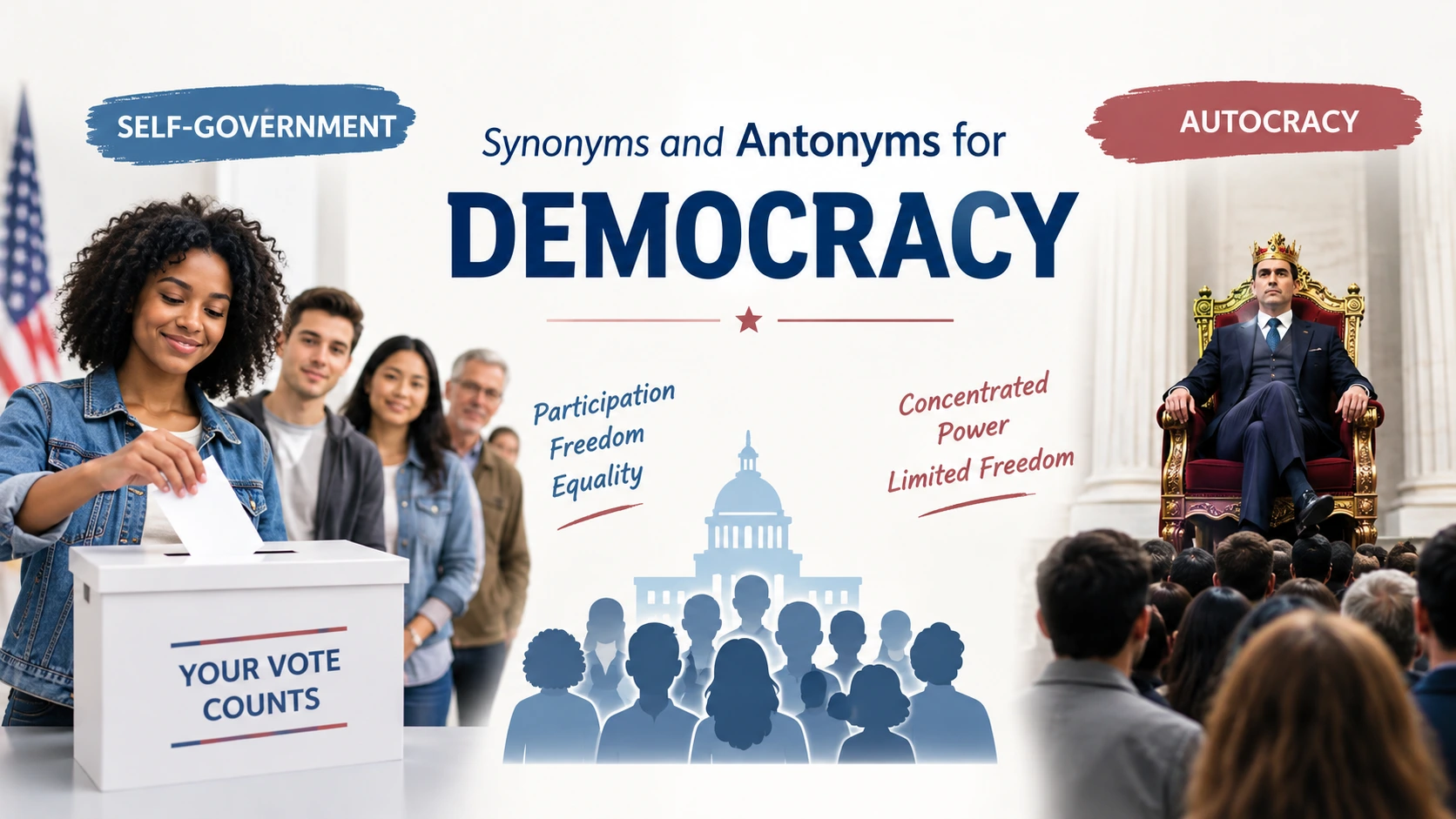
Synonyms for democracy include self-government, popular government, representative government, people’s rule, popular sovereignty, and democratic governance. Antonyms include autocracy, dictatorship, authoritarianism, tyranny, despotism, and oligarchy.
Imagine a school where students vote for their class representative instead of allowing one student to make every decision. This simple example helps explain the basic idea of democracy: people have a voice in decisions that affect them.
The word democracy is common in politics, history, social studies, and everyday discussions about freedom and equality. However, repeating the same word can make writing sound dull. Learning its synonyms helps you explain different forms of public participation, while understanding its antonyms helps you describe systems where political power is concentrated in the hands of one person or a small group.
Some words, such as self-government and popular government, closely express the central idea of democracy. Others, such as republic and majority rule, describe related political concepts but are not exact replacements in every sentence.
In this guide, you will learn useful synonyms and antonyms for democracy, their meanings, and how to use them correctly in sentences.
Synonyms and antonyms for democracy: Quick Answer
Democracy means a system of government in which people have a role in making political decisions, usually through voting and elected representatives.
- Synonyms: self-government, popular government, representative government, democratic governance, and popular sovereignty.
- Antonyms: autocracy, dictatorship, authoritarianism, tyranny, and despotism.
Not every alternative is an exact synonym or antonym. For example, a republic can be democratic, but the terms describe different features of government. Likewise, oligarchy means rule by a small group rather than necessarily rule
Synonyms and antonyms for democracy: What Does Democracy Mean?
Democracy is a system of government in which political power belongs to the people, who exercise it directly or through elected representatives.
For example, citizens may vote in elections to choose leaders and influence public policy.
Democracy is a noun. Its plural is democracies, which refers to more than one democratic system or state.
Synonyms for Democracy
The following 20 words and expressions can help you discuss democracy in different contexts. Some are close synonyms, while others describe important features or forms of democratic government.
1. Self-Government
Meaning: The ability of people to govern themselves rather than being ruled by an outside authority.
Example: The region gained self-government and began making its own political decisions.
2. Popular Government
Meaning: A government based on the authority or participation of the people.
Example: The constitution established a system of popular government.
3. Representative Government
Meaning: A system in which citizens elect representatives to make political decisions on their behalf.
Example: Representative government allows citizens to choose lawmakers through elections.
4. Democratic Governance
Meaning: The process of governing according to democratic principles, including public participation and accountability.
Example: Democratic governance encourages public involvement in important decisions.
5. Popular Sovereignty
Meaning: The principle that political authority ultimately comes from the people.
Example: Popular sovereignty is an important principle in many democratic constitutions.
6. People’s Rule
Meaning: Government in which the people hold political power.
Example: The movement called for people’s rule and fair elections.
7. Majority Rule
Meaning: A decision-making principle in which the option supported by more than half of the votes wins.
Example: The committee used majority rule to choose its new chairperson.
Note: Majority rule is a feature of many democracies, not a complete synonym for democracy. Democratic systems may also protect minority rights.
8. Electoral Government
Meaning: A government whose leaders or representatives are chosen through elections.
Example: The country introduced an electoral government after years of political unrest.
Note: Elections alone do not guarantee that a government is fully democratic.
9. Citizen Participation
Meaning: The involvement of citizens in political decisions and public affairs.
Example: Citizen participation increased when the government invited people to public meetings.
Note: This describes an important democratic practice rather than an entire political system.
10. Political Participation
Meaning: The actions people take to influence government, such as voting, campaigning, or joining political discussions.
Example: Political participation allows citizens to express their views.
11. Participatory Government
Meaning: A system that gives people opportunities to take part in political decision-making.
Example: The town introduced participatory government by involving residents in budget discussions.
12. Constitutional Democracy
Meaning: A democratic system in which government powers are limited by a constitution.
Example: Constitutional democracy protects political rights through established legal rules.
13. Liberal Democracy
Meaning: A form of democracy that combines elections with civil liberties, legal protections, and limits on government power.
Example: A liberal democracy protects freedom of speech alongside electoral rights.
14. Direct Democracy
Meaning: A system in which citizens vote directly on particular laws or public decisions.
Example: The proposal was put to a public referendum as an example of direct democracy.
15. Representative Democracy
Meaning: A democratic system in which citizens elect officials to govern on their behalf.
Example: In a representative democracy, voters choose members of the legislature.
16. Parliamentary Democracy
Meaning: A democratic system in which the government depends on the support of a parliament.
Example: Parliamentary democracy gives elected lawmakers a central role in forming a government.
17. Democratic System
Meaning: A political arrangement based on democratic principles.
Example: The country worked to build a democratic system with fair elections.
18. Democratic Rule
Meaning: The exercise of political power under democratic principles.
Example: The election marked the beginning of democratic rule.
19. Popular Rule
Meaning: A form of government in which the people are the source of political authority.
Example: The reform movement demanded popular rule and greater accountability.
20. Republic
Meaning: A state in which the head of state is not a hereditary monarch, generally operating under a constitutional or public system of government.
Example: The republic held elections to choose its national representatives.
Note: A republic is not automatically a democracy. Some republics are authoritarian, while some democracies are constitutional monarchies.
Antonyms for Democracy
Democracy does not have just one perfect antonym. The best opposite depends on which feature of democracy you want to contrast: rule by the people, political freedom, or the distribution of power.
1. Autocracy
Meaning: A system in which one person holds supreme political power.
Example: Under the autocracy, the ruler made major decisions without meaningful public participation.
Why it contrasts with democracy: Democracy distributes political authority through public participation, while autocracy concentrates it in one ruler.
2. Dictatorship
Meaning: A system in which a dictator holds power, often without meaningful democratic checks or free political competition.
Example: The country remained under a dictatorship for many years.
Why it contrasts with democracy: A dictatorship restricts the public’s ability to choose and replace political leaders freely.
3. Authoritarianism
Meaning: A system of government that concentrates power and restricts political freedoms and opposition.
Example: Authoritarianism limited the media’s ability to criticize government policies.
Why it contrasts with democracy: Democracy generally allows political competition and public criticism, while authoritarian systems restrict these activities.
4. Totalitarianism
Meaning: A form of government that seeks extensive control over political, social, and public life.
Example: The regime used censorship and surveillance to strengthen its totalitarian rule.
Why it contrasts with democracy: Totalitarianism seeks far-reaching control, leaving little room for independent political activity.
5. Tyranny
Meaning: Cruel, oppressive, or unjust use of political power.
Example: The citizens protested against the ruler’s tyranny.
Why it contrasts with democracy: Tyranny represents oppressive rule rather than government that respects people’s political rights.
6. Despotism
Meaning: Government by a ruler who exercises power in an oppressive or unrestricted way.
Example: The people struggled to free themselves from despotism.
Why it contrasts with democracy: Despotism places power in the hands of an oppressive ruler rather than making government accountable to citizens.
7. Oligarchy
Meaning: A system in which a small group of people holds political power.
Example: Critics argued that wealthy families had turned the political system into an oligarchy.
Why it contrasts with democracy: Oligarchy concentrates power in a small group, whereas democracy gives citizens a meaningful role in political authority.
8. Absolute Monarchy
Meaning: A system in which a monarch holds extensive or supreme governing power without effective constitutional limits.
Example: The country was ruled by an absolute monarchy.
Why it contrasts with democracy: An absolute monarch is not dependent on democratic elections to exercise supreme authority.
Important distinction: Not every monarchy is an antonym of democracy. Constitutional monarchies can be democratic when elected institutions govern and the monarch’s powers are limited.
Synonyms and antonyms for democracy: Quick Comparison
| Word | Meaning | Main contrast with democracy |
|---|---|---|
| Democracy | Rule by the people | Public political participation |
| Autocracy | Rule by one person | Concentrated individual power |
| Dictatorship | Rule by a dictator | Restricted democratic choice |
| Authoritarianism | Concentrated political power | Limited political freedom |
| Totalitarianism | Extensive state control | Restricted independent activity |
| Tyranny | Oppressive rule | Abuse of political power |
| Despotism | Unrestricted, oppressive rule | Lack of public accountability |
| Oligarchy | Rule by a small group | Power held by a few |
| Absolute monarchy | Supreme power held by a monarch | Hereditary, concentrated authority |
Synonyms and Antonyms of Democracy in Sentences
Examples make it easier to understand which terms fit different situations.
- Democracy: Citizens voted to choose their national representatives.
- Self-government: The community gained the power to manage its own affairs.
- Representative government: Elected officials debated the proposed law.
- Popular sovereignty: The constitution recognized the people as the source of political authority.
- Majority rule: More than half of the voters supported the proposal.
- Autocracy: The ruler made decisions without consulting the public.
- Dictatorship: Opposition parties were prevented from competing freely.
- Authoritarianism: Government restrictions limited political criticism.
- Oligarchy: A small group of powerful individuals controlled major political decisions.
- Tyranny: The ruler used fear and oppression to silence citizens.
Common Mistakes When Using Democracy Synonyms and Antonyms
Mistake 1: Treating every republic as a democracy
A republic does not automatically guarantee free elections, political competition, or civil liberties.
Mistake 2: Calling majority rule a complete synonym
Majority rule is a decision-making principle. A democratic system may also include minority protections, constitutional limits, and individual rights.
Mistake 3: Treating monarchy as the opposite of democracy in every case
A constitutional monarchy can operate as a democracy when elected representatives hold governing power.
Mistake 4: Using dictatorship and oligarchy interchangeably
A dictatorship typically concentrates power in one ruler, while an oligarchy concentrates power in a small group.
Mistake 5: Assuming elections alone make a country democratic
Meaningful political competition, freedom to express opinions, and the ability to hold leaders accountable also matter.
Synonyms and antonyms for democracy: Frequently Asked Questions
What is the closest synonym for democracy?
Popular government and self-government are close alternatives because both express the idea that political authority belongs to the people. Representative government is more precise when citizens elect officials to govern for them.
What is the main antonym of democracy?
Autocracy is a strong general antonym because it describes a system in which one person holds supreme political power. Dictatorship is another common opposite.
Is republic a synonym for democracy?
Not exactly. A republic is a state without a hereditary monarch as its head of state, while democracy concerns the people’s role in political power. A republic can be democratic or authoritarian.
Are authoritarianism and dictatorship the same?
No. A dictatorship describes a system or form of rule centered on a dictator, while authoritarianism is a broader concept involving concentrated power and restricted political freedoms.
What is the difference between democracy and oligarchy?
Democracy gives citizens a meaningful role in political authority, while oligarchy places political power in the hands of a small group.
Conclusion
Democracy is closely associated with self-government, popular government, and representative government. Its strongest contrasts include autocracy and dictatorship, while authoritarianism, tyranny, despotism, and oligarchy describe other forms of concentrated or oppressive power.
Choose the word that matches your meaning. These distinctions will help you write more clearly about government, political rights, and public participation.
Synonyms and Antonyms for Radiation

I’m Moazama Akbar, an English language researcher and content writer with a passion for helping people build stronger vocabulary and language skills. I create clear, well-researched guides on antonyms, opposite words, and word meanings, designed to make English learning simple, practical, and enjoyable for students, writers, and learners everywhere.