Opposites of denotation include connotation, implication, association, suggestion, and figurative meaning, depending on the context.
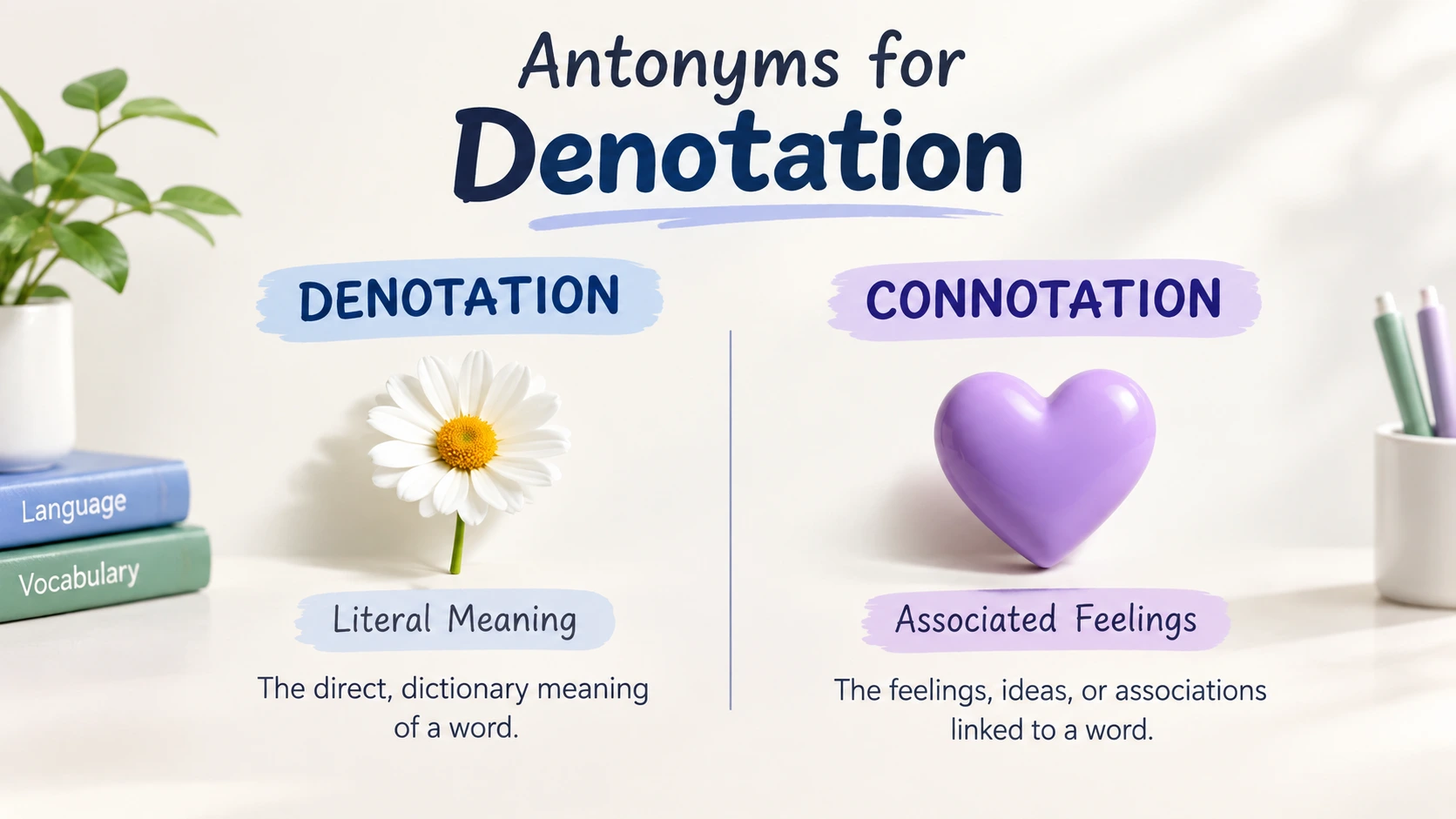
The most common contrast to denotation is connotation. Denotation refers to a word’s direct or literal meaning, while connotation refers to the feelings, ideas, or associations linked to it. They are contrasting concepts, though not exact antonyms.
What Is the Difference Between Denotation and Connotation?
| Term | Meaning | Example |
|---|---|---|
| Denotation | The direct or literal meaning of a word | Rose means a type of flower. |
| Connotation | The feelings or ideas a word suggests | Rose may suggest love or romance. |
Definition of Denotation
Denotation (noun): The direct, literal, or basic meaning of a word, symbol, or sign.
Main contrasting term: Connotation: the feelings, ideas, or associations connected to a word beyond its literal meaning.
After reading this guide, you will understand the difference between denotation and connotation, learn other contextual contrasts, and see how to use these terms in writing.
Antonyms and Contrasting Terms for Denotation
Because denotation is a technical term, it does not have a perfect opposite in every context. The following words are useful contrasts in language, literature, and communication.
1. Connotation (Noun)
Meaning: The feelings or ideas associated with a word beyond its literal meaning.
Example: The word home denotes a place to live but connotes comfort and belonging.
Usage: This is the strongest and most common contrast to denotation.
2. Figurative Meaning (Noun Phrase)
Meaning: A meaning that goes beyond the literal sense of words.
Example: In “He has a heart of stone,” the figurative meaning suggests that he is unkind.
Usage: Useful when contrasting literal language with metaphors or other figures of speech.
3. Implied Meaning (Noun Phrase)
Meaning: A message or idea suggested without being stated directly.
Example: Her silence carried an implied meaning of disagreement.
Usage: Best when the intended message is indirect.
4. Suggestion (Noun)
Meaning: An idea or feeling that a word or statement brings to mind.
Example: The word slender carries a suggestion of grace.
Usage: Describes an idea that language evokes rather than states directly.
5. Association (Noun)
Meaning: An idea, feeling, or memory connected to a word.
Example: The word school may bring associations with learning and friendship.
Usage: Useful in discussions of language, culture, and personal experience.
6. Implication (Noun)
Meaning: An idea or meaning that is hinted at rather than stated openly.
Example: His comment had the implication that the work was incomplete.
Usage: Often used to discuss hidden messages or indirect meanings.
7. Symbolic Meaning (Noun Phrase)
Meaning: A meaning that represents a larger idea.
Example: A white dove often has symbolic meaning related to peace.
Usage: Useful in literature, art, and cultural studies.
8. Emotional Meaning (Noun Phrase)
Meaning: The feelings a word expresses or brings to mind.
Example: The word mother may carry strong emotional meaning for many people.
Usage: Highlights the emotional side of language rather than its literal definition.
9. Associative Meaning (Noun Phrase)
Meaning: The ideas and experiences linked to a word beyond its basic meaning.
Example: The word winter may have associative meaning linked to loneliness or rest.
Usage: Useful in language studies and literary analysis.
10. Subjective Meaning (Noun Phrase)
Meaning: A meaning shaped by a person’s own views or experiences.
Example: The word success has subjective meaning because people define it differently.
Usage: Contrasts personal interpretation with a more direct, shared definition.
11. Hidden Meaning (Noun Phrase)
Meaning: A meaning that is not immediately clear or directly expressed.
Example: The poem may contain a hidden meaning about freedom.
Usage: Useful when a message requires interpretation.
12. Underlying Meaning (Noun Phrase)
Meaning: The deeper idea behind a word, statement, or text.
Example: The underlying meaning of the story concerns the value of honesty.
Usage: Often used in literary analysis.
13. Nonliteral Meaning (Noun Phrase)
Meaning: A meaning that differs from the direct, literal meaning.
Example: “Time is money” has a nonliteral meaning about the value of time.
Usage: Useful when discussing figurative expressions.
14. Metaphorical Meaning (Noun Phrase)
Meaning: A meaning created by comparing one thing to another.
Example: Calling her a “ray of sunshine” gives the phrase a metaphorical meaning.
Usage: Best for metaphors and creative writing.
15. Symbolism (Noun)
Meaning: The use of an object, image, or action to represent a larger idea.
Example: The broken chain represents freedom through symbolism.
Usage: Useful in literature, films, and art.
16. Inference (Noun)
Meaning: A conclusion reached from clues or available information.
Example: From his wet clothes, we made the inference that he had walked in the rain.
Usage: Describes what a reader or listener works out rather than what a word directly denotes.
17. Subtext (Noun)
Meaning: An unstated idea or feeling beneath the surface of a conversation or text.
Example: The friendly dialogue had a subtext of rivalry.
Usage: Particularly useful for stories, plays, and conversations.
18. Nuance (Noun)
Meaning: A small but important difference in meaning, tone, or feeling.
Example: The writer chose slim instead of skinny to create a different nuance.
Usage: Helps explain subtle differences that a literal definition may not capture.
19. Figurative Language (Noun Phrase)
Meaning: Language that uses imagery or comparison instead of only literal meanings.
Example: “The classroom was a zoo” uses figurative language to describe noise and disorder.
Usage: Useful when explaining how writers move beyond literal expression.
20. Pragmatic Meaning (Noun Phrase)
Meaning: The meaning a statement has in a particular situation or context.
Example: “Can you open the window?” is literally a question about ability but often functions as a request.
Usage: Important in linguistics because context can change how an utterance is understood.
Contextual Contrasts: Which Word Should You Choose?
Not every term above is a true antonym of denotation. These are related concepts that contrast with literal meaning in different ways.
| If you mean… | Best contrasting term | Why it fits |
|---|---|---|
| Feelings linked to a word | Connotation | Focuses on emotional or cultural associations |
| A nonliteral expression | Figurative meaning | Goes beyond literal interpretation |
| An unstated message | Implied meaning | Suggests something indirectly |
| A deeper message in a story | Subtext | Reveals meaning beneath the surface |
| Meaning shaped by context | Pragmatic meaning | Depends on the situation and speaker’s intent |
| A conclusion drawn from clues | Inference | Requires interpretation by the reader or listener |
Denotation vs. Connotation: Example Sentences
Consider the word snake.
- Denotation: A snake is a legless reptile.
- Connotation: The word snake may suggest dishonesty or betrayal when used to describe a person.
Consider the word childish.
- Denotation: Relating to a child or typical of a child.
- Connotation: It often suggests immaturity when used to describe an adult.
These examples show why the direct meaning of a word can differ from the feelings or judgments it creates.
Antonyms for Denotation: Common Mistakes to Avoid
- Calling connotation an exact antonym: Connotation is the most common contrast to denotation, but the two concepts work together to explain different aspects of meaning.
- Confusing figurative meaning with connotation: Figurative meaning involves nonliteral language, while connotation concerns associations and feelings.
- Ignoring context: A word’s denotation may remain stable while its connotations change across cultures or situations.
Short Questions and Answers
What is the opposite of denotation?
Connotation is the most common contrasting term. It refers to the feelings and associations linked to a word rather than its direct meaning.
Is connotation a true antonym of denotation?
Not strictly. Denotation and connotation are contrasting concepts that describe different aspects of a word’s meaning.
What is another word for denotation?
Depending on the context, literal meaning, direct meaning, and basic meaning are useful alternatives.
What is the difference between denotation and figurative meaning?
Denotation is a word’s direct meaning. Figurative meaning is an intended meaning that goes beyond the literal sense.
Conclusion
The best answer to antonyms for denotation is usually connotation, especially in English language studies and literary analysis. However, other terms, such as figurative meaning, implied meaning, subtext, and pragmatic meaning, can provide useful contrasts in specific contexts.
Understanding these differences helps students interpret texts, recognize the deeper effects of words, and write with greater precision. Remember that denotation explains what a word directly means, while connotation explores the feelings and ideas associated with it. Choose the contrasting term that matches your intended meaning instead of treating every related expression as a direct antonym.
Antonyms for Honest: Opposite Words and Examples

I’m Noreen Akbar, an English language researcher and content writer with a passion for words,their meanings, origins, and the subtle differences between them. I specialize in antonyms and vocabulary, creating clear, easy-to-follow guides that help readers expand their word power, sharpen their understanding of language, and express themselves with greater clarity and confidence.