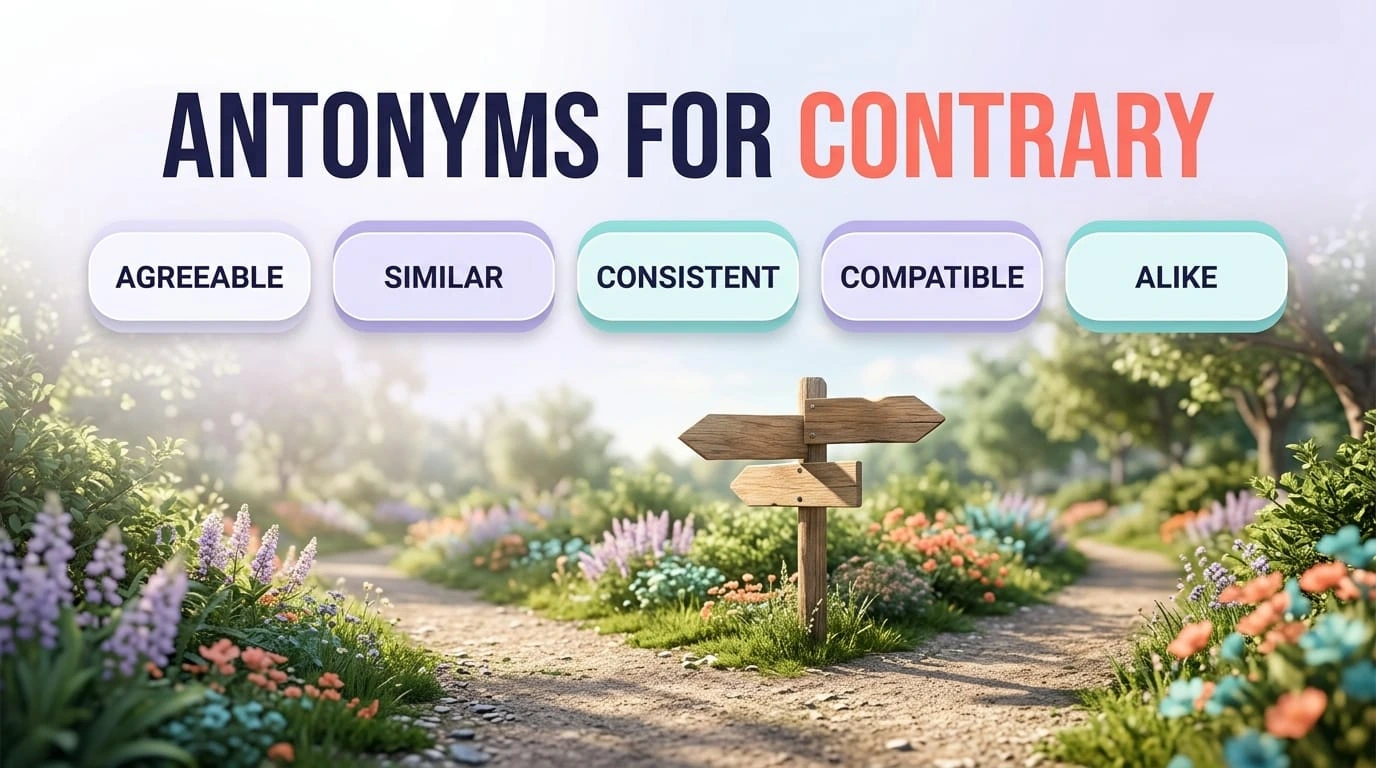
The most common antonyms for contrary are similar, agreeable, consistent, and compliant, depending on the context. Contrary can describe opposing ideas, conflicting facts, or a person who deliberately resists others.
What Is the Opposite of Contrary?
The opposite of contrary is often similar when describing things that differ, consistent when discussing facts or statements, and compliant when describing someone who refuses to cooperate or obey.
Contrary and Its Antonym: Quick Word Comparison
| Word | Meaning | Example |
| Contrary | Opposite, conflicting, or resistant | His opinion was contrary to mine. |
| Similar | Almost the same in nature or quality | Our opinions were similar. |
| Consistent | In agreement with facts or previous statements | Her explanation was consistent with the evidence. |
| Agreeable | Willing to agree or cooperate | He was agreeable to the proposed changes. |
| Compliant | Willing to follow rules or instructions | The employee was compliant with the new policy. |
Meaning in Brief
Contrary: Opposing, conflicting with, or deliberately going against something.
Main antonym: Similar alike in appearance, nature, meaning, or characteristics.
Main Antonyms for Contrary
Here are useful opposites of contrary, with simple meanings and natural examples.
1. Similar
Alike in nature, meaning, or characteristics. It is useful when contrary means different or opposite.
Example: Their views were similar rather than contrary.
2. Alike
Having the same or nearly the same qualities.
Example: The two proposals were alike in their main goals.
3. Same
Not different in identity, nature, or essential characteristics.
Example: We reached the same conclusion despite using different methods.
4. Identical
Exactly the same in every relevant detail.
Example: The two reports contained identical findings, not contrary results.
5. Compatible
Able to exist, work, or fit together without conflict.
Example: Her suggestion was compatible with the company’s existing policy.
6. Consistent
In agreement with something else or not contradicting it.
Example: His latest statement was consistent with his earlier explanation.
7. Concordant
In agreement or harmony, especially in formal or technical contexts.
Example: The researchers found concordant results in both studies.
8. Corresponding
Matching or having a similar relationship to something else.
Example: Each claim had a corresponding piece of evidence.
9. Matching
Similar or equal in relevant features.
Example: The two accounts contained matching details rather than contrary information.
10. Harmonious
Working or existing together without disagreement or conflict.
Example: The team maintained a harmonious relationship throughout the project.
11. Aligned
In agreement with a goal, position, principle, or plan.
Example: Her recommendations were aligned with the school’s objectives.
12. Agreeing
Sharing the same opinion or accepting the same position.
Example: The committee members were agreeing on the main points.
13. Supportive
Showing approval, encouragement, or assistance rather than opposition.
Example: The manager was supportive of the employee’s proposal.
14. Cooperative
Willing to work with others toward a shared goal.
Example: Unlike his contrary colleague, Mark was cooperative during the meeting.
15. Agreeable
Willing to agree, accept a suggestion, or cooperate.
Example: She was agreeable to the proposed changes.
16. Compliant
Willing to follow rules, instructions, or requirements.
Example: The contractor remained compliant with all safety regulations.
17. Obedient
Following instructions or authority without resistance.
Example: The obedient student followed the teacher’s directions.
18. Accommodating
Willing to adjust to other people’s needs or preferences.
Example: Our host was accommodating when we requested a different schedule.
19. Amenable
Open and willing to accept a suggestion, proposal, or change.
Example: The director was amenable to revising the original plan.
20. Willing
Ready or prepared to do something without resistance.
Example: He was willing to help instead of taking a contrary position.
Choosing the Right Antonym
Not every word above is a direct opposite of contrary. Some work best for conflicting ideas, while others describe a person’s attitude or behavior.
| If contrary means… | Choose an opposite such as… |
| Opposite or different | Similar, alike, same |
| Conflicting with facts | Consistent, concordant, agreeing |
| Incompatible with a plan | Compatible, aligned, harmonious |
| Resistant or difficult | Cooperative, agreeable, accommodating |
| Unwilling to follow instructions | Compliant, obedient, willing |
Understanding How These Antonyms Differ
- Similar vs. consistent: Similar means alike; consistent means in agreement or not contradictory.
- Compatible vs. harmonious: Compatible means able to work together; harmonious emphasizes a peaceful or balanced relationship.
- Agreeable vs. amenable: Both describe willingness to accept something, but amenable often emphasizes openness to a particular proposal or change.
- Cooperative vs. compliant: A cooperative person actively works with others, while a compliant person follows rules or instructions.
- Supportive vs. agreeing: Someone can support another person without agreeing with every opinion they express.
Contrary and Its Antonyms in Everyday Sentences
Here are additional examples showing how the right opposite changes with the sentence.
- Contrary → Similar: The two plans were similar in cost and design.
- Contrary → Consistent: The witness’s account was consistent with the available evidence.
- Contrary → Compatible: His proposal was compatible with the team’s long-term goals.
- Contrary → Cooperative: The usually contrary child became cooperative during the activity.
- Contrary → Amenable: The landlord was amenable to discussing a lower rent.
- Contrary → Supportive: Her parents were supportive of her decision to study abroad.
Grammar and Word Class
Contrary is commonly used as an adjective.
- Contrary opinion: an opposing opinion.
- Contrary evidence: evidence that conflicts with a claim.
- A contrary person: someone who tends to oppose others or act against expectations.
The antonym must match the intended meaning and grammatical role. For example, consistent works well in “consistent evidence,” while cooperative works in “a cooperative person.”
A Useful Language Tip
The phrase “on the contrary” is used to introduce a statement that rejects or corrects a previous idea.
Example: “I thought he disliked the job. On the contrary, he enjoys it.”
In this expression, replacing contrary with similar would not preserve the meaning. Choose an antonym according to the complete expression, not just the individual word.
Common Errors to Avoid
1. Treating “similar” as the opposite in every situation
“Similar” works when contrary means different or opposite, but it does not directly describe a person’s willingness to obey.
2. Confusing “consistent” with “identical”
Consistent statements do not contradict each other, but they do not have to use the same words or contain exactly the same details.
3. Using “compliant” for every kind of disagreement
Compliant refers mainly to following rules, instructions, or requirements. Use agreeing or consistent when discussing opinions or evidence instead.
Test Your Knowledge
Choose the best antonym for contrary in this sentence:
“The witness gave an account that was _____ with the available evidence.”
A. Stubborn B. Consistent C. Opposing
Answer: B. Consistent. It means the witness’s account agreed with the evidence rather than contradicting it.
Frequently Asked Questions
What is the most common antonym for contrary?
Similar is a useful opposite when contrary means opposite or different. In other contexts, consistent, compatible, or cooperative may be more accurate.
What is the opposite of a contrary person?
Depending on the situation, a contrary person may be described as cooperative, agreeable, accommodating, or compliant. These words distinguish willingness to work with others from willingness to follow instructions.
Are contrary and contradictory the same?
They overlap, but they are not identical in every use. Contrary can describe opposing ideas, directions, or behavior, while contradictory usually describes statements, claims, or facts that conflict with one another.
Can similar always replace contrary?
No. Similar works when the intended contrast is between opposing or different things. It does not naturally replace contrary in expressions such as “a contrary attitude” or “on the contrary.”
What to Remember
The best antonym for contrary depends on what is being described. Use similar for likeness, consistent for agreement with facts, compatible for things that work together, and cooperative for a person willing to work with others.
Antonyms for Gingerly: Opposites to Know

I’m Daniel Carter, a language enthusiast and content writer focused on the fascinating world of antonyms and vocabulary. I break down word meanings and opposites into simple, practical guides helping readers build a richer vocabulary, understand language more deeply, and speak or write with greater confidence.