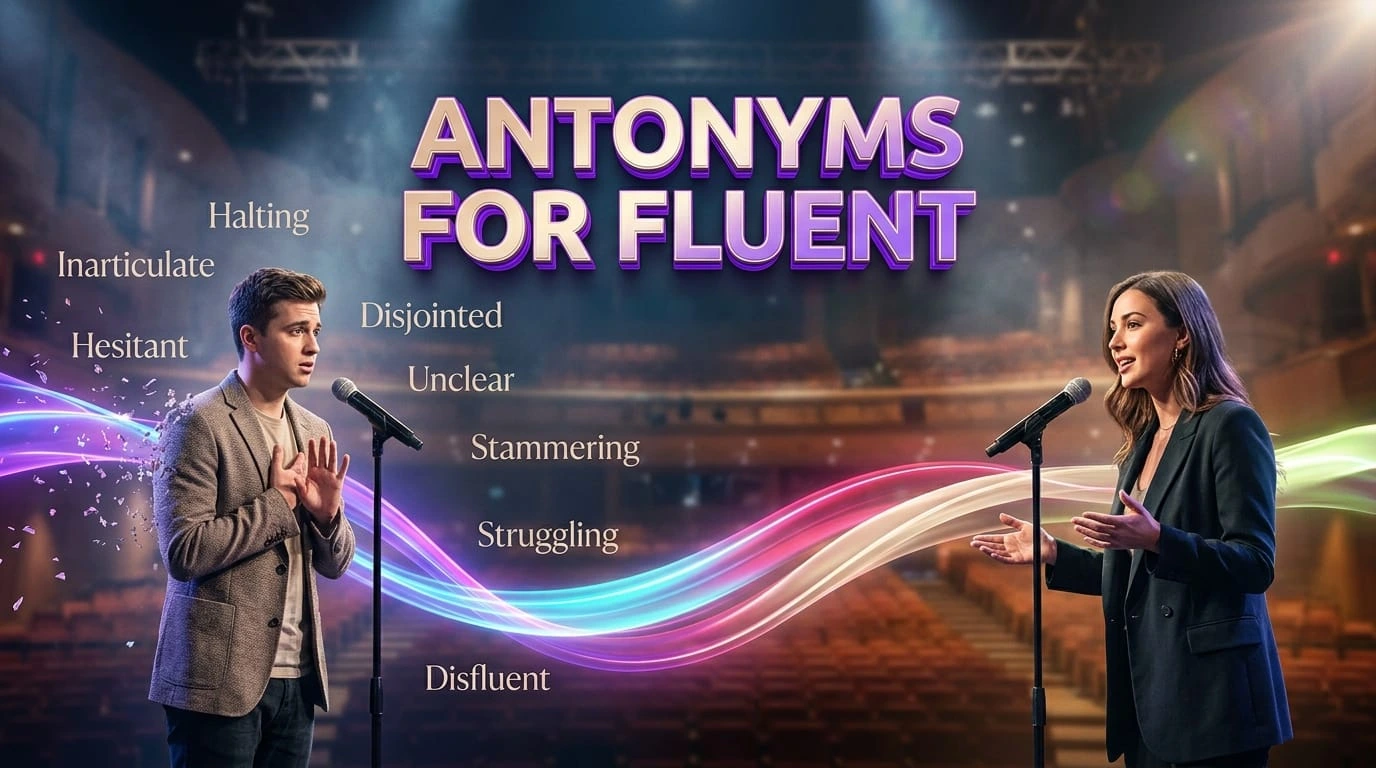
The most common antonyms for fluent are inarticulate, halting, hesitant, disfluent, and struggling, depending on the context.
What Is the Opposite of Fluent?
The best opposite of fluent depends on what you mean. Disfluent describes speech that lacks smoothness, while halting describes speech with frequent pauses. Inarticulate refers to difficulty expressing ideas clearly, and hesitant describes speech that sounds uncertain.
Fluent vs. Its Opposites
| Word | Meaning | Example |
|---|---|---|
| Fluent | Speaking smoothly and easily | She is fluent in French. |
| Disfluent | Not speaking smoothly | His disfluent speech included frequent pauses. |
| Halting | Slow and interrupted | He gave a halting answer. |
| Hesitant | Uncertain or reluctant | She sounded hesitant during the interview. |
| Inarticulate | Unable to express ideas clearly | He felt inarticulate when explaining his concerns. |
| Unskilled | Lacking a particular skill | He was unskilled in written English. |
Fluent: Meaning in Brief
Able to speak, read, or write a language smoothly, easily, and naturally.
Main antonym disfluent: Not smooth or continuous, especially when referring to speech.
After reading this guide, you will understand the most useful opposites of fluent, how their meanings differ, and which word fits conversations, language learning, writing, and professional communication.
Main Antonyms for Fluent: 15 Useful Opposites
Not every word below is a perfect antonym in every situation. Some describe interrupted speech, while others refer to limited language ability or difficulty expressing thoughts.
1. Disfluent
Meaning: Speech that is not smooth or continuous, often because of pauses, repetitions, or interruptions.
Example: The speaker’s disfluent delivery made the presentation harder to follow.
Best used when: Discussing speech patterns, communication, or language research.
2. Halting
Meaning: Speaking slowly and with frequent pauses, often because of uncertainty or difficulty.
Example: She gave a halting introduction in English.
Best used when: Someone struggles to speak continuously.
3. Hesitant
Meaning: Speaking or acting with uncertainty or reluctance.
Example: He sounded hesitant when answering questions in Spanish.
Best used when: The speaker seems unsure rather than lacking language knowledge.
4. Inarticulate
Meaning: Unable to express thoughts clearly or effectively.
Example: I felt inarticulate when trying to explain the complicated problem.
Best used when: The problem is expressing ideas, not necessarily speaking a language fluently.
5. Faltering
Meaning: Becoming weaker, less steady, or less confident; speech may lose its smoothness.
Example: Her faltering voice revealed how nervous she was.
Best used when: Speech or confidence breaks down during communication.
6. Stumbling
Meaning: Making mistakes or struggling while speaking or reading.
Example: He was stumbling over unfamiliar words during the presentation.
Best used when: Someone repeatedly struggles with words or pronunciation.
7. Unskilled
Meaning: Lacking the ability or training needed for a particular task.
Example: She was unskilled in formal academic writing.
Best used when: Discussing writing, language tasks, or communication skills more broadly.
8. Awkward
Meaning: Not smooth, natural, or comfortable.
Example: His awkward phrasing made the email sound unnatural.
Best used when: Describing unnatural wording or uncomfortable communication.
9. Labored
Meaning: Requiring considerable effort; speech may sound forced or difficult.
Example: His labored explanation suggested that he was struggling to find the right words.
Best used when: Speaking takes noticeable effort.
10. Broken
Meaning: Informal description of language that contains substantial grammatical errors or incomplete structures.
Example: The character spoke in broken English while learning the language.
Best used when: Describing limited command of a language. Be aware that this term can sound disrespectful when applied to real people; limited proficiency is often more considerate.
11. Incoherent
Meaning: Unclear or difficult to follow because ideas or words do not connect logically.
Example: His explanation became incoherent when he lost his train of thought.
Best used when: The message lacks clarity or logical connection, rather than simply containing pauses.
12. Inexpressive
Meaning: Showing or communicating little emotion or expression.
Example: Her inexpressive delivery made the speech sound flat.
Best used when: Describing expressive delivery, not language fluency itself. It is a contextual contrast rather than a direct antonym.
13. Uncertain
Meaning: Not confident or sure about what to say or do.
Example: He sounded uncertain when discussing the topic in German.
Best used when: The speaker lacks confidence, even if their language skills are good.
14. Struggling
Meaning: Experiencing difficulty doing something.
Example: The student was struggling to speak English without long pauses.
Best used when: Describing someone who finds speaking, reading, or writing difficult.
15. Nonfluent
Meaning: Not fluent or not able to use a language with fluency.
Example: The course provides additional support for nonfluent speakers.
Best used when: You need a relatively direct contrast with fluent, especially in language-learning contexts. Depending on the audience, learners with limited English proficiency may sound more natural and respectful.
Choosing the Right Antonym
The best opposite changes according to the meaning of fluent in a sentence.
| If fluent means… | Choose… | Why? |
|---|---|---|
| Speaking smoothly | Disfluent | Directly contrasts with smooth speech |
| Speaking without interruptions | Halting | Highlights pauses and breaks |
| Expressing ideas clearly | Inarticulate | Focuses on difficulty communicating ideas |
| Speaking confidently | Hesitant | Highlights uncertainty |
| Using a language proficiently | Nonfluent | Contrasts with language fluency |
| Writing naturally | Awkward | Describes unnatural phrasing |
| Speaking with little effort | Labored | Highlights effort and difficulty |
Understanding Each Antonym
Disfluent vs. Halting
Both words can describe speech that is not smooth, but their emphasis differs. Disfluent is a broader, more technical term for interruptions or disruptions in speech. Halting emphasizes frequent pauses that make speaking sound slow or broken.
- Disfluent: He repeated several words during his answer.
- Halting: He spoke in a halting voice, pausing after nearly every phrase.
Hesitant vs. Inarticulate
Hesitant describes uncertainty about speaking or what to say. Inarticulate describes difficulty putting thoughts into clear words.
- Hesitant: She was hesitant to answer the question.
- Inarticulate: He could not clearly explain why he disagreed.
Nonfluent vs. Broken
Nonfluent is a more neutral description of limited fluency. Broken is informal and may imply that someone’s grammar or sentence structure is seriously limited. It is often better to describe the specific issue or say that someone is still developing proficiency.
Awkward vs. Incoherent
Awkward language may be understandable but sound unnatural. Incoherent language is difficult to follow because the words or ideas do not form a clear message.
Examples in Context
Here are natural examples showing how these opposites work in everyday situations.
- Language learning: Although Maya understands French, her spoken French is still halting.
- Job interview: The candidate gave hesitant answers because he was nervous.
- Public speaking: His speech became disfluent when he lost his place in the notes.
- Writing: The paragraph sounded awkward because the sentences did not flow naturally.
- Communication: She struggled to express her ideas and felt inarticulate.
- Pronunciation: He stumbled over several unfamiliar words while reading aloud.
- Academic discussion: The student gave an incoherent explanation of the theory.
- Language proficiency: The program offers extra practice for learners who are not yet fluent in English.
Grammar and Word Class
Fluent is an adjective. Most of its useful opposites are also adjectives, although some can be used in other grammatical forms.
| Word | Word class | Example |
|---|---|---|
| Fluent | Adjective | She is fluent in Arabic. |
| Disfluent | Adjective | His speech was disfluent. |
| Halting | Adjective | He gave a halting response. |
| Hesitant | Adjective | She sounded hesitant. |
| Inarticulate | Adjective | He felt inarticulate. |
| Nonfluent | Adjective | The assessment included nonfluent speakers. |
| Awkward | Adjective | The sentence sounded awkward. |
How to Use Fluent and Its Opposites Correctly
The adjective fluent commonly appears in these patterns:
- Fluent in + language: She is fluent in Italian.
- Fluent at + activity: He is fluent at using the software. This is possible, but proficient at using the software is usually more natural.
- Fluent speech or writing: The student produced fluent speech.
- Speak fluently: She speaks Japanese fluently.
Compare these examples:
- She is not fluent in English. (A general statement about fluency.)
- She speaks English haltingly. (Describes the manner of speaking.)
- She is hesitant to speak English. (Describes reluctance or uncertainty.)
These expressions are related, but they do not mean exactly the same thing.
Common Errors to Avoid
Mistake 1: Treating hesitant as the opposite of fluent in every situation
A person can speak fluently but hesitate because they are nervous or choosing their words carefully.
- Incorrect assumption: A hesitant speaker cannot speak fluently.
- Better understanding: Hesitation describes uncertainty; fluency describes smoothness and ease.
Mistake 2: Using inarticulate when you mean nonfluent
Someone may speak a second language fluently but struggle to explain a complex idea. In that situation, inarticulate may describe the communication difficulty, but it does not necessarily mean the person lacks language fluency.
Mistake 3: Confusing fluent with accurate
A fluent speaker communicates smoothly, but their grammar or facts may still be incorrect. Fluency and accuracy are different skills.
Teacher’s Tip: Fluency Is Not the Same as Correctness
When evaluating a language learner, distinguish between how smoothly they communicate and how accurately they use grammar and vocabulary. A student who speaks with confidence but makes grammatical errors may still be fluent. A student who knows grammar rules but pauses constantly may be less fluent in spontaneous conversation.
Quick Practice: Choose the Correct Antonym
1. The speaker paused repeatedly and struggled to continue. His speech was:
- A. Fluent
- B. Halting
- C. Expressive
Answer: B. Halting — it describes speech interrupted by frequent pauses.
2. She spoke English smoothly but was unsure how to answer a difficult question. She sounded:
- A. Hesitant
- B. Incoherent
- C. Nonfluent
Answer: A. Hesitant — uncertainty does not automatically mean a lack of fluency.
Frequently Asked Questions
What is the main antonym of fluent?
The main antonyms of fluent include disfluent and nonfluent. Disfluent focuses on interrupted or nonsmooth speech, while nonfluent means not fluent, particularly in a language.
What is a simple opposite of fluent?
Not fluent is the simplest everyday opposite. Halting is useful when someone speaks with frequent pauses, while disfluent is more precise when discussing interruptions in speech.
Is hesitant the opposite of fluent?
Not exactly. Hesitant means uncertain or reluctant, whereas fluent means smooth and easy. A fluent speaker can still sound hesitant when nervous.
What is the opposite of fluent English?
Depending on the context, you can say nonfluent English, limited English proficiency, or halting English. The first describes a lack of fluency, the second describes limited language ability more broadly, and the third emphasizes interrupted speech.
What is the opposite of fluent writing?
Possible opposites include awkward, disjointed, and halting, depending on the problem. Awkward writing sounds unnatural, disjointed writing lacks smooth connections between ideas, and halting writing does not flow easily.
Can disfluent and nonfluent be used interchangeably?
Not always. Disfluent usually describes disruptions in the flow of speech, such as repetitions or pauses. Nonfluent describes a lack of fluency more generally, often in someone’s ability to use a language.
What to Remember
The best antonym for fluent depends on the kind of difficulty you want to describe. Use disfluent for disrupted speech, halting for frequent pauses, hesitant for uncertainty, inarticulate for difficulty expressing ideas, and nonfluent for a lack of language fluency. Choosing the right word makes your meaning more precise.
Antonyms for Rhythm: Is Silence the Opposite of Rhythm?

I’m Daniel Carter, a language enthusiast and content writer focused on the fascinating world of antonyms and vocabulary. I break down word meanings and opposites into simple, practical guides helping readers build a richer vocabulary, understand language more deeply, and speak or write with greater confidence.