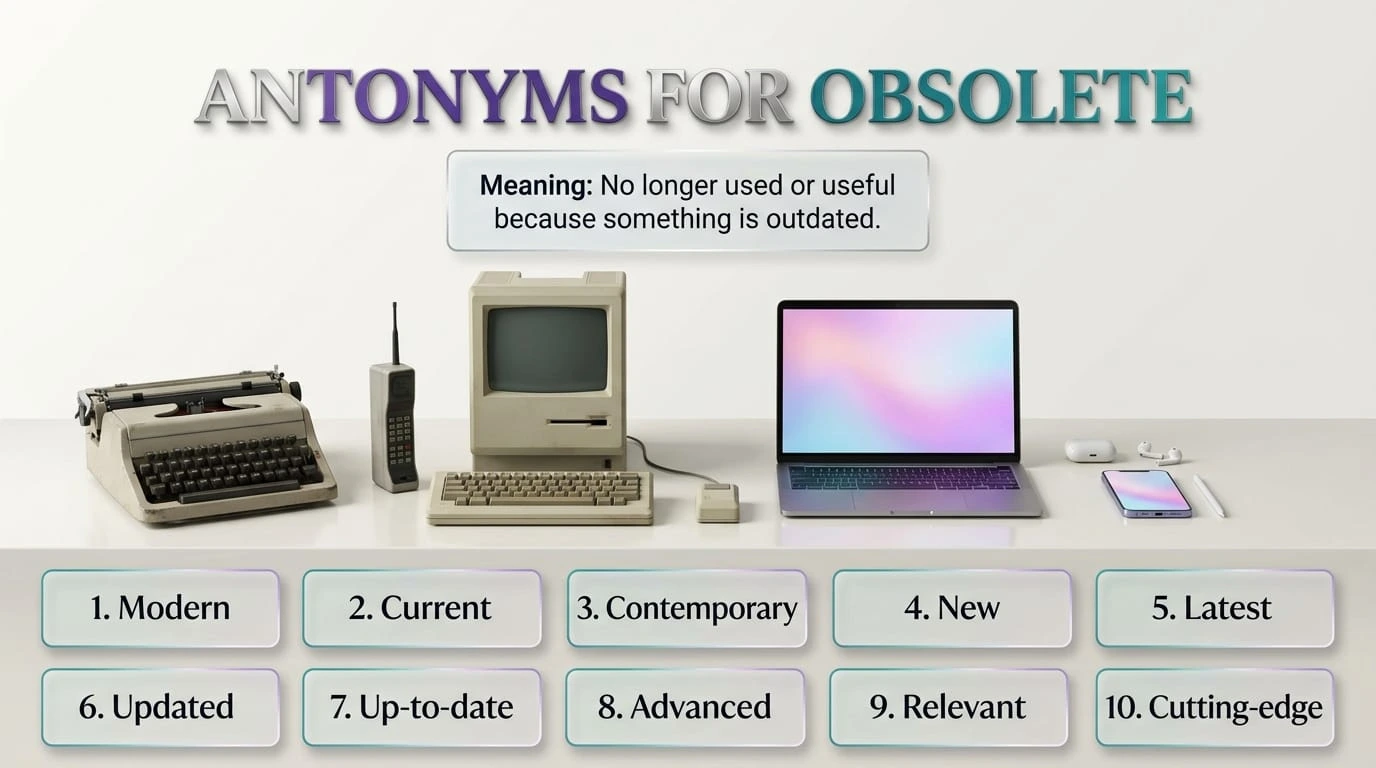
The most common antonyms for obsolete are modern, current, up-to-date, and contemporary. Obsolete describes something that is outdated, no longer used, or replaced by something newer.
What Is the Opposite of Obsolete?
The best opposite of obsolete depends on the context. Use modern for something belonging to the present age, current for something relevant now, up-to-date for something with the latest information, and functional for something that still works as intended.
Quick Answer: The Main Opposites of Obsolete
- Modern: Belonging to the present or recent times.
- Current: Happening, existing, or being used now.
- Up-to-date: Including the latest information or developments.
- Contemporary: Existing or occurring in the present period.
- Relevant: Connected to current needs or situations.
- In use: Still being used rather than abandoned or replaced.
Obsolete vs. Its Opposite
| Word | Meaning | Example |
| Obsolete | Outdated or no longer useful | The obsolete computer was replaced. |
| Modern | Designed for the present age | They installed a modern computer. |
| Current | Relevant or existing now | We need the current version. |
| Up-to-date | Having the latest information | Keep your software up-to-date. |
| Functional | Working as intended | The functional machine runs smoothly. |
Meaning in Brief
Obsolete: An adjective describing something that is outdated, no longer commonly used, or replaced by a newer alternative.
Main antonym — Modern: Something that reflects current times, methods, designs, or technology.
After reading this guide, you will understand the main opposites of obsolete, learn how they differ, and see how to use them naturally in everyday and academic English.
Common Opposites of Obsolete
Here are 20 useful antonyms and contextual opposites, with simple meanings and examples.
1. Modern
Belonging to the present or recent times.
Example: The school replaced its obsolete equipment with modern technology.
2. Current
Existing or relevant at the present time.
Example: Please check the current rules before submitting your application.
3. Up-to-date
Containing the newest information or features.
Example: Our website uses an up-to-date security system.
4. Contemporary
Belonging to the same period, especially the present age.
Example: Contemporary designs often combine simplicity with functionality.
5. Relevant
Closely connected to a present need, topic, or situation.
Example: The teacher removed obsolete examples and added relevant information.
6. Functional
Working properly or serving its intended purpose.
Example: Although the machine looks old, it is still functional.
7. Usable
Suitable for use.
Example: The technician repaired the old equipment and made it usable again.
8. Useful
Providing practical help or value.
Example: The old instructions were obsolete, so we replaced them with useful guidance.
9. Applicable
Suitable for a particular situation or purpose.
Example: Some older rules are no longer applicable to modern workplaces.
10. Valid
Still legally, officially, or logically acceptable.
Example: The company replaced obsolete procedures with valid, approved guidelines.
11. Active
Currently operating, functioning, or participating.
Example: The obsolete account was closed, but her current account remains active.
12. Operational
Working and ready to perform its intended function.
Example: The obsolete system was replaced with an operational network.
13. Advanced
Highly developed or incorporating newer methods and technology.
Example: The hospital invested in advanced medical equipment.
14. Innovative
Introducing new ideas, methods, or products.
Example: The company replaced its obsolete design with an innovative solution.
15. New
Recently made, created, introduced, or acquired.
Example: We purchased a new printer to replace the obsolete one.
16. Recent
Having happened or appeared not long ago.
Example: Recent research offers a better explanation than the obsolete theory.
17. Fresh
New, recently produced, or newly updated.
Example: The editor added fresh examples to the outdated textbook.
18. Viable
Capable of working successfully or being effective.
Example: The team developed a viable alternative to the obsolete process.
19. Sustained
Maintained or continued over time.
Example: The obsolete program was replaced by a system that supports sustained growth.
20. In use
Still being used in practice.
Example: Although the technology is old, it remains in use in some rural areas.
Usage note: These words are not interchangeable in every sentence. Some are direct opposites in particular contexts, while others contrast with obsolete in terms of usefulness, operation, validity, or continued use.
Choosing the Right Antonym
The opposite of obsolete changes slightly depending on what you are describing.
| When obsolete means… | Best opposite | Example |
| Old-fashioned technology | Modern | They installed modern computers. |
| Information that is no longer current | Up-to-date | The records are up-to-date. |
| A rule that no longer applies | Applicable | The new policy is applicable to all staff. |
| A machine that no longer works or serves its purpose | Functional | The repaired machine is functional. |
| A method that is no longer useful | Effective | The new method is more effective. |
| A product that has been replaced | Current | This is the current model. |
| A theory no longer accepted | Accepted or current | Researchers use a current theory. |
Understanding Each Antonym
Modern vs. Contemporary
Both words refer to the present age, but they are not identical.
- Modern often emphasizes new designs, technology, methods, or styles.
- Contemporary emphasizes belonging to the same period, particularly the present.
Examples:
- The company uses modern manufacturing equipment.
- The gallery displays contemporary art.
Current vs. Up-to-Date
These words are especially useful when discussing information, records, and software.
- Current means existing or relevant now.
- Up-to-date means updated to include the latest information or developments.
Examples:
- This is the current price.
- The price list is up-to-date.
Functional vs. Relevant
Neither word is a universal antonym of obsolete, but both can provide a useful contrast.
- Functional emphasizes whether something works.
- Relevant emphasizes whether something matters to the current situation.
An old machine can be functional but outdated. An old theory can remain historically relevant even when it is no longer accepted.
Examples in Context
Here are additional sentences showing how obsolete and its opposites work naturally.
- The obsolete software could not support the latest features.
- Our office now uses a modern communication system.
- Please download the current version of the application.
- The teacher shared an up-to-date reading list.
- Contemporary architecture often explores new materials.
- The old policy is no longer applicable.
- The engineer restored the machine to functional condition.
- The company introduced an innovative production method.
- Recent evidence challenged the obsolete theory.
- Several older devices remain in use despite newer alternatives.
Grammar and Word Forms
Obsolete is an adjective. Most of its common opposites in this article are also adjectives, so they can replace it in similar grammatical positions when the meaning fits.
- An obsolete system → a modern system
- Obsolete information → current information
- An obsolete manual → an up-to-date manual
Obsolete can also appear in the phrase become obsolete, meaning to become outdated or no longer useful.
Example: Many older technologies eventually become obsolete.
Its opposite depends on the intended meaning:
- become modern
- remain relevant
- stay current
- continue to be useful
Common Errors to Avoid
1. Assuming modern always means functional
A modern device may still be broken. Functional describes whether something works, while modern describes its relationship to present times.
2. Using current and up-to-date as exact synonyms
A document can be the current document without necessarily containing every recent update. Up-to-date more directly emphasizes the inclusion of recent information.
3. Treating old as the exact opposite of obsolete
Something old is not necessarily obsolete. An old building, book, or machine may still be useful, relevant, or functional.
Teacher’s Tip
When choosing an antonym for obsolete, ask yourself what has become outdated: its age, information, usefulness, validity, or function. This simple question helps you choose a more precise word instead of relying on modern every time.
Quick Antonym Quiz
Choose the best antonym for obsolete in this sentence:
“The website needs an updated guide instead of its obsolete instructions.”
A. Ancient B. Up-to-date C. Unusable
Correct answer: B. Up-to-date.
Why? The sentence contrasts outdated instructions with information that reflects the latest developments.
Frequently Asked Questions
What is the strongest antonym of obsolete?
There is no single strongest antonym for every context. Modern is a strong general contrast, while current and up-to-date are often more precise for information, software, and records.
Is modern the opposite of obsolete?
Yes, modern is a common antonym of obsolete, particularly when discussing technology, designs, equipment, and methods. However, current or up-to-date may be better for information.
What is the opposite of obsolete technology?
Common opposites include modern technology, current technology, advanced technology, and up-to-date technology. The best choice depends on whether you mean newer, more developed, or currently used technology.
Can something old still be useful rather than obsolete?
Yes. Age alone does not make something obsolete. An old tool may remain functional, a historical book may remain relevant, and an older method may still be effective.
What is a synonym of obsolete?
Common synonyms include outdated, outmoded, antiquated, old-fashioned, and superseded. Each has slightly different uses, and some are more formal than others.
Key Takeaways
- Modern is a common general antonym of obsolete.
- Current and up-to-date work especially well for information and software.
- Functional and usable emphasize whether something still works or serves a purpose.
- The best antonym depends on the meaning and context of the sentence.
Antonyms for Historian: Understanding the Opposites

I’m Moazama Akbar, an English language researcher and content writer with a passion for helping people build stronger vocabulary and language skills. I create clear, well-researched guides on antonyms, opposite words, and word meanings, designed to make English learning simple, practical, and enjoyable for students, writers, and learners everywhere.