The Opposite of Inhibit at a Glance
The best antonym for inhibit is often encourage when discussing behavior or actions. Other useful opposites include enable, permit, promote, support, and stimulate. For restrictions or barriers, remove or release may express the intended contrast more naturally.
Quick Answer
- Encourage
- Enable
- Facilitate
- Promote
- Allow
- Stimulate
- Support
- Release
Quick Comparison
| Word | Meaning | Example |
| Inhibit | Hold back or restrict | Fear can inhibit progress. |
| Encourage | Give confidence or support | Teachers encourage participation. |
| Enable | Make possible | Training enables growth. |
| Facilitate | Make easier | Technology facilitates learning. |
| Promote | Help something develop | Exercise promotes good health. |
| Allow | Give permission | The rules allow discussion. |
| Stimulate | Increase activity | The game stimulates creativity. |
| Support | Help or strengthen | Parents support their children. |
| Release | Free from restraint | The valve releases pressure. |
| Unleash | Allow something powerful to emerge | The project unleashes creativity. |
Inhibit in One Line
Inhibit: To prevent, limit, or slow down an action, process, feeling, or development.
Main antonym: Encourage to give someone or something support to act, grow, or develop.
Main Antonyms for Inhibit
These are the most useful opposite words for inhibit, with examples showing how each word works in context.
1. Encourage
To encourage means to give someone confidence, support, or motivation to do something. It is a strong opposite of inhibit when the subject is behavior, participation, or personal development.
Example: A supportive teacher encourages students to express their opinions.
2. Enable
To enable means to make an action possible or give someone the ability or means to do something.
Example: Digital tools enable students to learn at their own pace.
Best used when: Something removes a limitation or provides the means to act.
3. Facilitate
To facilitate means to make an action, process, or activity easier.
Example: Clear instructions facilitate effective communication.
Best used when: You want to emphasize reducing obstacles rather than directly motivating someone.
4. Promote
To promote means to encourage, support, or help something develop.
Example: The school promotes independent thinking among students.
Best used when: Discussing growth, progress, health, learning, or positive change.
5. Allow
To allow means to let something happen or give permission for an action.
Example: The new policy allows employees to work flexible hours.
Best used when: Inhibit means to restrict or prevent an action.
6. Stimulate
To stimulate means to increase activity, interest, thought, or development.
Example: Open-ended questions stimulate critical thinking.
Best used when: Something increases mental, physical, or creative activity.
7. Support
To support means to help, encourage, or strengthen someone or something.
Example: Her colleagues supported her decision to lead the project.
Best used when: The contrast involves discouragement, opposition, or a lack of help.
8. Release
To release means to free someone or something from a restraint, restriction, or controlled state.
Example: The mechanism releases the pressure inside the container.
Best used when: Inhibit refers to holding back movement, pressure, or a process.
9. Unleash
To unleash means to release something powerful or allow it to emerge freely.
Example: The competition unleashed the students’ creativity.
Best used when: You want to express a strong release of energy, potential, emotion, or creativity.
10. Advance
To advance means to move something forward or help it progress.
Example: The research advances our understanding of language development.
Best used when: Inhibit means to slow progress or prevent development.
Choosing the Right Antonym for Inhibit
The opposite of inhibit changes according to its meaning. Choose an antonym that fits the sentence rather than treating all the words as interchangeable.
| Context | Best antonym | Example |
| Behavior or confidence | Encourage | Praise encourages participation. |
| Ability or opportunity | Enable | The grant enables further research. |
| A process or task | Facilitate | Automation facilitates production. |
| Growth or development | Promote | Good habits promote well-being. |
| Permission or restrictions | Allow | The policy allows changes. |
| Mental or physical activity | Stimulate | Music stimulates brain activity. |
| Restraint or pressure | Release | The device releases trapped air. |
| Progress | Advance | New discoveries advance science. |
How These Antonyms Differ
Although these words can oppose inhibit, each communicates a different idea.
- Encourage vs. enable: Encourage means motivating or supporting action; enable means making action possible.
- Facilitate vs. promote: Facilitate makes a process easier, while promote helps something develop or gain support.
- Allow vs. encourage: Allow means permitting an action, whereas encourage means actively supporting it.
- Stimulate vs. support: Stimulate increases activity or interest; support provides help or reinforcement.
- Release vs. unleash: Release removes restraint, while unleash often suggests allowing something powerful to emerge.
- Advance vs. facilitate: Advance moves something forward; facilitate makes the process easier.
Inhibit and Its Antonyms in Sentences
Here are examples from everyday life, education, work, and science.
- Inhibit: Fear may inhibit a student’s willingness to speak.
- Encourage: Positive feedback encourages students to participate.
- Enable: Internet access enables learners to find educational resources.
- Facilitate: Group activities facilitate communication.
- Promote: Reading promotes language development.
- Allow: The teacher allows students to ask questions.
- Stimulate: Challenging puzzles stimulate problem-solving skills.
- Support: The school supports creative projects.
- Release: The switch releases the locking mechanism.
- Unleash: The workshop unleashed the team’s creative potential.
- Advance: The findings advance scientific knowledge.
Grammar and Word Class
Inhibit is a verb. Most of its common antonyms are also verbs, which makes them suitable replacements in many sentence structures.
| Word | Part of speech | Example form |
| Inhibit | Verb | inhibit growth |
| Encourage | Verb | encourage growth |
| Enable | Verb | enable progress |
| Facilitate | Verb | facilitate learning |
| Promote | Verb | promote development |
| Allow | Verb | allow change |
| Stimulate | Verb | stimulate activity |
Useful word forms
- Inhibit → inhibition (noun), inhibitory (adjective)
- Encourage → encouragement (noun), encouraging (adjective)
- Enable → enablement (noun), enabled (past participle)
- Facilitate → facilitation (noun), facilitative (adjective)
- Promote → promotion (noun), promotional (adjective)
Use the verb form when replacing inhibit in a sentence such as “Fear can inhibit progress.” For example, “Confidence can encourage progress.”
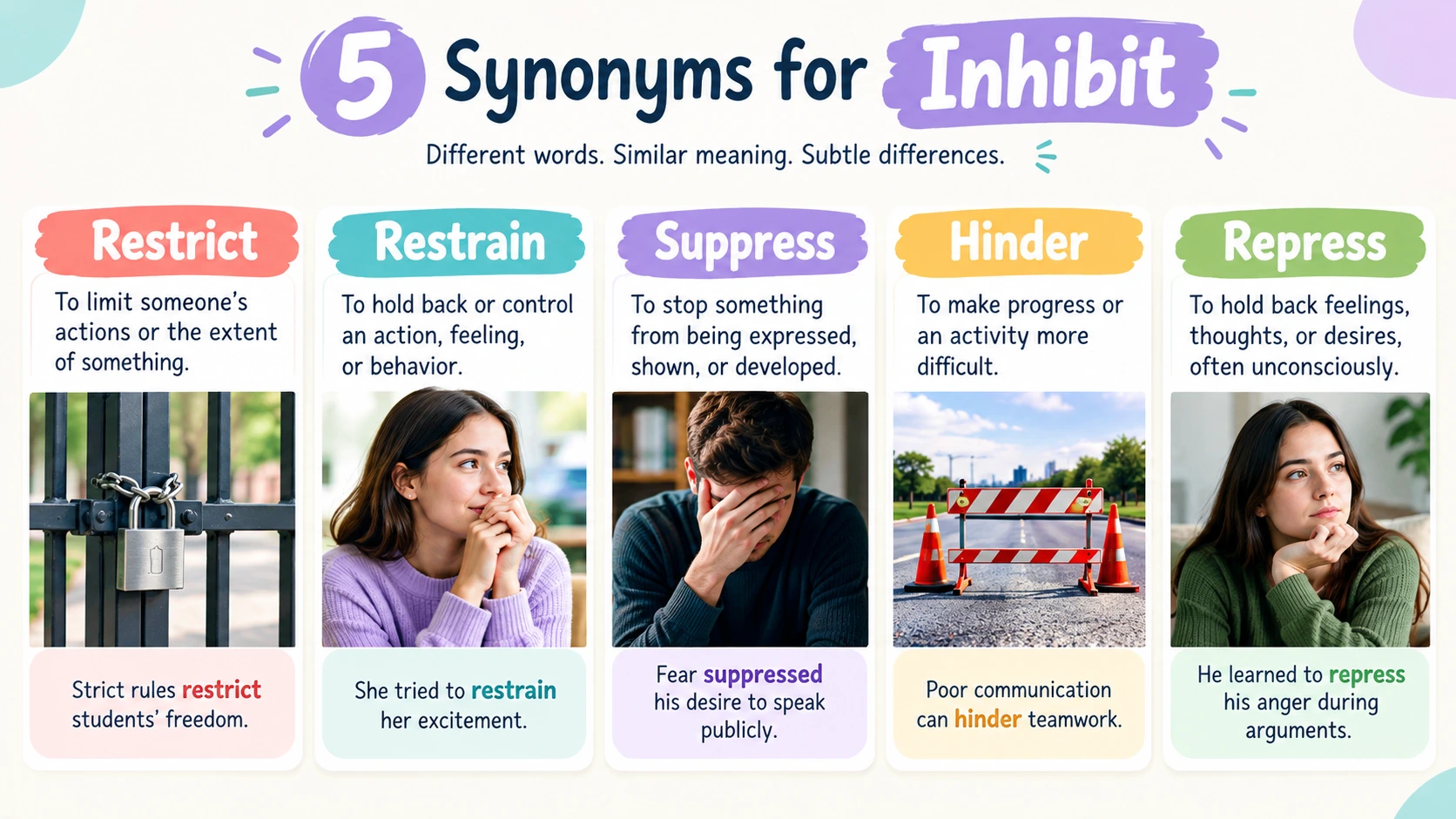
5 Synonyms for Inhibit
Although inhibit means to restrain, limit, or hold something back, these five synonyms express slightly different shades of meaning.
1. Restrict
to limit someone’s actions or the extent of something. Example: Strict rules restrict students’ freedom.
2. Restrain
to hold back or control an action, feeling, or behavior. Example: She tried to restrain her excitement.
3. Suppress
to stop something from being expressed, shown, or developed. Example: Fear suppressed his desire to speak publicly.
4. Hinder
to make progress or an activity more difficult. Example: Poor communication can hinder teamwork.
5. Repress
to hold back feelings, thoughts, or desires, often unconsciously. Example: He learned to repress his anger during arguments.
Quick tip: Use restrict for limitations, restrain for control, suppress for stopping expression, hinder for obstacles, and repress for hidden feelings or thoughts.
Common Mistakes to Avoid
1. Treating every antonym as interchangeable
Incorrect: “The permission enabled the students to participate” when the intended meaning is simply that participation was permitted.
Better: “The permission allowed the students to participate.”
Enable emphasizes making something possible; allow emphasizes permission.
2. Using encourage when facilitate is more accurate
Incorrect: “The software encourages the process” when the intended meaning is that the software makes the process easier.
Better: “The software facilitates the process.”
3. Confusing allow with promote
Allowing an activity does not necessarily mean actively supporting or developing it. A school may allow an activity without promoting it.
Teacher’s Tip
When selecting an antonym for inhibit, ask yourself: Is something being encouraged, made possible, made easier, or freed from restraint? The answer helps you choose the most precise opposite.
Quick Antonym Quiz
Which word best replaces “inhibit” in this sentence?
“The new teaching method helps rather than inhibits creative thinking.”
A. Restrict B. Stimulate C. Prevent
Answer: B. Stimulate. It means to encourage activity or development, making it a suitable opposite in this context.
Frequently Asked Questions
What is the strongest antonym for inhibit?
Encourage is a strong general antonym when inhibit means to hold back someone’s actions, confidence, or participation. Enable or facilitate may be more accurate when the context concerns ability or making a process easier.
Is enable the opposite of inhibit?
Yes, in contexts where inhibit means preventing or limiting an action. Enable means making that action possible, although it does not always imply encouragement.
What is the opposite of inhibit in science?
Depending on the context, scientific opposites include stimulate, activate, promote, and enhance. For example, a substance that inhibits an enzyme reduces its activity, while a substance that activates it increases its activity.
What is the opposite of inhibit growth?
Promote growth is a natural expression. Encourage growth, stimulate growth, and facilitate growth can also work, depending on whether the emphasis is on support, increased activity, or easier development.
What is the difference between inhibit and prevent?
Inhibit means to restrain, reduce, or slow something, while prevent means to stop something from happening. Their opposites can differ: stimulate may oppose inhibit in a scientific context, whereas allow may oppose prevent.
Key Takeaways
- Encourage is a useful general antonym for inhibit when behavior or confidence is involved.
- Enable means making an action possible.
- Facilitate means making a process easier.
- Promote and stimulate are useful for growth and activity.
- Allow is appropriate when the context concerns permission or restrictions.
The most accurate antonym depends on what is being inhibited and how it can be helped, permitted, or released.
Antonyms for Rely: Common Opposites Explained

I’m Daniel Carter, a language enthusiast and content writer focused on the fascinating world of antonyms and vocabulary. I break down word meanings and opposites into simple, practical guides helping readers build a richer vocabulary, understand language more deeply, and speak or write with greater confidence.