What is the opposite of radiation?
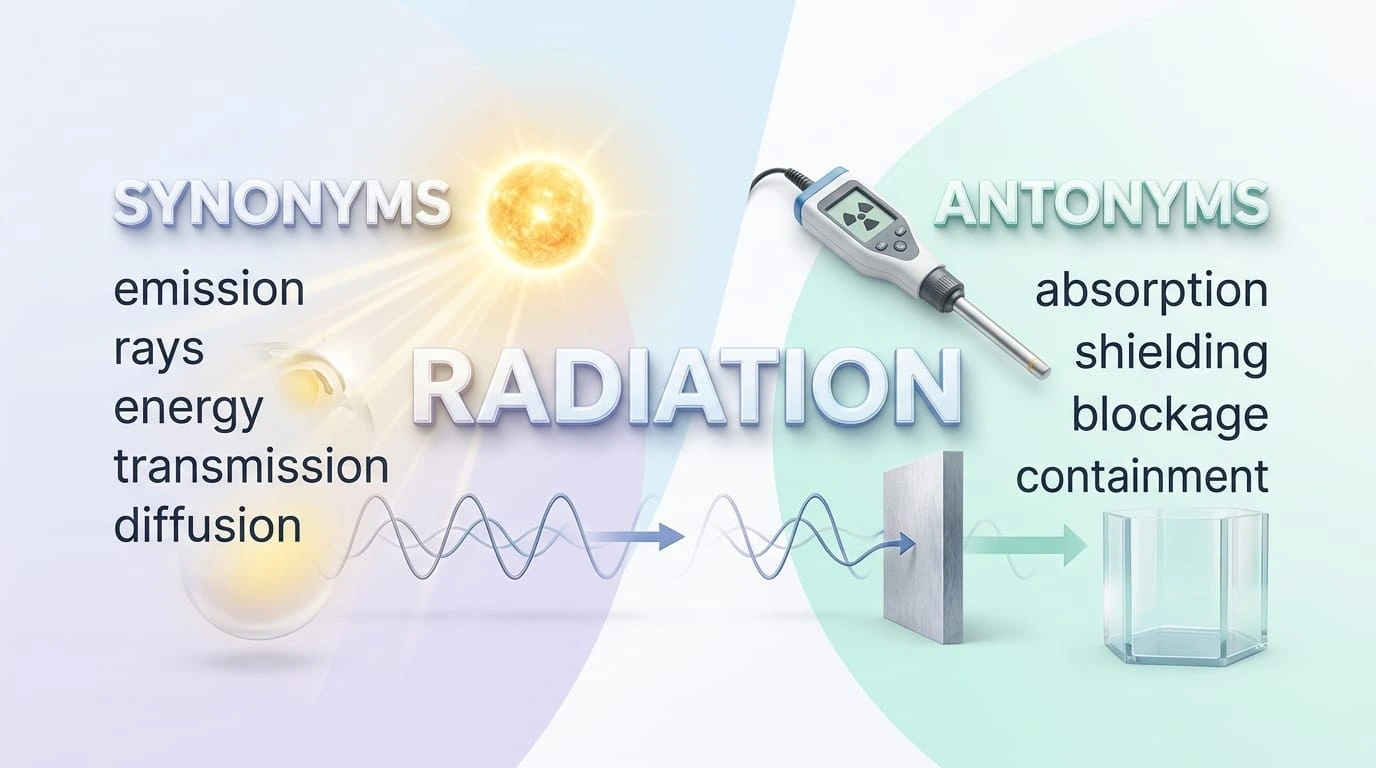
The answer depends on the context. Absorption is the clearest contrasting process when radiation means energy being emitted or transferred. In other contexts, shielding, blocking, containment, or focusing may describe an opposite or contrasting action.
Quick Answer
The most useful synonym for radiation is emission when the word refers to energy being sent out. The most useful contextual opposite is absorption, where energy is taken in rather than emitted or transmitted. Shielding and blocking are also useful contrasts when discussing protection from radiation.
Radiation and Its Antonym at a Glance
| Word | Meaning | Example |
| Radiation | Energy transmitted as waves or particles | The material gives off radiation. |
| Emission | The act of sending out energy or particles | The device produces infrared emission. |
| Absorption | The process of taking in energy | The surface has high absorption of solar energy. |
| Shielding | Protection that reduces radiation exposure | The workers used radiation shielding. |
| Blocking | Preventing radiation from passing through | The material blocks harmful radiation. |
Meaning in Brief
Radiation: Energy that travels through space or a material in the form of waves or particles.
Main contextual opposite: Absorption the process of taking in energy instead of allowing it to continue as transmitted or emitted radiation.
The word radiation can refer to several scientific, medical, and everyday concepts, so it does not have one perfect antonym for every situation.
What You’ll Learn
After reading this guide, you will know:
- Common synonyms for radiation
- The main contextual antonyms of radiation
- Why absorption is often considered its strongest opposite
- When to use shielding, blocking, or containment
- How radiation-related words differ in meaning
- How to use these words naturally in sentences
Common Opposites of Radiation
1. Absorption
Absorption is the process in which a material takes in energy rather than allowing it to pass through or continue outward.
It is the strongest contextual opposite when radiation refers to energy being transmitted or emitted.
Example:
The dark surface has greater absorption of solar radiation.
2. Shielding
Shielding means protecting a person, object, or area from radiation by using a barrier or protective material.
Example:
The laboratory uses special shielding to reduce radiation exposure.
Usage note: Shielding is not a strict dictionary antonym of radiation. It describes a protective response to radiation.
3. Blocking
Blocking means stopping something from passing through.
When used with radiation, it means preventing radiation from reaching a particular area.
Example:
The protective material is effective at blocking ultraviolet radiation.
4. Containment
Containment means keeping something within a controlled area and preventing it from spreading.
It can be a useful contextual opposite when radiation is discussed together with radioactive materials or contamination.
Example:
The facility has strict containment procedures for radioactive materials.
5. Focusing
Focusing can contrast with the spreading of radiation or rays. Instead of allowing rays to spread outward, focusing directs them toward a particular point or area.
Example:
The lens focuses the light rays onto a small surface.
Usage note: This is a context-specific contrast rather than a direct antonym of radiation.
Useful Synonyms to Know
1. Emission
Emission is one of the closest synonyms when radiation means energy or particles being sent out.
Example:
The instrument detected the emission of infrared energy.
2. Irradiation
Irradiation means exposing something to radiation, often for a specific scientific, medical, or industrial purpose.
Example:
The food was treated through controlled irradiation.
Important: Irradiation is more specific than radiation and cannot replace it in every sentence.
3. Radiant Energy
Radiant energy refers to energy carried by electromagnetic waves.
Example:
Solar radiation carries radiant energy from the Sun to Earth.
4. Radioactive Emission
Radioactive emission refers to radiation released by radioactive substances.
Example:
The scientists measured radioactive emissions from the material.
5. Electromagnetic Emission
Electromagnetic emission describes electromagnetic energy released by a source.
Example:
The equipment detected electromagnetic emission from the object.
6. Radiotherapy
Radiotherapy is the use of radiation as a medical treatment, particularly in cancer care.
Example:
The patient began radiotherapy after discussing the treatment options with the medical team.
Usage note: Radiotherapy is a related medical term, not a general synonym for radiation.
Different Meanings, Different Opposites
The correct opposite changes according to what radiation means in a sentence.
When Radiation Means Energy Being Emitted
The clearest contrast is:
Radiation → Absorption
Radiation can involve energy being emitted or transmitted, while absorption involves energy being taken in.
Example:
The surface absorbs much of the incoming radiation.
When Radiation Means Harmful Exposure
The useful contrast may be:
Radiation → Shielding
Shielding protects against or reduces exposure.
Example:
The workers wore protective equipment and used shielding around the radiation source.
When Radiation Means Something Spreading
A suitable contrast can be:
Radiation → Containment
Containment focuses on preventing radioactive material or associated hazards from spreading.
Example:
The emergency response focused on the containment of radioactive material.
When Radiation Means Rays Spreading Outward
A context-specific contrast may be:
Radiation → Focusing
Focusing directs rays toward a particular location instead of allowing them to spread.
Example:
The optical system focuses the incoming rays onto one point.
How These Antonyms Differ
Not every word in an antonym list has the same relationship with radiation.
Absorption vs. Radiation
This is a process-level contrast.
- Radiation: energy is emitted or transferred as radiation.
- Absorption: energy is taken in by matter.
Example:
The material absorbs radiation instead of transmitting all of it.
Shielding vs. Radiation
This is a protection-based contrast.
- Radiation: energy or particles are being emitted or transmitted.
- Shielding: something is placed between the radiation source and the protected area.
Example:
The thick barrier provides shielding from radiation.
Blocking vs. Radiation
This is an action-based contrast.
- Radiation: energy travels or is emitted.
- Blocking: the movement or transmission is stopped.
Example:
The screen blocks some forms of radiation.
Containment vs. Radiation
This is a control-based contrast.
- Radiation-related hazard: potentially spreads beyond its intended area.
- Containment: keeps the material or hazard within a controlled boundary.
Example:
The facility strengthened containment measures.
Focusing vs. Radiation
This is a directional contrast in certain contexts.
- Radiation or rays: spread outward.
- Focusing: directs rays toward a specific point.
Example:
The lens focuses the rays onto the detector.
See the Antonyms in Action
Here are natural examples showing the different meanings:
- Radiation:
The equipment measures radiation from the source. - Emission:
The scientist recorded the emission of thermal energy. - Absorption:
The black surface has a high level of energy absorption. - Shielding:
Proper shielding can reduce radiation exposure. - Blocking:
The barrier helps block harmful radiation. - Containment:
The team established containment around the affected area. - Focusing:
The lens focuses the rays onto the sensor. - Irradiation:
Controlled irradiation is used in some industrial processes.
What Part of Speech Is It?
Radiation is primarily a noun.
Common related forms include:
- Radiate verb
- Radiation noun
- Radiant adjective
- Radioactive adjective
- Radioactivity noun
- Irradiate verb
- Irradiation noun
- Absorb verb
- Absorption noun
- Shield verb/noun
- Shielding noun/gerund
Example
Radiate:
The object radiates heat.
Radiation:
The object produces radiation.
Absorb:
The material absorbs energy.
Absorption:
The material has high energy absorption.
This shows why radiation and absorption can form a useful conceptual contrast even though they are different grammatical forms.
Commonly Confused Opposites
Radiation vs. Absorption
These words should not be treated as universal opposites in every situation.
Radiation describes energy being emitted or transferred as radiation, while absorption describes energy being taken in.
Radiation vs. Radioactivity
Radioactivity is not simply another word for radiation.
- Radiation: energy or particles transmitted or emitted.
- Radioactivity: the property or process associated with unstable atomic nuclei.
Incorrect:
❌ The radioactivity from the lamp was very bright.
Better:
✅ The radiation from the lamp was very bright.
Radiation vs. Irradiation
Irradiation emphasizes the act of exposing something to radiation.
Radiation:
The device produces radiation.
Irradiation:
The material underwent irradiation.
The two words are related but are not interchangeable in all contexts.
A Useful Language Tip
When a scientific noun does not have one perfect antonym, identify what aspect you want to contrast.
For radiation, ask:
- Is the contrast about energy being taken in? → absorption
- Is it about protection? → shielding
- Is it about stopping transmission? → blocking
- Is it about preventing spread? → containment
- Is it about directing rays instead of spreading them? → focusing
This approach produces a more accurate answer than treating every contextual contrast as a strict antonym.
Quick Antonym Quiz
Which word best completes the sentence?
The material was designed to ______ harmful radiation.
A. emit
B. block
C. radiate
Answer: B. block
Why?
The sentence describes preventing radiation from passing through, so block is the natural choice.
Another Question
The surface takes in incoming energy through ______.
A. emission
B. absorption
C. radiation
Answer: B. absorption
Why?
Absorption refers to taking in energy rather than emitting or transmitting it.
Frequently Asked Questions
What is the opposite of radiation?
The most useful contextual opposite is absorption when radiation refers to energy being emitted or transferred. Shielding, blocking, containment, and focusing can also provide contrasting meanings in specific contexts.
What is a synonym for radiation?
Emission is a close synonym when radiation refers to energy or particles being sent out. Other related terms include irradiation, radiant energy, and electromagnetic emission, depending on the context.
Is absorption the antonym of radiation?
Absorption can be a contextual antonym of radiation, especially when discussing energy transfer. Radiation involves energy being emitted or transmitted, while absorption involves energy being taken in.
Is shielding a true antonym of radiation?
No. Shielding is better described as a protective measure against radiation rather than a strict lexical antonym. It is useful when the context involves reducing radiation exposure.
What is the difference between radiation and radioactivity?
Radiation refers to energy or particles that travel or are emitted, while radioactivity refers to the property or process through which unstable atomic nuclei produce radiation. The terms are related but not interchangeable.
Can irradiation be used as a synonym for radiation?
Not in every situation. Irradiation specifically emphasizes exposing something to radiation, while radiation has a much broader meaning.
Key Takeaways
The phrase synonyms and antonyms for radiation requires a context-based answer.
- Emission is a useful synonym when radiation means energy being sent out.
- Absorption is the clearest contrasting process in many physics contexts.
- Shielding describes protection from radiation.
- Blocking describes preventing radiation from passing through.
- Containment relates to controlling the spread of radioactive material or hazards.
- Focusing can contrast with rays spreading outward in specific optical contexts.
- Irradiation is related to radiation but has a more specific meaning.
The best word depends on the exact meaning of radiation in the sentence.
Synonyms and Antonyms for Geography You Should Know

I’m Daniel Carter, a language enthusiast and content writer focused on the fascinating world of antonyms and vocabulary. I break down word meanings and opposites into simple, practical guides helping readers build a richer vocabulary, understand language more deeply, and speak or write with greater confidence.