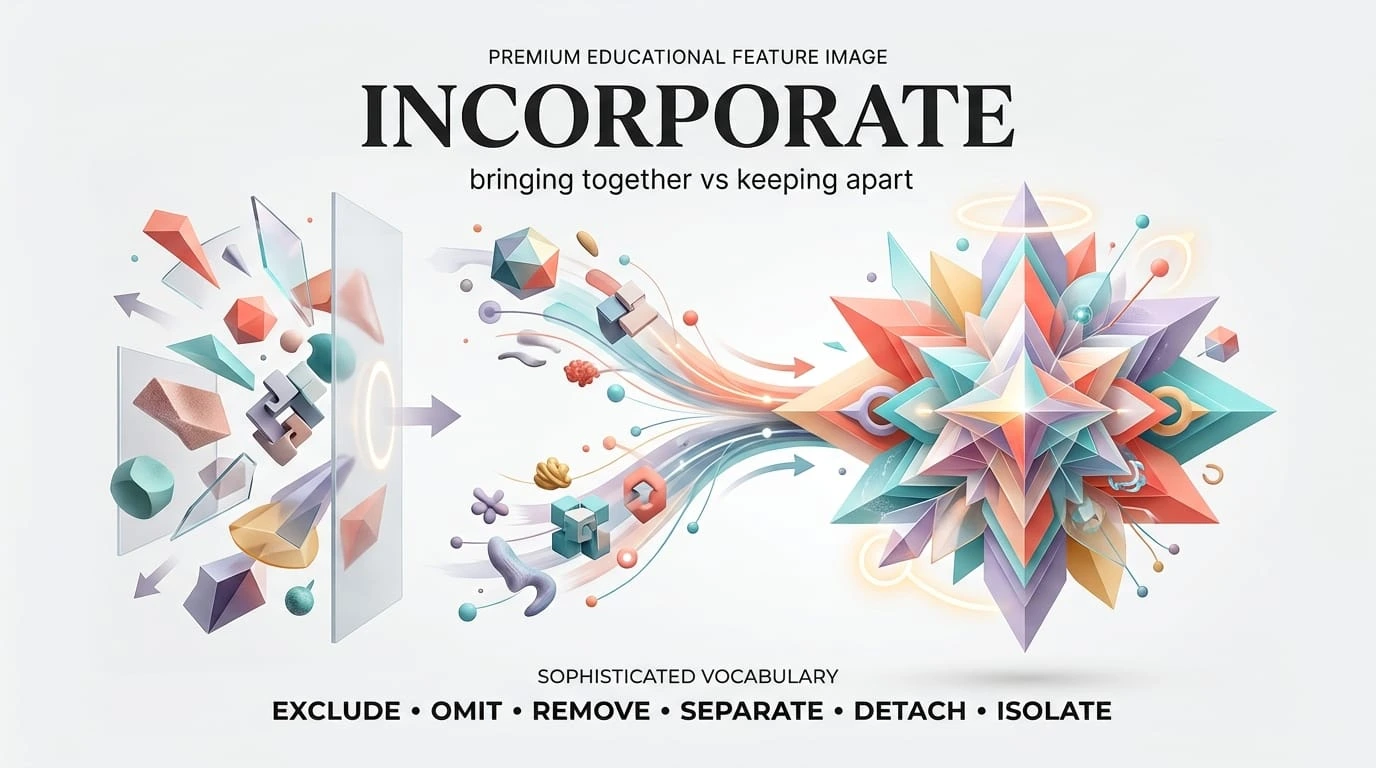
The Opposite of Incorporate at a Glance
The most common antonym of incorporate is exclude, meaning to leave someone or something out rather than include it as part of a whole. Depending on context, other opposites include omit, leave out, separate, and disincorporate in legal or organizational contexts.
The Short Answer
Incorporate usually means to include something as part of a larger whole.
Its strongest everyday opposite is exclude, which means to deliberately keep something or someone out.
Other useful opposites depend on the sentence:
- Exclude keep out or prevent inclusion
- Omit leave something out, especially from writing or a list
- Leave out not include something
- Separate keep things apart rather than combining them
- Remove take something away from a whole
- Detach disconnect something from another thing
- Disincorporate legally remove a corporation’s incorporated status
Incorporate and Its Antonym
| Word | Meaning | Example |
| Incorporate | To include something as part of a whole | The teacher incorporated games into the lesson. |
| Exclude | To keep something or someone out | The teacher excluded games from the lesson. |
| Omit | To leave something out | She omitted one important detail. |
| Separate | To keep things apart | The designer separated the two sections. |
Meaning in Brief
Incorporate: To include something as part of a larger whole, system, plan, or activity.
Main antonym: Exclude to keep something or someone outside a group, system, plan, or whole.
For example:
- The new policy incorporates employee feedback.
- The new policy excludes employee feedback.
The first sentence says the feedback became part of the policy. The second says it was deliberately left out.
What You’ll Learn
After reading this guide, you will understand:
- The main antonym of incorporate
- Other useful opposites and their differences
- Which antonym fits different contexts
- How to use these words naturally in sentences
- Why disincorporate has a specialized legal meaning
Common Opposites of Incorporate
1. Exclude
Exclude is the clearest general antonym of incorporate when incorporate means “include.”
Meaning: To deliberately keep someone or something out.
Example:
The committee decided to exclude the outdated information from the report.
In contrast:
The committee decided to incorporate the updated information into the report.
2. Omit
Omit means to leave something out, especially from writing, speech, a list, or a process.
Example:
The editor omitted several unnecessary details from the article.
In contrast:
The editor incorporated several useful details into the article.
Usage note: Omit does not always suggest deliberate rejection. Something can be omitted simply because it is unnecessary or forgotten.
3. Leave Out
Leave out is the everyday phrasal-verb equivalent of not including something.
Example:
Please don’t leave out the final paragraph.
In contrast:
Please incorporate the final paragraph into the report.
It is common in conversation and informal writing.
4. Keep Out
Keep out emphasizes preventing someone or something from entering or becoming part of something.
Example:
The filter keeps out harmful particles.
In contrast:
The system incorporates useful materials into the process.
This opposite works particularly well when incorporate has the idea of bringing something into a system.
5. Remove
Remove means to take something away rather than add or include it.
Example:
The editor removed unnecessary sections from the document.
In contrast:
The editor incorporated new sections into the document.
Remove is not a perfect antonym in every context, but it works when incorporation involves adding something to an existing whole.
6. Separate
Separate means to keep things apart instead of combining them.
Example:
The architect separated the work areas from the public spaces.
In contrast:
The architect incorporated the work areas into the main building.
This is especially useful when incorporate means to combine or integrate.
7. Detach
Detach means to disconnect something from another thing.
Example:
The technician detached the device from the main system.
In contrast:
The technician incorporated the device into the main system.
This is a contextual opposite rather than a universal antonym.
8. Disconnect
Disconnect means to break a connection or prevent things from being connected.
Example:
The engineer disconnected the old equipment from the network.
In contrast:
The engineer incorporated the new equipment into the network.
9. Isolate
Isolate means to keep something separate from others.
Example:
The researchers isolated the substance from the mixture.
In contrast:
They incorporated the substance into the new compound.
Isolate is useful when incorporation involves bringing something into a combined system.
10. Reject
Reject means to refuse to accept, approve, or use something.
Example:
The board rejected the proposed changes.
In contrast:
The board incorporated the proposed changes into the final plan.
Important: Reject is stronger than omit. Something can be omitted without being actively rejected.
Different Meanings, Different Opposites
The meaning of incorporate changes slightly according to context, so its opposite can change too.
When Incorporate Means “Include”
The strongest opposites are:
- Exclude
- Omit
- Leave out
- Keep out
Example:
The report incorporates data from several studies.
Opposite:
The report excludes data from several studies.
When Incorporate Means “Combine”
Useful opposites include:
- Separate
- Divide
- Disconnect
- Detach
- Isolate
Example:
The designer incorporated traditional elements into the modern style.
Opposite:
The designer separated the traditional elements from the modern style.
When Incorporate Refers to a Legal Corporation
In legal or organizational language, incorporate can mean to legally form a corporation.
The specialized opposite is disincorporate.
Disincorporate means to end or remove a corporation’s incorporated legal status, depending on the legal system and context.
This is a specialized term and should not replace exclude in ordinary sentences.
How These Antonyms Differ
The antonyms of incorporate are not interchangeable.
Exclude vs. Omit
Exclude usually emphasizes keeping something out.
Omit emphasizes not including something, especially in a piece of writing or a list.
- The policy excludes people under 18.
- The writer omitted the final example.
Omit vs. Remove
It means something is not included in the first place.
Remove suggests that something was present and was then taken away.
- She omitted the unnecessary information.
- She removed the unnecessary information from the draft.
Separate vs. Exclude
Separate means keeping things apart.
Exclude means keeping something or someone out of a group, system, or activity.
- The teacher separated the two groups.
- The teacher excluded one student from the activity.
Reject vs. Exclude
Reject focuses on refusing to accept something.
Exclude focuses on preventing inclusion.
- The committee rejected the proposal.
- The committee excluded the proposal from the final report.
Examples in Context
Here are natural examples showing how different antonyms work:
- The software incorporates several security features.
- The software excludes unnecessary features.
- The writer omitted the final paragraph.
- The manager left out one item from the schedule.
- The architect separated the private and public areas.
- The technician detached the cable from the machine.
- The system keeps out unauthorized users.
- The editor removed outdated information.
- The researchers isolated the sample for further testing.
- The board rejected the proposed amendment.
- The company decided to disincorporate under the applicable legal procedure.
What Part of Speech Is It?
Incorporate is primarily a verb.
Its common contextual opposites are also verbs:
- incorporate → exclude
- incorporate → omit
- incorporate → remove
- incorporate → separate
- incorporate → detach
- incorporate → reject
The word disincorporate is also a verb and is specifically related to the legal or organizational sense of incorporate.
Related Forms
- incorporate verb
- incorporation noun
- incorporated adjective/past participle
- incorporation can refer to the act or process of incorporating
For ordinary vocabulary use, focus on incorporate and the verb forms of its contextual opposites.
Antonyms in Everyday Sentences
Incorporate:
The chef incorporated fresh herbs into the recipe.
Exclude:
The recipe excludes dairy products.
Omit:
The writer omitted the unnecessary explanation.
Separate:
The teacher separated the students into two groups.
Remove:
The editor removed the repeated sentence.
Reject:
The committee rejected the proposed changes.
These examples show why there is no single antonym that works naturally in every sentence containing incorporate.
Commonly Confused Opposites
“Exclude” Is Not Always the Same as “Remove”
These words describe different actions.
Exclude means something is kept out or not allowed in.
Remove means something is taken away after being present.
Compare:
- The rules exclude children under five.
- The administrator removed the child from the list.
“Omit” Does Not Always Mean “Reject”
If a writer omits a detail, the writer simply does not include it. That does not necessarily mean the writer believes the detail is wrong.
Reject, however, usually suggests active refusal to accept something.
A Useful Language Tip
When you mean “not include”, choose exclude, omit, or leave out according to the situation.
- Exclude → keep out
- Omit → leave out from writing, speech, or a list
- Leave out → everyday expression for not including something
When you mean “not combine”, use words such as separate, detach, or disconnect instead.
Quick Practice
Choose the best antonym for incorporate:
The editor decided to ______ the outdated information from the final report.
A. incorporate
B. omit
C. connect
Answer: B. omit
Why?
The sentence describes leaving information out of a report, so omit is the most precise choice.
Frequently Asked Questions
What is the main antonym of incorporate?
The main antonym of incorporate is exclude, meaning to keep someone or something out instead of including it as part of a whole.
What is another word for the opposite of incorporate?
Depending on context, omit, leave out, separate, remove, and detach can express different opposite ideas. Exclude is the most general choice when incorporate means “include.”
Is omit the same as exclude?
Not exactly. Omit means to leave something out, especially from writing or a list. Exclude more strongly suggests deliberately keeping something or someone out.
What is the opposite of incorporate in a legal context?
When incorporate refers to forming or maintaining a corporation, disincorporate is the specialized opposite. It refers to ending or removing incorporated status under the relevant legal framework.
Can separate be an antonym of incorporate?
Yes, when incorporate means to combine or integrate something into a larger whole. Separate means to keep things apart rather than combine them.
What to Remember
Incorporate most commonly means to include something as part of a whole. In that sense, exclude is its clearest general antonym.
Other opposites depend on the intended contrast:
- Exclude → keep out
- Omit → leave out
- Leave out → not include
- Remove → take away
- Separate → keep apart
- Detach → disconnect
- Isolate → keep separate
- Reject → refuse to accept
- Disincorporate → end incorporated status in a specialized legal sense
The key is to choose the opposite that matches the exact meaning of incorporate in the sentence.
antonyms for incorporate.
Antonyms for Commerce: 10 Opposite Words

I’m Daniel Carter, a language enthusiast and content writer focused on the fascinating world of antonyms and vocabulary. I break down word meanings and opposites into simple, practical guides helping readers build a richer vocabulary, understand language more deeply, and speak or write with greater confidence.