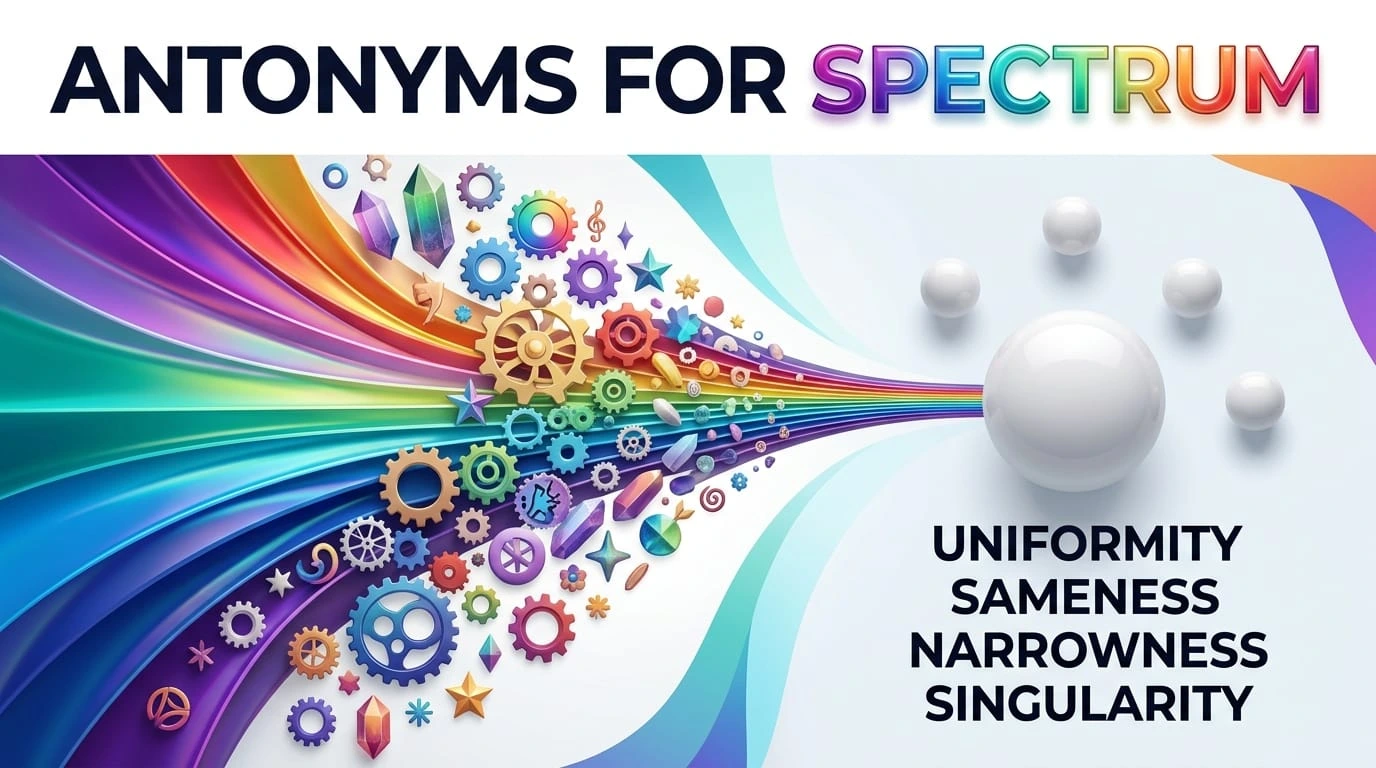
Common contextual opposites of spectrum include singularity, uniformity, sameness, homogeneity, narrowness, limitation, restriction, concentration, isolation, specificity, fixed point, and single value.
What Is the Opposite of Spectrum?
There is no single universal antonym for spectrum. When spectrum means a wide range of things, useful opposites include singularity, uniformity, sameness, homogeneity, narrowness, and restriction. When it refers to colors or light, monochrome can provide a useful contrast. The best opposite depends on the meaning of spectrum in the sentence.
Quick Answer
The closest opposite of spectrum is often singularity when the word means a wide range of different possibilities. Other contextual contrasts include uniformity, sameness, homogeneity, narrowness, limitation, restriction, concentration, and specificity.
Quick Comparison
| Word | Meaning | Example |
| Spectrum | A wide range of related things | The study covers a broad spectrum of opinions. |
| Singularity | One distinct thing or point | The discussion focused on a single singularity. |
| Uniformity | A state of being the same | The design has a high level of uniformity. |
| Narrowness | A small or limited range | The narrowness of the choices made the decision easy. |
| Homogeneity | Similarity within a group | The group showed strong homogeneity. |
| Monochrome | One color or shades of one color | The image uses a monochrome design. |
One-Line Definition
Spectrum: A broad range of related qualities, values, colors, or possibilities.
Main contextual opposite: Singularity the state of being one distinct point, thing, or possibility rather than a broad range.
What You Will Learn
After reading this guide, you will understand:
- The main meanings of spectrum
- Why it has no single universal antonym
- 22 useful opposite or contrasting terms
- Which words work best in different contexts
- How to use these words naturally in sentences
22 Antonyms and Contextual Opposites of Spectrum
Because spectrum has several meanings, the following words are best understood as contextual opposites or contrasts, rather than claiming that all 22 are dictionary-perfect antonyms.
1. Singularity
Meaning: The state of being one distinct thing, point, or possibility.
Example:
The report focused on a single singularity rather than a broad range of cases.
Best context: Use this when spectrum means a broad range of possibilities.
2. Uniformity
Meaning: A state in which things are the same or very similar.
Example:
The company values uniformity across all its products.
Contrast: A spectrum suggests variation, while uniformity suggests sameness.
3. Sameness
Meaning: The quality of having no important differences.
Example:
The lack of variety created a sense of sameness.
Best context: Everyday English and general writing.
4. Homogeneity
Meaning: A state in which members of a group are very similar.
Example:
The survey showed considerable homogeneity among the participants.
Best context: Academic and scientific writing.
5. Narrowness
Meaning: The quality of covering only a small range.
Example:
The narrowness of the study limited its conclusions.
Contrast: A broad spectrum covers many points; narrowness covers few.
6. Limitation
Meaning: A condition that restricts the range or extent of something.
Example:
The limitation of the program reduced the available choices.
Best context: When contrasting a broad range with a restricted one.
7. Restriction
Meaning: A rule or condition that limits what is possible.
Example:
The new restriction reduced the range of available options.
8. Confinement
Meaning: The state of being kept within a limited area, range, or condition.
Example:
The confinement of the discussion to one issue reduced its scope.
9. Concentration
Meaning: A gathering or focus of something in one place or area.
Example:
The concentration of resources in one department left little for others.
Contrast: A spectrum spreads across a range, while concentration focuses in one area.
10. Isolation
Meaning: The state of being separate from other things.
Example:
The issue was studied in isolation rather than across a broad range of cases.
11. Specificity
Meaning: The quality of referring to one particular thing rather than a broad category.
Example:
The specificity of the question made the answer easier to find.
Best context: Academic and informational writing.
12. Fixed Point
Meaning: One definite position or value rather than a range.
Example:
The measurement was treated as a fixed point rather than a range.
13. Single Value
Meaning: One exact numerical or measurable value.
Example:
The system uses a single value instead of a range of values.
Best context: Mathematics, science, and technical writing.
14. Single Option
Meaning: One available choice instead of several possibilities.
Example:
The customer was given a single option instead of a range of products.
15. Limited Range
Meaning: A small number of possibilities within restricted boundaries.
Example:
The store offers a limited range of sizes.
Contrast: This is a particularly useful phrase when spectrum means a broad range.
16. Restricted Range
Meaning: A range that has been reduced or controlled by limits.
Example:
The experiment examined a restricted range of temperatures.
17. Confined Range
Meaning: A range limited to a small area or set of possibilities.
Example:
The study examined a confined range of social conditions.
18. Monochrome
Meaning: Using one color or different shades of one color.
Example:
The designer chose a monochrome color scheme.
Best context: Visual art, photography, design, and color.
19. Single Color
Meaning: One color rather than a variety of colors.
Example:
The logo uses a single color instead of a full range of colors.
20. Color Uniformity
Meaning: Consistency in color without significant variation.
Example:
The product requires strong color uniformity across every panel.
21. One-Dimensionality
Meaning: A lack of variety, depth, or multiple aspects.
Example:
The one-dimensionality of the argument ignored other viewpoints.
Best context: Figurative discussions about ideas, opinions, or approaches.
22. Fixed Category
Meaning: One defined classification rather than a continuous range.
Example:
The system places each item into a fixed category rather than treating it as part of a spectrum.
Contextual Antonyms of Spectrum
The right contrast changes with the meaning of spectrum.
When Spectrum Means a Wide Range
When spectrum means a broad range of opinions, choices, conditions, or qualities, useful contrasts include:
- singularity
- uniformity
- narrowness
- limitation
- restriction
- specificity
- single option
- limited range
- fixed point
- single value
Example:
The survey covers a broad spectrum of opinions.
→ The survey focuses on a single viewpoint.
When Spectrum Means a Range of Colors
For color-related uses, the strongest contextual contrast is often monochrome or single color.
Example:
The painting uses a spectrum of bright colors.
→ The painting uses a monochrome palette.
When Spectrum Means a Range of Frequencies
In science, a spectrum can describe a range of frequencies or wavelengths. In this context, words such as single frequency, fixed wavelength, or narrow band can express a contrasting idea.
Example:
The instrument detects a broad spectrum of frequencies.
→ The instrument detects a narrow band of frequencies.
Spectrum vs. Its Contextual Opposites
The central idea behind spectrum is variety across a range. Its opposite depends on what kind of range is being discussed.
- Spectrum vs. uniformity: variation vs. sameness
- Spectrum vs. singularity: many possibilities vs. one possibility
- Spectrum vs. narrowness: broad range vs. small range
- Spectrum vs. homogeneity: diversity within a range vs. similarity
- Spectrum vs. restriction: broad possibilities vs. limited possibilities
- Spectrum vs. monochrome: many colors vs. one color family
These contrasts are useful because simply replacing spectrum with one antonym may change the intended meaning.
Grammar and Word Class
Spectrum is primarily a noun.
Examples:
- a spectrum of opinions
- the electromagnetic spectrum
- a color spectrum
- a broad spectrum of products
Most useful contextual opposites are also nouns or noun phrases:
- singularity noun
- uniformity noun
- sameness noun
- homogeneity noun
- narrowness noun
- limitation noun
- restriction noun
- specificity noun
- monochrome noun/adjective depending on use
- single color noun phrase
- fixed point noun phrase
Common Mistakes
Mistake 1: Treating one word as the universal antonym
❌ Spectrum always means the opposite of uniformity.
✅ Uniformity can contrast with spectrum when spectrum refers to variation across a range.
The correct opposite depends on the meaning.
Mistake 2: Using “monochrome” in every context
❌ The political debate has a monochrome of opinions.
✅ The political debate covers a broad spectrum of opinions.
Monochrome is mainly useful for color and visual contexts. It is not a general antonym for every meaning of spectrum.
Mistake 3: Calling every contextual contrast a strict antonym
Words such as single option, fixed point, and limited range can contrast with spectrum, but they are not always dictionary antonyms.
Expert Tip
When writing about spectrum, first identify what the word means in your sentence. If it means variety, use a contrast such as uniformity or singularity and If it means colors, monochrome may be more precise. If it means a scientific range, use a technical contrast such as narrow band or single frequency.
Short Questions & Answers
What is the opposite of spectrum?
There is no single universal opposite of spectrum. Singularity, uniformity, narrowness, and homogeneity can work as contextual opposites when spectrum means a broad range.
Is uniformity an antonym of spectrum?
Uniformity can be a contextual antonym when spectrum refers to variation or diversity. A spectrum contains different points across a range, while uniformity suggests little or no variation.
What is the opposite of a color spectrum?
Monochrome or single color can provide the clearest contrast because they describe one color or shades of one color rather than many colors across a range.
What is the opposite of a broad spectrum?
Useful contrasts include narrow range, limited range, restricted range, and specific focus. The best choice depends on the sentence.
Can “singularity” always replace “spectrum”?
No. Singularity works when the contrast is between many possibilities and one distinct point. It does not work as a direct replacement in every scientific or color-related use of spectrum.
Key Takeaways
- Spectrum means a broad range in many common contexts.
- It has no single universal antonym.
- Singularity works when the contrast is one point versus many possibilities.
- Uniformity and homogeneity contrast with variation.
- Narrowness, limitation, and restriction contrast with breadth.
- Monochrome is useful when spectrum refers to colors.
- In technical contexts, phrases such as single frequency or narrow band may be more accurate.
Antonyms for Transformed: Words That Mean Unchanged

I’m Daniel Carter, a language enthusiast and content writer focused on the fascinating world of antonyms and vocabulary. I break down word meanings and opposites into simple, practical guides helping readers build a richer vocabulary, understand language more deeply, and speak or write with greater confidence.