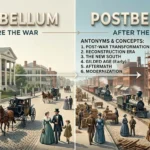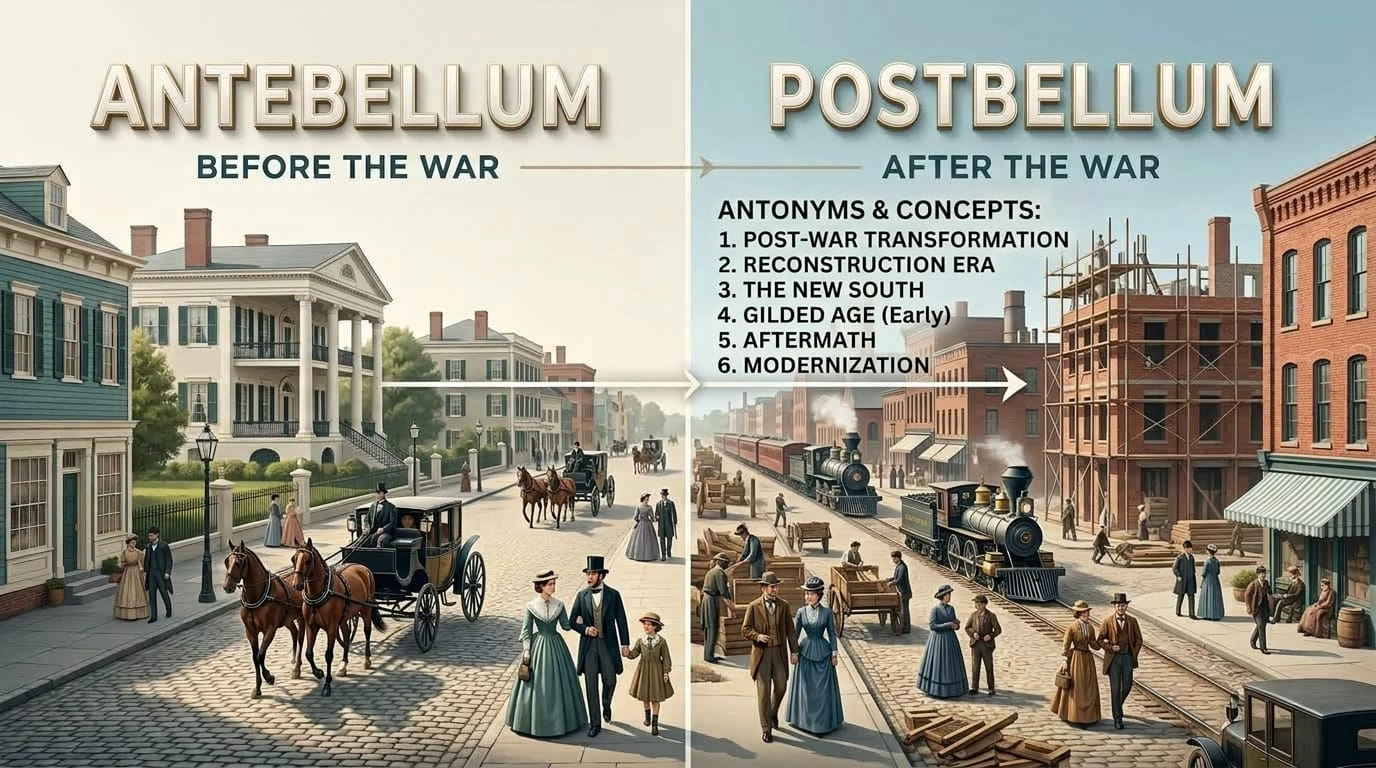
Antonyms for antebellum include postbellum, postwar, post-conflict, wartime, modern-day, contemporary, and later-era terms.
What is the opposite of antebellum?
The strongest antonym of antebellum is postbellum, meaning occurring after a war, especially the American Civil War. Postwar is the common everyday alternative. Depending on context, wartime, post-conflict, and other later-period expressions can also provide useful contrasts.
Quick Answer
The main antonym for antebellum is postbellum. Antebellum describes a period before a war, especially the American Civil War, while postbellum describes a period after a war. Postwar has essentially the same temporal contrast in more familiar English.
Other words such as wartime, post-conflict, after the war, and following the war can contrast with antebellum in particular sentences, but they are not all exact dictionary antonyms.
Quick Comparison
| Word | Meaning | Example |
| Antebellum | Before a war, especially the American Civil War | The house dates from the antebellum period. |
| Postbellum | After a war, especially the American Civil War | The town changed greatly during the postbellum era. |
| Postwar | Relating to the period after a war | Postwar rebuilding transformed the city. |
| Wartime | During a war | The factory operated under wartime conditions. |
The direct before/after relationship between antebellum and postbellum is especially clear from their Latin roots: ante bellum means “before the war,” while post bellum means “after the war.”
One-Line Definition
Antebellum: belonging to a period before a war, especially the American Civil War.
Main antonym: Postbellum belonging to the period after a war, particularly the period following the American Civil War.
What You Will Learn
After reading this guide, you will know:
- The exact opposite of antebellum
- The difference between postbellum and postwar
- Other contextual words that contrast with antebellum
- Which alternatives work in formal and everyday writing
- How to use these words naturally in sentences
22 Antonyms and Contextual Contrasts for Antebellum
Because antebellum has a specialized historical meaning, it does not have 20–30 equally exact antonyms. The first two below are the strongest direct opposites. The remaining terms are useful contextual contrasts rather than strict dictionary antonyms.
1. Postbellum
Meaning: Occurring after a war, especially after the American Civil War.
Example:
The museum contains artifacts from the postbellum South.
Usage: This is the closest and most precise antonym of antebellum.
2. Postwar
Meaning: Relating to or occurring after a war.
Example:
The novel examines postwar changes in American society.
Usage: Postwar is more common and broadly understood than postbellum. It can refer to the period after many different wars.
3. After the War
Meaning: A period or event occurring following a war.
Example:
The family returned home after the war.
Usage: This is a phrase rather than a single-word antonym, but it clearly expresses the opposite time relationship.
4. Post-Conflict
Meaning: Occurring after a conflict has ended.
Example:
The government began post-conflict reconstruction.
Usage: This term is broader than postbellum because a conflict does not necessarily have to be formally called a war.
5. Post-Hostilities
Meaning: Relating to the period after active fighting has ended.
Example:
The agreement established a framework for post-hostilities recovery.
Usage: This is mainly formal or academic language.
6. Aftermath
Meaning: The period or situation that follows a major event, especially a destructive one.
Example:
The region struggled in the aftermath of the war.
Usage: Aftermath focuses on consequences rather than simply indicating that something happened later.
7. Reconstruction
Meaning: The rebuilding or reorganization that follows destruction or major conflict.
Example:
The city entered a long period of reconstruction after the conflict.
Usage: In American history, Reconstruction has a specific historical meaning associated with the period following the Civil War.
8. Wartime
Meaning: Happening during a war.
Example:
The museum displays several wartime photographs.
Usage: This is a temporal contrast, not a strict antonym. Antebellum means before the war; wartime means during the war.
9. During the War
Meaning: At a time when a war was taking place.
Example:
The building was converted into a hospital during the war.
Usage: This phrase marks the middle point between the antebellum and postbellum periods.
10. War-Era
Meaning: Belonging to the period associated with a war.
Example:
The archive contains several war-era documents.
Usage: It can refer to a broad period surrounding a war, so context determines its exact meaning.
11. Post-Conflict Era
Meaning: The period following a conflict.
Example:
The country faced economic challenges in the post-conflict era.
Usage: More formal and broader than postwar.
12. Post-Hostility Period
Meaning: A period following active hostilities.
Example:
The post-hostility period required extensive political negotiations.
Usage: This expression is more specialized and less common in everyday English.
13. Later Period
Meaning: A time that occurs afterward.
Example:
The later period showed major changes in architecture.
Usage: This can contrast with antebellum when discussing historical periods, but it is not a fixed antonym.
14. Subsequent Period
Meaning: A period that follows an earlier one.
Example:
The subsequent period brought significant social changes.
Usage: Subsequent is formal and useful in academic writing.
15. Following Period
Meaning: The period that comes after another period.
Example:
The following period was marked by economic recovery.
Usage: A general chronological contrast rather than a strict lexical antonym.
16. Succeeding Era
Meaning: An era that comes after an earlier era.
Example:
The succeeding era introduced new political institutions.
Usage: Appropriate in historical or academic writing.
17. Later Era
Meaning: A historical period occurring afterward.
Example:
The architecture became more modern in the later era.
Usage: Useful when comparing historical periods without naming a specific war.
18. Modern Era
Meaning: A relatively recent historical period associated with modern society.
Example:
The building’s design differs greatly from that of the modern era.
Usage: Modern era can contrast with antebellum when discussing historical development, but it is not its direct lexical opposite.
19. Contemporary
Meaning: Existing or occurring at the present time or belonging to the same modern period.
Example:
Contemporary buildings often use materials that were unavailable in the antebellum period.
Usage: This is a broad chronological contrast, not a strict antonym.
20. Present-Day
Meaning: Existing or happening now.
Example:
Present-day architecture looks very different from antebellum architecture.
Usage: Useful when comparing historical objects with things that exist today.
21. Current
Meaning: Existing or happening now.
Example:
Current building standards differ from those used during the antebellum period.
Usage: Current contrasts with historical periods in some contexts but should not be treated as a direct dictionary antonym.
22. Modern-Day
Meaning: Belonging to the present period.
Example:
Modern-day cities have very different transportation systems from those of the antebellum era.
Usage: This works as a broad historical contrast when the intended meaning is “present rather than historical.”
The Most Important Contextual Difference
The safest way to understand antonyms for antebellum is to divide them into two groups.
Strict Antonyms
The strongest direct opposites are:
- Postbellum
- Postwar
Postbellum is especially precise because it mirrors the structure and meaning of antebellum. Dictionary sources define antebellum as the period before a war and postbellum as the period after a war.
Contextual Contrasts
Other terms can contrast with antebellum depending on what the sentence is trying to express:
- Wartime during the war
- Post-conflict after a conflict
- After the war following the war
- Reconstruction rebuilding or reorganizing after conflict
- Modern-day belonging to the present period
- Contemporary relating to the present or modern period
These should not automatically replace postbellum. Their meanings are broader or different.
Antebellum vs. Postbellum vs. Postwar
Antebellum
Antebellum describes something belonging to the period before a war. In American English, it is particularly associated with the period before the American Civil War.
Example:
The historian studied antebellum architecture in the American South.
Postbellum
Postbellum describes something occurring after a war, especially after the American Civil War.
Example:
The book examines postbellum social changes.
Postwar
Postwar has the same basic chronological direction as postbellum, but it is more general and common in everyday English.
Example:
The city experienced rapid postwar development.
The simple pattern
Antebellum → before the war
Wartime → during the war
Postbellum/Postwar → after the war
This timeline makes the relationship much easier to remember.
Example Sentences
Here are some natural examples showing the differences:
- The house was built during the antebellum period.
- The museum specializes in antebellum architecture.
- The historian compared antebellum and postbellum society.
- The city experienced major changes in the postwar years.
- Many families struggled in the aftermath of the conflict.
- The government introduced new policies during the post-conflict period.
- Several factories operated under wartime conditions.
- The building was used as a hospital during the war.
- The subsequent period brought important economic changes.
- Modern-day buildings often have very different designs.
Grammar and Word Class
Antebellum is primarily an adjective.
Examples:
- an antebellum house
- antebellum architecture
- the antebellum period
- antebellum society
Postbellum is also an adjective.
Examples:
- postbellum America
- postbellum reforms
- postbellum architecture
Postwar is an adjective as well.
Examples:
- postwar society
- postwar reconstruction
- postwar literature
Keeping the same adjective-to-adjective structure makes these comparisons natural in sentences.
Word Formation: Ante- and Post-
The contrast between antebellum and postbellum is also visible in their Latin-derived word formation.
- ante- = before
- post- = after
- bellum = war
So:
ante + bellum → antebellum = before the war
post + bellum → postbellum = after the war
The American Heritage Dictionary traces antebellum to Latin ante bellum, meaning “before the war.” Collins likewise gives postbellum as deriving from Latin post bellum, meaning “after the war.”
Common Mistakes
Mistake 1: Treating “modern” as the exact antonym
❌ Modern is the direct antonym of antebellum.
✅ Postbellum is the direct historical opposite of antebellum.
Why?
Antebellum specifically describes a period before a war. Modern describes something associated with the present or recent times, so the two can contrast but do not have exactly opposite meanings.
Mistake 2: Using “wartime” as if it meant “after the war”
❌ The country entered a wartime period after the war ended.
✅ The country entered a postwar period after the war ended.
Why?
Wartime means during a war, whereas postwar means after it.
Mistake 3: Assuming postbellum always means “modern”
❌ Postbellum means modern.
✅ Postbellum means occurring after a war.
A postbellum period can still be historical and may be much older than the modern period.
Expert Tip
When you need the exact opposite of antebellum, choose postbellum. When writing for a general audience, postwar is usually easier to understand. Use wartime only when you mean the period during the war.
Short Questions & Answers
What is the opposite of antebellum?
The most precise opposite of antebellum is postbellum, meaning occurring after a war, especially after the American Civil War. Postwar is the more familiar general alternative.
Is postwar the same as postbellum?
They are closely related, but not identical in every context. Postwar is a broad term for the period after a war, while postbellum is a more formal historical term and is especially associated with the period after the American Civil War.
Is wartime an antonym of antebellum?
Not exactly. Antebellum means before a war, while wartime means during a war. Therefore, they describe different points in a war-related timeline rather than being exact opposites.
What is the opposite of antebellum South?
The most precise historical contrast is postbellum South, referring to the South after the American Civil War. The general phrase postwar South can also be used when the context is clear.
Is modern an antonym for antebellum?
Not in the strict lexical sense. Modern can provide a broad contrast when comparing an old historical period with the present, but postbellum is the more precise antonym because it directly reverses the “before the war” time relationship.
Key Takeaways
- Postbellum is the strongest direct antonym of antebellum.
- Postwar is the most familiar general alternative.
- Wartime means during the war, so it is a chronological contrast rather than an exact antonym.
- Post-conflict and after the war work when the focus is on the period following conflict.
- Words such as modern-day and contemporary can contrast with antebellum in broader historical comparisons, but they are not strict antonyms
antonyms for antebellum
Antonyms for Spectrum: 22 Opposite Words and Contrasts

I’m Moazama Akbar, an English language researcher and content writer with a passion for helping people build stronger vocabulary and language skills. I create clear, well-researched guides on antonyms, opposite words, and word meanings, designed to make English learning simple, practical, and enjoyable for students, writers, and learners everywhere.