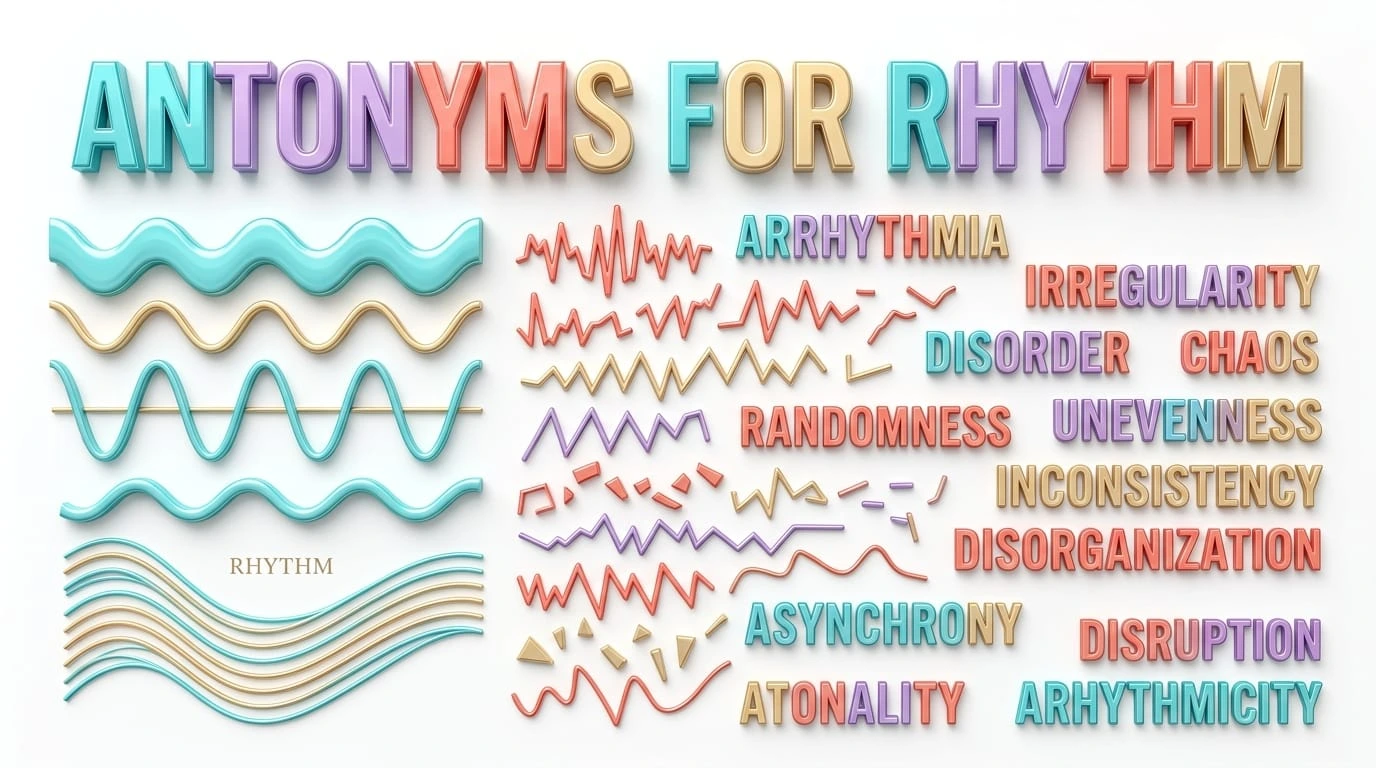
Its closest opposites include arrhythmia, irregularity, disorder, and arrhythmicity, depending on the meaning.
The Short Answer
The most useful antonym of rhythm is irregularity when discussing an uneven pattern. In music, arrhythmia can describe an abnormal heart rhythm, while disorder or chaos may contrast with an organized rhythmic pattern. The best choice depends on whether you mean music, movement, speech, or a repeating pattern.
Rhythm and Its Opposites at a Glance
| Word | Meaning | Example |
| Rhythm | A regular pattern of beats, sounds, or movements | The drummer kept a steady rhythm. |
| Irregularity | A lack of consistent pattern | Irregularity in the beats made the music sound unusual. |
| Disorder | A lack of organization | The dancers lost their rhythm and moved in disorder. |
| Chaos | Complete confusion or lack of order | The sudden changes turned the performance into chaos. |
| Arrhythmia | An abnormal heart rhythm | The doctor examined the patient’s arrhythmia. |
| Inconsistency | A lack of steadiness or uniformity | Inconsistency in the timing disrupted the performance. |
| Stillness | A state without movement | The dancer paused in complete stillness. |
| Silence | An absence of sound | Silence followed the final drumbeat. |
Important distinction: These words are contextual opposites, not perfect synonyms for one another. For example, silence contrasts with rhythmic sound, but it does not necessarily mean irregularity.
Rhythm: Meaning in Brief
A repeated pattern of sounds, beats, movements, or events that creates a sense of timing and flow.
Main contextual opposite: Irregularity a lack of a consistent or repeating pattern.
Common Opposites of Rhythm
1. Irregularity
Meaning: A lack of a regular, steady, or predictable pattern.
Example: The irregularity of the drumbeats made it difficult for the dancers to stay in time.
Best context: Music, movement, timing, and repeating patterns. This is one of the clearest opposites when rhythm means regularity.
2. Disorder
Meaning: A state in which things lack order or organization.
Example: The orchestra fell into disorder when the musicians lost their timing.
Best context: Organized performances, coordinated movement, and structured patterns.
3. Chaos
Meaning: A state of complete confusion or lack of order.
Example: Without a shared beat, the rehearsal descended into chaos.
Best context: Figurative descriptions of performances, movement, or events that have lost their coordination. Chaos is stronger than irregularity.
4. Inconsistency
Meaning: A lack of steadiness or uniformity.
Example: The inconsistency of the beat made the song difficult to dance to.
Best context: Music, speech, repeated actions, and timing that changes unpredictably.
5. Arrhythmia
Meaning: An abnormal pattern or timing of heartbeats.
Example: The doctor investigated the patient’s arrhythmia after detecting an unusual heartbeat.
Best context: Medical discussions of heart rhythm. Arrhythmia is a clinical term, not a general antonym for musical rhythm.
6. Arrhythmicity
Meaning: The quality or condition of being arrhythmic, or lacking a regular rhythm.
Example: The researcher studied the arrhythmicity of the movement pattern.
Best context: Technical or scientific writing. This word is less common in everyday English than irregularity.
7. Disorganization
Meaning: A lack of structure, planning, or coordination.
Example: Disorganization among the performers disrupted the smooth flow of the dance.
Best context: Group activities, performances, and coordinated movements.
8. Incoordination
Meaning: A lack of coordinated or smoothly synchronized movement.
Example: The dancer’s incoordination made the sequence look uneven.
Best context: Physical movement, dance, and motor coordination. It is not a direct opposite of rhythm in every musical context.
9. Stillness
Meaning: A state of being motionless or not moving.
Example: After the energetic rhythmic dance, the performer stood in stillness.
Best context: Contrasting movement with no movement. Stillness is an opposite of rhythmic motion in some situations, but a motionless state can still contain sound or an internal rhythm.
10. Silence
Meaning: The absence of audible sound.
Example: The music stopped, leaving a moment of silence in the hall.
Best context: Contrasting audible rhythm with no sound. Silence does not necessarily mean that a rhythmic pattern is irregular.
Choosing the Right Antonym
The opposite of rhythm changes with the context. A word that works for music may not work for speech, dance, or biology.
| If rhythm refers to… | Best contrasting word | Why it fits |
| A regular beat | Irregularity | The beat lacks consistency. |
| Organized musical timing | Disorder | The musical parts lack coordination. |
| A coordinated dance | Incoordination | The movements are not synchronized. |
| A repeated pattern | Inconsistency | The pattern does not remain steady. |
| A heartbeat | Arrhythmia | The heartbeat has an abnormal rhythm. |
| Movement | Stillness | Movement gives way to a motionless state. |
| Audible beats | Silence | The sound is absent. |
How These Antonyms Differ
- Irregularity vs. inconsistency: Irregularity emphasizes uneven timing or spacing; inconsistency emphasizes a failure to remain steady.
- Disorder vs. chaos: Disorder means a lack of organization. Chaos suggests a more extreme state of confusion.
- Arrhythmia vs. arrhythmicity: Arrhythmia commonly refers to an abnormal heart rhythm. Arrhythmicity describes the quality of lacking a regular rhythm and is more technical.
- Silence vs. irregularity: Silence means no audible sound; irregularity means that a pattern is uneven. An irregular beat is still a beat.
Rhythm and Its Antonyms in Sentences
Here are natural examples showing how these contrasting words work.
- Rhythm: The guitarist maintained a steady rhythm throughout the song.
- Irregularity: The irregularity of the beats made the song sound unpredictable.
- Disorder: The rehearsal descended into disorder when everyone played at a different tempo.
- Chaos: The sudden loss of coordination created chaos on stage.
- Inconsistency: The inconsistency of his speech made the presentation difficult to follow.
- Arrhythmia: The medical team monitored the patient’s heart for signs of arrhythmia.
- Disorganization: Disorganization among the dancers disrupted their routine.
- Incoordination: The exercise revealed incoordination between the dancer’s arms and legs.
- Stillness: The sudden stillness after the music ended captured everyone’s attention.
- Silence: A brief silence followed the final note.
Grammar and Word Class
Rhythm is a noun. Most of its contextual opposites are also nouns, making them suitable for direct comparison.
| Word | Part of speech | Example form |
| Rhythm | Noun | a steady rhythm |
| Irregularity | Noun | an irregularity in the beat |
| Disorder | Noun | a state of disorder |
| Chaos | Noun | complete chaos |
| Inconsistency | Noun | inconsistency in timing |
| Arrhythmia | Noun | a cardiac arrhythmia |
| Arrhythmic | Adjective | an arrhythmic pattern |
| Stillness | Noun | complete stillness |
Usage tip: Use irregular or arrhythmic when you need an adjective, rather than using the noun irregularity to describe another noun.
- Correct: The drummer produced an irregular beat.
- Correct: The drummer’s timing showed irregularity.
- Incorrect: The drummer produced an irregularity beat.
A Useful Language Tip
Rhythm does not always mean regularity. It can describe the pattern of stresses in poetry, the pace of speech, the movement of dancers, or recurring events. Before choosing an antonym, identify what kind of rhythm you mean.
For example, silence contrasts with sound, while irregularity contrasts with a steady pattern. These are different relationships.
Frequently Asked Questions
What is the main antonym of rhythm?
Irregularity is a useful antonym when rhythm means a regular, repeating pattern. It describes uneven timing or a lack of consistency. In other contexts, words such as disorder, stillness, or silence may express a more suitable contrast.
What are five antonyms for rhythm?
Five useful contextual antonyms are irregularity, disorder, chaos, inconsistency, and arrhythmicity. Each emphasizes a different aspect of lacking a regular or organized pattern.
What is the opposite of rhythm in music?
In music, irregularity is a useful contrast when beats lack a steady pattern. Disorder can describe a performance that has lost coordination, while silence refers to the absence of audible sound.
Is arrhythmia an antonym of rhythm?
Not in every context. Arrhythmia is a medical term for an abnormal heart rhythm. It is relevant when discussing heartbeats, but it is not the general opposite of musical or poetic rhythm.
Is silence the opposite of rhythm?
Silence can contrast with audible rhythm because no sound is heard. However, silence does not necessarily indicate an irregular pattern, so irregularity is more appropriate when the intended contrast is between steady and uneven beats.
What to Remember
The best antonym for rhythm depends on the intended meaning. Irregularity is a strong general choice for an uneven pattern, while disorder and chaos describe a loss of organization. For medical contexts, arrhythmia refers to abnormal heart rhythm; for sound and movement, silence and stillness provide different kinds of contrast.
Antonyms for Contrary: 20 Opposites and Their Meanings

I’m Noreen Akbar, an English language researcher and content writer with a passion for words,their meanings, origins, and the subtle differences between them. I specialize in antonyms and vocabulary, creating clear, easy-to-follow guides that help readers expand their word power, sharpen their understanding of language, and express themselves with greater clarity and confidence.