What Is the Opposite of Explicit?
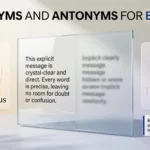
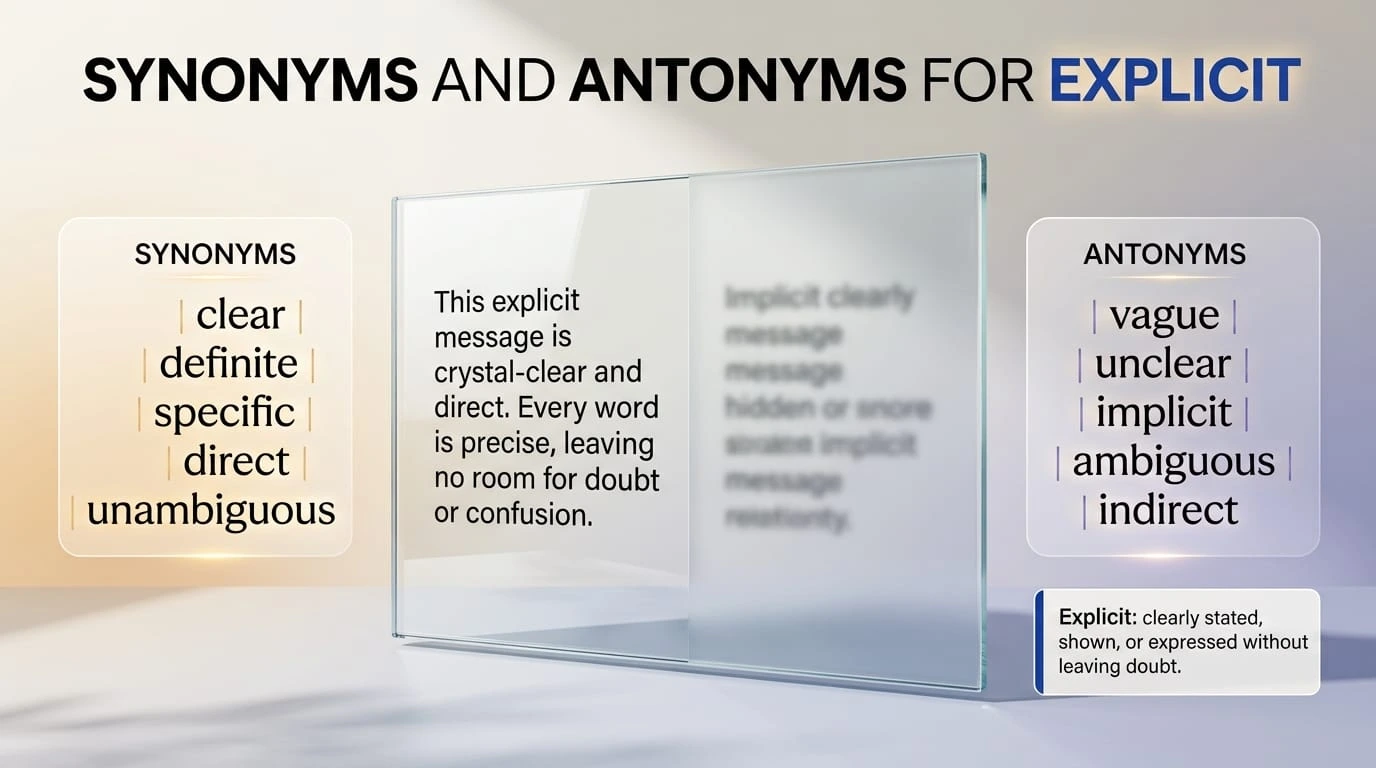
The most common antonym of explicit is implicit, meaning something that is suggested or understood without being directly stated. Other useful opposites include vague, unclear, ambiguous, indirect, and unstated, depending on the context.
Quick Answer
Explicit means clear, direct, and fully stated. Its closest antonym is implicit, which describes something suggested rather than directly expressed. Vague, ambiguous, unclear, indirect, and unstated can also work as contextual opposites.
Explicit vs. Its Opposites
| Word | Meaning | Example |
| Explicit | Clearly and directly stated | The instructions gave explicit details about the task. |
| Implicit | Suggested without being directly stated | Her silence gave an implicit warning. |
| Vague | Not clearly expressed or defined | His answer was too vague to understand. |
| Ambiguous | Open to more than one interpretation | The wording was ambiguous. |
| Indirect | Expressed without stating something directly | She gave an indirect response. |
Meaning in Brief
Explicit: Clearly expressed, stated, or shown without leaving the meaning to be guessed.
Main antonym: Implicit understood or suggested without being directly stated.
What You’ll Learn
After reading this guide, you will know:
- The meaning of explicit
- Common synonyms for explicit
- The main antonyms of explicit
- How explicit differs from implicit
- Which alternatives fit formal, everyday, and descriptive contexts
- How to use these words naturally in sentences
Main Synonyms for Explicit
The best synonym depends on what explicit means in a particular sentence.
1. Clear
Clear means easy to understand or not confusing.
Example:
The teacher gave clear instructions for completing the assignment.
2. Direct
Direct describes something expressed plainly without avoiding the main point.
Example:
She gave a direct answer to the question.
3. Specific
Specific means precise and focused on particular details.
Example:
Please provide specific instructions for the project.
4. Definite
Definite means clear, certain, or precisely stated.
Example:
We need a definite answer before making a decision.
5. Precise
Precise means exact and accurate rather than general.
Example:
The report provides precise information about the results.
6. Unambiguous
Unambiguous means having only one clear meaning or interpretation.
Example:
The contract contains an unambiguous statement about payment.
7. Plain
Plain means expressed in simple and straightforward language.
Example:
The policy is written in plain language.
8. Express
Express can describe something clearly stated rather than merely implied.
Example:
The agreement contains an express prohibition against sharing the information.
Common Antonyms of Explicit
1. Implicit
Implicit is the closest and most direct antonym of explicit.
It describes something that is suggested or understood without being directly stated.
Example:
There was an implicit agreement between the two teams.
2. Vague
Vague describes something that lacks clear details or precise meaning.
Example:
His explanation was too vague to be useful.
3. Ambiguous
Ambiguous means capable of having two or more possible meanings.
Example:
The sentence was ambiguous and confused the readers.
4. Unclear
Unclear means difficult to understand or interpret.
Example:
The instructions were unclear, so several students made mistakes.
5. Indirect
Indirect means communicated without stating the message in a straightforward way.
Example:
She made an indirect reference to the problem.
6. Unstated
Unstated describes something that has not been directly expressed in words.
Example:
The unstated assumption affected the entire discussion.
7. Implied
Implied means communicated through suggestion rather than direct expression.
Example:
His criticism was implied rather than openly stated.
Choosing the Right Opposite
Not every opposite of explicit works in every situation.
When explicit means “directly stated”
Use:
- implicit
- implied
- unstated
Example:
The rule was explicit.
→ The rule was implicit.
When explicit means “clear and precise”
Use:
- vague
- unclear
- ambiguous
Example:
The instructions were explicit.
→ The instructions were vague.
When explicit means “directly expressed”
Use:
- indirect
- implied
- unstated
Example:
She gave an explicit warning.
→ She gave an indirect warning.
How These Words Differ
Explicit vs. implicit:
Explicit information is directly stated; implicit information is understood from context.
Explicit vs. vague:
Explicit information gives clear details, while vague information lacks precision.
Explicit vs. ambiguous:
Explicit language aims to make the meaning clear, whereas ambiguous language can support multiple interpretations.
Explicit vs. indirect:
Explicit communication states the message directly; indirect communication approaches the message less directly.
Synonyms in Sentences
- Clear: The manager gave clear instructions.
- Direct: His response was direct and honest.
- Specific: The teacher gave specific examples.
- Definite: We received a definite confirmation.
- Precise: The scientist recorded precise measurements.
- Unambiguous: The wording was unambiguous.
- Plain: The rules were explained in plain language.
Antonyms in Sentences
- Implicit: Her statement contained an implicit criticism.
- Vague: The description was vague.
- Ambiguous: His answer was ambiguous.
- Unclear: The message was unclear.
- Indirect: She made an indirect suggestion.
- Unstated: There was an unstated expectation.
- Implied: The meaning was implied rather than expressed.
Grammar and Word Class
Explicit is primarily an adjective.
Examples:
- explicit instructions
- explicit details
- explicit permission
- explicit warning
Common related forms include:
- Explicitly adverb
- Explicity noun, referring to the quality of being explicit
The main synonyms and antonyms discussed above are mostly adjectives, although implied and unstated are commonly used as participial adjectives.
Common Errors to Avoid
Mistake 1: Treating every unclear word as a direct antonym
Vague, ambiguous, and unclear are contextual opposites, but implicit is the closest direct contrast when the issue is whether something is directly stated.
Mistake 2: Confusing implicit with ambiguous
Implicit does not necessarily mean confusing. An implicit message can be perfectly understandable from context.
Example:
Her smile gave an implicit indication that she agreed.
Mistake 3: Assuming indirect always means unclear
Something can be indirect but clear.
Example:
He indirectly asked whether the meeting had been canceled.
Teacher’s Tip
Remember the central contrast:
Explicit = stated clearly
Implicit = understood without being directly stated
If the information is present in the actual words, explicit is usually appropriate. If the reader or listener has to infer it, implicit is often the better word.
Quick Practice
Choose the best word:
The instructions did not directly say that phones were prohibited, but the rule was ______.
A. explicit
B. implicit
C. precise
Answer: B. implicit
The rule was understood or suggested without being directly stated.
Frequently Asked Questions
What is the closest synonym for explicit?
Common synonyms include clear, direct, specific, definite, precise, unambiguous, and plain. The best choice depends on the sentence and intended meaning.
What is the main antonym of explicit?
The closest antonym is implicit, which means suggested or understood without being directly stated.
Is vague the opposite of explicit?
Vague can be a contextual opposite of explicit when explicit means detailed or precise. However, implicit is the more direct antonym when explicit means directly stated.
What is the difference between explicit and implicit?
Explicit information is directly and clearly stated. Implicit information is suggested or understood without being directly stated.
Can ambiguous be an antonym of explicit?
Yes, in some contexts. Ambiguous describes language that can have multiple interpretations, while explicit language communicates its intended meaning clearly.
What to Remember
Explicit means clear, direct, and fully stated. Its closest antonym is implicit, while vague, ambiguous, unclear, indirect, unstated, and implied can serve as contextual opposites. For synonyms, useful choices include clear, direct, specific, definite, precise, unambiguous, and plain.
Key Takeaways
- Explicit means clear, direct, and fully stated.
- Implicit is the closest antonym, meaning suggested rather than directly stated.
- Other contextual antonyms include vague, ambiguous, unclear, indirect, unstated, and implied.
- Useful synonyms for explicit include clear, direct, specific, precise, definite, and unambiguous.
- Choose the antonym according to context: implicit for unstated meaning, and vague or ambiguous when the issue is lack of clarity.
Synonyms and Antonyms for Transport: Complete Guide

I’m Noreen Akbar, an English language researcher and content writer with a passion for words,their meanings, origins, and the subtle differences between them. I specialize in antonyms and vocabulary, creating clear, easy-to-follow guides that help readers expand their word power, sharpen their understanding of language, and express themselves with greater clarity and confidence.