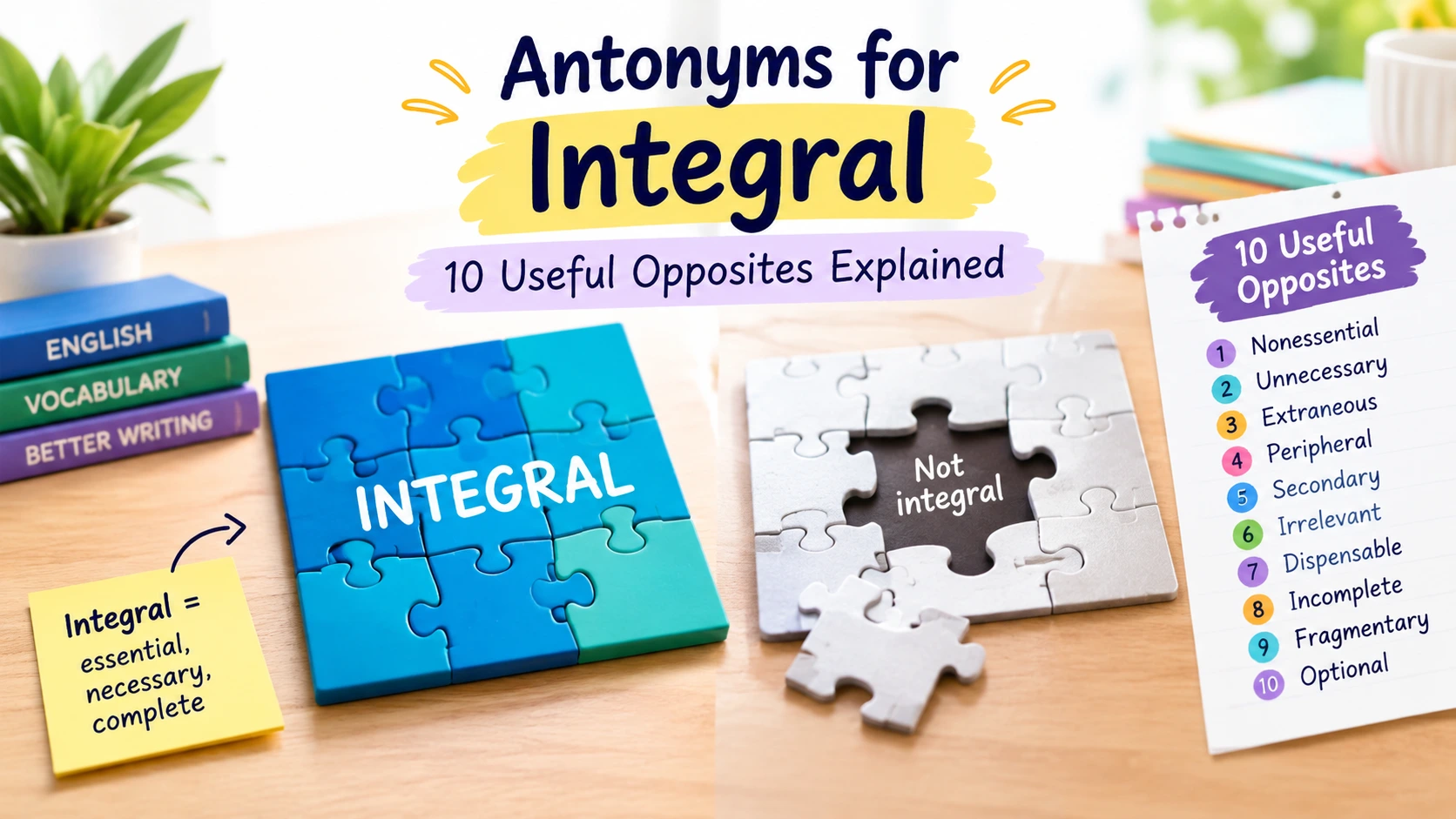
The Short Answer
The best antonym for integral is usually nonessential when integral means necessary or indispensable. Other opposites depend on the intended meaning:
- Nonessential not necessary or vital.
- Optional not required.
- Separate not joined or incorporated into a whole.
- Independent not dependent on or controlled by something else.
- Extraneous unnecessary or unrelated to the main subject.
Integral vs. Its Opposites
| Word | Meaning | Example |
| Integral | Essential to a whole | Trust is integral to a strong friendship. |
| Nonessential | Not necessary | Decorative details are nonessential to the report. |
| Optional | Not compulsory | The extra exercise is optional. |
| Separate | Distinct or not joined | The two departments operate separately. |
| Independent | Not dependent on another | The organization is independent of the company. |
Meaning in Brief
Integral: Essential to a whole, forming a necessary part of something, or incorporated into it.
Main antonym: Nonessential something that is not necessary for a whole to function or remain complete.
Common Opposites of Integral
1. Nonessential
Meaning: Not absolutely necessary or important to the basic purpose of something.
Example: Regular feedback is essential to the project, but decorative graphics are nonessential.
Usage: This is one of the clearest opposites when integral means necessary or vital.
2. Optional
Meaning: Available to choose or leave out; not compulsory.
Example: Attendance at the additional workshop is optional.
Usage: Use optional when participation, an activity, or an item is not required. It does not always mean unimportant.
3. Separate
Meaning: Not joined, combined, or treated as part of the same whole.
Example: The marketing team is an integral part of the company, while the external supplier operates as a separate business.
Usage: This opposite fits the sense of integral meaning incorporated into or forming part of a larger unit.
4. Independent
Meaning: Not relying on, controlled by, or connected through dependence on something else.
Example: The research team works independently rather than as an integral unit of the university department.
Usage: Use independent when the contrast involves dependence or organizational relationships, not simply importance.
5. Extraneous
Meaning: Unnecessary or unrelated to the main subject or purpose.
Example: Remove extraneous information that does not contribute to the argument.
Usage: This is particularly useful in academic and professional writing. Something extraneous may be irrelevant, but it is not necessarily the opposite of integral in every context.
6. Dispensable
Meaning: Able to be removed or done without.
Example: The team decided that the extra software subscription was dispensable.
Usage: This word contrasts with integral when something is considered necessary to a process or system. It often suggests that removing the item would not cause a serious problem.
7. Unnecessary
Meaning: Not needed or required.
Example: The instructions were clear, so an additional explanation was unnecessary.
Usage: This is a straightforward, everyday alternative to nonessential when discussing necessity.
8. Peripheral
Meaning: Secondary or less central to the main subject or activity.
Example: The discussion of office decoration was peripheral to the main business proposal.
Usage: Peripheral means not central, rather than completely unnecessary. It is a useful contrast when integral emphasizes being central or fundamental.
9. Incidental
Meaning: Occurring as a minor or secondary part of something rather than being central to it.
Example: The additional costs were incidental to the main purpose of the project.
Usage: This works when contrasting a central, defining element with something secondary. It is not a universal antonym of integral.
10. Unrelated
Meaning: Not connected with or relevant to something.
Example: The examples were unrelated to the main point of the lesson.
Usage: Use unrelated when the intended contrast concerns connection or relevance. It is weaker than nonessential as a direct opposite of integral.
Choosing the Right Antonym
The opposite of integral changes with its meaning. Choose the word that matches the contrast you want to express.
When Integral Means Essential
Use nonessential, unnecessary, dispensable, or optional.
- Integral: Clear communication is integral to successful teamwork.
- Nonessential: Decorative elements are nonessential to the design.
- Optional: The final activity is optional for students.
These words focus on whether something is needed or required.
When Integral Means Forming Part of a Whole
Use separate or independent when the intended contrast is about how things are connected or organized.
- Integral: The finance team is an integral part of the organization.
- Separate: The finance team and the external auditor operate as separate units.
These words focus on membership or connection rather than importance.
When Integral Means Central or Fundamental
Use peripheral, incidental, or sometimes extraneous, depending on the sentence.
- Integral: The evidence was integral to the investigation.
- Peripheral: The color scheme was peripheral to the investigation.
- Extraneous: The report included extraneous details that distracted from the findings.
These alternatives distinguish central information from secondary or irrelevant material.
Understanding the Differences Between These Opposites
Not all antonyms for integral are interchangeable.
| Antonym | Best used when you mean… |
| Nonessential | Something is not necessary |
| Optional | Something is not compulsory |
| Dispensable | Something can be removed or done without |
| Separate | Something is not joined or incorporated |
| Independent | Something does not depend on another |
| Peripheral | Something is not central |
| Extraneous | Something is unnecessary or irrelevant |
For example, an optional training session may still be valuable. A separate department may be essential to the organization. A peripheral issue may deserve attention even though it is not central. The correct choice depends on the exact meaning of integral in your sentence.
Integral and Its Opposites in Sentences
- Integral / Nonessential: Reliable data is integral to the study, but decorative charts are nonessential.
- Integral / Optional: The safety briefing is integral to the process, while the follow-up discussion is optional.
- Integral / Separate: Customer support is an integral part of the business, although the legal department remains a separate unit.
- Integral / Independent: The software is integral to the system, but the external review is conducted by an independent team.
- Integral / Extraneous: Every section should support the argument; extraneous details should be removed.
- Integral / Dispensable: The backup system is integral to data protection, while the older unused device is dispensable.
- Integral / Peripheral: The central finding was integral to the report, whereas the historical background was peripheral.
- Integral / Unnecessary: Clear instructions are integral to the task, but repeated warnings may be unnecessary.
Grammar and Word Class
Integral is usually an adjective.
- Integral: Exercise is integral to a healthy lifestyle.
- Nonessential: Some features are nonessential.
- Optional: The extra lesson is optional.
- Separate: The files are stored in separate folders.
- Independent: The organization is independent.
- Peripheral: The issue is peripheral to the discussion.
The word integrally is an adverb, as in “The two systems are integrally connected.” Its opposite depends on the intended meaning; for example, separately may work when describing something done apart, but it is not a universal antonym.
Common Errors to Avoid
Mistake 1: Treating every opposite as interchangeable
Incorrect: “The optional department is separate from the company.”
Better: “The department is a separate unit within the company.”
Optional means not compulsory; separate means distinct or not joined.
Mistake 2: Using unrelated when you mean unnecessary
“Unrelated” describes a lack of connection. “Unnecessary” describes a lack of need. An item can be related to a project but still be unnecessary.
Mistake 3: Assuming integral always means important
Integral can mean essential to a whole or forming part of it. If the intended meaning is “forming part of,” separate may be more appropriate than nonessential.
A Useful Language Tip
When choosing an antonym for integral, ask yourself: What kind of relationship am I reversing?
- Necessity → nonessential or unnecessary
- Requirement → optional
- Inclusion in a whole → separate
- Dependence → independent
- Central importance → peripheral
This simple check helps you select a natural, precise opposite rather than choosing a word that only seems similar.
Quick Practice
Choose the best antonym for integral in this sentence:
“The extra reading activity is not required; it is _____.”
A. independent
B. optional
C. integral
Answer: B. optional. An optional activity is available to choose but is not compulsory.
Frequently Asked Questions
What is the main antonym of integral?
Nonessential is one of the strongest antonyms when integral means necessary or indispensable. Depending on the sentence, optional, separate, or independent may be more accurate.
Is optional a synonym for nonessential?
No. Both can indicate that something is not necessary, but optional specifically means that it is not compulsory. Nonessential means it is not vital or required for the main purpose.
What is the opposite of integral in academic writing?
Nonessential works when discussing necessity. Peripheral can describe an issue that is not central to the argument, while extraneous describes information that is unnecessary or irrelevant.
Can separate be an antonym of integral?
Yes. Separate can contrast with integral when the latter means incorporated into or forming part of a whole. It does not express the opposite of integral when the intended meaning is simply “essential.”
What is a simple everyday opposite of integral?
Nonessential is a good general choice when integral means necessary. Use optional for something not required and separate for something that is not joined or included in a whole.
Key Takeaways
- Nonessential is often the clearest opposite of integral when it means essential.
- Optional means not compulsory, while dispensable means able to be done without.
- Separate and independent work when the contrast concerns inclusion or dependence.
- Peripheral and extraneous are useful when contrasting central elements with secondary or irrelevant details.
The best antonym is the one that reverses the meaning of integral in your particular sentence.
Antonyms for Option: Opposites Explained Clearly

I’m Moazama Akbar, an English language researcher and content writer with a passion for helping people build stronger vocabulary and language skills. I create clear, well-researched guides on antonyms, opposite words, and word meanings, designed to make English learning simple, practical, and enjoyable for students, writers, and learners everywhere.